Boeing Case Study: When Culture Drift Becomes a Crisis
This Boeing case study examines a hard lesson in organizational culture and crisis management: how a company long revered for engineering excellence drifted, over years, toward cost and schedule pressure, and what that drift ultimately cost. Two 737 MAX crashes in 2018 and 2019 took 346 lives and led to a lengthy global grounding; a 2024 in-flight panel failure reopened the quality questions. Official investigations point less to a single technical fault than to a culture that had changed. The recovery is a slow culture transformation and an exercise in rebuilding trust. The Boeing case study shows that culture and quality are not costs to optimize away.
Boeing's crises grew out of a culture that drifted from engineering excellence toward cost and schedule pressure, and its recovery shows how long and costly it is to rebuild quality and trust once they slip.
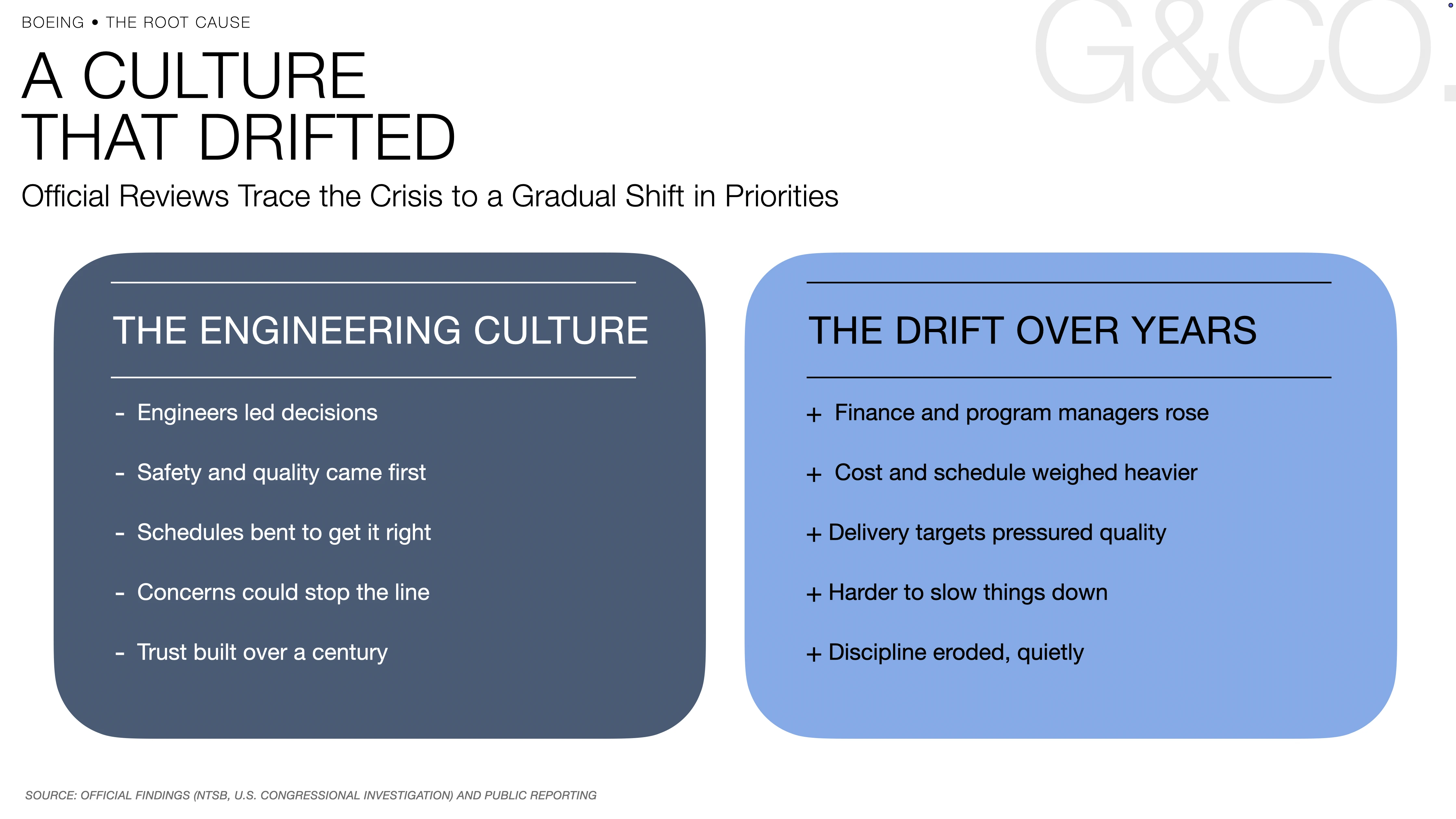
For most of its history, Boeing was a byword for engineering excellence, a company where engineers led and safety and quality were the point. Over the past two decades, by the account of official investigations, congressional reviews, and many inside and outside the company, that culture changed: financial targets, cost reduction, and production schedules came to weigh more heavily against the engineering discipline that had defined it. The consequences, when they came, were grave.
This case study treats Boeing soberly and factually, drawing on official findings, because the human stakes were real: two crashes of the 737 MAX, in 2018 and 2019, killed 346 people. It examines not the technical details of those tragedies but the business and cultural lesson behind them, how an organization's culture can erode under financial pressure, what that erosion can cost, and what it takes to rebuild trust and quality. For enterprise leaders, that lesson is uncomfortable and important.
Key Points
- Boeing's troubles are, at root, a culture problem. Over years, official reviews and congressional investigation concluded its organizational culture had drifted from engineering-led toward cost, schedule, and financial pressure.
- The human cost was grave, and it anchors everything else. Two 737 MAX crashes, in 2018 and 2019, killed 346 people; investigators tied them to failures in a flight-control system's design, certification, and disclosure. A 2024 in-flight door-panel failure, with no fatalities, reopened the quality questions.
- Eroding trust proved enormously expensive. The crises led to a roughly 20-month global grounding, tens of billions of dollars in costs, intense regulatory oversight, lost orders, and deep damage to a reputation built over a century, far more than cost pressures ever saved.
- Recovery is a slow culture transformation, not a messaging fix. New engineering-focused leadership, deliberate production slowdowns to fix quality, and safety-culture overhauls signal that rebuilding means changing how the company works.
- The lesson: culture and quality are not costs to optimize away. When financial pressure erodes the engineering and safety culture at a company's core, it can destroy far more value than it ever saves.
Why This Matters
For CEOs, boards, and senior leaders, Boeing is one of the most serious cautionary cases in modern business: a demonstration that organizational culture is not a soft, secondary concern but a hard determinant of outcomes, up to and including catastrophe. It is a reminder that the slow erosion of engineering discipline, quality, or safety in favor of short-term financial performance can go unnoticed until it produces a crisis that dwarfs whatever was saved. Few lessons in management are costlier or clearer.
The relevance is broad. Any company under pressure to cut costs, hit schedules, and satisfy financial markets faces some version of the tension Boeing faced, between the near-term numbers and the long-term discipline that protects quality, safety, and trust. Boeing shows what can happen when that balance tips too far, and how painful and prolonged the recovery is once it does. For leaders weighing cost and speed against the harder-to-measure value of culture and quality, this case study is a warning worth studying.






Let’s kickstart the conversation and design stuff people will love.

The Retail & Consumer Index


Strategic Context
Culture is hard to see changing. Boeing's shift did not happen in a single decision; by most accounts it unfolded over years, influenced by a major merger, a growing emphasis on shareholder returns, cost and schedule pressure in a tight competition with its main rival, and a gradual change in who held sway inside the company, from engineers toward financial and program managers. None of these was inherently wrong, and each looked reasonable in isolation. But cumulatively, investigators and critics argue, they weakened the primacy of engineering judgment and the safety culture that depended on it.
The strategic lesson in that context is that the most dangerous organizational changes are often slow and invisible, a gradual reweighting of priorities that no one decides outright but everyone adapts to. A safety-critical engineering company is only as strong as the culture that lets engineers raise concerns, slow things down, and put quality ahead of schedule. When that culture quietly erodes under financial pressure, the organization can look healthy on its financial statements right up until the moment it is not. The context of this case is not a single bad choice but the quiet drift of a culture, which is exactly what makes it so instructive and so hard to guard against.
Company Response
Boeing's response, the part most relevant to enterprise leaders, is its attempt at recovery, and the Boeing strategy for rebuilding has unfolded in stages.
Acknowledge the problem as cultural, not just technical.
After the crashes and the grounding, and again after the 2024 panel failure, external reviews, regulators, and eventually Boeing's own leadership increasingly framed the problem not as an isolated engineering defect but as a breakdown in culture, quality, and the systems meant to catch problems. That reframing matters: a company that treats a crisis as a one-off technical fault will patch the fault and move on, while one that recognizes a cultural cause has to change far more. Boeing's gradual, and externally pressured, acknowledgment that the issue was organizational culture is the necessary first step of any real culture transformation.
Change leadership and slow down to fix quality.
Boeing brought in new leadership with a deliberate engineering emphasis, a signal of intent to restore the primacy of engineering over finance, and, under regulatory pressure, slowed production to focus on quality and stability rather than rate and delivery targets. Slowing output is costly and painful for a manufacturer under financial strain, which is precisely why it signals a genuine shift in priorities: it puts quality ahead of the short-term numbers, and that shift sits at the center of the Boeing strategy, reversing the balance that investigators say had tilted the wrong way. This is crisis management aimed at the root cause rather than the symptom.
Rebuild trust with regulators, customers, and the public, slowly.
Reputation management for Boeing is not a communications campaign; it is the long work of demonstrating, over years, that the company has actually changed, through regulators' restored confidence, airlines' willingness to order and fly its aircraft, and the traveling public's trust. Trust of this kind, once broken, is rebuilt only by sustained evidence, not by statements, and Boeing's recovery will be measured in years of consistent performance under close scrutiny. That slowness is itself the lesson: trust is expensive to rebuild precisely because it was valuable.
The tension in the response is real and ongoing. Boeing operates in a market where it and its main competitor are the only serious choices for many aircraft, which gives it time that a company in a more competitive market might not have, but also makes its performance a matter of public interest. It remains under intense regulatory and public scrutiny, carries heavy financial losses from the crises, and must change a deep-rooted culture while still producing aircraft at scale. Culture transformation at that scale is slow, and the outcome is not yet settled.

Always-On Customer Intelligence
Turn your own customer data into foresight — validate, simulate, and sense every major decision before you commit.


Results and Evidence
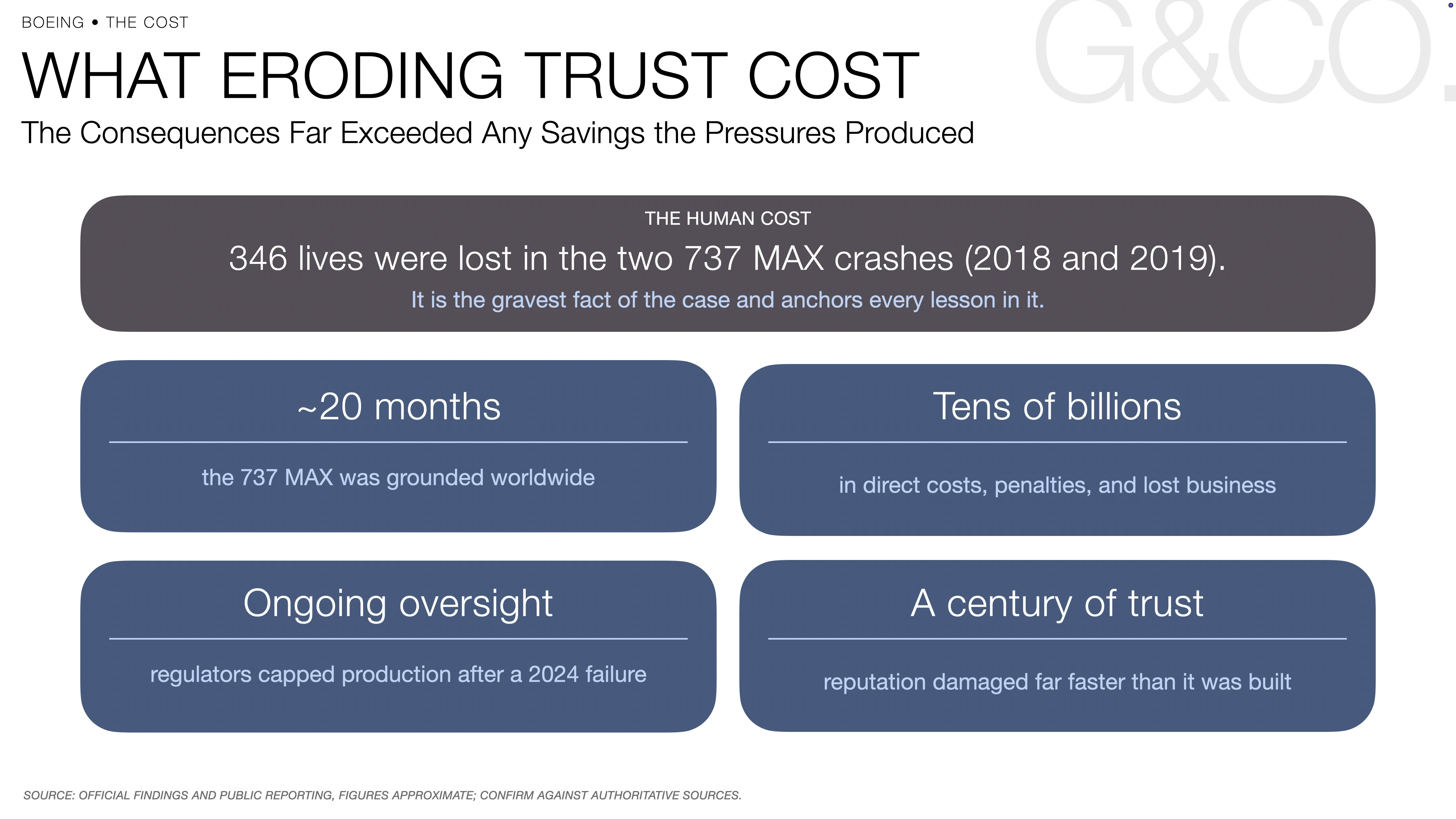
The evidence here is sobering rather than celebratory, and it is drawn from official investigations and public reporting. The human toll, 346 lives in the two crashes, is the gravest fact of the case and the one that anchors every business lesson in it. Beyond that, the crises led to the roughly 20-month global grounding of the 737 MAX, tens of billions of dollars in direct costs and lost business, a landmark legal settlement, sustained regulatory oversight including production limits after the 2024 panel failure, and severe damage to a reputation that had taken a century to build. Those costs vastly exceed any savings the earlier cost and schedule pressures could have produced, which is the central, measurable lesson: eroding quality and trust was not a trade that paid. The recovery remains in progress, with new leadership, slowed production, and culture and safety overhauls underway, and its success will only be provable over years of consistent, closely watched performance. These facts are drawn from official findings (including NTSB and congressional investigation) and public reporting, and specific figures should be confirmed against the latest authoritative sources before publishing, given the seriousness and the ongoing nature of the matter.
Strategic Implications
Read at scale, Boeing is a case about organizational culture as a determinant of outcomes, and about crisis management and reputation management when the root cause is cultural. The pattern is a warning that applies far beyond aerospace: in any organization, a slow drift of priorities toward short-term financial performance can quietly erode the discipline, quality, and safety culture that protect the business, and the resulting failure can cost orders of magnitude more than the pressures ever saved. Culture is not a soft factor adjacent to strategy; in Boeing's case it was the strategy's foundation, and its erosion was the deepest cause of the crisis.
The deeper implication is about the asymmetry of trust and the difficulty of cultural repair. Trust and reputation are built slowly over decades and can be damaged quickly, and rebuilding them requires not messaging but sustained, demonstrated change, exactly the slow, costly culture transformation Boeing is now attempting. For enterprise leaders, the takeaway is to treat culture, quality, and trust as strategic assets to be protected, not costs to be optimized, and to watch for the quiet reweighting of priorities that erodes them before any crisis makes the erosion visible. The time to defend an engineering or safety culture is before it fails, because afterward the cost, in Boeing's case the gravest cost of all, is beyond any budget's ability to justify.
What Enterprise Leaders Can Learn
- Treat culture as a strategic asset, not a soft factor.
Boeing shows that the company's culture can determine outcomes up to catastrophe. Protect the culture that safeguards quality and safety as deliberately as you manage the balance sheet. - Watch for slow drift, not just single decisions.
The dangerous change was gradual and invisible, a quiet reweighting toward cost and schedule. Monitor whether short-term pressure is eroding long-term discipline before a crisis reveals it. - Quality and trust are not costs to optimize away.
The savings from cost and schedule pressure were dwarfed by what their consequences cost. Short-term efficiency bought at the expense of quality can be the most expensive choice of all. - Treat a crisis as cultural when it is cultural.
Patching a technical fault is not enough if the cause is cultural; real recovery means changing how the organization works, which is slower and harder but necessary. - Rebuilding trust is slow and must be demonstrated.
Reputation management after a trust failure is not a campaign; it is years of consistent, visible performance. Plan for the length and cost of earning trust back.
Conclusion
Boeing's story is a hard one, and it should be told plainly. A company revered for engineering let that engineering culture erode, over years and under financial and schedule pressure, until the systems meant to ensure safety and quality failed, at a human cost of 346 lives and a business cost measured in tens of billions of dollars, a 20-month grounding, and the damage to a century-old reputation. Official investigations point not to a single villain or defect but to the slow drift of a culture, which is what makes the case so instructive: the erosion was gradual, reasonable-seeming at each step, and invisible on the financials until it was catastrophic. The recovery, new leadership, slowed production, and a long rebuilding of trust, is the work of years, and the Boeing strategy will be judged over that span. For enterprise leaders, the transferable lesson is grave and clear: culture, quality, and trust are strategic foundations, not costs to be optimized away, and the moment to defend them is long before any crisis proves how much they were worth.
Through the Acumen platform, G&CO. gives enterprise brands the intelligence to protect the reputation and trust that strategy depends on: where perception and confidence are shifting, how stakeholders actually see the brand, and where the gap between reputation and reality is widening before it becomes a crisis. G&CO. is a certified minority business enterprise through the National Minority Supplier Development Council (NMSDC). For enterprise organizations with diversity inclusion requirements in their procurement process, G&CO. meets the criteria for MBE-qualified partner status.
G&CO. works with enterprise brands on the reputation, brand, and intelligence strategy that helps protect and, when necessary, rebuild trust. If this Boeing case study raises questions about your own crisis management, reputation management, or culture transformation, submit an inquiry to G&CO. on our contact page or click the blue "Click to Contact Us" button in the bottom right corner of your screen. We look forward to hearing from you.
Frequently Asked Questions
What is the core lesson of the Boeing case study?
The core lesson is that the company's culture is a hard determinant of outcomes, not a soft side issue. According to official investigations and congressional review, Boeing's culture drifted over years from engineering-led toward cost, schedule, and financial pressure, and that drift, more than any single technical fault, is seen as the deepest cause of its crises. The two 737 MAX crashes took 346 lives and led to enormous business and reputational costs that far exceeded any savings the earlier pressures produced. The transferable lesson for leaders is that culture, quality, and trust are strategic assets to protect, not costs to optimize away.
What caused Boeing's 737 MAX crisis?
Official investigations, including by the NTSB and a U.S. congressional committee, tied the two crashes (in 2018 and 2019, which killed 346 people) to failures surrounding a flight-control system, including its design, how it was certified, and how information about it was disclosed and communicated. But the broader finding of those reviews was that these failures reflected deeper problems in Boeing's culture, quality systems, and the pressures acting on them, which is why this case is treated as a lesson in the company's culture and crisis management rather than a purely technical story. Specific findings should be read in the official reports.
Why is Boeing's situation described as a culture problem rather than a technical one? Because official and independent reviews concluded that the technical failures grew out of cultural ones. Over years, by these accounts, engineering judgment and safety culture lost ground to cost reduction, schedule pressure, and financial priorities, so the organization was less able to catch and stop problems. A purely technical problem can be fixed with an engineering change; a cultural problem requires changing how the company sets priorities, makes decisions, and lets people raise concerns. That is why Boeing's recovery is framed as a cultural change, and why the case matters to leaders in every industry, not just aerospace.
What is Boeing doing to recover?
Boeing's recovery has unfolded in stages: acknowledging (under external pressure) that the problem is cultural and not just technical, bringing in new leadership with an engineering emphasis, slowing production, at real financial cost, to prioritize quality and stability over delivery rate, and undertaking safety-culture overhauls under close regulatory oversight. Most fundamentally, it faces the long work of rebuilding trust with regulators, airlines, and the public, which can only be done through sustained, demonstrated performance over years rather than through communications. The outcome is not yet settled; cultural change at this scale is slow.
What can enterprise leaders learn from the Boeing case study?
That culture, quality, and trust are strategic foundations, and that their slow erosion under financial pressure can be ruinous. Boeing's warnings for leaders: treat the company's culture as a strategic asset and protect it deliberately; watch for the gradual, invisible reweighting of priorities toward short-term numbers, because that drift, not a single decision, is the real danger; recognize that quality and trust are not costs to optimize away, since their loss can cost far more than the savings; respond to a cultural crisis by changing how the organization works, not just by patching symptoms; and plan for how slow and costly it is to rebuild trust once it is lost. The time to defend these assets is before a crisis proves their worth.