
e.l.f. Beauty Case Study: Out-Marketing the Giants on Social Media
This e.l.f. Beauty case study examines how a mass-priced cosmetics brand outgrew far bigger, richer rivals by mastering social media marketing rather than outspending them. e.l.f. became a social-native brand, first onto new platforms, viral on TikTok, powered by creators, and built a genuine brand community rather than just an audience. Paired with fast, affordable product innovation and disciplined marketing ROI, that approach let it take share from legacy beauty giants and pass a billion dollars in sales. The e.l.f. Beauty strategy shows how a challenger wins through disruptive marketing and community engagement, not the size of its budget.
e.l.f. Beauty outgrew far bigger rivals by mastering social media, building a genuine community, and turning out affordable versions of prestige products faster than incumbents could react.
In beauty, the giants are supposed to win. The largest cosmetics companies have enormous marketing budgets, decades of brand equity, and shelves of prestige products at prestige prices. e.l.f. Beauty had none of that, a mass-market brand selling affordable cosmetics, with a fraction of the marketing money of its rivals. And yet, for several years running, e.l.f. has been one of the fastest-growing beauty companies, taking share from brands many times its size. It did not do it by spending more. It did it by being better at the thing that now matters most: reaching people on social media.
This case study looks at how e.l.f. used social media marketing, a real community, and fast, affordable product innovation to beat bigger and richer competitors, and how it did so with far more efficient spend. For enterprise leaders, the lesson reaches well beyond cosmetics. It is about how a challenger out-engages incumbents rather than outspending them, and turns a smaller budget into an advantage.
Key Points
- e.l.f. out-marketed bigger, richer rivals on social media: It became a social-native brand, often first onto new platforms, viral on TikTok, and powered by creators, reaching young audiences legacy beauty brands could not.
- It did it on a leaner budget, with disciplined marketing ROI. e.l.f. gets more reach and engagement per dollar than incumbents, proof that social-native creativity beats raw ad spend. This is disruptive marketing, not a spending war.
- Fast, affordable product innovation is the other half. e.l.f. delivers prestige-quality products, often affordable versions of expensive ones, at drugstore prices, developed fast enough to ride trends while they are hot.
- It built a genuine brand community, not just an audience. Through values, creator and fan content, and real community engagement, e.l.f. gets customers to participate in the brand rather than only buy from it.
- e.l.f. has posted around two dozen consecutive quarters of sales growth, passed a billion dollars in annual sales, and keeps taking share from companies many times its size.
Why This Matters
For CEOs, CMOs, and brand leaders, e.l.f. is one of the clearest proofs that in a social-first world, creativity and engagement beat budget. The old assumption, that the biggest marketing spend wins, breaks down when attention lives on social platforms where relevance and authenticity matter more than reach bought with money. e.l.f. is a working model of a challenger using that shift to outgrow incumbents it could never outspend, which is exactly the position most challenger brands and many established ones now find themselves in.
The timing matters. Marketing has moved decisively to social and creator-driven channels, and the brands winning young consumers are the ones that are native to those platforms rather than advertising on them. At the same time, rising media costs make marketing efficiency, doing more with less, a competitive necessity, not just a virtue. e.l.f. excels at both. For any leader trying to grow against larger competitors, or to make a marketing budget work far harder, e.l.f. shows what a social-native, community-led, efficient approach looks like in practice.





Let’s kickstart the conversation and design stuff people will love.

The Retail & Consumer Index


Strategic Context
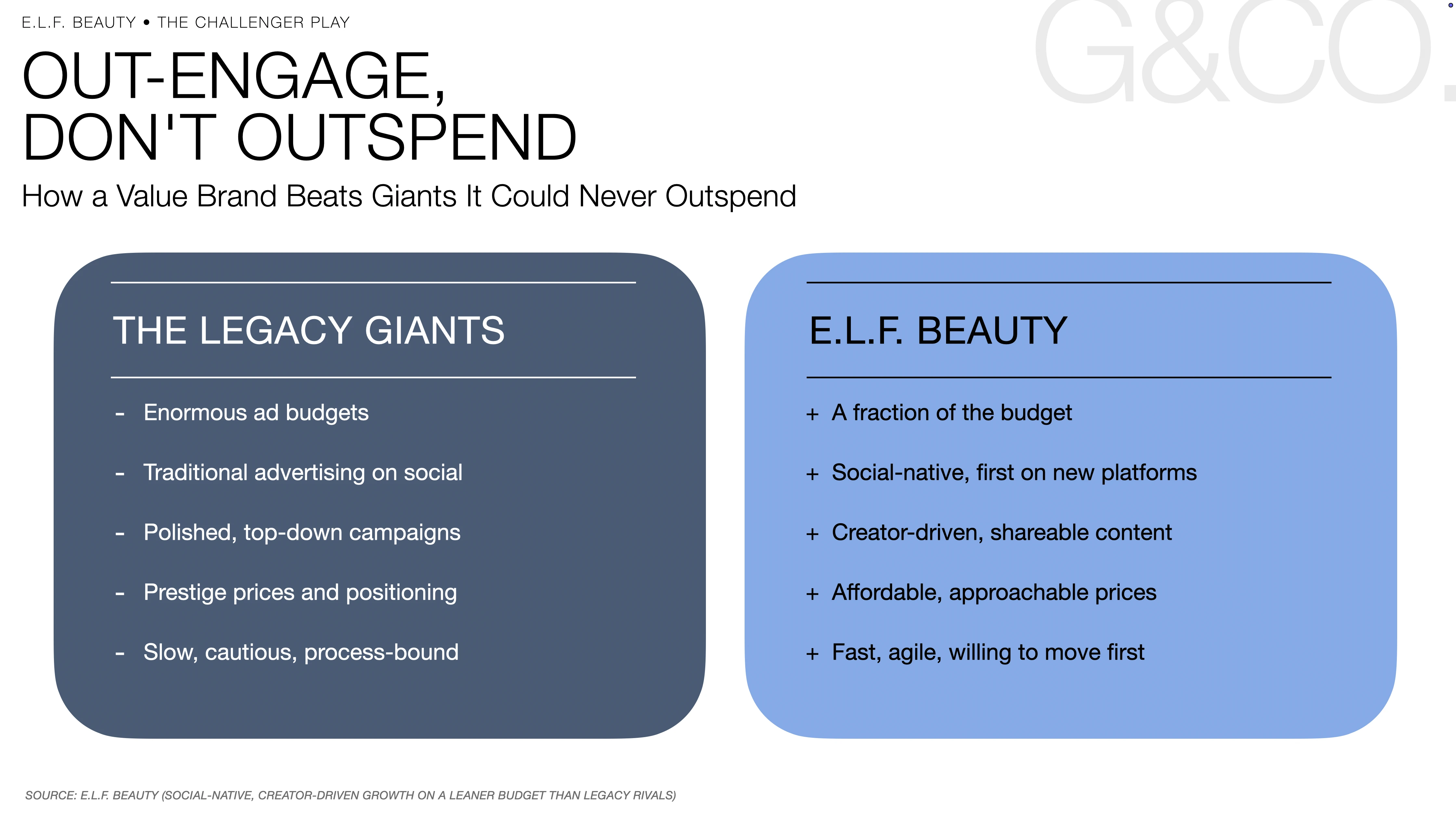
Beauty has long been dominated by large companies with two advantages: huge marketing budgets and prestige brands that justify premium prices. For a small, mass-priced brand, competing head-on looked hopeless, there was no way to outspend the giants on traditional advertising, and no prestige halo to charge more. The conventional path for a value brand was to compete quietly on price and shelf space and accept modest growth.
e.l.f.'s insight was that the rules were changing in its favor. As attention moved to social media, the advantage shifted from who could buy the most advertising to who could create the most engaging, authentic content and build a real relationship with an audience, and a nimble, affordable, unpretentious brand was far better suited to that than a buttoned-up prestige giant. Being inexpensive and approachable was an asset on platforms built on authenticity, not a liability. The strategic choice at the heart of this case is that e.l.f. decided not to fight the incumbents on their terms, big-budget advertising and prestige positioning, but to compete where it could win: social-native marketing, community, and speed, turning its smaller size into agility.
Company Response
Go social-native, not just social-present.
e.l.f. did not simply advertise on social media; it built its brand for it. It moved early and boldly onto new platforms, often as one of the first beauty brands on them, created content designed to be entertaining and shareable rather than promotional, and leaned heavily on creators and everyday users rather than polished campaigns. Its breakout moments came from genuinely viral social media marketing, including a now-famous original song that users turned into a massive trend. By being native to how young people actually use these platforms, e.l.f. earned attention that incumbents were trying, and largely failing, to buy.
Win on efficiency, not budget.
Because its growth came from creativity and engagement rather than sheer spend, e.l.f. achieved far better marketing ROI than its larger competitors, reaching and engaging more people per dollar. This is the essence of its disruptive marketing: it did not try to outspend companies with vastly deeper pockets, it out-created them, and let authentic, shareable content and creator relationships do work that would otherwise cost enormous sums. Efficiency was not a constraint it tolerated; it was a core part of the strategy, and it is what let a smaller brand compete with giants and still grow profitably.
Pair it with fast, affordable innovation and real community.
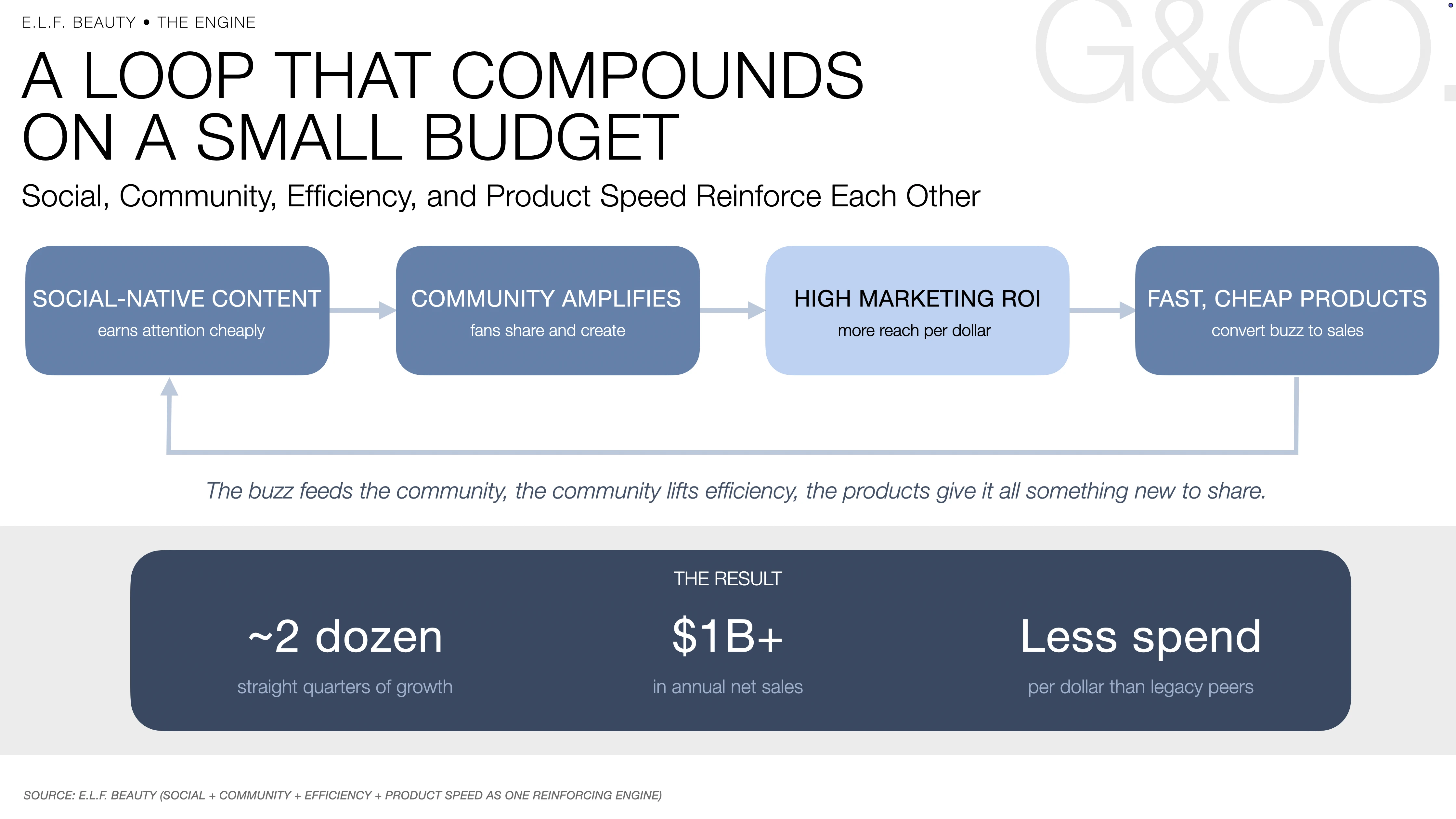
Marketing alone would not sustain growth without product behind it, so e.l.f. developed a fast product engine, bringing out high-quality products, often affordable takes on expensive prestige items, quickly enough to ride trends while they were current, at prices that made trying them easy. Around this it cultivated a genuine brand community, built on accessible values, inclusivity, and constant two-way community engagement, so that customers felt like participants in the brand rather than targets of its advertising. The community amplifies the marketing, the affordability lowers the barrier to joining, and the fast innovation keeps giving the community something new to talk about.
The approach carries real tension. Social-media success can be fickle, what goes viral is hard to predict or sustain, and a brand built on cultural relevance has to keep earning it. Growing from a small base is easier than sustaining growth at scale, and as e.l.f. gets bigger and expands (including into higher-priced and acquired brands), it must keep the authentic, scrappy quality that made it work. But the social-native, community-led, efficient model is precisely what the lumbering incumbents have struggled to copy, because it runs against their budgets, instincts, and corporate cultures.

Always-On Customer Intelligence
Turn your own customer data into foresight — validate, simulate, and sense every major decision before you commit.


Results and Evidence
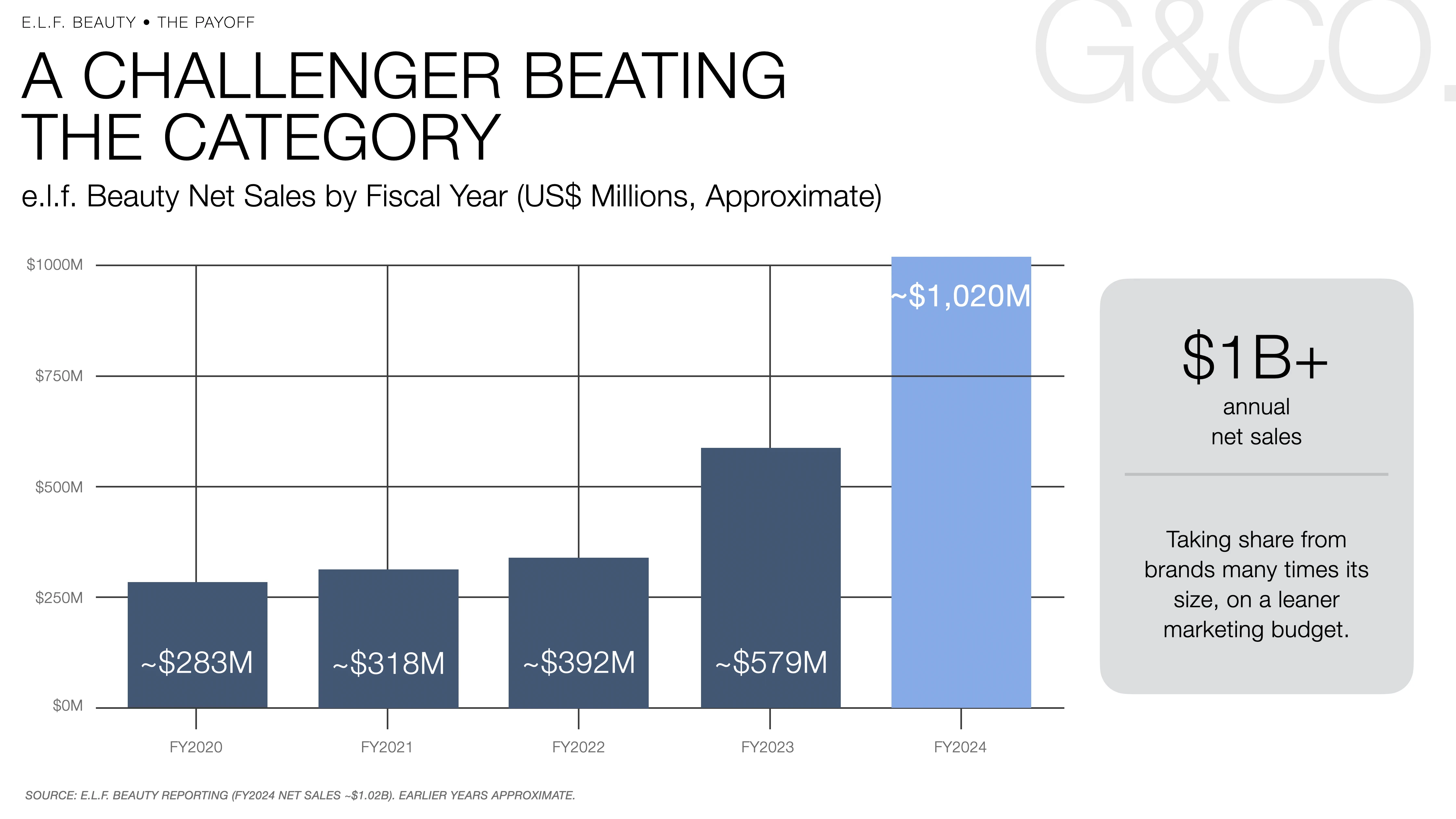
The evidence is in the growth, the share gains, and the efficiency behind them. e.l.f. has strung together around two dozen consecutive quarters of net sales growth, passed a billion dollars in annual sales, and climbed to the top ranks of mass cosmetics by units sold in the U.S., all while taking market share from far larger competitors, the clearest proof that its social-native approach is winning real customers, not just attention. The most telling point is how it got there: e.l.f. achieves this growth while spending proportionally less on marketing than many legacy peers, which is the signature of genuinely efficient, high-ROI social media marketing rather than a budget war. Its brand consistently over-indexes with younger consumers and on the platforms where attention is moving, and it has reinvested its momentum into acquisitions and new lines to extend the brand. These figures come from e.l.f. Beauty's public reporting and are worth confirming against the latest results before publishing, since this names a real company and the numbers update each quarter.
Strategic Implications
Read at scale, e.l.f. is a case about winning on engagement and efficiency rather than budget, and it connects to the broader shifts in social media marketing, creator-driven brand building, and community. The pattern is repeatable well beyond beauty: in a world where attention lives on social platforms and is earned through authenticity rather than bought with reach, a nimble challenger can out-engage incumbents it could never outspend, and turn a smaller budget into an advantage by being faster, more native, and more genuinely connected to its audience. e.l.f. did not beat the giants at their game; it changed the game to one where its agility and authenticity were the advantages.
The deeper implication is how social, community, product speed, and efficiency reinforce one another. Social-native content earns attention cheaply; the community amplifies and sustains it; affordable, fast products convert that attention and give the community something to rally around; and the whole loop runs at a marketing cost incumbents cannot match per dollar. For enterprise leaders, the takeaway is to stop assuming the biggest budget wins and ask where being smaller and more native could be an advantage, how to build a community that markets for you, and how to measure and maximize marketing ROI rather than raw spend. The brands growing fastest today are rarely the ones spending the most; they are the ones their audiences actually want to engage with and share.
What Enterprise Leaders Can Learn
- Out-engage, don't outspend.
When attention lives on social platforms, authentic, shareable content beats bought reach. A challenger can win by being more native and more creative, not richer. - Treat efficiency as strategy.
e.l.f.'s superior marketing ROI is not a side effect; it is the core advantage that lets a smaller brand compete with giants. Measure and optimize cost per engagement, not just spend. - Build a community that markets for you.
Real community engagement turns customers into participants and amplifiers, extending reach far beyond what paid media could buy. - Pair marketing with product speed.
Fast, affordable innovation converts attention into sales and keeps giving the community something new to share. Marketing and product have to move together. - Smaller can be an advantage.
Agility, authenticity, and willingness to move first on new platforms are easier for a challenger than for a big incumbent bound by budget, process, and brand caution.
Conclusion
e.l.f. Beauty's story is not really about cosmetics. It is about how a challenger beats incumbents it cannot outspend. Rather than fight the beauty giants on big-budget advertising and prestige positioning, e.l.f. competed where its size was an advantage: it went native on social media, earned attention through authentic and shareable content instead of buying it, built a genuine community that amplified everything, and backed it with fast, affordable products that converted the buzz into sales, all at a marketing efficiency its larger rivals could not match. That combination turned a small value brand into one of the fastest-growing names in beauty. For enterprise leaders, the transferable lesson is that in a social-first world, the biggest budget no longer wins by default; the brand that is most native, most engaging, and most efficient does. The way to beat a giant is not to spend like one, but to out-create and out-connect it.
Through the Acumen platform, G&CO. gives enterprise brands the intelligence to win on engagement rather than budget: where being more social-native and authentic would beat bought reach, how to build a community that markets for you, and how to measure and lift marketing ROI rather than raw spend. G&CO. is a certified minority business enterprise through the National Minority Supplier Development Council (NMSDC). For enterprise organizations with diversity inclusion requirements in their procurement process, G&CO. meets the criteria for MBE-qualified partner status.
G&CO. works with enterprise brands on the brand, community, and marketing strategy that turns a smaller budget into a social-first advantage. If this e.l.f. Beauty case study raises questions about your own social media marketing, brand community, or marketing efficiency, submit an inquiry to G&CO. on our contact page or click the blue "Click to Contact Us" button in the bottom right corner of your screen. We look forward to hearing from you.
Frequently Asked Questions
What is the e.l.f. Beauty strategy in a sentence?
The e.l.f. Beauty strategy is to beat bigger, richer rivals by out-engaging them rather than outspending them. e.l.f. built its brand to be native to social media, earning attention through authentic, shareable content and creators instead of expensive traditional advertising, cultivated a genuine community around accessible values, and backed it with fast, affordable product innovation. The result is rapid growth and market-share gains achieved on a leaner marketing budget, a challenger winning by being more creative, more connected, and more efficient than the incumbents it competes with.
How does e.l.f. use social-native marketing differently from legacy brands?
e.l.f. is social-native rather than social-present. Instead of running traditional ads on social platforms, it builds content designed for how people actually use those platforms, entertaining, shareable, and creator-driven, and it moves early, often becoming one of the first beauty brands on a new platform. Its biggest moments have come from genuinely viral content rather than bought reach. Legacy brands tend to adapt old advertising to social; e.l.f. starts from the platform's own culture, which is why its social-native marketing earns the attention incumbents struggle to buy.
What does e.l.f.'s marketing efficiency have to do with its success?
Everything. Because e.l.f.'s growth comes from creativity and community rather than sheer spend, it reaches and engages far more people per marketing dollar than its larger competitors, spending proportionally less on marketing while growing faster. That superior marketing efficiency is not a happy side effect; it is the core of the strategy. It is what allows a smaller, value-priced brand to compete with companies that have vastly deeper pockets and still grow profitably. In a world of rising media costs, that efficiency is a durable competitive advantage.
How does community engagement fit into e.l.f.'s growth?
It amplifies everything else. e.l.f. built a genuine community around accessible values, inclusivity, and constant two-way interaction, so customers feel like participants in the brand rather than targets of its advertising. That community shares content, creates its own, and spreads the brand far beyond what paid media could reach, effectively marketing for e.l.f. Combined with affordable prices that make joining easy and fast product launches that give the community something new to talk about, community engagement turns attention into a self-reinforcing growth loop.
What can enterprise leaders learn from the e.l.f. Beauty case study?
The central lesson is that in a social-first world, engagement and efficiency beat budget. e.l.f.'s repeatable playbook: go social-native rather than just advertising on social, treat marketing efficiency (ROI) as a core strategy rather than a constraint, build a community that amplifies and markets for you, and pair all of it with fast, affordable product innovation so attention converts to sales. Above all, recognize that being smaller can be an advantage, more agile, more authentic, quicker to move, against incumbents bound by budget and caution. Leaders should ask where out-engaging beats outspending in their own category.