Ferrari Case Study: How Scarcity Became the Strategy
This Ferrari case study examines one of the purest examples of scarcity marketing in business: a company that deliberately makes fewer cars than the market demands, so desire always outruns supply. That restraint is not a limitation but the strategy itself, it protects exclusivity, desirability, and extraordinary pricing power, and it is reinforced by allocating the most coveted models only to loyal owners. The result is that Ferrari is valued by investors like a luxury house rather than a carmaker, worth more than companies that build a hundred times as many vehicles. The Ferrari strategy shows how, in luxury, making less can be worth far more.
Ferrari deliberately builds fewer cars than the world wants, keeping demand permanently ahead of supply, so its scarcity protects the desirability, exclusivity, and pricing power that make it worth more than far bigger carmakers.
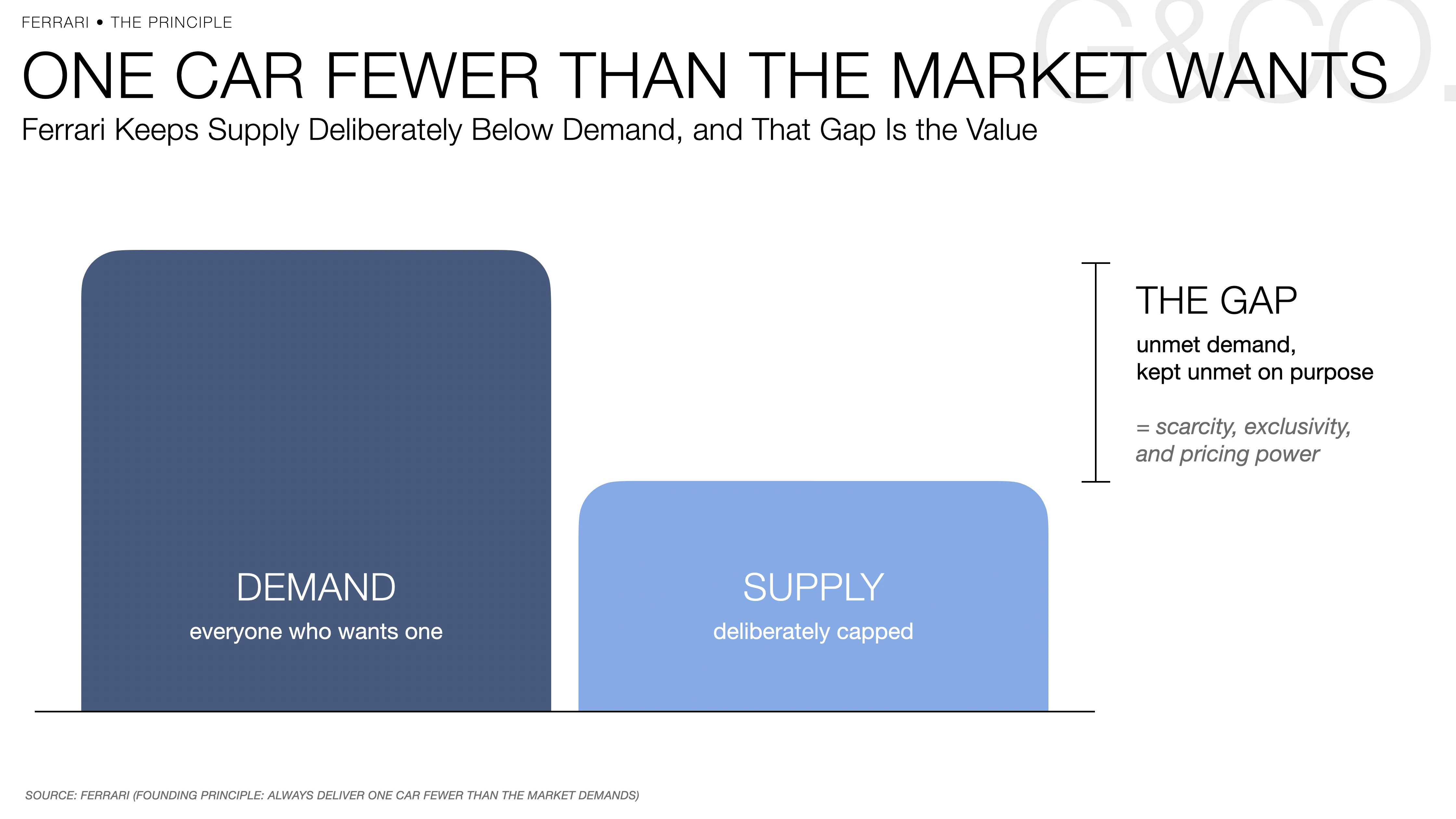
Almost every company is built to sell more. Grow volume, capture share, satisfy demand, that is the default logic of business. Ferrari runs on the opposite principle. It deliberately makes fewer cars than people want to buy, and treats the gap between demand and supply not as a problem to solve but as the very thing that makes the brand valuable. The guiding idea, attributed to its founder, is to always deliver one car fewer than the market demands.
This case study looks at how Ferrari turned scarcity into its core strategy, how deliberately constraining supply protects desirability and extraordinary pricing power, and why that makes a company building a relatively tiny number of cars worth more than automakers a hundred times its size. For enterprise leaders, the lesson reaches well beyond supercars. It is about how, for a true luxury brand, restraint can create far more value than growth.
Key Points
- Ferrari deliberately makes fewer cars than people want to buy. Its guiding principle is to deliver one car fewer than the market demands, keeping desire permanently ahead of supply.
- Scarcity is the strategy, not a constraint. By controlling volume, Ferrari protects exclusivity, desirability, and resale value, the scarcity marketing that chasing volume would destroy.
- Allocation rewards loyalty and deepens the relationship. Its most coveted limited editions are offered only to established owners, so the scarcity also builds a devoted, repeat-buying elite.
- The payoff is extraordinary pricing power and margins. Because demand always exceeds supply, Ferrari commands premium prices and among the highest per-car profits in the industry, the essence of its premium positioning.
- It is valued like a luxury house, not a carmaker. Investors price Ferrari alongside luxury brands, worth far more than automakers that build a hundred times as many cars, because it sells desirability, not transport.
Why This Matters
For CEOs, CMOs, and brand leaders, Ferrari is the definitive example of scarcity as a deliberate, disciplined strategy rather than an accident of limited capacity. Most companies instinctively equate success with selling more, and would see unmet demand as money left on the table. Ferrari shows that for a luxury brand, satisfying all the demand would be the mistake, because the moment anyone who wants one can have one, the exclusivity that makes it desirable, and valuable, evaporates. That counterintuitive discipline, choosing not to grow volume even when you could, is one of the hardest and most powerful moves in brand strategy.
The relevance extends to any premium or aspirational brand. As markets get more crowded and the temptation to chase growth through volume and discounting intensifies, Ferrari is a standing reminder that for luxury, desirability depends on restraint, and that pricing power comes from scarcity, not scale. For any leader whose brand trades on exclusivity or aspiration, and who faces pressure to expand, Ferrari is both the model and the warning.






Let’s kickstart the conversation and design stuff people will love.

The Retail & Consumer Index


Strategic Context
For most of the automotive industry, the logic is scale: higher volume spreads fixed costs, captures share, and grows revenue, so more is better. Luxury operates on a different logic entirely. The value of a luxury good is bound up with its rarity and the status of owning something few others can, which means that for a true luxury brand, abundance is destructive. If everyone who wants a Ferrari can simply buy one, a Ferrari stops being special, and the premium it commands, financial and emotional, collapses.
Ferrari's defining insight, rooted in its founder's philosophy, was that it should manage demand rather than merely meet it, always keeping supply just below what the market wants. This is not a failure to scale; it is a deliberate refusal to, because the scarcity is the source of the value. The strategic choice at the heart of this case is that Ferrari chose to protect desirability over maximizing volume, treating its own restraint, the discipline to make fewer cars than it could sell, as its most important strategic asset, and building the whole business, from allocation to pricing to brand, around sustaining that scarcity.
Company Response
Constrain supply on purpose.
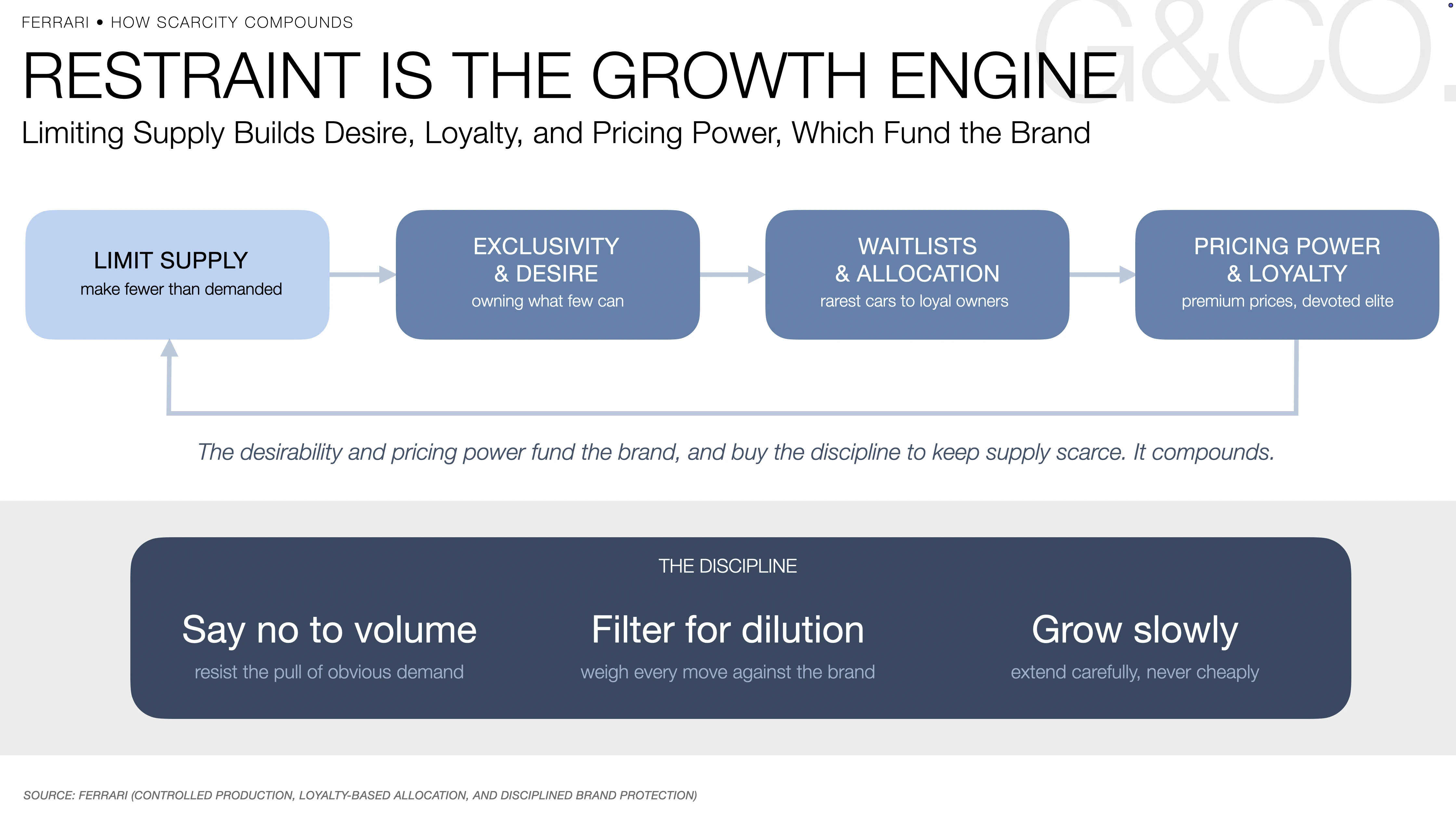
Ferrari deliberately limits how many cars it produces, keeping annual volumes far below what demand would support and growing them only slowly and carefully. This controlled production is the foundation of everything else: because Ferrari makes fewer cars than people want, ownership stays exclusive, waiting lists stay long, and the cars hold their value, often appreciating rather than depreciating. Where a mass carmaker would ramp production to capture every sale, Ferrari does the opposite, protecting the scarcity that underpins the brand. The restraint is the product.
Use allocation to reward loyalty and deepen exclusivity.
Ferrari does not simply sell its most special cars to the highest bidder; it allocates them, offering the most coveted limited editions and halo models only to established, loyal owners with a history of buying and collecting. This turns scarcity into a relationship: to be offered the rarest Ferraris, you must already be part of the club, which both rewards loyalty and makes the brand even more aspirational for everyone outside it. The allocation system is luxury marketing as access, exclusivity is not just about price but about who is permitted to buy, which deepens desire and devotion at once.
Protect the brand from dilution, and extend it carefully.
Everything Ferrari does is filtered through whether it protects or dilutes the brand's exclusivity. It expands cautiously, into new models, limited merchandise, and eventually electrification, always weighing growth against the risk of becoming too common. It resists the temptation to chase volume or over-extend the name, because the brand's value depends on remaining rare and special. This disciplined premium positioning, growing the business without ever undermining the scarcity, is the hardest part of the Ferrari strategy, and the most important.
The approach carries real tension. There is constant pressure, from markets and the pull of obvious demand, to make more cars and capture more revenue now, and Ferrari must resist the short-term gains that would erode the long-term brand. Growth has to be managed with extreme care: even expanding into a new model or raising volumes slightly risks diluting exclusivity if done wrong. And major shifts, like the move to electric vehicles, must be navigated without losing the emotional, heritage-rich essence that makes a Ferrari a Ferrari. But that discipline is precisely the moat: competitors can build fast or beautiful cars, but they cannot easily manufacture the scarcity and desirability Ferrari has protected for decades.

Always-On Customer Intelligence
Turn your own customer data into foresight — validate, simulate, and sense every major decision before you commit.


Results and Evidence
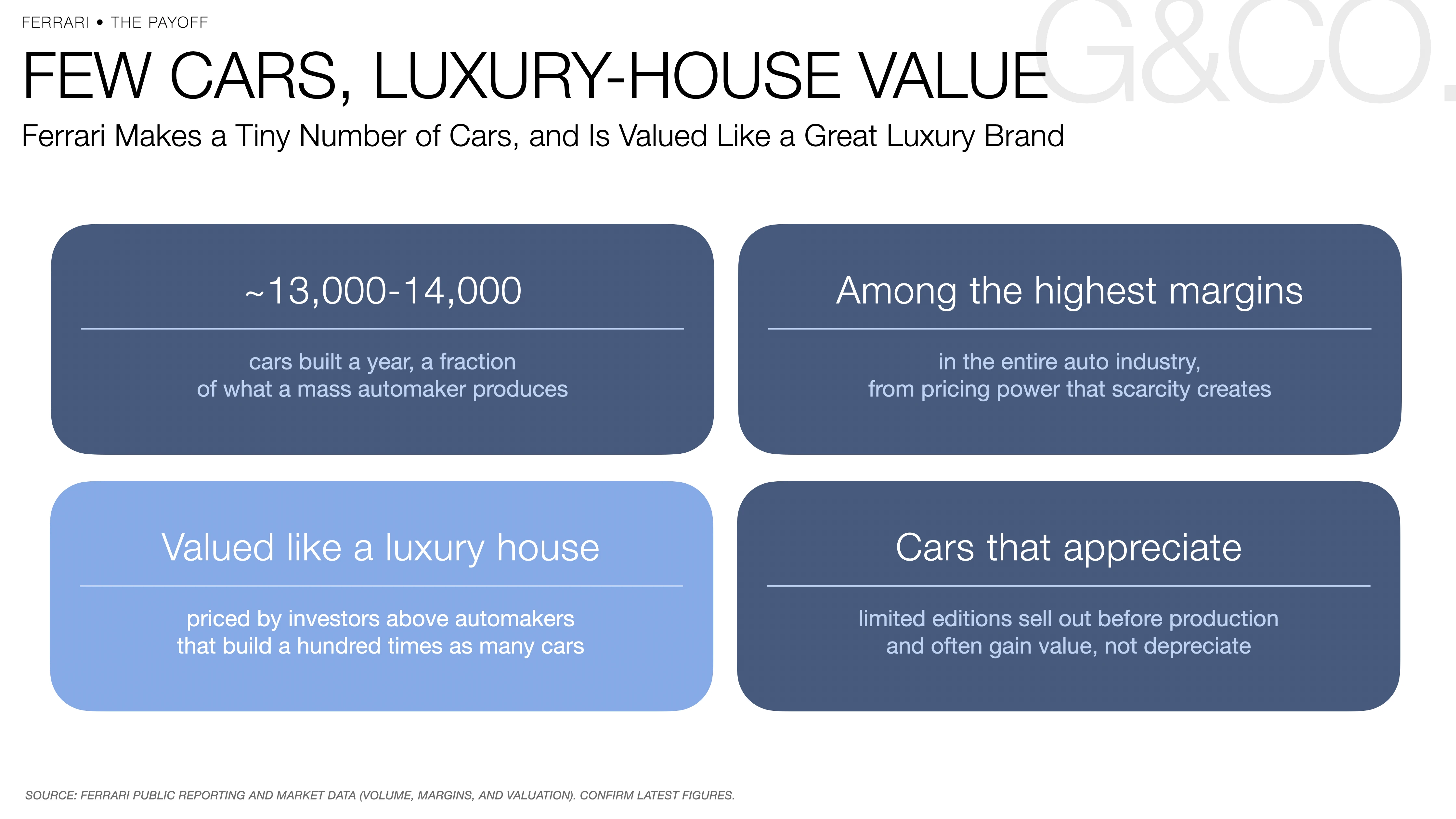
The evidence is in the economics and the valuation. Ferrari builds only on the order of thirteen to fourteen thousand cars a year, a tiny number by automotive standards, yet it earns among the highest profit margins in the entire industry, because constrained supply and relentless demand give it pricing power few companies in any sector enjoy. The clearest proof that scarcity is the strategy is how the market values the company: Ferrari is priced by investors not as a carmaker but as a luxury house, carrying a valuation that exceeds those of automakers producing a hundred times as many vehicles, because its earnings are as rare and defensible as the cars themselves. Its limited editions routinely sell out before production and often appreciate in value, the opposite of normal car depreciation, which is the ultimate market confirmation that the scarcity is real and prized. These figures come from Ferrari's public reporting and market data and are worth confirming against the latest results before publishing, since this names a real company and the numbers update each year.
Strategic Implications
Read at scale, Ferrari is a case about scarcity and restraint as a source of value, and it connects to the broader principles of luxury brand strategy, premium positioning, and pricing power. The pattern is repeatable for aspirational brands well beyond cars: desirability is often inversely related to availability, so deliberately constraining supply, and resisting the universal pull to sell more, can protect the exclusivity that commands premium prices and devotion. Ferrari did not become the most valuable name in its industry by making the most cars; it did so by making fewer than it could, and making that scarcity the point.
The deeper implication is that for a luxury brand, growth and value can be in tension, and discipline is the resolution. The instinct to satisfy all demand is, for an aspirational brand, a path to commoditization; the harder and more valuable discipline is to grow slowly, protect rarity, and let demand always exceed supply. For enterprise leaders, the takeaway is to recognize when your brand's value depends on exclusivity, and to treat restraint as a strategic asset rather than a missed opportunity, resisting the pressure to chase volume at the expense of desirability, and managing demand rather than simply maximizing it. The most valuable aspirational brands are often the ones disciplined enough to make less.
What Enterprise Leaders Can Learn
- For a luxury brand, scarcity is a strategy, not a shortfall.
Deliberately keeping supply below demand protects the exclusivity and desirability that premium value depends on. Restraint can be worth more than growth. - Manage demand; don't just satisfy it.
Satisfying all demand can commoditize an aspirational brand. Keeping desire ahead of supply sustains pricing power and allure. - Turn scarcity into a relationship.
Allocating the rarest offerings to loyal customers rewards devotion and deepens exclusivity, making scarcity a loyalty engine, not just a price lever. - Filter every decision through brand dilution.
Weigh each growth or extension move against whether it erodes the rarity that makes the brand valuable. Protecting exclusivity has to outrank short-term volume. - Pricing power comes from scarcity, not scale.
Ferrari's margins and valuation flow from making fewer, not more. Where desirability is the asset, constraining supply is how you monetize it.
Conclusion
Ferrari's story is not really about cars. It is about the counterintuitive power of making less. In an industry, and a business world, built on the logic of selling more, Ferrari deliberately builds fewer cars than people want, and has turned that restraint into the most valuable position in its field. By constraining supply on purpose, allocating its rarest cars to reward loyalty, and filtering every decision through whether it protects the brand's exclusivity, Ferrari keeps demand permanently ahead of supply, and with it the desirability, pricing power, and devotion that let a maker of a few thousand cars be valued like a great luxury house. For enterprise leaders, the transferable lesson is that for an aspirational brand, growth is not always the goal, desirability is, and desirability often depends on the discipline to make less than you could. The rarest thing Ferrari produces is its own restraint, and that is exactly what makes it so valuable.
Through the Acumen platform, G&CO. gives enterprise brands the intelligence to manage desirability as carefully as demand: where exclusivity drives your brand's value, where chasing volume would erode it, and how restraint, scarcity, and allocation could protect pricing power rather than leave money on the table. G&CO. is a certified minority business enterprise through the National Minority Supplier Development Council (NMSDC). For enterprise organizations with diversity inclusion requirements in their procurement process, G&CO. meets the criteria for MBE-qualified partner status.
G&CO. works with enterprise brands on the brand, positioning, and pricing strategy that turns exclusivity and restraint into durable desirability and pricing power. If this Ferrari case study raises questions about your own scarcity marketing, luxury brand strategy, or premium positioning, submit an inquiry to G&CO. on our contact page or click the blue "Click to Contact Us" button in the bottom right corner of your screen. We look forward to hearing from you.
Frequently Asked Questions
What is Ferrari's scarcity marketing strategy?
Ferrari's scarcity marketing strategy is to deliberately produce fewer cars than the market demands, keeping desire permanently ahead of supply. The guiding principle, attributed to its founder, is to always deliver one car fewer than the market wants. By controlling production and growing volumes only slowly, Ferrari ensures that ownership stays exclusive, waiting lists stay long, and the cars hold or gain value. The unmet demand is not a failure to capture sales; it is the deliberate source of the brand's desirability and pricing power. Making less, on purpose, is the core of the Ferrari strategy.
Why does Ferrari deliberately limit how many cars it makes?
Because for a luxury brand, abundance is destructive. The value of a Ferrari is bound up with its rarity and the status of owning something few others can; if everyone who wanted one could simply buy one, it would stop being special and the premium it commands, financial and emotional, would collapse. By keeping supply just below demand, Ferrari protects the exclusivity that makes the brand desirable and the cars valuable, including on the resale market, where Ferraris often appreciate rather than depreciate. Limiting volume is how Ferrari sustains the desirability that is its real product.
How does Ferrari's allocation system work?
Ferrari does not simply sell its most special cars to whoever will pay; it allocates them, offering the most coveted limited editions and halo models only to established, loyal owners with a history of buying and collecting Ferraris. This turns scarcity into a relationship: to be offered the rarest models, you must already be a committed member of the community. It rewards loyalty, encourages owners to keep buying, and makes the brand even more aspirational for those on the outside. The allocation system is a form of luxury marketing based on access as much as price, exclusivity is about who is allowed to buy, not just what it costs.
Why is Ferrari valued like a luxury company rather than a carmaker?
Because its economics resemble a luxury house far more than a volume automaker. Ferrari builds only around thirteen to fourteen thousand cars a year but earns among the highest profit margins in the industry, thanks to the pricing power that constrained supply and relentless demand create. Investors therefore value it alongside luxury brands, and its valuation exceeds those of automakers producing a hundred times as many vehicles, because its earnings are as rare and defensible as its cars. The market is effectively confirming that Ferrari's scarcity-driven desirability, not its production volume, is the true asset.
What can enterprise leaders learn from the Ferrari case study?
The central lesson is that for an aspirational brand, restraint can create more value than growth. Ferrari's repeatable principles: treat scarcity as a deliberate strategy, not a shortfall, by keeping supply below demand; manage demand rather than simply satisfying it, since meeting all of it can commoditize the brand; turn scarcity into a loyalty engine by allocating the rarest offerings to devoted customers; and filter every growth decision through whether it dilutes the exclusivity that makes the brand valuable. The broader principle is that pricing power comes from scarcity, not scale, so leaders of exclusive brands should recognize when making less, on purpose, is worth far more than selling more.