
Uber Case Study: From Cash Burn to a Profitable Platform
This Uber case study examines one of the most watched turnarounds in technology: how a company that burned billions building a two-sided marketplace at global scale finally became profitable. For years the Uber strategy prioritized growth and market share over economics; the turn came from discipline, exiting unprofitable markets and fixing unit economics, and from monetizing the platform. A super-app that cross-sells rides, food, and grocery, a fast-growing advertising business, and the Uber One subscription that drives customer retention together reshaped the Uber business model. The Uber case study shows that scale and network effects alone do not make a platform profitable, the platform business model has to be monetized.
Uber spent years burning billions to build a two-sided marketplace at global scale, then turned the corner to profit by fixing its unit economics and monetizing the platform, cross-selling rides and food, adding advertising, and locking in customers with a subscription.
For most of its life, Uber was synonymous with two things: changing how the world moves, and losing staggering amounts of money. It built an enormous two-sided marketplace connecting riders and drivers, then eaters and couriers, by spending aggressively, subsidizing fares, expanding into dozens of countries, and fighting price wars, all in pursuit of scale and market share, and all at a loss measured in billions of dollars a year. For a long time it was an open question whether the business could ever actually make money.
This case study looks at how Uber answered that question, turning a famously unprofitable marketplace into a profitable platform by imposing financial discipline and, crucially, by monetizing the platform it had built. For enterprise leaders, the lesson reaches well beyond ride-hailing. It is about the difference between building scale and building a profitable platform business model, and about what it actually takes to make a two-sided marketplace pay.
Key Points
- Uber built a marketplace at enormous scale, and burned billions doing it. For years it prioritized growth and market share over profit, subsidizing rides and expanding globally at a steep loss.
- The turn was discipline, not just scale. New leadership exited unprofitable markets, fixed unit economics, and cut costs, proof that network effects and size alone do not make a platform profitable.
- The super-app strategy monetizes the platform. One app for rides, food, and grocery lets Uber cross-sell across services, and a fast-growing, high-margin advertising business rides on top, turning the marketplace into a platform business model with several revenue streams.
- A subscription locks in the most valuable customers. Uber One bundles discounts across rides and delivery, driving customer retention and more spending from members who use more of the platform.
- After years of losses, Uber reached full-year profitability, with roughly $44 billion in revenue and around $162 billion flowing through the platform, proof that the model can work at scale.
Why This Matters
For CEOs, CFOs, and anyone building or running a platform or marketplace, Uber is the defining case of the gap between scale and profitability. A generation of companies raised enormous sums on the premise that if they built a big enough network, profit would follow automatically, and many never made the leap. Uber is the highest-profile example of a company that did make it, but only after abandoning the assumption that growth alone would do the work and instead imposing discipline and building real monetization on top of the network. That transition, from growth-at-all-costs to a genuinely profitable platform, is one of the most important and least automatic in modern business.
The timing matters. The era of cheap capital that funded years of unprofitable growth has ended, and investors now demand that platforms demonstrate real economics, not just rising user counts. Uber's turnaround is a template for how a scaled-but-unprofitable platform gets to profit: exit what does not work, fix the unit economics of what does, and monetize the platform through cross-selling, advertising, and subscriptions. For any leader whose business was built for growth and now must prove it can make money, Uber is essential study.






Let’s kickstart the conversation and design stuff people will love.

The Retail & Consumer Index


Strategic Context
A marketplace has a well-known strategic logic: network effects. More drivers mean shorter waits and lower prices, which attract more riders, which attract more drivers, and density in a given city makes the service better and cheaper to run. That logic justified Uber's early strategy of spending heavily to build scale and win markets, because in a network business, scale and density genuinely matter. The problem is that network effects explain why scale is valuable; they do not, by themselves, produce profit. A marketplace can be enormous and still lose money on every transaction if its unit economics do not work.
For years, Uber lived in exactly that gap, massive and unprofitable, as it chased growth and market share in markets and services where it could not yet make money. The strategic insight that drove its turnaround was that scale had to be converted into profit deliberately, by fixing the economics of each transaction and by building revenue streams on top of the network, rather than assuming size alone would eventually pay off. The strategic choice at the heart of this case is that Uber shifted from a growth-at-all-costs marketplace strategy to a disciplined platform business model, keeping the scale and scale effects it had built, but finally making them pay.
Company Response
Impose discipline and fix the unit economics.
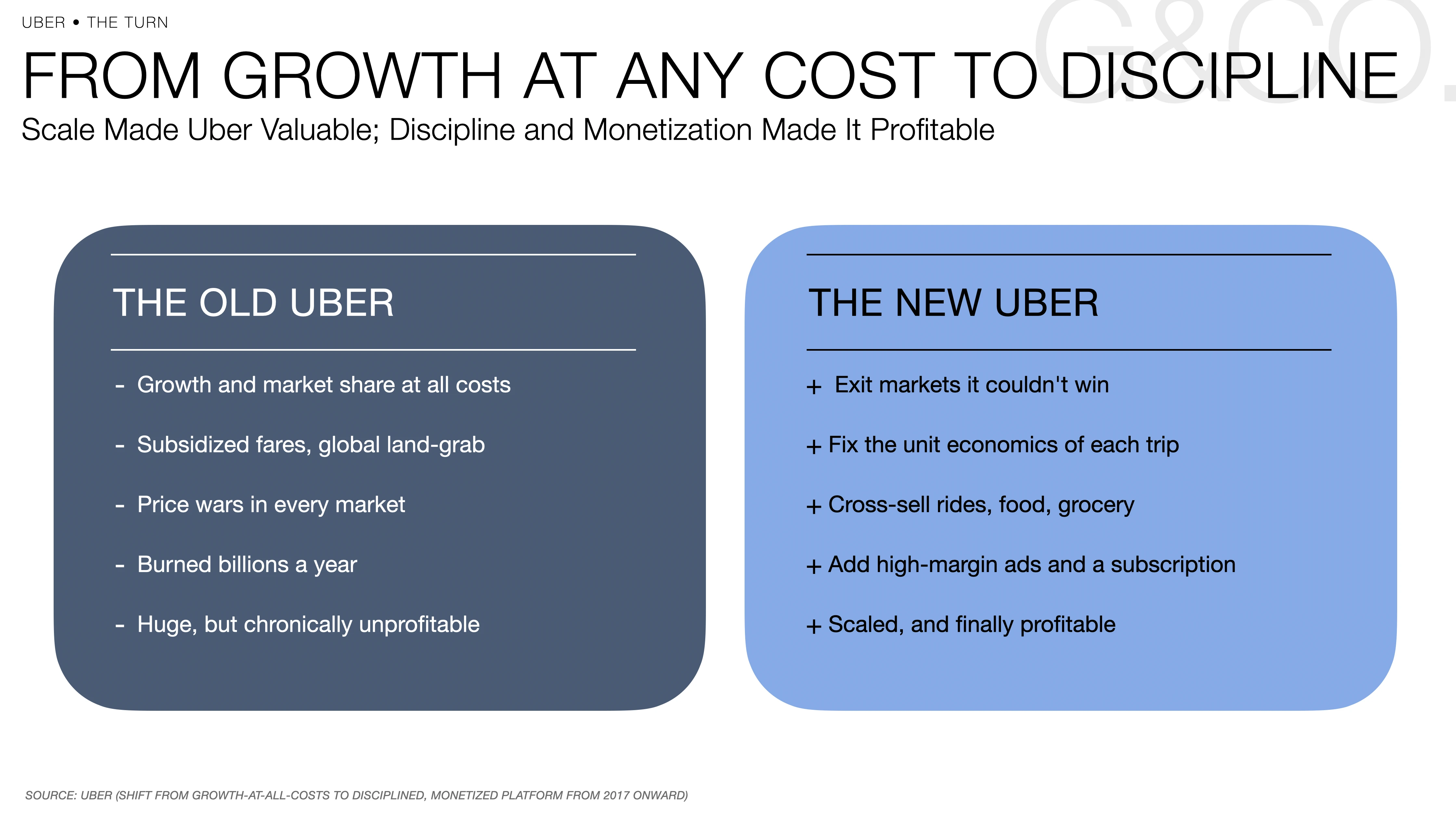
Under new leadership, Uber abandoned "growth at any cost" for a focus on profitability. It exited markets where it was losing badly and could not win, selling or ceding operations in several regions to local competitors rather than burning cash to compete, cut costs across the company, and concentrated on the core businesses where it had real advantage. Crucially, it set about making the economics of each ride and delivery actually work, so that growth would add to profit rather than subtract from it. This was the unglamorous foundation of the turnaround: a marketplace that loses money on each transaction cannot scale its way to profit, so the per-transaction economics had to be fixed first.
Build the super-app and cross-sell the platform.
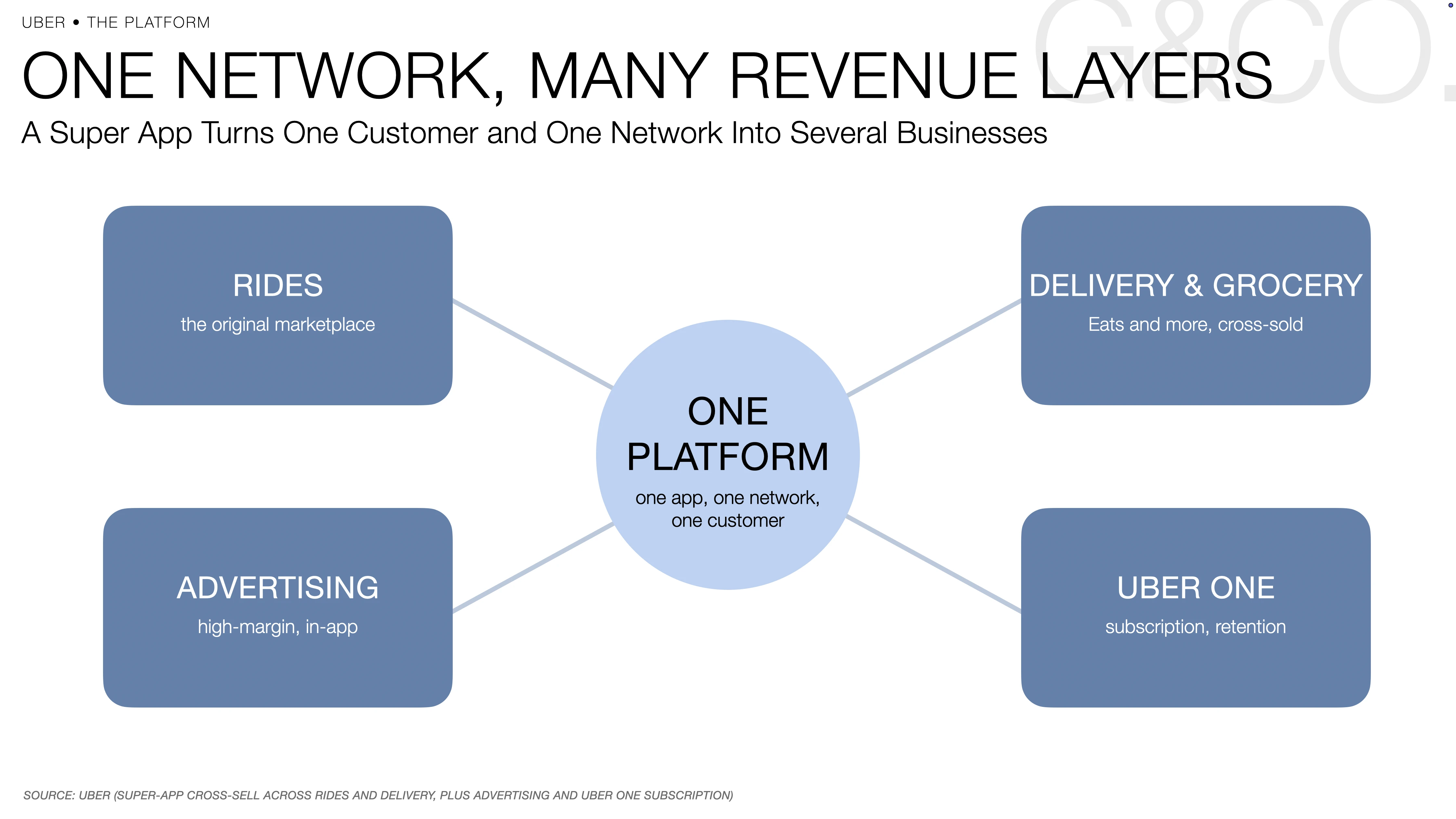
Rather than run separate businesses, Uber turned its app into a super app, a single platform offering rides, food delivery, grocery, and more, so a customer acquired for one service can be sold others at little additional cost. This cross-selling raises the value of each customer and the efficiency of the whole platform, and it is central to the Uber business model: the same user, the same app, and the same logistics network now generate multiple kinds of revenue. The more services a customer uses, the more valuable and the more loyal they become, which strengthens the platform's economics well beyond what any single service could.
Add high-margin revenue and lock in loyalty.
On top of the marketplace, Uber built new, higher-margin revenue streams, most notably a fast-growing advertising business that lets restaurants and brands reach users inside the app, which adds profit without proportional cost. And it launched a subscription, Uber One, that bundles discounts and benefits across rides and delivery, driving customer retention by giving frequent users a reason to consolidate their spending on Uber. Advertising improves the margin mix; the subscription deepens loyalty and frequency. Together they turn a transactional marketplace into a platform with recurring, higher-margin, and stickier revenue.
The approach carries real tension. Uber's economics still depend on its relationship with drivers and couriers, whose classification, pay, and treatment are the subject of ongoing legal and regulatory pressure that could materially affect costs. Some of its reported profitability has been flattered by one-off gains, so the quality and durability of the profit matter. And sustaining growth and profit simultaneously, while fending off competitors in rides and delivery, is a continuing balance. But the shift from a cash-burning marketplace to a monetized, disciplined platform is real, and it is what moved Uber from chronic losses to profit.

Always-On Customer Intelligence
Turn your own customer data into foresight — validate, simulate, and sense every major decision before you commit.


Results and Evidence
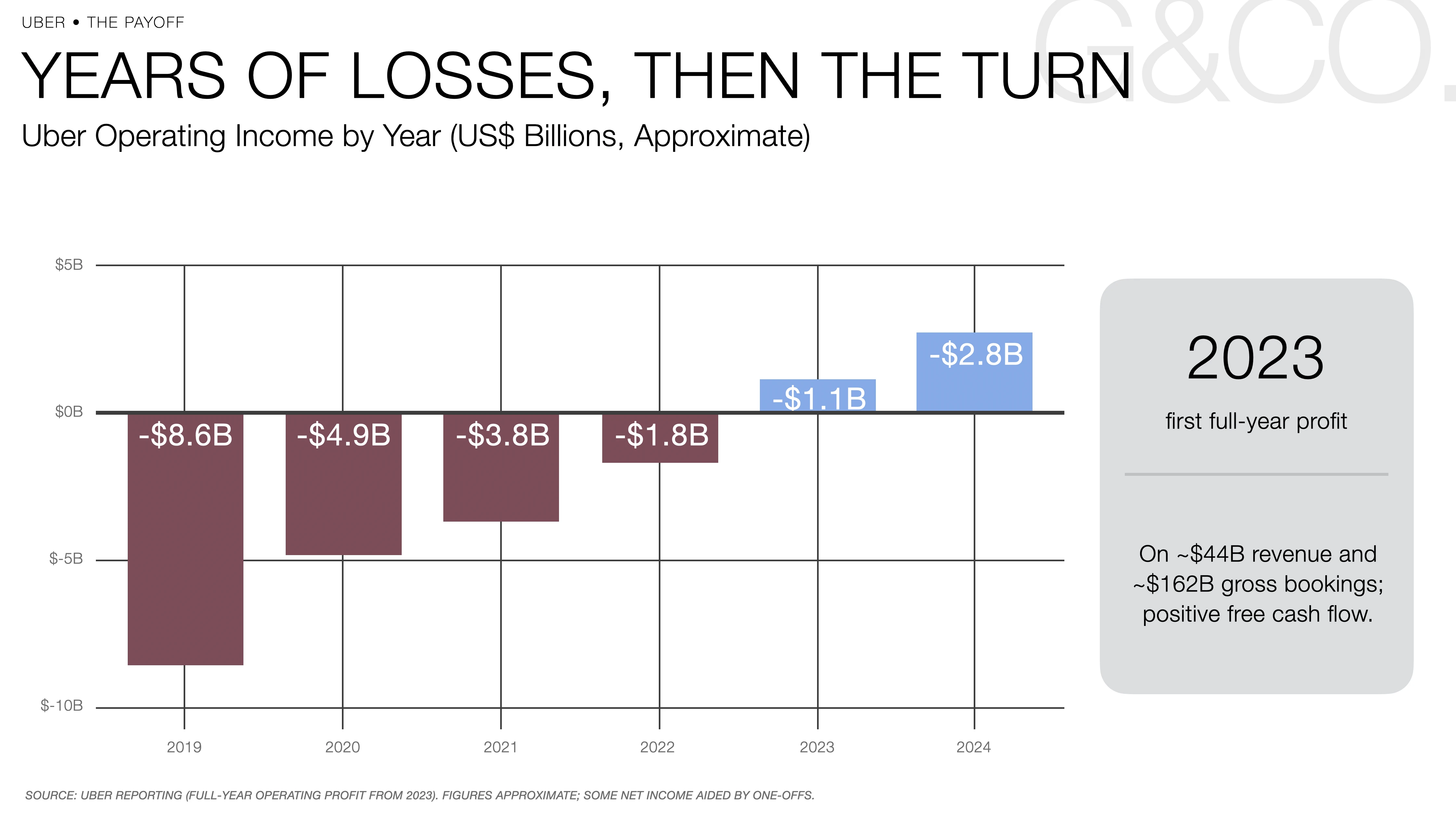
The evidence is the turnaround itself: after years of losing billions, Uber reached full-year profitability, generating positive operating income and strong free cash flow where it had long produced deep losses, a genuine inflection point for a company many doubted could ever make money. It did so at enormous scale, with roughly $44 billion in revenue and on the order of $162 billion in gross bookings flowing across the platform annually, serving well over a hundred million active consumers. The clearest proof that the turnaround is structural rather than cosmetic is where the profit comes from: improved unit economics, the cross-selling efficiency of the super app, a high-margin advertising business growing quickly, and a subscription base that lifts retention and frequency, not merely cost-cutting. One honest caveat: some reported bottom-line figures have been boosted by investment and one-time gains, so the operating trend matters more than any single net-income number. These figures come from Uber's public reporting and are worth confirming against the latest results before publishing, since this names a real company and the numbers update each quarter.
Strategic Implications
Read at scale, Uber is a case about converting a scaled marketplace into a profitable platform, and it connects to the broader questions of platform business models, marketplaces, and the end of growth-at-all-costs. The pattern is a correction to a widespread error: scale effects and scale make a marketplace valuable, but they do not automatically make it profitable, and a company that assumes they will can grow enormous and still lose money indefinitely. Profit comes from deliberately fixing unit economics and building monetization, cross-selling, advertising, subscriptions, on top of the network. The Uber strategy did not stop being a marketplace; it became a platform that finally makes its marketplace pay.
The deeper implication is that a platform's real value is unlocked only when it is monetized across multiple layers. The same customer, app, and network that deliver one service can deliver several, carry advertising, and support a subscription, and each added layer improves the economics and the stickiness of the whole. For enterprise leaders, the takeaway is to distinguish clearly between building scale and building a profitable platform model, to treat unit economics as something to be engineered rather than outgrown, and to look for the additional revenue layers, cross-sell, high-margin services, recurring subscriptions, that turn a network into a profitable platform. The companies that win in the platform era are not the ones that merely got big; they are the ones that made getting big pay.
What Enterprise Leaders Can Learn
- Scale is not profit.
Scale effects make a marketplace valuable but do not make it profitable on their own. Converting scale into profit is a deliberate act, not an automatic outcome. - Fix unit economics before scaling further.
A marketplace that loses money per transaction cannot grow its way to profit. Make each transaction work first; then scale adds to profit instead of subtracting from it. - Monetize the platform in layers.
A super app lets one customer and one network generate many revenue streams through cross-selling; advertising and subscriptions add higher-margin, stickier revenue on top. - Use a subscription to drive retention and frequency.
Uber One gives the most valuable customers a reason to consolidate spending, lifting retention and the lifetime value of the platform's best users. - Discipline can coexist with scale.
Exiting what cannot win and fixing the core is not retreat; it is what lets a scaled business finally convert its size into durable profit.
Conclusion
Uber's story is not really about rides. It is about the hard, non-automatic work of turning scale into profit. Uber built one of the largest marketplaces in the world by spending aggressively for years, and in doing so proved that scale effects make a marketplace valuable, but it also proved that they do not, by themselves, make it pay. The turnaround came when Uber stopped assuming growth would become profit on its own and started engineering it: fixing the unit economics of each transaction, exiting what could not win, and monetizing the platform through a super app that cross-sells services, a high-margin advertising business, and a subscription that locks in loyalty. The result was a company that moved from chronic, billion-dollar losses to genuine profitability at enormous scale. For enterprise leaders, the transferable lesson is that building a big platform and building a profitable one are different achievements, and the second requires deliberately engineering the economics and stacking the revenue layers that make the network finally pay.
Through the Acumen platform, G&CO. gives enterprise brands the intelligence to turn scale into profit: where unit economics are leaking, which additional revenue layers a platform could support, and how cross-selling, advertising, and subscriptions could convert a network into a profitable platform business. G&CO. is a certified minority business enterprise through the National Minority Supplier Development Council (NMSDC). For enterprise organizations with diversity inclusion requirements in their procurement process, G&CO. meets the criteria for MBE-qualified partner status.
G&CO. works with enterprise brands on the platform, data, and monetization strategy that converts scale and scale effects into a profitable platform model. If this Uber case study raises questions about your own platform model, marketplace strategy, or customer retention, submit an inquiry to G&CO. on our contact page or click the blue "Click to Contact Us" button in the bottom right corner of your screen. We look forward to hearing from you.
Frequently Asked Questions
How did Uber finally become profitable?
Uber became profitable by shifting from growth-at-all-costs to disciplined economics and by monetizing its platform. New leadership exited markets where it was losing badly, cut costs, and set about fixing the unit economics of each ride and delivery so that growth would add to profit rather than subtract from it. On top of that, Uber built revenue beyond the core marketplace: a super app that cross-sells rides, food, and grocery, a fast-growing high-margin advertising business, and the Uber One subscription. After years of billion-dollar losses, this combination moved Uber to full-year profitability at scale, the central subject of this Uber case study.
Why did scale alone not make Uber profitable?
Because scale effects and size make a marketplace valuable, but they do not automatically make it profitable. A marketplace can be enormous and still lose money on every transaction if its unit economics do not work, which is exactly where Uber lived for years, massive and unprofitable. Profit does not emerge from scale by itself; it has to be engineered, by fixing per-transaction economics and by building monetization on top of the network. The lesson of the Uber business model is that growth and profitability are different achievements, and confusing the two is how a platform can grow huge and still lose money indefinitely.
What is Uber's super-app strategy?
Uber's super-app strategy is to offer multiple services, rides, food delivery, grocery, and more, through a single app and platform, so a customer acquired for one service can be sold others at little additional cost. This cross-selling raises the value of each customer and the efficiency of the whole platform, because the same user, app, and logistics network generate several kinds of revenue. It is central to the Uber business model and to its profitability: the more services a customer uses, the more valuable and loyal they become, which strengthens the platform's economics far beyond what any single service could achieve on its own.
How does Uber One fit into the strategy?
Uber One is Uber's subscription, bundling discounts and benefits across rides and delivery for a recurring fee. Its role is customer retention and frequency: by giving the most active customers a reason to consolidate their spending on Uber rather than split it with competitors, it increases loyalty and the lifetime value of the platform's best users. Alongside the high-margin advertising business, the subscription is part of how Uber turned a transactional marketplace into a platform with stickier, higher-quality revenue, which is a key reason the profitability is more durable than cost-cutting alone would make it.
What can enterprise leaders learn from the Uber case study?
The central lesson is that scale and profitability are different things, and converting one into the other is deliberate work. Uber's repeatable playbook: recognize that scale effects make a marketplace valuable but not automatically profitable; fix unit economics before scaling further, since a business that loses money per transaction cannot grow its way to profit; monetize the platform in layers through cross-selling (a super app), high-margin services (advertising), and subscriptions that drive retention; and understand that discipline, exiting what cannot win, is what lets a scaled business finally convert size into profit. Any leader running a growth-first platform can apply the same sequence.