Nintendo Case Study: Winning by Not Playing the Same Game
This Nintendo case study examines a company that wins by refusing to compete on the terms everyone else fights over. Against Sony and Microsoft, which battle on raw hardware power and graphics, Nintendo opts out of the specs arms race and competes on brand differentiation instead: irreplaceable franchises like Mario, Zelda, and Pokemon, and inventive new ways to play. Its product innovation lives in form and experience, not horsepower, and it famously uses cheaper, proven technology in clever ways. Now its IP compounds far beyond games, into films and theme parks. The Nintendo strategy shows that the best competitive strategy is often to change the dimension you compete on.
Nintendo refuses to fight the hardware arms race against bigger rivals, and instead wins on what they cannot copy, beloved characters like Mario and Zelda and inventive new ways to play, differentiating on creativity rather than raw power.
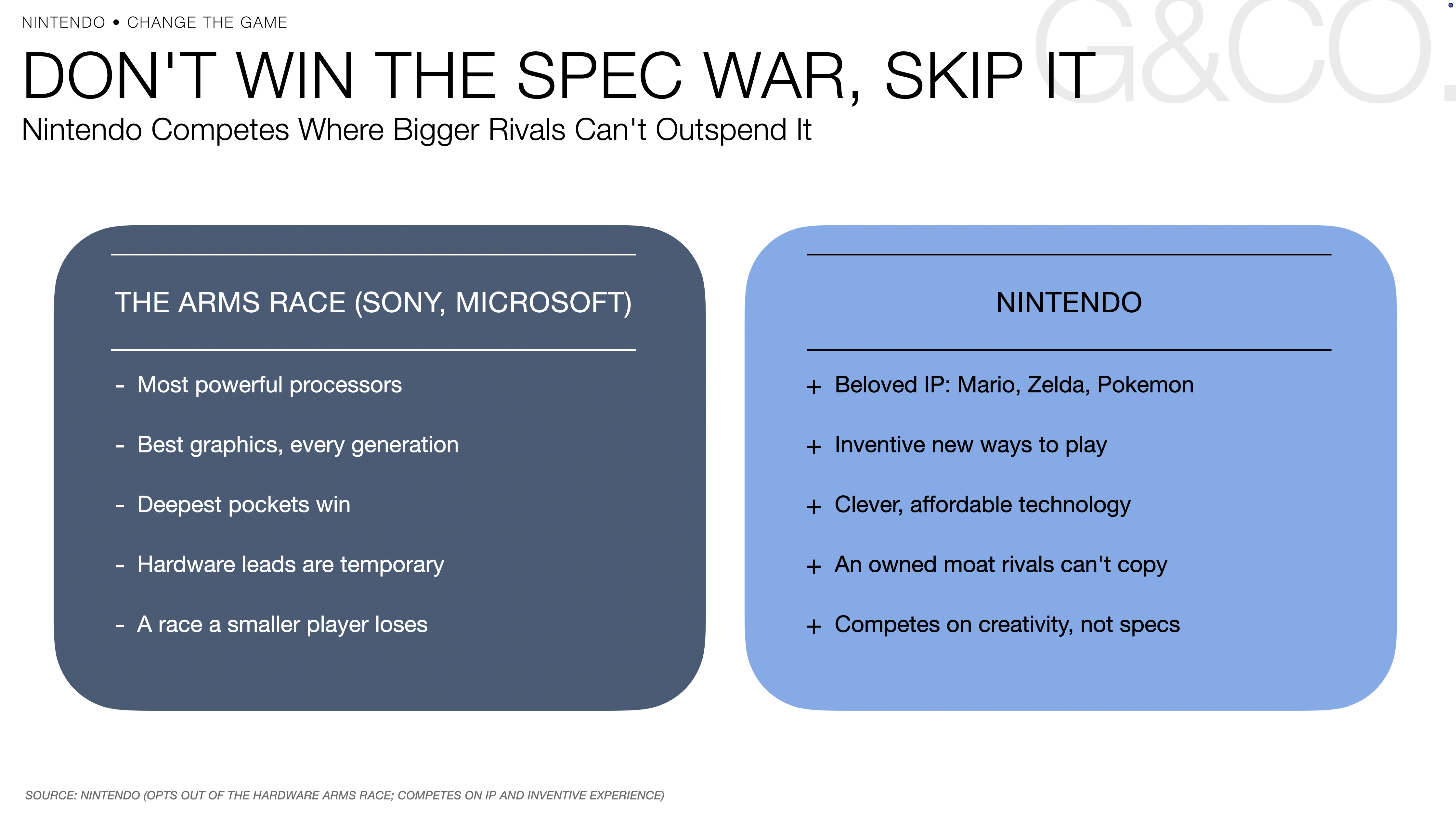
In the video game console business, the obvious way to compete is on power: faster processors, better graphics, more horsepower, each generation leapfrogging the last. Sony and Microsoft play that game with enormous resources, and for a company Nintendo's size to go head-to-head on specifications would be a losing battle. So Nintendo largely refuses to play it. Instead of fighting to build the most powerful machine, it competes on something its rivals cannot replicate: the most beloved characters in gaming and the most inventive ways to play them.
This case study looks at how Nintendo built a durable position by differentiating on IP and creativity rather than hardware, how it uses clever, affordable technology instead of chasing the most powerful chips, and how its franchises now generate value far beyond games. For enterprise leaders, the lesson reaches well beyond gaming. It is about the power of refusing to compete on the dimension where bigger rivals win, and choosing one where you cannot be copied.
Key Points
- Nintendo refuses to compete on raw hardware power. Against Sony and Microsoft, which win the specs-and-graphics arms race, Nintendo deliberately opts out and competes on a different dimension entirely.
- Its moat is irreplaceable IP. Mario, Zelda, Pokemon, and a stable of beloved, decades-old franchises are something no rival can copy, the heart of its brand differentiation.
- It wins on inventive experiences, not specs. From the Wii's motion controls to the Switch's hybrid design, Nintendo competes through novel ways to play, product innovation in form and experience rather than horsepower.
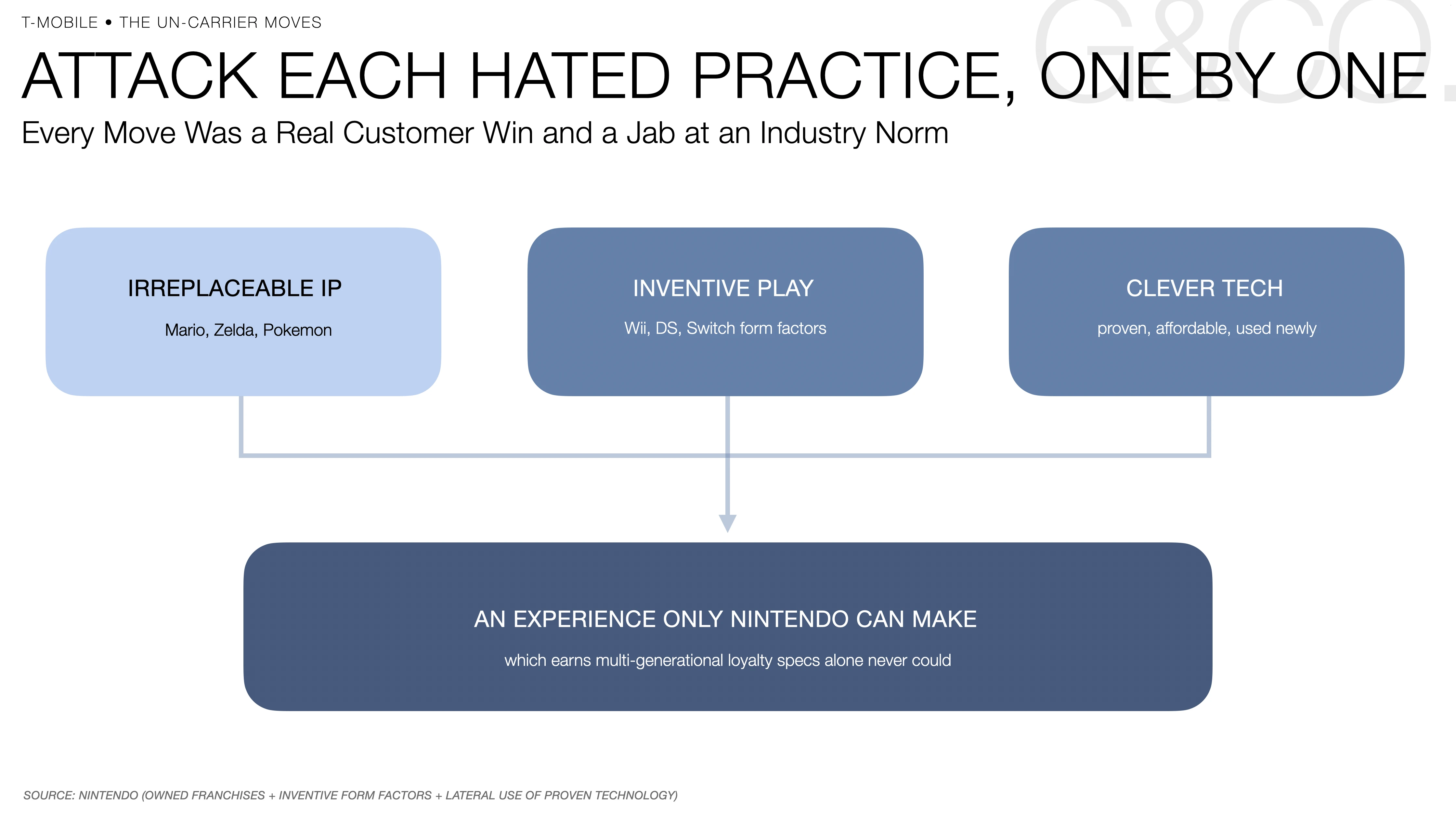
- It uses cheaper, proven technology in new ways. Rather than chase the most powerful chips, Nintendo combines affordable, reliable tech in inventive ways, a disciplined innovation strategy that protects margins and sidesteps the spec race.
- The IP now compounds far beyond games. A hit Mario movie and Nintendo theme parks turn the franchises into a Disney-like engine, monetizing the IP across films, parks, and merchandise.
Why This Matters
For CEOs, chief product officers, and strategy leaders, Nintendo is one of the clearest examples of winning by changing the terms of competition rather than trying to win on the terms set by bigger rivals. The instinctive move in a hardware category is to match and beat competitors on performance, but against larger, deeper-pocketed opponents that is a war of attrition a smaller player usually loses. Nintendo's refusal to fight that war, and its choice to compete instead on creativity and owned franchises that cannot be copied, is a textbook demonstration of differentiation as competitive strategy.
The relevance is broad. In many industries, companies exhaust themselves competing on the same dimension, price, speed, specifications, where scale decides the winner, when the more durable move is to compete on something rivals cannot easily match. Nintendo shows what that looks like sustained over decades: an owned, beloved portfolio of IP and a willingness to innovate on experience rather than raw capability. For any leader tempted to fight a larger competitor on its strongest ground, Nintendo is the case for finding different ground.






Let’s kickstart the conversation and design stuff people will love.

The Retail & Consumer Index


Strategic Context
The console industry has a default competitive logic: each generation, win on hardware. More powerful processors, better graphics, and bigger technical specifications are the terms on which consoles are usually compared, and companies pour enormous resources into leading on them. For Sony and Microsoft, with deep pockets and adjacent businesses to support the fight, that arms race is sustainable. For Nintendo, trying to out-spec them generation after generation would mean competing on exactly the dimension where its larger rivals are strongest, a fight it could not reliably win.
Nintendo's strategic insight was that power was not the only axis of competition, and arguably not the most important one. What makes people love and keep playing is not raw specifications but the quality of the experience and the characters they are attached to, and those are things Nintendo could own and rivals could not copy. The strategic choice at the heart of this case is that Nintendo opted out of the hardware arms race and chose to compete on differentiation instead, on irreplaceable franchises, inventive new forms of play, and clever rather than powerful technology, deliberately competing where it was strong and its rivals could not simply outspend it.
Company Response
Own irreplaceable IP.
Nintendo's deepest advantage is its stable of beloved, decades-old franchises, Mario, Zelda, Pokemon, Donkey Kong, Animal Crossing, and more, characters that generations have grown up with and that exist nowhere else. A competitor can build a more powerful console, but it cannot build Mario; the IP is a moat that money and engineering cannot cross. This owned, emotionally resonant catalog is the foundation of Nintendo's brand differentiation, giving people a reason to choose Nintendo that has nothing to do with technical specifications and everything to do with what, and who, they can play.
Innovate on experience, not horsepower.
Rather than chase the most powerful hardware, Nintendo competes by inventing new ways to play. The Wii introduced motion controls and drew in people who had never considered themselves gamers, expanding the market rather than fighting for the existing one; the DS pioneered a dual-screen, touch-based handheld; and the Switch created a hybrid that is both a home console and a portable one. None of these won on raw power, and that was the point: they offered experiences the more powerful machines did not, which is product innovation in form and interaction rather than specifications. Nintendo also embraces a philosophy of using proven, affordable technology in inventive combinations, an innovation strategy that keeps costs and risk down while still delivering something new, and avoids a spec race it would lose.
Turn the IP into an engine beyond games.
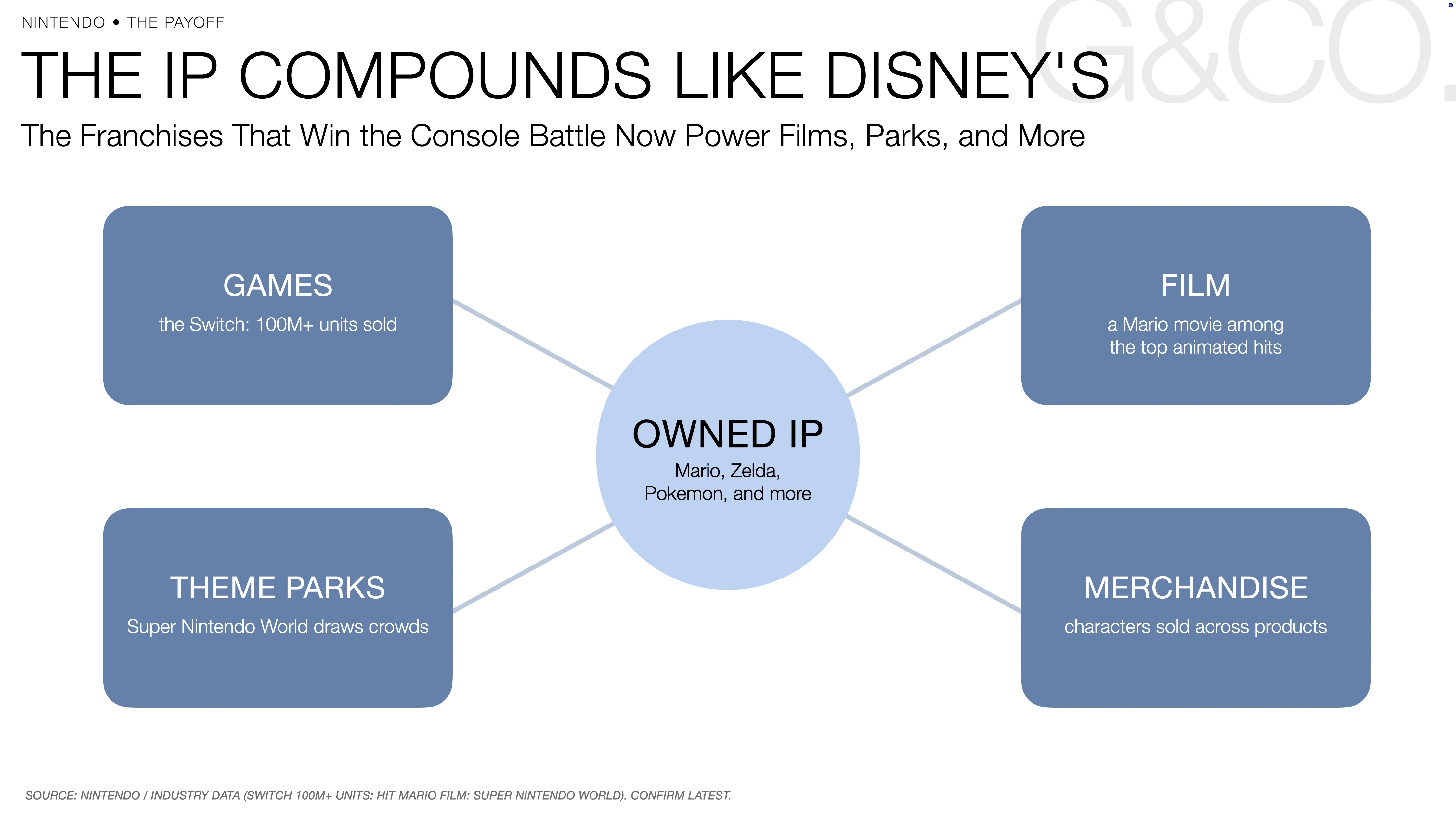
Increasingly, Nintendo is doing what Disney did with its characters: extending its IP across formats. A hugely successful Mario movie and the Super Nintendo World theme parks turn the franchises into experiences far beyond the console, generating revenue and deepening attachment to the characters in ways that reinforce the games. This expansion compounds the value of the IP, because each film, park, and piece of merchandise strengthens the emotional bond that makes the games, and the differentiation, so durable. The characters that win the console battle also become a media and experiences business in their own right.
The approach carries real tension. Opting out of the hardware race means Nintendo sometimes trails on technical capability, which can matter for certain games and players, and it must keep inventing genuinely new experiences, since a form-factor idea that does not land (as some have not) can cost a generation. Its fortunes are tied closely to its own creativity and to protecting its IP fiercely. But that reliance on creativity and owned franchises is exactly the moat: rivals can match or exceed Nintendo on hardware, but they cannot copy its characters or manufacture the inventive magic that defines its best products.
Always-On Customer Intelligence
Turn your own customer data into foresight — validate, simulate, and sense every major decision before you commit.


Results and Evidence
The evidence is in the sustained success of a strategy that, by conventional console logic, should not work. The Switch, far from the most powerful machine of its generation, became one of the best-selling consoles of all time, selling well over a hundred million units on the strength of its hybrid design and Nintendo's games rather than its specifications, direct proof that differentiation on experience and IP beats competing on raw power. Nintendo remains highly profitable, with enormous cash reserves, because its owned IP gives it pricing power and loyalty that do not depend on winning the specs race. And the expansion beyond games is working: the Mario movie was among the highest-grossing animated films, and the theme parks draw large crowds, showing the IP compounds across formats the way Disney's does. These figures come from Nintendo's public reporting and industry data and are worth confirming against the latest results before publishing, since this names a real company and the numbers update each year and move with console cycles.
Strategic Implications
Read at scale, Nintendo is a case about competing on differentiation rather than on a rival's strongest dimension, and it connects to the broader principles of competitive strategy, product innovation, and owning defensible IP. The pattern is repeatable well beyond gaming: when a larger competitor dominates a particular axis, specifications, price, scale, a smaller player can often win not by fighting there but by competing on a different dimension it can own, creativity, experience, or irreplaceable intellectual property. The Nintendo strategy was not to build a more powerful console than Sony and Microsoft; it changed what the competition was about, to something it could win.
The deeper implication is the durability of an advantage built on what cannot be copied. Hardware advantages are temporary and expensive to defend; owned IP and a culture of inventive experience design are far harder for a competitor to replicate, and they compound, each beloved franchise and each successful new form of play deepening the moat and, increasingly, spinning off value in films, parks, and merchandise. For enterprise leaders, the takeaway is to resist the instinct to fight bigger rivals on their strongest ground, and instead to identify the dimension where you can build an advantage competitors cannot match, and to invest in assets, like IP and distinctive experience, that appreciate and compound rather than depreciate. The company that changes the terms of competition to ones it can own does not have to be the biggest to win.
What Enterprise Leaders Can Learn
- Don't fight bigger rivals on their strongest dimension.
Competing on specs, price, or scale against a larger opponent is a war of attrition. Change the axis of competition to one you can win. - Build advantage on what can't be copied.
Nintendo's IP is a moat no amount of engineering can cross. Owned, beloved assets outlast hardware or feature advantages that rivals can match. - Innovate on experience, not just capability.
The Wii and Switch won on new ways to play, not raw power. Differentiation through experience can beat differentiation through specifications. - Use clever technology, not just powerful technology.
Combining proven, affordable tech in inventive ways protects margins and reduces risk while still delivering something genuinely new. - Make owned IP compound across formats.
Nintendo's characters now power films and theme parks. Assets that appreciate and extend into new businesses build a far more durable advantage than one-off products.
Conclusion
Nintendo's story is not really about consoles. It is about the power of refusing to compete on someone else's terms. In an industry that measures itself in processing power and graphics, where larger rivals have every advantage, Nintendo chose not to fight the arms race and instead to compete on what it alone possesses: the most beloved characters in gaming and an unmatched instinct for inventive play. It wins with Mario and Zelda, not teraflops; with hybrid consoles and motion controls, not the most powerful chips; and increasingly it turns those characters into films and theme parks that compound the value of the IP far beyond the console. The result is a company that does not have to be the biggest or the most powerful to be one of the most successful and durable in its field. For enterprise leaders, the transferable lesson is that the smartest competitive move is often not to win the game everyone is playing, but to change the game to one you can win, and to build your advantage on the things competitors cannot copy.
Through the Acumen platform, G&CO. gives enterprise brands the intelligence to compete on their own terms: where a larger rival dominates and fighting there is a losing battle, which dimension you could own instead, and how to build advantage on assets, like IP and distinctive experience, that competitors cannot copy and that compound over time. G&CO. is a certified minority business enterprise through the National Minority Supplier Development Council (NMSDC). For enterprise organizations with diversity inclusion requirements in their procurement process, G&CO. meets the criteria for MBE-qualified partner status.
G&CO. works with enterprise brands on the differentiation, product, and competitive strategy that lets a company win by changing the terms of competition rather than out-spending a larger rival. If this Nintendo case study raises questions about your own brand differentiation, competitive strategy, or product innovation, submit an inquiry to G&CO. on our contact page or click the blue "Click to Contact Us" button in the bottom right corner of your screen. We look forward to hearing from you.
Frequently Asked Questions
What is Nintendo's brand differentiation strategy?
Nintendo's differentiation strategy is to refuse to compete on raw hardware power and to win instead on things rivals cannot copy: beloved, owned franchises like Mario, Zelda, and Pokemon, and inventive new ways to play. Against Sony and Microsoft, which battle on processors and graphics, Nintendo deliberately competes on a different dimension, creativity, experience, and irreplaceable IP, where its larger rivals cannot simply outspend it. That is the essence of its differentiation: people choose Nintendo for its characters and the experiences only it offers, not for technical specifications, which makes the advantage durable and hard to attack.
Why doesn't Nintendo compete on hardware power?
Because trying to out-spec Sony and Microsoft would mean fighting on exactly the dimension where those larger, deeper-pocketed rivals are strongest, a war of attrition Nintendo could not reliably win. Its strategic insight is that raw power is not what makes people love and keep playing games; the experience and the characters are. So rather than chase the most powerful chips each generation, Nintendo competes on inventive play and owned IP, and often uses cheaper, proven technology in clever ways. This keeps its costs and risk down and sidesteps a spec race it would lose, while competing where it is genuinely strong.
What makes Nintendo's IP such a powerful moat?
Nintendo owns a stable of beloved, decades-old franchises, Mario, Zelda, Pokemon, and many more, that generations have grown up with and that exist nowhere else. A competitor can build a more powerful console, but it cannot build Mario. That owned, emotionally resonant catalog gives people a reason to choose Nintendo that has nothing to do with specifications and everything to do with who and what they can play, and it is something money and engineering cannot replicate. Increasingly, the IP also compounds across formats, into films and theme parks, deepening the attachment and extending the moat well beyond games.
How does Nintendo innovate if not on hardware power?
Through product innovation in form and experience rather than horsepower. Nintendo invents new ways to play: the Wii's motion controls brought in people who had never considered themselves gamers; the DS pioneered dual-screen, touch-based handheld play; and the Switch created a hybrid that works as both a home console and a portable one. None won on raw power, and that was the point, each offered an experience the more powerful machines did not. Nintendo also embraces using proven, affordable technology in inventive combinations, an innovation strategy that delivers something genuinely new while keeping cost and risk low.
What can enterprise leaders learn from the Nintendo case study?
The central lesson is to compete on differentiation rather than on a larger rival's strongest dimension. Nintendo's repeatable principles: do not fight a bigger competitor on specs, price, or scale where it will win, change the axis of competition to one you can own; build advantage on assets that cannot be copied, like beloved IP, rather than on hardware or features rivals can match; innovate on experience, not just capability; use clever technology rather than only powerful technology; and make owned IP compound by extending it across formats. The broader principle is that you do not have to be the biggest to win, if you change the game to one you can win and build your advantage on what competitors cannot replicate.