IKEA Case Study: Engineering Low Prices Into the Supply Chain
This IKEA case study examines how a furniture retailer made low price a permanent, engineered advantage rather than a promotion. IKEA designs products to be cheap to make and ship, flat-packs them to slash transport cost, integrates and controls much of its supply chain, and runs giant self-service stores that are both a cost lever and a distinctive experience. Together, design, the supply chain, and the store form a single cost-leadership system rivals cannot easily copy. The IKEA case study also looks at the hard part now: translating a model built for big stores and flat-pack self-service into e-commerce and city-center formats without losing the supply chain strategy that made it cheap.
IKEA built an unbeatable cost advantage by designing furniture to be cheap to make and ship, flat-packing it, and running its supply chain and stores as one system, so it sells well-designed furniture at prices rivals cannot match.
Most retailers get to a low price at the end, through discounts, promotions, and squeezing suppliers on an already-finished product. IKEA does the opposite: it builds the low price in at the very beginning, designing each product, and the entire system that makes, ships, and sells it, around cost from the start. The result is not a sale price but a structurally lower cost base, which is why IKEA has sold well-designed furniture more cheaply than almost anyone for decades, and made money doing it.
This case study looks at how IKEA engineered cost out of every stage, design, supply chain, and store, to build durable cost leadership, and at the hard challenge it faces now in translating that physical-world model to digital. For enterprise leaders, the lesson reaches well beyond furniture. It is about building a cost advantage into an integrated system rather than chasing it with discounts, and about how hard it is to reinvent a cost model when the world changes around it.
Key Points
- IKEA engineers low cost into the product before it is ever made. Through its "democratic design" approach, it designs furniture to be cheap to produce and ship, so affordability is built in, not discounted later.
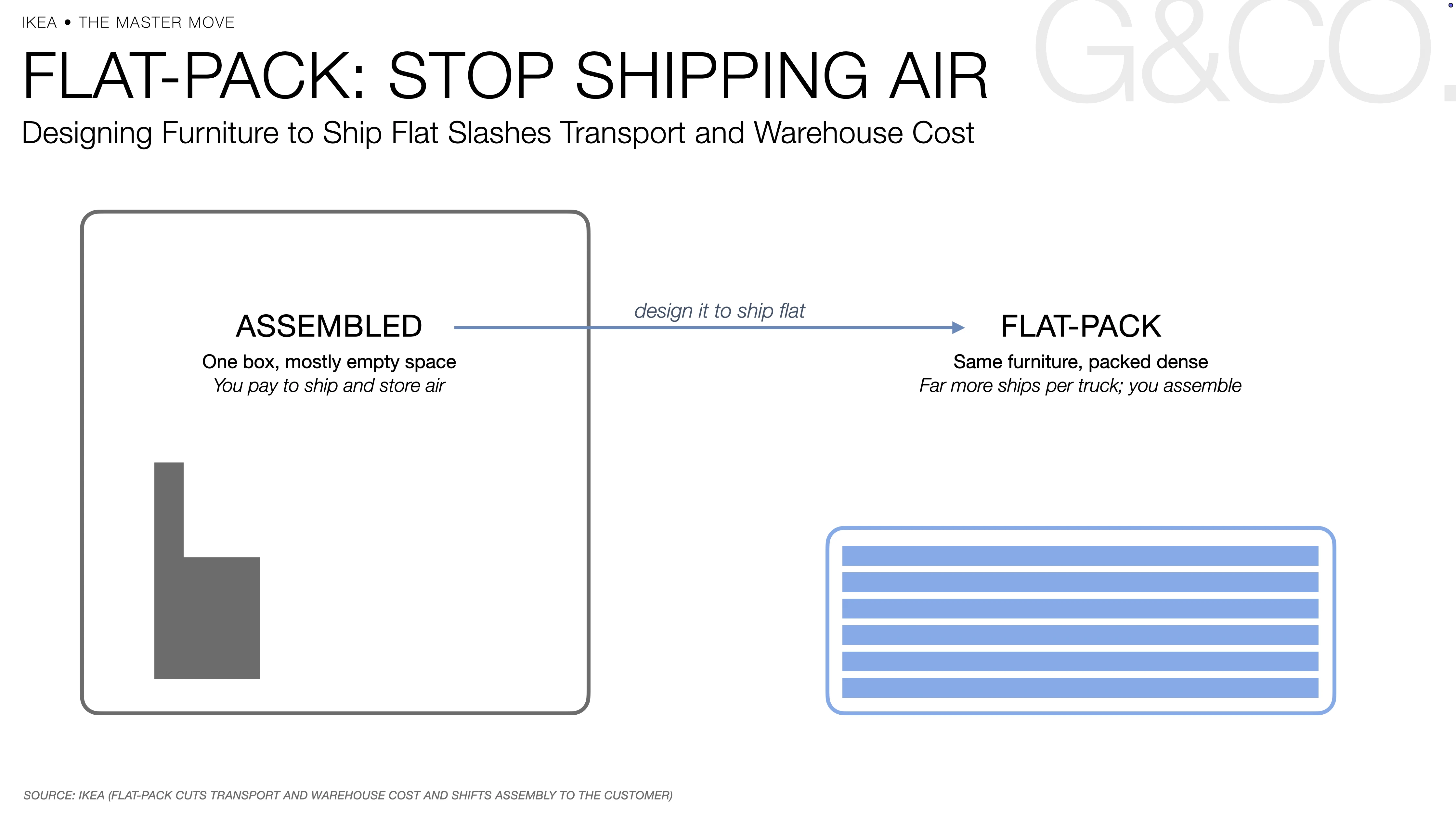
- Flat-pack is the master move. Shipping furniture disassembled slashes transport and warehouse costs and shifts assembly to the customer, the single biggest lever in its cost leadership and supply chain strategy.
- Vertical integration and scale lock in the advantage. Long-term supplier relationships, enormous volume, and control over much of its supply chain let IKEA drive cost optimization at every step, something rivals cannot easily copy.
- The store is both a cost lever and the experience. Giant self-service warehouses with showroom layouts keep staff and handling costs low while creating a distinctive experiential retail visit, operational efficiency and experience at once.
- The challenge now is digital. The flat-pack, drive-to-a-warehouse model that made IKEA cheap is hard to translate online, so IKEA is investing heavily in e-commerce, city-center formats, and delivery without losing its cost edge.
Why This Matters
For CEOs, COOs, and supply chain and retail leaders, IKEA is one of the clearest examples of cost leadership built as a system rather than won through discounting. Many companies try to be the low-price option by cutting margins or pressuring suppliers on finished products, a fragile advantage that competitors can match. IKEA instead engineered a structurally lower cost base into design, logistics, and the store experience, an advantage that compounds and is genuinely hard to copy. That distinction, between a low price you discount to and a low cost you build in, is one of the most durable sources of competitive advantage there is.
The timing adds a second lesson. IKEA's cost model was optimized for a particular world: large out-of-town stores, customers with cars and time, and flat-packs they carry home and assemble. As shopping moves online and into cities, that model is under pressure, and IKEA must adapt without surrendering the cost advantage that defines it. For any leader whose efficient, legacy operating model now has to work in a digital, omnichannel world, IKEA shows both the power of an engineered cost system and the difficulty of reinventing one.






Let’s kickstart the conversation and design stuff people will love.

The Retail & Consumer Index


Strategic Context
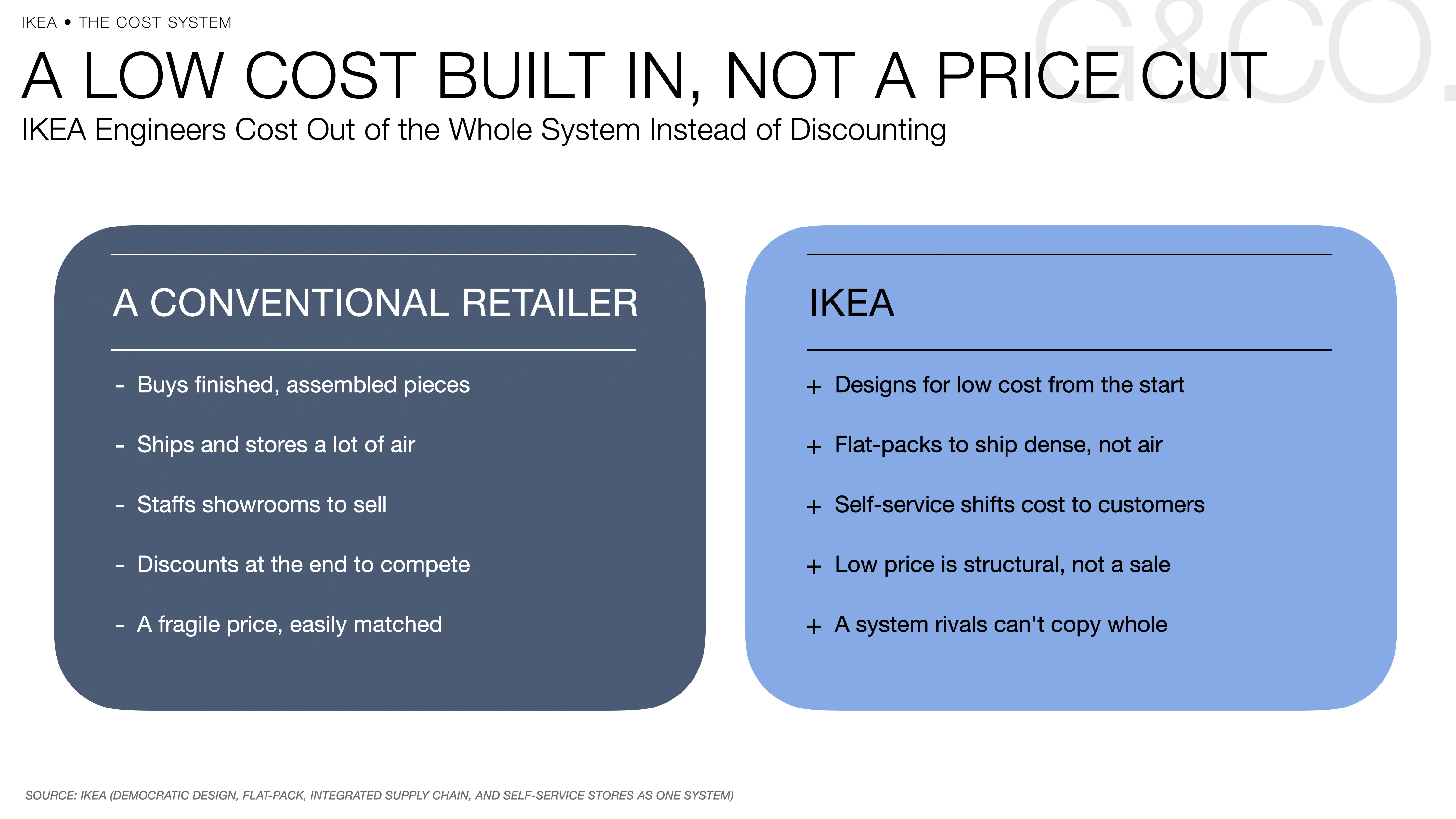
Furniture is bulky, heavy, and expensive to ship and store, which makes it an unusually hard category to sell cheaply. A conventional furniture retailer buys finished pieces, ships and warehouses them fully assembled (paying to move a great deal of air), staffs showrooms to sell them, and arranges delivery, with cost piling up at every stage. Competing on price in that structure means squeezing margins on a cost base you did not design, which is a losing game over time.
IKEA's founding insight was that price is determined long before the point of sale, in how a product is designed, made, shipped, and sold, and that the way to be reliably cheap was to engineer cost out of the entire system rather than discount at the end. If a product could be designed to use less material, ship flat, and be assembled by the customer, and if the supply chain and store were built around that same logic, the low price would be structural and defensible. The strategic choice at the heart of this case is that IKEA treated cost leadership as a design and systems problem spanning the whole value chain, not a pricing decision, and built an integrated model, democratic design, flat-pack, an integrated supply chain, and self-service stores, in which every part lowers cost and reinforces the others.
Company Response
Design for cost from the start.
IKEA's "democratic design" principle holds that a product must deliver form, function, and quality at a low price, and cost is a design constraint from the first sketch, not an afterthought. Designers work to use less material, to fit products into efficient flat packages, and to build them from materials and processes IKEA can source cheaply at scale. Because the low price is designed in, IKEA does not have to discount to reach it; the affordability is structural. This is the foundation on which the rest of the cost system is built.
Flat-pack and integrate the supply chain.
The signature move is flat-pack: shipping furniture disassembled, in flat boxes, rather than bulky and built. This dramatically cuts the cost of transport and warehousing (you are no longer paying to ship and store empty space), enables dense, efficient logistics, and shifts final assembly to the customer, removing labor cost. Around it, IKEA built a deeply integrated supply chain strategy, enormous purchasing scale, long-term relationships with suppliers, and control or influence over much of production and materials, through vertical integration, that lets it drive cost optimization relentlessly at every step. The flat-pack lowers cost directly; the integrated supply chain compounds the saving across hundreds of millions of items.
Make the store a cost lever and an experience.
IKEA's large, out-of-town stores are designed to be efficient as well as memorable. Customers walk a showroom laid out as inspiring room sets, then collect their flat-packed purchases themselves from a self-service warehouse, which keeps staffing and handling costs low while giving the visit a distinctive, immersive quality, the famous layout, the displays, the food. This experiential retail is not a contradiction of the cost model; it is part of it, because self-service shifts cost out of the store while the experience drives volume. Low cost and a strong experience are engineered to coexist.
The approach carries real tension, and it is most acute now. The entire system was optimized for a specific context, big stores, car-owning customers, and flat-packs carried home, and that context is shifting. E-commerce makes shipping bulky furniture to the door expensive and undoes some of the flat-pack advantage; urban customers without cars cannot easily visit a vast suburban store or haul a wardrobe home; and online shopping bypasses the in-store experience that drives so much of IKEA's sales. IKEA is responding with smaller city-center stores, heavy investment in e-commerce and delivery, and digital tools, but reinventing a cost model built for one era to work in another is genuinely hard, and it is the central challenge of the company's next chapter.
Always-On Customer Intelligence
Turn your own customer data into foresight — validate, simulate, and sense every major decision before you commit.


Results and Evidence
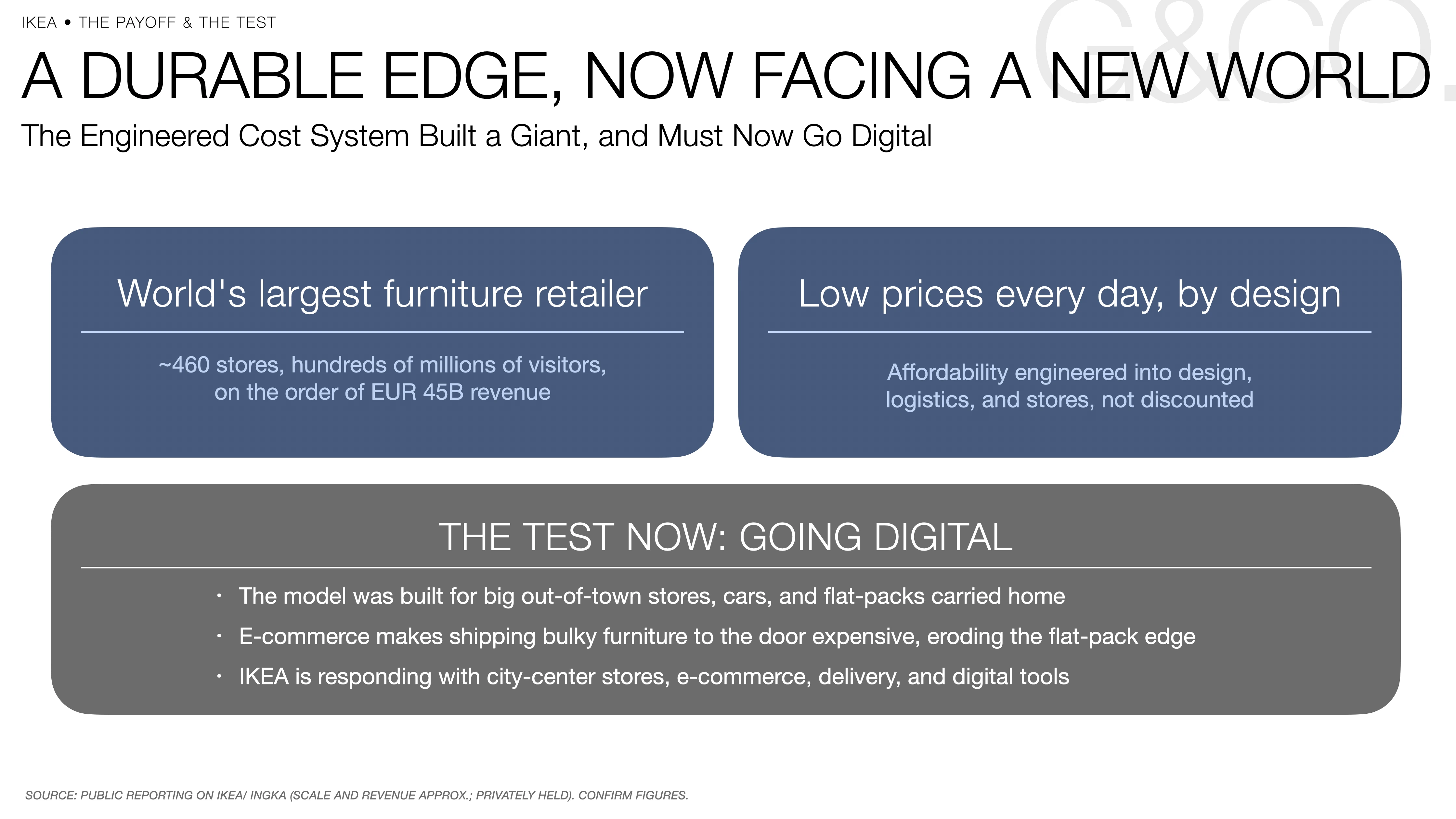
The evidence is in the scale and the durability of the cost advantage. IKEA is the world's largest furniture retailer, selling to hundreds of millions of customers a year across roughly 460 stores and generating on the order of EUR 45 billion in annual revenue, a position built not on being the cheapest through discounts but on having the lowest structural cost, which is why it has sustained affordability and profitability for decades where discount-driven rivals could not. The clearest proof that the advantage is systemic rather than promotional is that IKEA's prices are low every day, by design, not during sales, which is only possible because the cost is engineered out of design, logistics, and the store rather than sacrificed from margin. The live evidence to watch is the digital transition: IKEA's growing e-commerce share, its smaller urban formats, and its investment in delivery and digital tools are the test of whether the engineered cost system can be carried into an online, omnichannel world. These figures come from public reporting on IKEA and its main franchise group, and because IKEA's ownership and structure are complex and privately held, specific figures should be confirmed against the latest available sources before publishing.
Strategic Implications
Read at scale, IKEA is a case about building cost leadership into an integrated system, and about the challenge of reinventing an efficient legacy model for a new era, connecting to the broader questions of supply chain strategy, operational efficiency, and omnichannel retail. The pattern is repeatable well beyond furniture: durable low cost comes not from discounting or squeezing suppliers but from engineering cost out of the entire value chain, design, production, logistics, and the point of sale, so that each stage lowers cost and reinforces the others. IKEA did not win on price by charging less for the same thing; it won by building a different, lower-cost system end to end.
The deeper implication is twofold. First, an integrated cost advantage is powerful precisely because it is a system: competitors can copy a flat-pack box or a low price, but not the whole interlocking model of design, supply chain, and store at once, which is what makes it durable. Second, that same integration is what makes reinvention hard, because the cost advantage is woven into a physical model, shifting to digital risks unpicking the very threads that made it cheap. For enterprise leaders, the takeaway is to pursue cost advantage as a whole-system design problem rather than a pricing tactic, and to recognize that the more tightly optimized a model is for one world, the harder and more deliberate the work of adapting it to the next. The companies with the most durable cost advantages are the ones that engineered them into the system, and the ones that endure are those that can re-engineer that system when the world moves.
What Enterprise Leaders Can Learn
- Build low cost in; don't discount to it.
A price you reach by cutting margin is fragile. A cost you engineer into design, logistics, and operations is structural and far harder to copy. - Treat cost as a whole-system design problem.
IKEA's advantage spans design, supply chain, and store, each reinforcing the others. Cost leadership is strongest when it is integrated, not a single trick. - Shift cost to where it is cheapest, even to the customer.
Flat-pack and self-service move transport, handling, and assembly cost out of IKEA's system; look for where cost can be removed or relocated. - An experience and low cost can be engineered to coexist.
IKEA's self-service store is both a cost lever and a draw. Design the experience so it lowers cost and drives volume at once. - The tighter the optimization, the harder the reinvention.
A model perfectly tuned for one era resists change; adapting an engineered cost system to a digital world takes deliberate, careful re-engineering.
Conclusion
IKEA's story is not really about furniture. It is about the difference between a low price you discount to and a low cost you build in. By treating cost as a design problem across the whole value chain, designing products to be cheap to make and ship, flat-packing them to cut logistics cost, integrating the supply chain to squeeze cost at every step, and using self-service stores as both a cost lever and an experience, IKEA engineered a structurally lower cost base that let it sell well-designed furniture affordably, and profitably, for decades. That integrated system is its real moat, far more durable than any single price. The next chapter is the hard one: carrying a cost model built for big stores and flat-pack self-service into an online, urban, omnichannel world without losing the advantage. For enterprise leaders, the transferable lesson is to engineer cost advantage into the system rather than chase it with discounts, and to understand that the most finely tuned models are the hardest to reinvent, which is exactly why doing so is the test of a great company.
Through the Acumen platform, G&CO. gives enterprise brands the intelligence to build and defend cost advantage as a system: where cost is engineered in versus discounted away, how design, supply chain, and the point of sale reinforce one another, and how to carry an efficient operating model into a digital, omnichannel world. G&CO. is a certified minority business enterprise through the National Minority Supplier Development Council (NMSDC). For enterprise organizations with diversity inclusion requirements in their procurement process, G&CO. meets the criteria for MBE-qualified partner status.
G&CO. works with enterprise brands on the operations, architecture, and omnichannel strategy that turns low-cost advantage into a durable, digital-ready system. If this IKEA case study raises questions about your own supply chain strategy, low-cost advantage, or omnichannel reinvention, submit an inquiry to G&CO. on our contact page or click the blue "Click to Contact Us" button in the bottom right corner of your screen. We look forward to hearing from you.
Frequently Asked Questions
What is IKEA's supply chain strategy?
IKEA's supply-chain model is to engineer cost out of the entire system rather than discount at the end. It designs products to use less material and to ship flat, flat-packs them to cut transport and warehousing cost, and builds a deeply integrated supply chain, enormous purchasing scale, long-term supplier relationships, and control over much of production and materials, to drive cost down at every step. The store then shifts further cost to the customer through self-service. Because the low price is built into design, logistics, and operations, it is structural and durable, not a promotion, which is the core of IKEA's low-cost advantage.
Why is flat-pack so important to IKEA's cost advantage?
Flat-pack is the single biggest lever. Furniture is bulky and expensive to ship and store, and shipping it fully assembled means paying to move and warehouse a great deal of empty space. By shipping furniture disassembled in flat boxes, IKEA dramatically cuts transport and warehousing costs, enables dense and efficient logistics, and shifts the labor of final assembly to the customer. That one design decision, made possible by designing products to flat-pack in the first place, lowers cost directly and is amplified across hundreds of millions of items, which is why it sits at the center of IKEA's supply-chain model and low-cost advantage.
How does experiential retail fit with IKEA's low-cost model?
They are designed to work together rather than against each other. IKEA's large stores guide customers through showroom-style room sets and then have them collect their flat-packed purchases from a self-service warehouse. The self-service keeps staffing and handling costs low, a cost lever, while the immersive layout, displays, and food create a distinctive, memorable visit that drives volume. So the experiential retail is part of the cost system, not a contradiction of it: it shifts cost out of the store while making the trip worth taking, which is why IKEA can offer both low prices and a strong in-store experience.
What is IKEA's biggest challenge now?
Digital. IKEA's cost model was optimized for a specific world, large out-of-town stores, customers with cars, and flat-packs carried home and assembled, and that world is shifting. E-commerce makes shipping bulky furniture to the door expensive and erodes part of the flat-pack advantage; urban customers without cars cannot easily visit a vast suburban store; and online shopping bypasses the in-store experience that drives sales. IKEA is responding with smaller city-center stores, heavy investment in e-commerce and delivery, and digital tools, but carrying a finely tuned physical cost model into an omnichannel world without losing the cost advantage is genuinely hard, and it is its central challenge.
What can enterprise leaders learn from the IKEA case study?
The central lesson is to build cost advantage into an integrated system rather than chase it with discounts. IKEA's repeatable principles: design cost in from the start; treat cost as a whole-system problem spanning design, supply chain, and the store; shift cost to where it is cheapest, even to the customer, as flat-pack and self-service do; and engineer the experience so it lowers cost and drives volume at once. The second lesson is a warning: the more tightly a model is optimized for one era, the harder it is to reinvent for the next, so leaders should pursue durable, systemic cost advantage while building the capacity to re-engineer it as the world changes, exactly the test IKEA faces in going digital.