Patagonia Case Study: When Brand Purpose Is Real, and Costly
This Patagonia case study examines a brand purpose so real it works as strategy. Patagonia does not treat environmentalism as a marketing layer; it lets the mission genuinely shape decisions, even costly ones, telling customers to buy less, repairing and reselling old gear, and ultimately giving the company away so its profits fund the planet. That authenticity is precisely what builds a premium brand and ferocious loyalty, because a sustainability strategy backed by real sacrifice cannot be faked. The Patagonia case study shows that purpose, ethical branding, and corporate social responsibility become a durable advantage only when they are genuine and costly, not when they are a slogan.
Patagonia built its brand on a genuine environmental purpose, backed by costly actions, telling customers to buy less, repairing old gear, and giving the company to a climate trust, so the mission is believed and the loyalty is fierce.
Almost every company now claims a purpose. Mission statements invoke sustainability, responsibility, and doing good, and most of it is marketing, a veneer over business as usual that customers have learned to distrust. Patagonia is the rare case where the purpose is not a veneer but the foundation, where the company repeatedly does things that cost it money in the short term because its mission requires them, and where that willingness to pay the price is exactly what makes the brand so powerful.
This case study looks at how Patagonia made environmental purpose the actual core of its business, how it proved that purpose with genuinely costly actions, and why that authenticity built a premium brand with loyalty most companies can only envy. For enterprise leaders, the lesson reaches well beyond outdoor gear. It is about the difference between purpose as a slogan and purpose as a strategy, and why only the real, costly version creates lasting advantage.
Key Points
- Patagonia made environmental purpose the core of the business, not a marketing layer. Its mission, famously framed as being in business to save the planet, genuinely drives decisions, even against short-term sales.
- It proves the purpose with costly actions, which is why it is believed. The "Don't Buy This Jacket" campaign, the Worn Wear repair-and-resale program, 1% of sales to environmental causes, and sustainable materials are ethical branding backed by real cost, not claims.
- The ultimate proof: the founder gave the company away. In 2022 ownership passed to a trust and a nonprofit, so profits, around $100 million a year, fund environmental causes. "Earth is now our only shareholder."
- Genuine purpose builds a premium brand and fierce loyalty. Because the sustainability strategy is real rather than greenwashing, customers pay more and stay devoted, turning values into durable brand equity.
- The lesson: purpose works as strategy only when it is real and costly. Acting against short-term interest is what makes the purpose credible, and credibility is the advantage competitors cannot fake.
Why This Matters
For CEOs, CMOs, and brand leaders, Patagonia is the definitive example of purpose done right, and a standing rebuke to the far more common version done wrong. In an era when nearly every company professes values and most consumers assume those professions are hollow, Patagonia proves that purpose can be a genuine source of competitive advantage, but only when it is real enough to cost something. That distinction, between purpose as marketing and purpose as strategy, is one of the most important and most misunderstood in modern branding.
The relevance is growing. Consumers, especially younger ones, increasingly want the brands they buy to stand for something, and they are increasingly skilled at detecting when a brand does not mean it. Conscious consumerism rewards authenticity and punishes greenwashing, which raises the stakes on getting purpose right. Patagonia shows what authentic, costly purpose looks like and what it earns in return. For any leader tempted to bolt a mission statement onto an unchanged business, Patagonia is both the model and the warning.






Let’s kickstart the conversation and design stuff people will love.

The Retail & Consumer Index


Strategic Context
Most corporate purpose fails for a simple reason: it is not real. A company adopts a cause, markets it, and changes little about how it actually operates, and customers, who are not fooled, treat the claim as the marketing it is. This greenwashing is not just ineffective; it can be actively damaging, because it invites the accusation of hypocrisy and deepens the distrust it was meant to overcome. The result is that "purpose" has become one of the least credible words in business.
Patagonia's founding conviction was the opposite: that the company existed to serve an environmental mission, and that the business was a means to that end rather than the reverse. From that conviction follows a willingness to make decisions that a purely commercial logic would reject, because the mission, not the quarter, is the point. The strategic insight at the heart of this case is that this willingness to act against short-term commercial interest is not a cost to be minimized but the very thing that makes the purpose believable, and a believable purpose is a brand asset no amount of advertising can buy. Patagonia did not market its way to credibility; it earned it by paying for it.
Company Response
Let the mission override the sales motive.
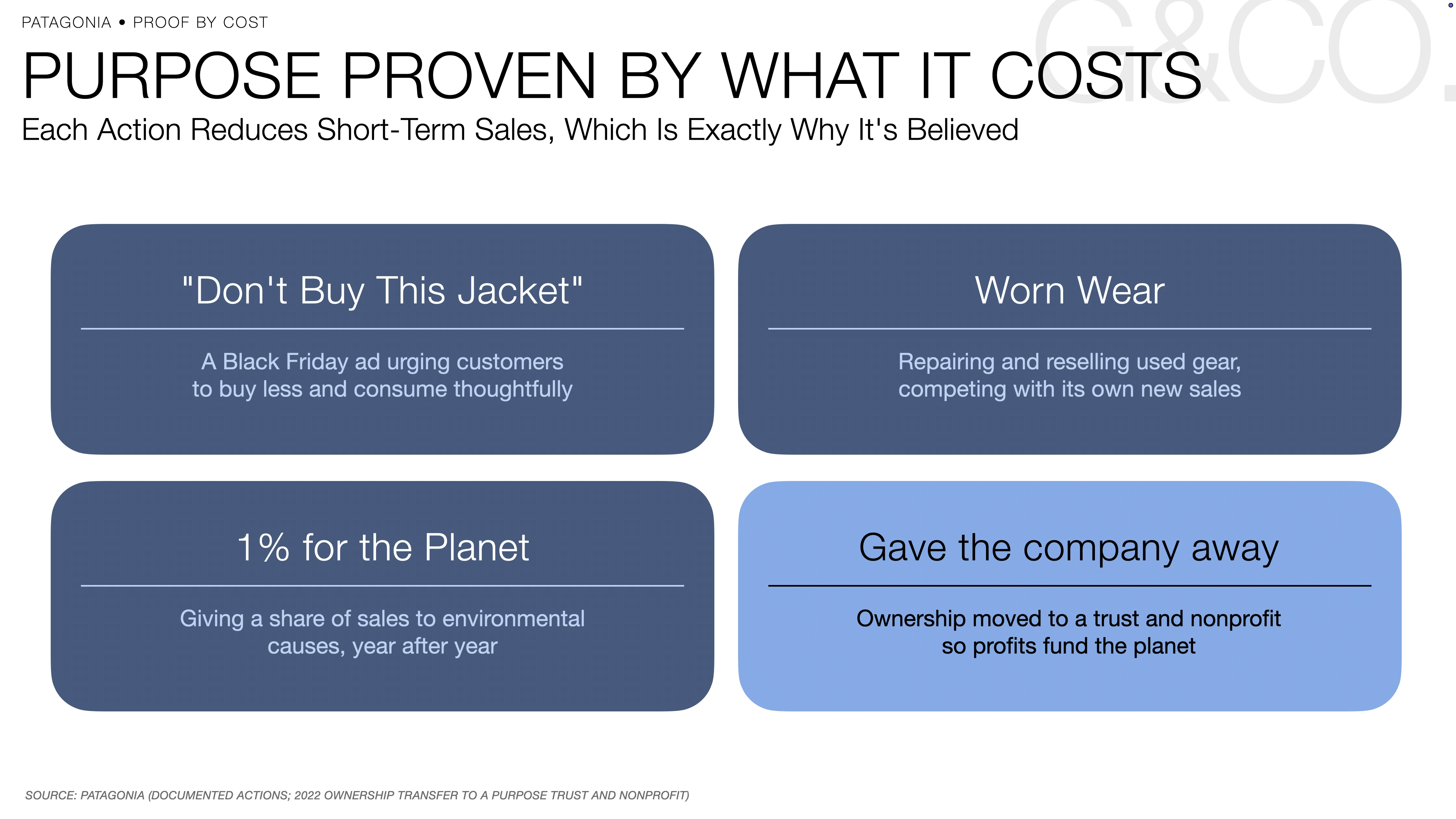
Patagonia repeatedly does things that reduce its own short-term sales because the mission demands it. The most famous example ran a full-page advertisement on the biggest shopping day of the year telling customers not to buy its jacket, to buy less, repair what they own, and consume more thoughtfully. This is conscious consumerism turned into brand strategy: by genuinely urging restraint, Patagonia demonstrated that its environmentalism was real, and that proof made customers trust and admire it more, not less. A company willing to tell you to buy less, and mean it, earns a credibility that no ordinary campaign can.
Build the values into products and operations.
The purpose is not only in messaging; it is in how Patagonia makes and services what it sells. It pioneered a circular economy approach with Worn Wear, repairing garments and reselling used ones so products last longer and fewer are made, offers a strong repair guarantee, uses organic and recycled materials, and pursues fair-labor and transparent supply chains, the substance behind its ethical branding and corporate social responsibility. Because the values show up in the product and the operations, not just the advertising, the claim is backed by evidence a skeptical customer can verify, which is what separates real purpose from a campaign.
Prove it at the ownership level.
The ultimate demonstration came in 2022, when founder Yvon Chouinard transferred ownership of the company so that its profits, roughly $100 million a year, would fund the fight against climate change, declaring that "Earth is now our only shareholder." This is as costly and credible a proof of purpose as a company can offer: it restructured who owns the business and who benefits from its profits around the mission. No competitor can match that with marketing, because it is not marketing, it is the company's purpose made structural and permanent.
The approach carries real tension. A company that tells customers to consume less, while still selling products, lives with an inherent paradox it must navigate honestly. The costly choices genuinely reduce certain revenues and constrain growth in ways a conventional competitor would not accept. And the standard Patagonia sets for itself is unforgiving, any gap between its words and its actions would be seized on, so it must keep living up to a very high bar. But that difficulty is the moat: the purpose is valuable precisely because it is hard and costly, which is why rivals cannot simply copy it.

Always-On Customer Intelligence
Turn your own customer data into foresight — validate, simulate, and sense every major decision before you commit.


Results and Evidence
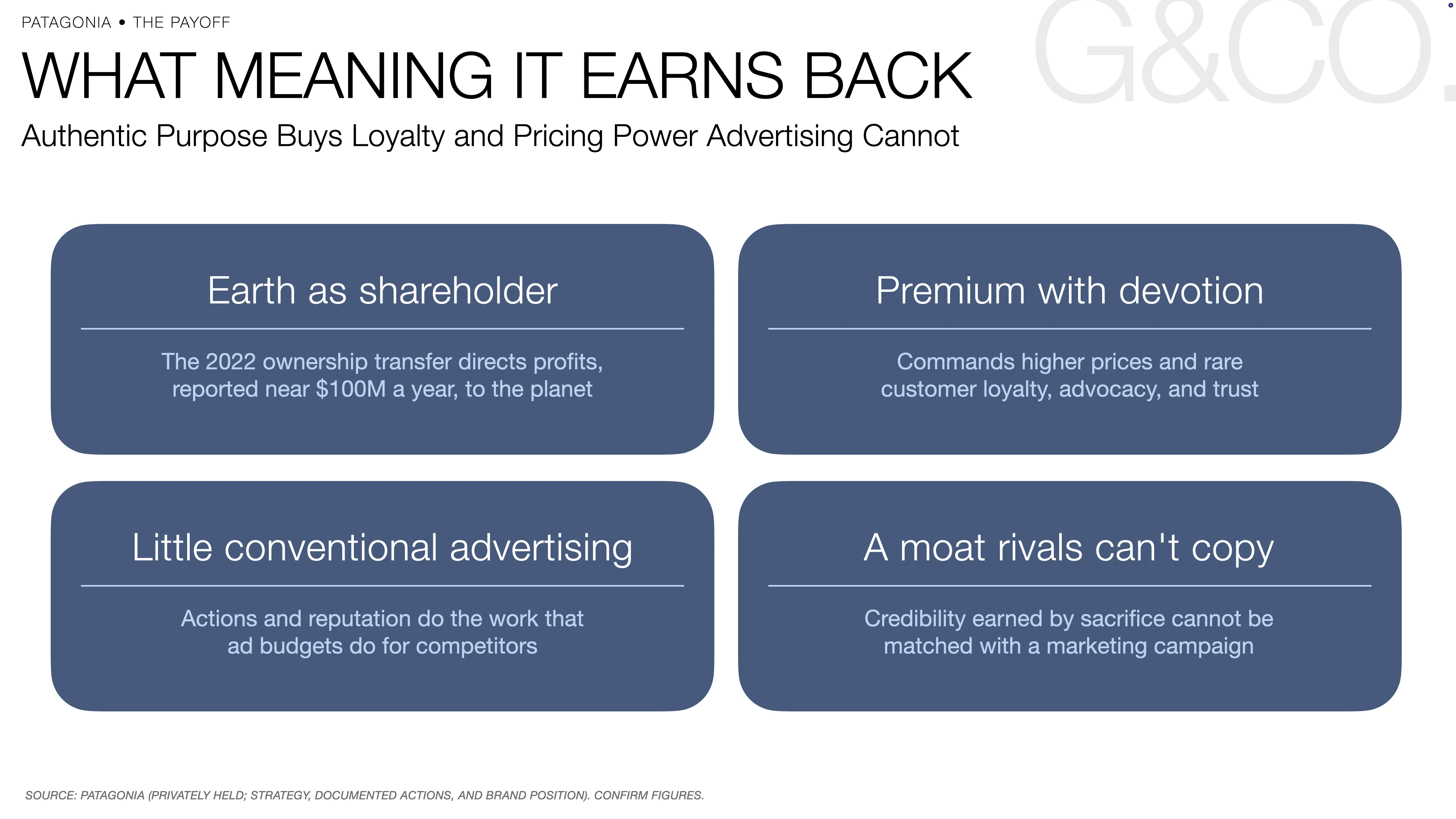
The evidence is in the brand strength, the loyalty, and the credibility that costly action bought. Patagonia commands premium prices and inspires a level of customer devotion, advocacy, and trust that few brands in any category achieve, and it does so with comparatively little conventional advertising, because its actions and reputation do the work. The clearest proof that the purpose is real, and the reason it is so credible, is the pattern of self-sacrificing choices: telling customers to buy less, building a resale and repair business that competes with its own new sales, and finally giving the company away so its profits fund environmental causes. Those are not the moves of a brand performing purpose for marketing; they are the moves of a company whose purpose is genuine, and customers reward that authenticity with exactly the loyalty and pricing power that greenwashing can never earn. As a privately held company, Patagonia does not disclose detailed financials, so these points describe its strategy, brand position, and documented actions rather than audited results, and specific figures should be confirmed against the latest available sources before publishing.
Strategic Implications
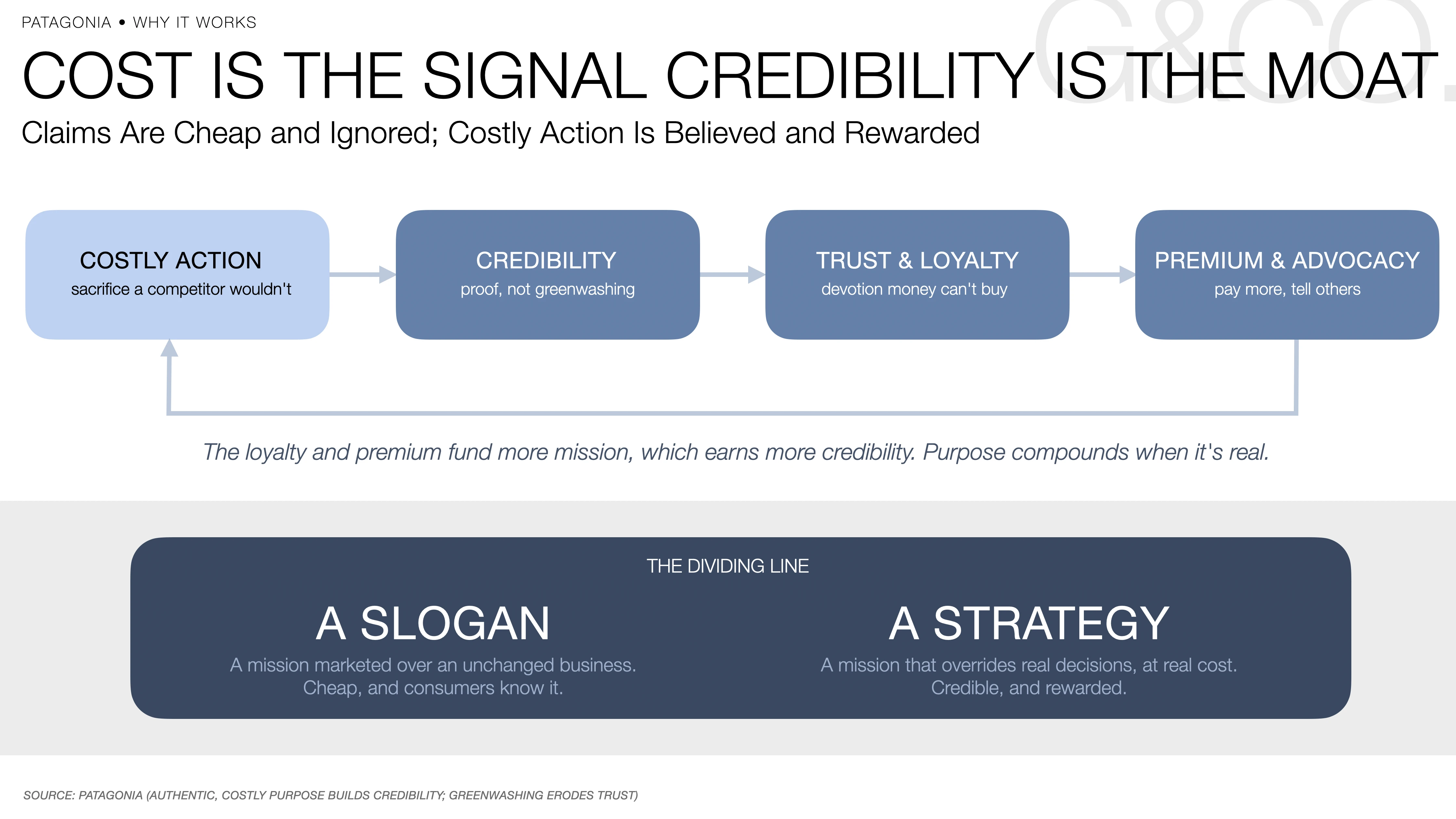
Read at scale, Patagonia is a case about authentic, costly purpose as a durable brand advantage, and it connects to the broader shifts in brand purpose, sustainability strategy, conscious consumerism, and the collapse of trust in greenwashing. The pattern is repeatable, but only under a hard condition: purpose builds brand equity and loyalty when it is genuine enough to cost something, and backfires when it is a slogan over an unchanged business. Patagonia's advantage is not that it has a mission, every competitor claims one, but that it demonstrably sacrifices for it, and that sacrifice is the proof customers cannot get anywhere else.
The deeper implication is the asymmetry between claiming purpose and proving it. Claims are cheap and therefore worthless as signals; costly, verifiable actions are expensive and therefore credible, and credibility is what converts stated values into loyalty and pricing power. For enterprise leaders, the takeaway is uncomfortable but clear: a purpose worth having has to change how the company actually behaves, sometimes against its own short-term interest, or it is worse than having none, because consumers now punish the gap between words and actions. The question is not whether to have a purpose, but whether you are willing to pay for one, because only the purpose you pay for earns the advantage Patagonia has.
What Enterprise Leaders Can Learn
- Purpose only works if it is real and costly.
A mission that never constrains a commercial decision is marketing, and consumers know it. Authentic purpose shows up in choices that cost something. - Prove values in products and operations, not just ads.
Patagonia's repair, resale, and materials make its claims verifiable. Build the purpose into what you make and how, so skeptics can check it. - Credibility is earned by sacrifice, not asserted.
Acting against short-term interest, like urging customers to buy less, is what makes a purpose believable. The cost is the signal. - Authentic purpose compounds into pricing power and loyalty.
When the values are real, customers pay more and stay devoted, advantages conventional advertising cannot buy. - A hollow purpose is worse than none.
The gap between a professed mission and actual behavior invites accusations of hypocrisy and deepens distrust. Do not claim a purpose you are not willing to pay for.
Conclusion
Patagonia's story is not really about jackets. It is about the difference between having a purpose and meaning it. In a market saturated with mission statements, Patagonia stands apart not because it claims to care about the environment, everyone claims something, but because it repeatedly acts against its own short-term interest in service of that mission: telling customers to buy less, building a business that keeps its products out of landfills and off the new-sales ledger, and finally handing the entire company to the cause. Those costly, verifiable choices are what make the purpose believable, and a believable purpose is a brand asset no competitor can replicate with advertising, because it was never advertising in the first place. For enterprise leaders, the transferable lesson is that purpose becomes strategy only when it is willing to pay a price, and that the credibility earned by that price, not the mission statement, is the real advantage. The companies that mean it win a loyalty the ones that merely say it never will.
Through the Acumen platform, G&CO. gives enterprise brands the intelligence to make purpose real rather than performative: whether your stated values actually show up in how you operate, where customers see a gap between what you say and what you do, and how authentic, costly commitment could build loyalty and pricing power that marketing cannot. G&CO. is a certified minority business enterprise through the National Minority Supplier Development Council (NMSDC). For enterprise organizations with diversity inclusion requirements in their procurement process, G&CO. meets the criteria for MBE-qualified partner status.
G&CO. works with enterprise brands on the brand and purpose strategy that turns genuine values into durable loyalty and advantage, and helps avoid the greenwashing trap. If this Patagonia case study raises questions about your own brand purpose, sustainability strategy, or ethical branding, submit an inquiry to G&CO. on our contact page or click the blue "Click to Contact Us" button in the bottom right corner of your screen. We look forward to hearing from you.
Frequently Asked Questions
What is Patagonia's brand purpose, and why does it work?
Patagonia's brand purpose is environmental: it frames itself as being in business to help save the planet, and it treats the business as a means to that mission rather than the other way around. It works because the purpose is genuine and costly. Patagonia repeatedly makes decisions that reduce its own short-term sales, urging customers to buy less, reselling and repairing used gear, and ultimately giving the company away, because the mission demands them. That willingness to sacrifice is exactly what makes the purpose believable, and a believable purpose builds trust, loyalty, and pricing power that marketing alone never could.
What was the "Don't Buy This Jacket" campaign?
It was a Patagonia advertisement, run on one of the biggest shopping days of the year, that told customers not to buy the jacket, to buy less, repair what they owned, and consume more thoughtfully. On its face it was a company discouraging its own sales, which is why it became so powerful: it proved that Patagonia's environmentalism and commitment to conscious consumerism were real, not a marketing pose. Rather than hurting the brand, the campaign deepened customers' trust and admiration, demonstrating the core lesson of this case, that acting against short-term interest is what makes a purpose credible.
How does the circular economy fit into Patagonia's strategy?
Patagonia built circular-economy practices into its business through Worn Wear, a program to repair garments and resell used ones so products last longer and fewer new ones are made, supported by a strong repair guarantee and the use of organic and recycled materials. This matters because it puts the values into the product and operations, not just the advertising: a resale-and-repair business literally competes with Patagonia's own new-product sales, which is a costly, verifiable proof of its environmental commitment. The circular-economy approach is part of what makes Patagonia's sustainability strategy credible rather than cosmetic.
Why did Patagonia's founder give the company away?
In 2022, founder Yvon Chouinard transferred ownership of Patagonia so that its profits, reported to be around $100 million a year, would go to fighting climate change, summed up in the line "Earth is now our only shareholder." He did it as the ultimate expression of the company's purpose: rather than sell the company or take it public, he restructured ownership so the business permanently serves the environmental mission. It is the most credible proof of purpose a company can offer, because it is structural and irreversible, not a campaign, and no competitor can replicate it with marketing.
What can enterprise leaders learn from the Patagonia case study?
The central lesson is that purpose becomes a real strategic advantage only when it is genuine and costly, and is worse than useless when it is a slogan. Patagonia's repeatable principles: let the mission actually override some commercial decisions, build the values into products and operations so they are verifiable, earn credibility through visible sacrifice rather than claims, and recognize that authentic purpose compounds into loyalty and pricing power. The warning is just as important: in an age of conscious consumerism, a hollow purpose invites charges of hypocrisy and deepens distrust. Leaders should ask not whether to have a purpose, but whether they are willing to pay for one.