Maersk Case Study: Escaping the Commodity Trap With Integrated Logistics
This Maersk case study examines how the world's best-known shipping company is trying to escape the commodity trap of ocean freight by becoming an integrated logistics provider. Instead of selling container shipping by the box, a volatile, commoditized business, Maersk aims to manage a customer's entire supply chain end to end: ocean, ports, trucking, air, and warehousing, tied together by supply chain digitization and real-time visibility. By assembling the pieces and connecting them with logistics technology, Maersk is turning a cyclical freight business into a stickier, higher-value partnership. The Maersk case study shows how a company in a brutally cyclical commodity industry can move up the value chain.
Maersk is turning itself from a container shipping line into an integrated logistics company that manages a customer's entire supply chain, ocean, port, land, air, and warehouse, through one connected, digital service.
Container shipping is one of the most important businesses in the world and one of the hardest to make money in consistently. Freight rates swing violently with global demand, a container is a container no matter whose ship carries it, and customers choose largely on price. It is the definition of a commodity business: essential, enormous, and brutally cyclical. Maersk, long one of the giants of that business, decided it did not want to be only a shipping line anymore.
This case study looks at how Maersk is repositioning itself from an ocean carrier into an end-to-end, digitally integrated logistics company, one that manages a customer's whole supply chain rather than just the sea leg, and why that shift is an attempt to escape the commodity trap. For enterprise leaders, the lesson reaches well beyond shipping. It is about how a company stuck selling a volatile commodity moves up the value chain by integrating and digitizing the entire customer journey.
Key Points
- Maersk is moving from container shipping to integrated logistics. Instead of selling only ocean freight, it aims to manage a customer's entire supply chain end to end, ocean, ports, trucking, air, and warehousing.
- The reason is escaping a brutal commodity cycle: Ocean shipping is commoditized and violently cyclical; end-to-end logistics is stickier, higher-value, and less exposed to swings in freight rates.
- Digitization is what ties it together. Supply chain digitization, real-time visibility, instant online booking, and data across every leg, lets Maersk sell one connected service rather than disconnected shipping.
- It assembled the pieces largely by acquisition. Maersk added ports, warehousing, inland trucking, and air freight to its ocean network, building end-to-end logistics technology under one roof.
- The payoff is a stickier customer and a steadier business. A customer who hands Maersk its whole supply chain is far harder to lose than one buying ocean freight by the box, on roughly $55 billion in annual revenue.
Why This Matters
For CEOs, COOs, and any leader whose business is stuck selling a commodity, Maersk is a clear, large-scale example of trying to climb out of that trap by integration. Competing on price for an undifferentiated product is a race almost no one wins for long; Maersk's response, to wrap the commodity in a broader, higher-value, harder-to-copy service, is one of the few durable ways out. Watching a company this big attempt that shift, with real successes and real difficulty, is instructive precisely because it is hard.
The timing matters. Supply chains have moved from a back-office afterthought to a boardroom priority, after years of disruption, shortages, and volatility exposed how fragile and opaque they were. Companies now want visibility and reliability across their whole supply chain, not just a cheap ocean rate, and they are willing to pay a partner who can provide it. Maersk is betting its future on being that partner. For any leader whose customers are moving from buying a product to wanting an outcome, Maersk shows the opportunity and the challenge.



.png)
%20(1).png)

Let’s kickstart the conversation and design stuff people will love.

The Retail & Consumer Index


Strategic Context
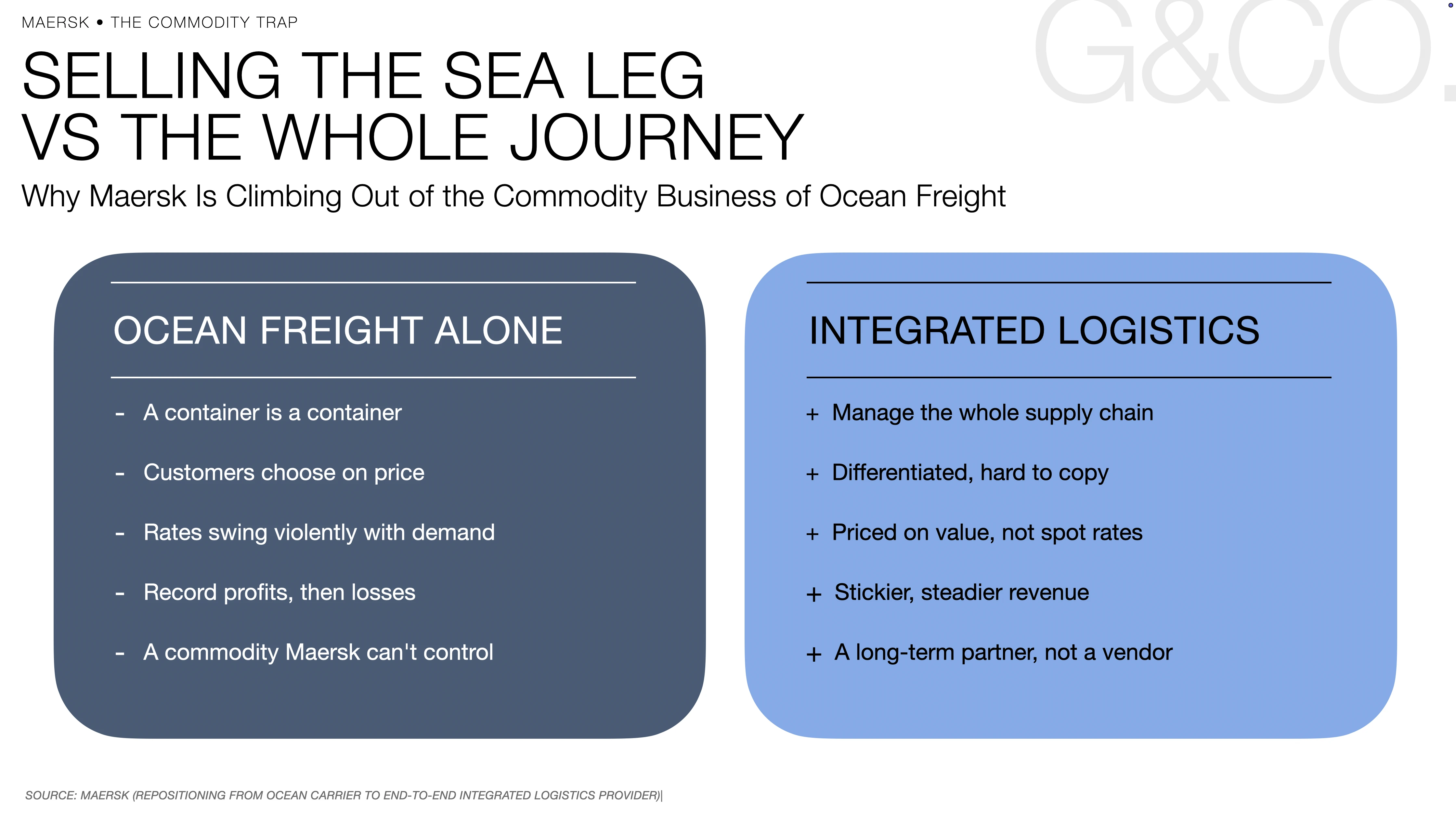
Ocean container shipping is a textbook commodity business. The service is essentially identical between carriers, capacity is expensive and slow to adjust, and when demand softens, rates collapse as carriers compete for cargo; when demand surges, rates spike. The result is wild cyclicality: shipping lines can earn record profits one year and heavy losses the next, with little control over the swing. For a company the size of Maersk, that volatility is a strategic problem, not just a financial one, because it makes the whole business hostage to forces it cannot manage.
Maersk's strategic insight was that while the sea leg is a commodity, the customer's actual need is not. What a company shipping goods really wants is for its products to move reliably and visibly from the factory to the final destination, across every mode and border, not just across the ocean. That end-to-end journey is complex, fragmented across many providers, and badly in need of coordination, which means it is valuable, differentiated, and much harder to commoditize. The strategic choice at the heart of this case is that Maersk decided to stop defining itself as an ocean carrier and start becoming the end-to-end logistics provider for the whole journey, moving up the value chain into the part of the business that is sticky and high-value rather than cyclical and commoditized.
Company Response
Assemble the whole chain.
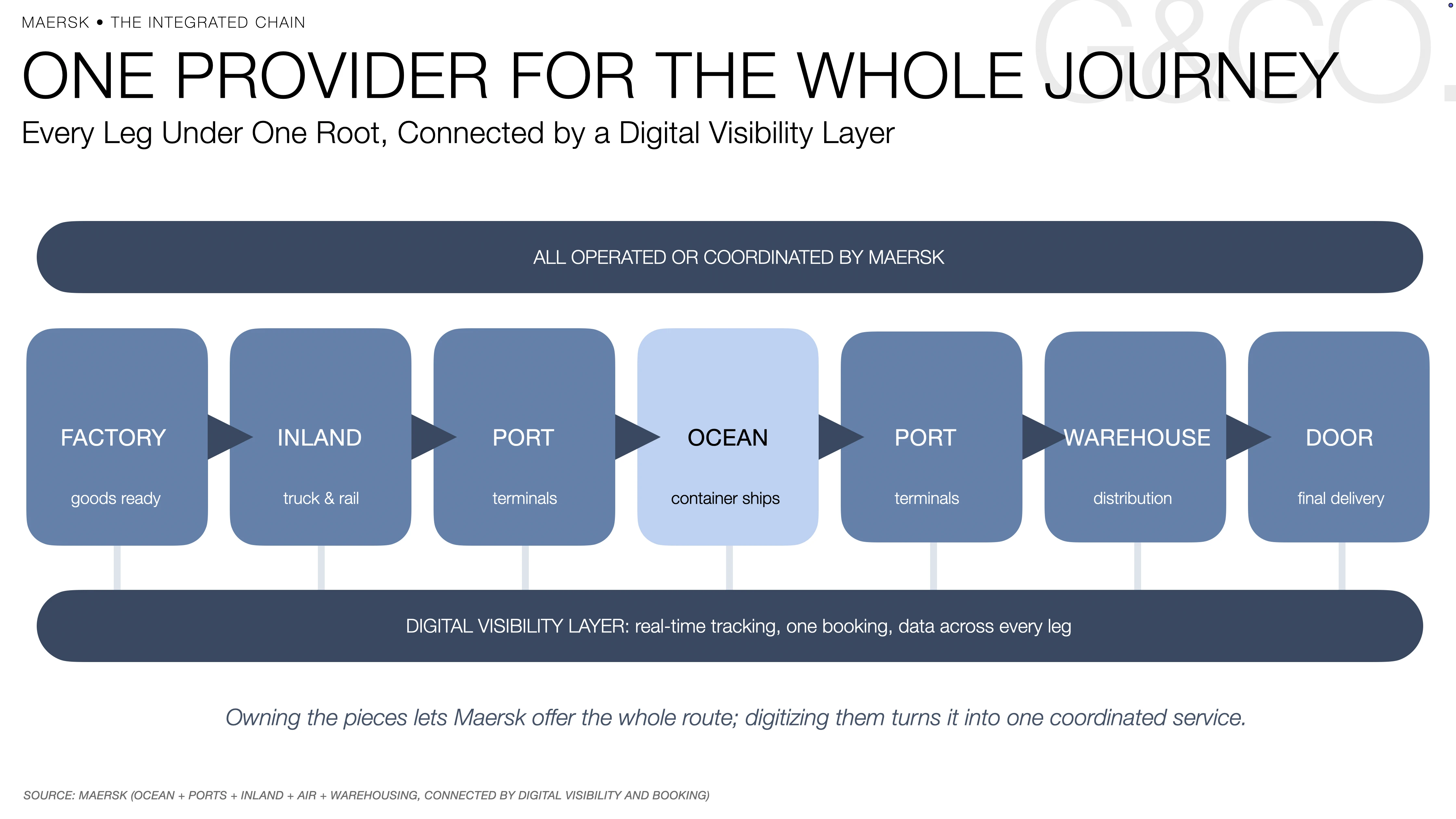
To manage a customer's end-to-end supply chain, Maersk had to own or operate all the pieces, not just ships. Building on its ocean network and its global ports business, it acquired and built capabilities in inland trucking and rail, warehousing and distribution, air freight, and customs handling, so that it could move a customer's goods across every leg of the journey. Much of this came through acquisition, deliberately turning a shipping line into a full logistics network. The point was to be able to offer one accountable provider for the entire route, rather than a sea leg the customer then has to stitch to a dozen other vendors.
Digitize and connect it.
Owning the pieces is not enough; the value comes from connecting them into one visible, coordinated service, and that requires supply chain digitization. Maersk invested in platforms for real-time tracking and visibility, instant online pricing and booking, and data that spans the whole journey, so a customer can see and manage their goods from factory to door in one place. This logistics technology is what turns a collection of ships, trucks, and warehouses into an integrated service, and it is what customers increasingly demand after years of supply-chain opacity and disruption. The digital layer is the difference between owning logistics assets and selling end-to-end logistics.
Reposition the business and the customer relationship.
Maersk has deliberately reframed what it sells, from ocean freight by the container to managing a customer's supply chain management needs as a long-term partner. This changes the relationship: instead of a transactional, price-driven booking that moves to whoever is cheapest next quarter, Maersk aims for an integrated, embedded relationship where it runs a meaningful part of the customer's operations. That is far stickier and less cyclical, because a customer who has handed over its whole logistics operation does not switch on a spot-rate difference. The repositioning is the whole point: to turn a commodity transaction into a durable partnership.
The approach carries real tension. Integration is expensive and complex; acquiring and knitting together ports, trucks, warehouses, and software is hard, and the ocean business still dominates revenue and still swings with the cycle. Some digital efforts have not worked out and have been wound down. And Maersk now competes not only with other shipping lines but with freight forwarders and logistics specialists. But the integrated, digitized relationship is exactly what a pure ocean carrier competing on price cannot easily replicate, and it is the part of the business least exposed to the commodity cycle.
Always-On Customer Intelligence
Turn your own customer data into foresight — validate, simulate, and sense every major decision before you commit.


Results and Evidence
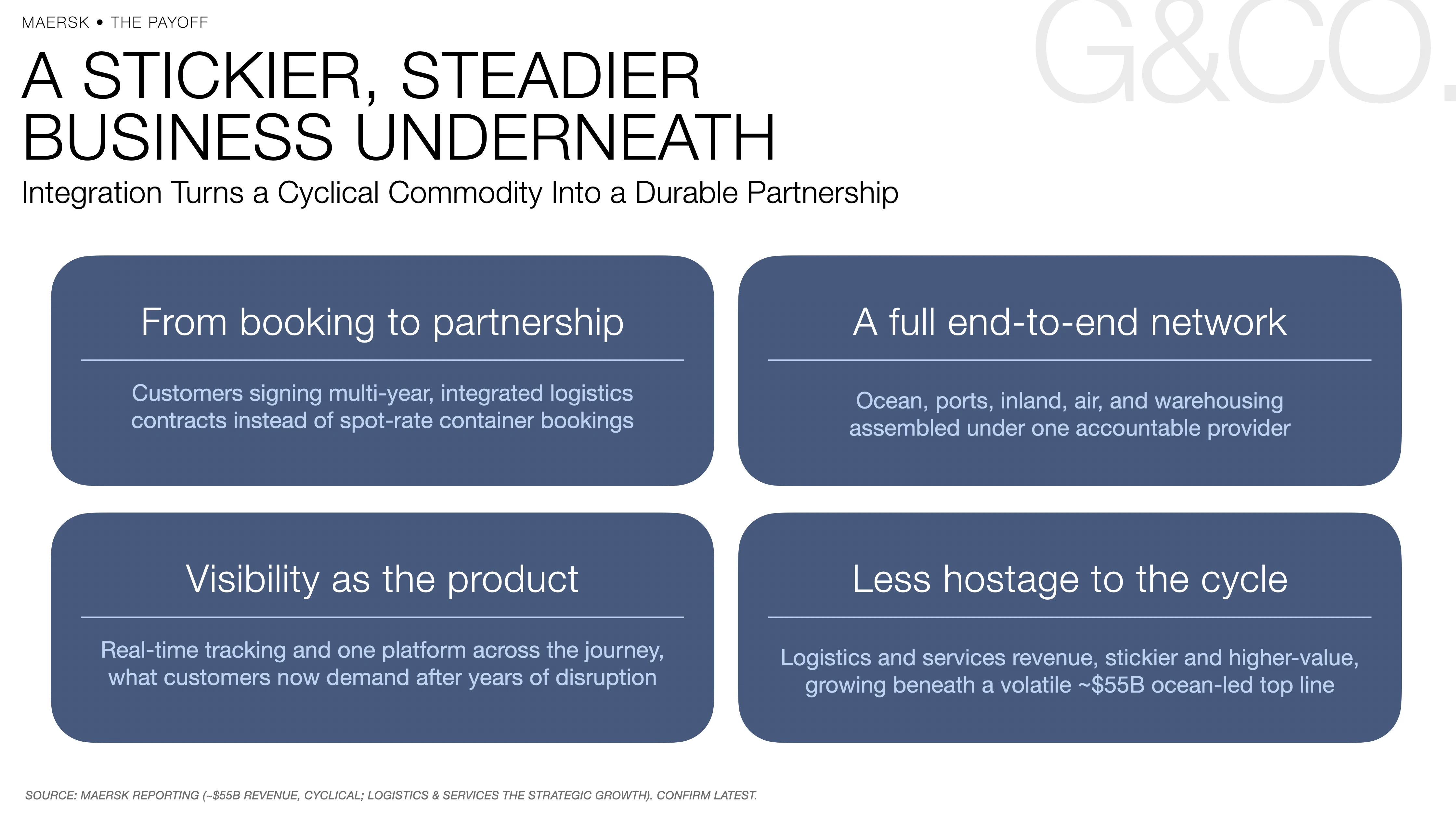
The evidence is in the repositioning and its logic, more than in any single year's numbers, because the numbers are precisely what Maersk is trying to make less volatile. Maersk has built a genuine end-to-end network, adding ports, warehousing, inland, and air capabilities to its ocean business so it can manage a customer's whole journey, and it has pushed its logistics and services revenue to a substantial and strategically central share of the company, the part it is deliberately growing because it is stickier and less cyclical than ocean freight. The clearest proof of the strategy is the nature of the customer relationship it is pursuing: large shippers signing up for integrated, multi-year logistics management rather than booking containers at the spot rate, which is a fundamentally more durable form of revenue. Maersk's total revenue, roughly $55 billion in a recent year, still swings with the freight cycle (it spiked dramatically during the pandemic-era rate boom and then fell back), which is exactly why the shift toward end-to-end logistics matters: the goal is a steadier, higher-value business underneath the volatile ocean line. These figures come from Maersk's public reporting and are worth confirming against the latest results before publishing, since this names a real company and the numbers move sharply with the shipping cycle.
Strategic Implications
Read at scale, Maersk is a case about escaping a commodity trap by integrating and digitizing up the value chain, and it connects to the broader shifts in supply chain management, digitization, and the move from selling products to selling outcomes. The pattern is repeatable well beyond shipping: a company stuck selling an undifferentiated commodity can move into the larger, more valuable, harder-to-copy job of coordinating the whole customer outcome around that commodity, and use digitization to tie the pieces into one service only it can provide. Maersk did not try to make ocean freight less of a commodity; it changed what it sells, from the sea leg to the whole journey.
The deeper implication is how integration and digitization reinforce each other into stickiness. Owning the pieces lets Maersk offer end-to-end service; digitizing them makes that service visible and coordinated; and together they turn a transactional, price-driven customer into an embedded, long-term partner who cannot easily leave. For enterprise leaders, the takeaway is to ask whether your business is trapped competing on price for a commodity, and whether the real opportunity is to integrate and digitize the broader outcome your customer actually needs, moving from selling a component to managing the whole. The companies that escape commodity cycles are usually the ones that stop selling the commodity and start selling the coordinated result.
What Enterprise Leaders Can Learn
- Escape a commodity by selling the whole outcome.
The sea leg is a commodity; the end-to-end journey is not. Move from selling a component to coordinating the result the customer actually needs. - Integration plus digitization is the moat.
Owning the pieces lets you offer end-to-end service; digitizing them makes it one coordinated product a price-only competitor cannot match. - Turn transactions into partnerships.
A customer who hands you their whole supply chain is far stickier than one buying by the unit. Reframe the relationship from a booking to a long-term partnership. - Visibility is now a product, not a nicety.
After years of disruption, customers will pay for a partner who can make the whole chain visible and reliable. Treat supply chain digitization as core value. - Expect the transition to be slow and costly.
Integration is expensive and the legacy commodity business still dominates for a while; the payoff is a steadier, higher-value business built underneath it over time.
Conclusion
Maersk's story is not really about ships. It is about how a company escapes a commodity trap. Faced with a shipping business that is essential but brutally cyclical and undifferentiated, Maersk chose not to keep fighting on price for the sea leg but to change what it sells, becoming the end-to-end logistics provider for the customer's entire journey, and tying ocean, port, land, air, and warehouse together with the digitization that makes it one coordinated, visible service. That shift turns a transactional commodity into a sticky, higher-value partnership, and it moves the company into the part of logistics least hostage to the freight cycle. For enterprise leaders, the transferable lesson is that the way out of a commodity business is rarely a better version of the commodity; it is to integrate and digitize the larger outcome the customer actually wants, and to become the one partner who can deliver the whole of it. The companies that climb out of commodity cycles are the ones that start selling the coordinated result, not the component.
Through the Acumen platform, G&CO. gives enterprise brands the intelligence to climb out of a commodity trap: where your customer's real outcome is bigger than the component you sell, where integration and digitization would create a service only you can offer, and how to turn transactional customers into embedded, long-term partners. G&CO. is a certified minority business enterprise through the National Minority Supplier Development Council (NMSDC). For enterprise organizations with diversity inclusion requirements in their procurement process, G&CO. meets the criteria for MBE-qualified partner status.
G&CO. works with enterprise brands on the integration, platform, and data strategy that turns a commoditized product into a coordinated, higher-value service. If this Maersk case study raises questions about your own end-to-end logistics, supply chain digitization, or logistics technology strategy, submit an inquiry to G&CO. on our contact page or click the blue "Click to Contact Us" button in the bottom right corner of your screen. We look forward to hearing from you.
Frequently Asked Questions
What is Maersk's end-to-end logistics strategy?
Maersk's end-to-end logistics strategy is to move from being an ocean container carrier to managing a customer's entire supply chain end to end, ocean, ports, inland trucking and rail, air freight, and warehousing, as one coordinated service. The aim is to escape the commodity trap of ocean shipping, where the service is undifferentiated and rates are violently cyclical, by selling the whole journey rather than just the sea leg. Because the end-to-end outcome is complex and valuable, and because an integrated relationship is far stickier than a per-container booking, this moves Maersk into a higher-value, less cyclical part of the business.
Why is Maersk moving away from just container shipping?
Because container shipping on its own is a brutal business to rely on. The service is essentially identical between carriers, so customers choose on price, and freight rates swing wildly with global demand, producing record profits one year and losses the next. That volatility is a strategic problem Maersk cannot control from within the shipping business. By expanding into end-to-end logistics, managing the whole supply chain rather than just the ocean leg, Maersk aims for stickier customer relationships and steadier, higher-value revenue that is less exposed to the freight cycle.
How does digitizing the supply chain fit into Maersk's strategy?
Digitization is what turns Maersk's collection of ships, ports, trucks, and warehouses into a single integrated service. Maersk invested in platforms for real-time tracking and visibility, instant online pricing and booking, and data that spans the entire journey, so a customer can see and manage their goods from factory to door in one place. This digitizing the supply chain is essential: without it, Maersk would simply own a lot of logistics assets; with it, it can sell one coordinated, visible service, which is exactly what customers demand after years of supply-chain disruption and opacity. The digital layer is the difference between owning logistics and selling end-to-end logistics.
How did Maersk build its end-to-end logistics capabilities?
Largely through acquisition and investment, on top of its existing ocean and ports networks. To manage the whole journey, Maersk added inland trucking and rail, warehousing and distribution, air freight, and customs capabilities, deliberately turning a shipping line into a full logistics network so it could offer one accountable provider for the entire route. It then connected those pieces with logistics technology for visibility and booking. The goal was to be able to handle a customer's complete supply chain in-house, rather than moving only the sea leg and leaving the customer to coordinate many other vendors.
What can enterprise leaders learn from the Maersk case study?
The central lesson is how to escape a commodity trap: stop competing on price for an undifferentiated product and move up the value chain to coordinate the larger outcome the customer actually needs. Maersk's repeatable playbook: integrate the pieces so you can offer the whole result end to end, digitize them so the service is visible and coordinated in a way a price-only competitor cannot match, and reframe the relationship from a transaction into a long-term partnership that is far stickier and less cyclical. Leaders should ask whether their business is trapped selling a commodity, and whether integrating and digitizing the broader outcome is the way out.