Strava Case Study: Why the Community Is the Product
This Strava case study examines how Strava turned fitness tracking into a community platform for athletes, and why that community, not the tracking features, is its real moat. Recording a run or a ride is a commodity any app can do; Strava built a social network around it, with kudos, clubs, and competitive segments that drive daily user engagement and network effects competitors cannot copy. It grows largely through that community and monetizes with a freemium model, free to use, funded by subscriptions rather than ads. The result is a durable business built on belonging, and a lesson for any company: the features can be copied, but the community cannot.
Strava turned fitness tracking into a social network for athletes, where the community, not the features, keeps people coming back and paying to subscribe.
Dozens of apps and devices can record a run or a bike ride. The GPS, the map, the pace, all of it is a commodity, available on any phone or watch. So why do so many athletes upload their activities to Strava, and keep coming back to it every day? Not for the tracking, which they could get anywhere, but for the people: the friends who give "kudos," the clubs they belong to, the segments they compete on. Strava figured out early that the recording was not the product. The community was.
This case study looks at how Strava built a community platform whose real moat is the network of athletes on it, not any feature, and how it monetized that community with a freemium model rather than advertising. For enterprise leaders, the lesson reaches well beyond fitness. It is about the difference between a product people use and a community people belong to, and why the second is so much harder for a competitor to take away.
Key Points
- Strava's real product is the community, not the tracking. Recording an activity is a commodity; Strava built a social network of athletes around it, and that network is the moat.
- The community platform runs on engagement loops. Kudos, comments, followers, clubs, and competitive segment leaderboards bring athletes back daily, driving user engagement that features alone cannot.
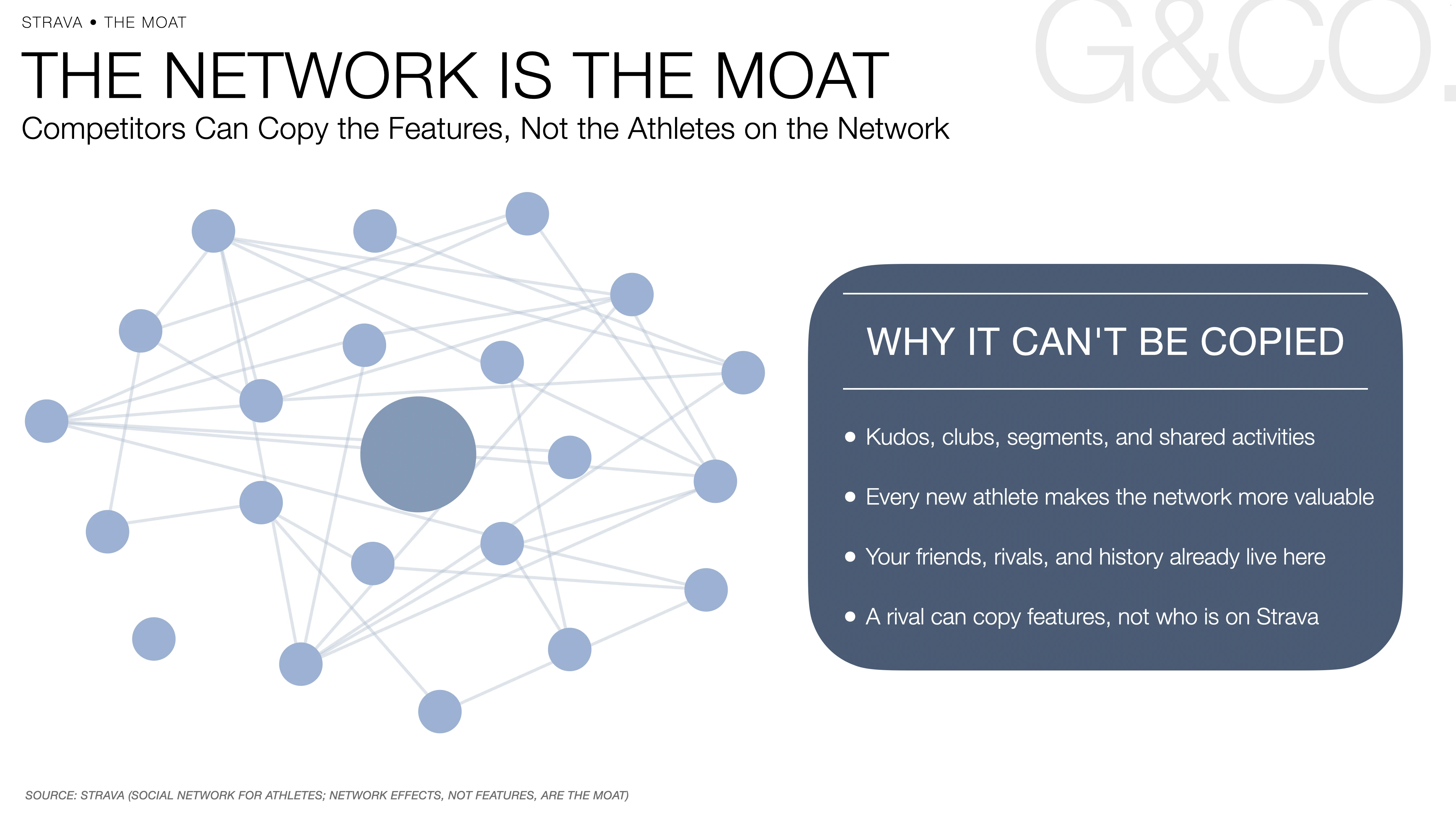
- The more of your friends and rivals are on Strava, the more valuable it is, so competitors with similar features cannot easily pull the community away. That is community-led growth in action.
- A freemium model monetizes the most committed athletes. Strava is free to use and funded by subscriptions rather than ads, so the people who value it most pay for advanced training, analytics, and route tools.
- Strava has grown past 150 million registered athletes, adding millions each month, and has moved toward profitability while deliberately choosing subscriptions over advertising.
Why This Matters
For CEOs, chief product officers, and anyone building a consumer product in a crowded category, Strava is one of the clearest proofs that a community is a stronger moat than a feature. In a market where every competitor, including Apple, Garmin, and Nike, can match the tracking, Strava wins because it owns something they cannot copy: the network of athletes and the relationships between them. That is a fundamentally more durable position than a feature lead.
The timing matters. As it gets easier and cheaper to build any given feature, and as customer acquisition costs rise, the companies that endure are increasingly the ones with genuine community and network effects, assets that compound and cannot be bought quickly. Strava built exactly that, and monetized it without resorting to advertising, which is itself a statement about protecting the community. For any leader trying to build a defensible consumer business rather than compete on a feature treadmill, Strava is instructive.


%20(1).png)

Let’s kickstart the conversation and design stuff people will love.

The Retail & Consumer Index


Strategic Context
In fitness technology, features are a losing battle. Recording a workout accurately, drawing a map, calculating pace and heart rate, these were once differentiators and are now table stakes, available on every smartphone and every rival device. A company that competes only on the quality of its tracking is competing on something that gets commoditized and copied every year, against rivals with far bigger hardware businesses behind them.
Strava's founding insight was that the durable value in fitness was not the data but the social layer around it, the motivation, accountability, and belonging that come from doing these activities alongside other people. Athletes train harder and more consistently when friends can see their effort, when they are chasing a leaderboard, when they belong to a club. The strategic choice at the heart of this case is that Strava did not try to build the best tracking app; it built the social network for athletes, treating the recording as the entry point and the community as the product. That reframing, from "a better fitness tracker" to "the place athletes connect", is what everything else in Strava's success is built on.
Company Response
Make the community the core, not a feature.
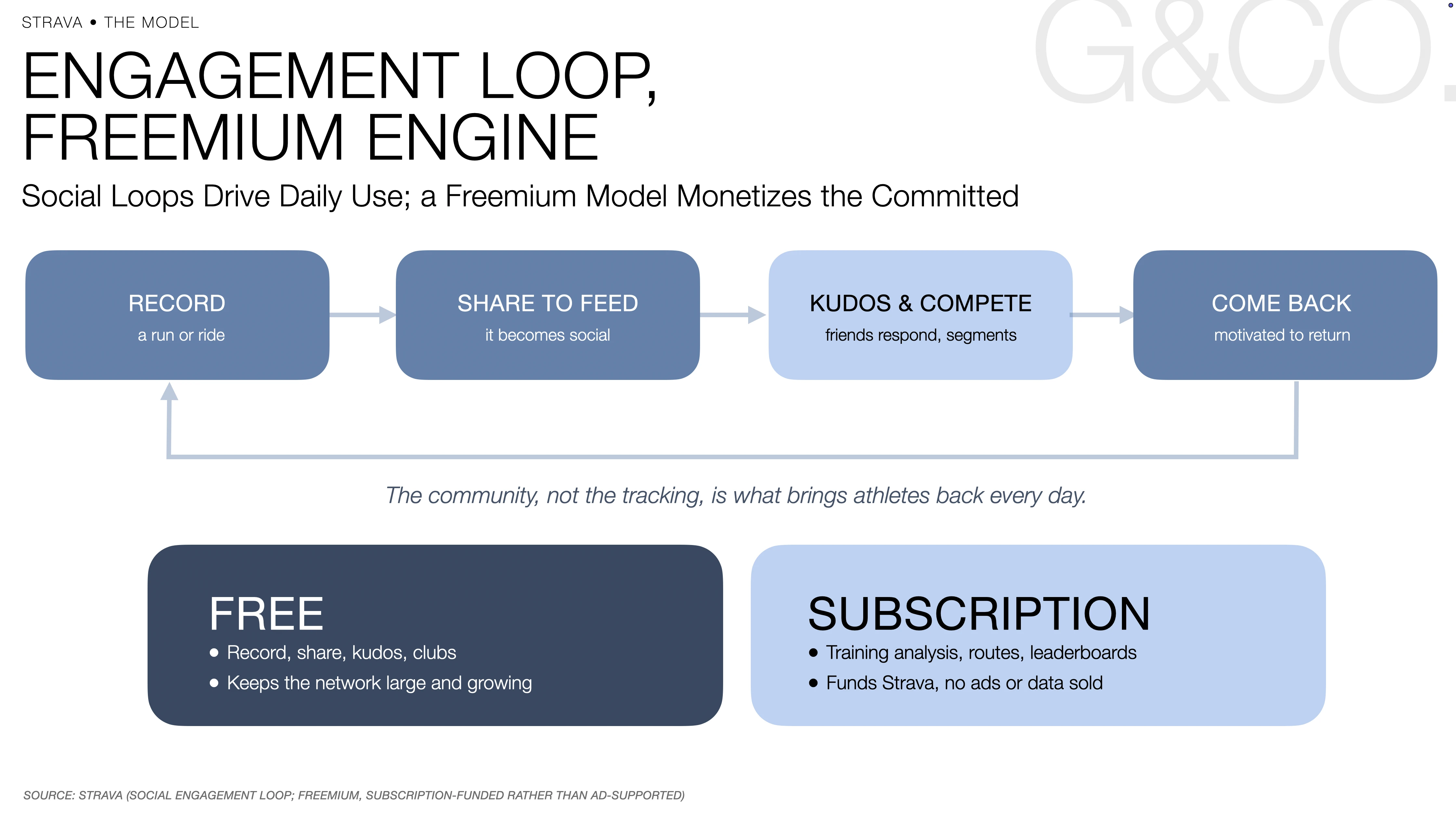
Strava built its product around social connection: a feed where athletes share activities, "kudos" and comments to cheer each other on, the ability to follow friends, clubs to join, and competitive "segments" where athletes race the same stretch of road or trail and climb a leaderboard. These are not add-ons to a tracking app; they are the reason people are there. Every recorded activity becomes a social object others can see and respond to, which turns solitary exercise into a shared experience. This is what makes Strava a community platform rather than a fitness tracker, and it is the source of the user engagement that keeps athletes opening the app every day.
Let the network effects and community drive growth.
Because Strava's value comes from the people on it, it grows in a self-reinforcing loop: each new athlete brings their friends, invites their training partners, and makes the network more valuable for everyone already there. Kudos and shared activities are, in effect, invitations. This community-led growth means Strava acquires many users through the network itself rather than through heavy paid marketing, and it builds a moat that pure features cannot breach: a competitor can copy segments or a feed, but it cannot copy the fact that your friends, your rivals, and your history are already on Strava. The network is the switching cost.
Monetize with a freemium model that protects the community.
Strava is free to use for its core social and tracking features, and it makes money through subscriptions that unlock advanced training analysis, route planning, competitive leaderboards, and other tools for committed athletes. Crucially, Strava funds itself through this freemium model rather than by selling advertising or member data, a deliberate choice to keep the experience clean and preserve the trust of its community. The people who get the most value, serious and frequent athletes, pay, while the free tier keeps the network large and growing. The subscription monetizes engagement without compromising it.
The approach carries real tension. A community is fragile: changes that upset athletes, such as moving features behind the paywall or altering how data is shared, can provoke strong backlash, so Strava has to monetize carefully. Growth in a subscription model depends on continually deepening the value for paying athletes, which is why Strava keeps adding training tools and, more recently, AI-driven features. And large platforms circle the same users. But the community and its network effects are exactly what those larger, feature-rich competitors cannot easily take.
Always-On Customer Intelligence
Turn your own customer data into foresight — validate, simulate, and sense every major decision before you commit.


Results and Evidence
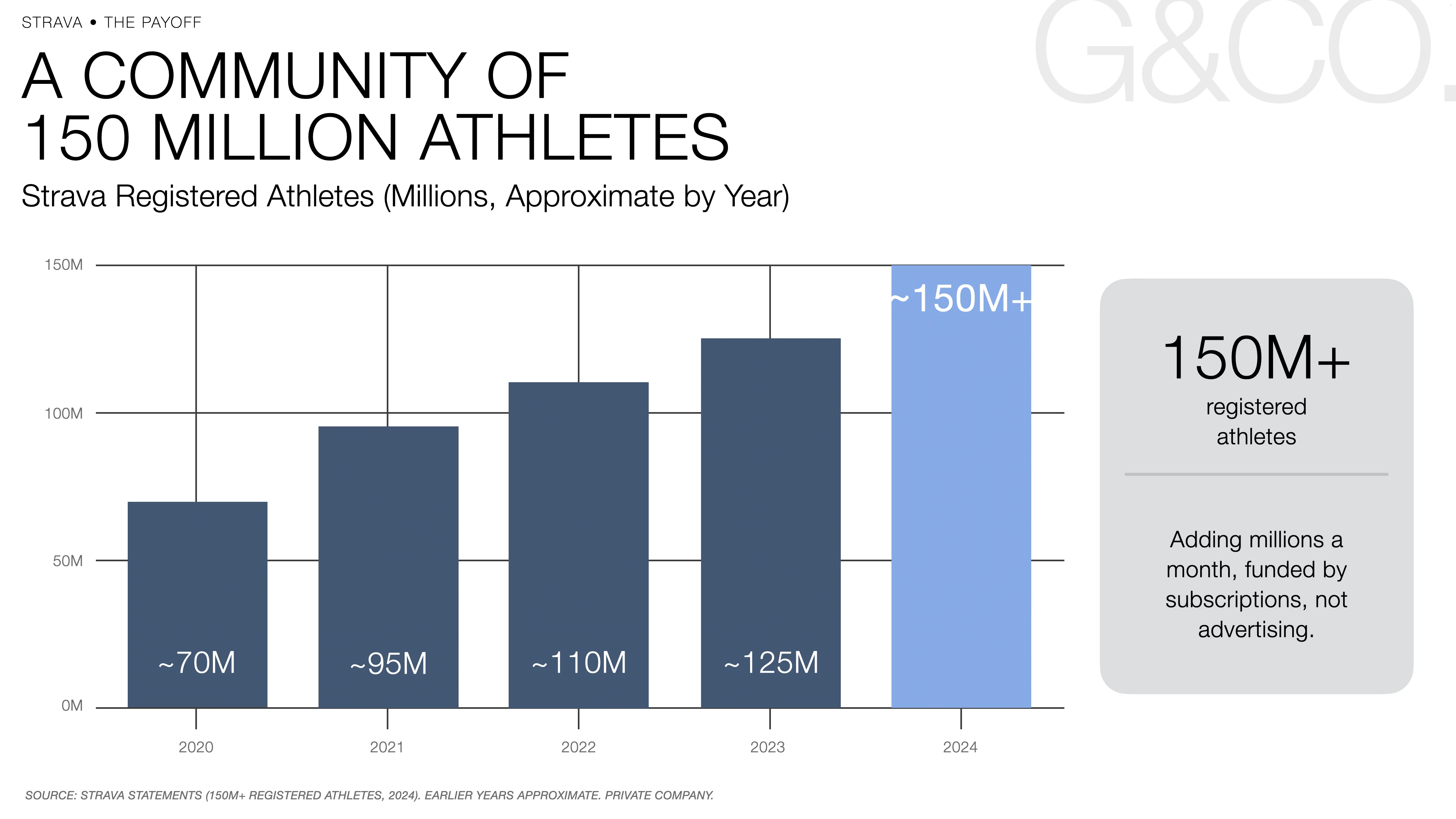
The evidence is in the scale, the engagement, and the choice of how to monetize. Strava has grown past 150 million registered athletes and continues to add millions each month, across more than 30 sports and virtually every country, an enormous, active community rather than a passive user base. The engagement is the real proof: athletes upload billions of activities and exchange enormous volumes of kudos and comments, the daily social behavior that shows the community, not the tracking, is what brings people back. Just as telling is the business model: Strava funds itself through subscriptions rather than advertising, and has moved toward profitability on that basis, evidence that a freemium community can be monetized without selling attention or data. It has also begun adding AI-powered features and made acquisitions to deepen the value for paying athletes. These figures come from Strava's public statements and reporting, and because Strava is a private company, they are worth confirming against its latest disclosures before publishing, since the numbers update over time.
Strategic Implications
Read at scale, Strava is a case about community and network effects as a moat, and it connects to the broader shifts in digital community, engagement, and subscription business models. The pattern is repeatable well beyond fitness: in a category where features are commoditized, the durable advantage belongs to whoever builds the community and the network around the product, because a competitor can copy what your product does but not who is on it. Strava did not win by having the best tracker; it won by being the place athletes connect, and the connections are the moat.
The deeper implication is how community compounds into defensibility and growth at once. The network effects mean each new member makes the product more valuable and helps bring the next, lowering the cost of growth, and the same network raises the cost of leaving, because a competitor cannot replicate your friends and history. Layer a freemium approach on top, and the most engaged members fund the platform without the company having to monetize attention. For enterprise leaders, the takeaway is to ask whether your product could become a community rather than just a tool, where the relationships between your users would create value and lock-in that no feature could, and how a freemium approach could monetize that engagement without breaking it. The businesses that build genuine community are among the hardest of all to displace.
What Enterprise Leaders Can Learn
- Build a community, not just a feature.
When features are commoditized, the network of people on your product is the moat competitors cannot copy. Make the community the core, not an add-on. - Turn usage into social objects.
Strava made each activity something friends can see and respond to; designing for shared, visible engagement is what turns a tool into a community. - Let network effects lower your cost of growth.
When each member brings the next, community-led growth reduces reliance on paid acquisition and compounds over time. - Monetize the engaged core with freemium.
A freemium approach lets the most committed users fund the platform while a free tier keeps the network large, and it can avoid monetizing attention or data. - Protect the community above short-term revenue.
A community is fragile; changes that erode trust can trigger backlash. The long-term asset is the belonging, and it must be defended.
Conclusion
Strava's story is not really about tracking runs and rides. It is about the difference between a product people use and a community people belong to. Anyone can build an app that records a workout; Strava built the place where athletes connect, compete, and cheer each other on, and that community, not the tracking, is why they come back every day and why they pay. The features can be, and have been, copied by far larger companies; the network of relationships cannot. By making the community the core, letting its network effects drive growth, and monetizing with a freemium approach that protects rather than exploits its members, Strava built one of the most defensible positions in consumer technology. For enterprise leaders, the transferable lesson is to ask whether your product could become a community, because the businesses whose users belong rather than merely use are the ones a competitor can least afford to face, and least easily beat.
Through the Acumen platform, G&CO. gives enterprise brands the intelligence to build community as a moat: where your product could become a network rather than a tool, how to design engagement that compounds into belonging, and how a freemium approach could monetize that community without breaking the trust that holds it together. G&CO. is a certified minority business enterprise through the National Minority Supplier Development Council (NMSDC). For enterprise organizations with diversity inclusion requirements in their procurement process, G&CO. meets the criteria for MBE-qualified partner status.
G&CO. works with enterprise brands on the product, community, and growth strategy that turns a tool into a network people belong to. If this Strava case study raises questions about your own community platform, user engagement, or freemium approach, submit an inquiry to G&CO. on our contact page or click the blue "Click to Contact Us" button in the bottom right corner of your screen. We look forward to hearing from you.
Frequently Asked Questions
What is Strava's community network, and why is it the real product?
Strava is a social network for athletes built around recording activities. But the recording is not the product; the community is. A feed of shared activities, "kudos" and comments, followers, clubs, and competitive segment leaderboards turn solitary exercise into a shared experience, and that social layer is why athletes keep coming back. Because any app can record a run, Strava's durable advantage is the network of athletes and the relationships between them, which is why it functions as a community network rather than a fitness tracker, and why competitors with equal features cannot easily displace it.
How does Strava drive user engagement?
Through social loops built into every activity. When an athlete records a run or ride, it becomes something their friends can see, give kudos to, and comment on; athletes also chase segment leaderboards, join clubs, and take part in challenges. These interactions create daily reasons to open the app that have nothing to do with the tracking itself. That user engagement, the kudos, comments, and competition, is both the sign that the community is the real product and the mechanism that keeps the network active and growing.
What are network effects, and how do they protect Strava?
Network effects mean the product becomes more valuable as more people use it. On Strava, the more of your friends, training partners, and rivals are on the platform, the more useful and motivating it is, so value grows with the community. This protects Strava because a competitor can copy its features but not the fact that your friends and your athletic history already live on Strava. That makes the network itself the switching cost, and it is why community-led growth, each member bringing the next, is such a durable advantage in a category where features are easily copied.
How does Strava's freemium approach make money?
Strava is free to use for its core social and tracking features, and it earns revenue through subscriptions that unlock advanced training analysis, route planning, competitive leaderboards, and other tools for serious athletes. Importantly, Strava funds itself through this freemium approach rather than by selling advertising or member data, a deliberate choice to protect the experience and the community's trust. The most committed athletes pay, while the free tier keeps the network large and growing, so the model monetizes engagement without compromising it. Strava has moved toward profitability on this basis.
What can enterprise leaders learn from the Strava case study?
The central lesson is that a community is a stronger, more durable moat than any feature. In a category where every rival can match the product, Strava wins because it owns the network of users and their relationships, which cannot be copied. The repeatable playbook: make the community the core rather than an add-on, turn usage into shared social objects that drive engagement, let network effects lower your cost of growth, monetize the engaged core with a freemium approach, and protect the community above short-term revenue. Leaders should ask whether their product could become a network people belong to, not just a tool they use.