Red Bull Case Study: The Media Company That Sells a Drink
This Red Bull case study examines how a beverage company became, in effect, a media company that happens to sell a drink. Through its own content studio, a slate of films and events, and a global portfolio of extreme sports and teams, Red Bull produces content and experiences people actively seek out, rather than advertising they skip. It earns attention instead of buying it, and attaches the drink to an identity of energy and adventure through relentless brand storytelling. The result is category dominance built on content marketing and experiential marketing rather than price or paid media. The Red Bull marketing strategy shows that a brand can turn marketing from a cost into an owned asset.
Red Bull built a media and events empire, films, extreme-sports spectacles, a dominant Formula 1 team, that markets an identity of energy and adventure, so the content does the selling and the drink rides on the brand.
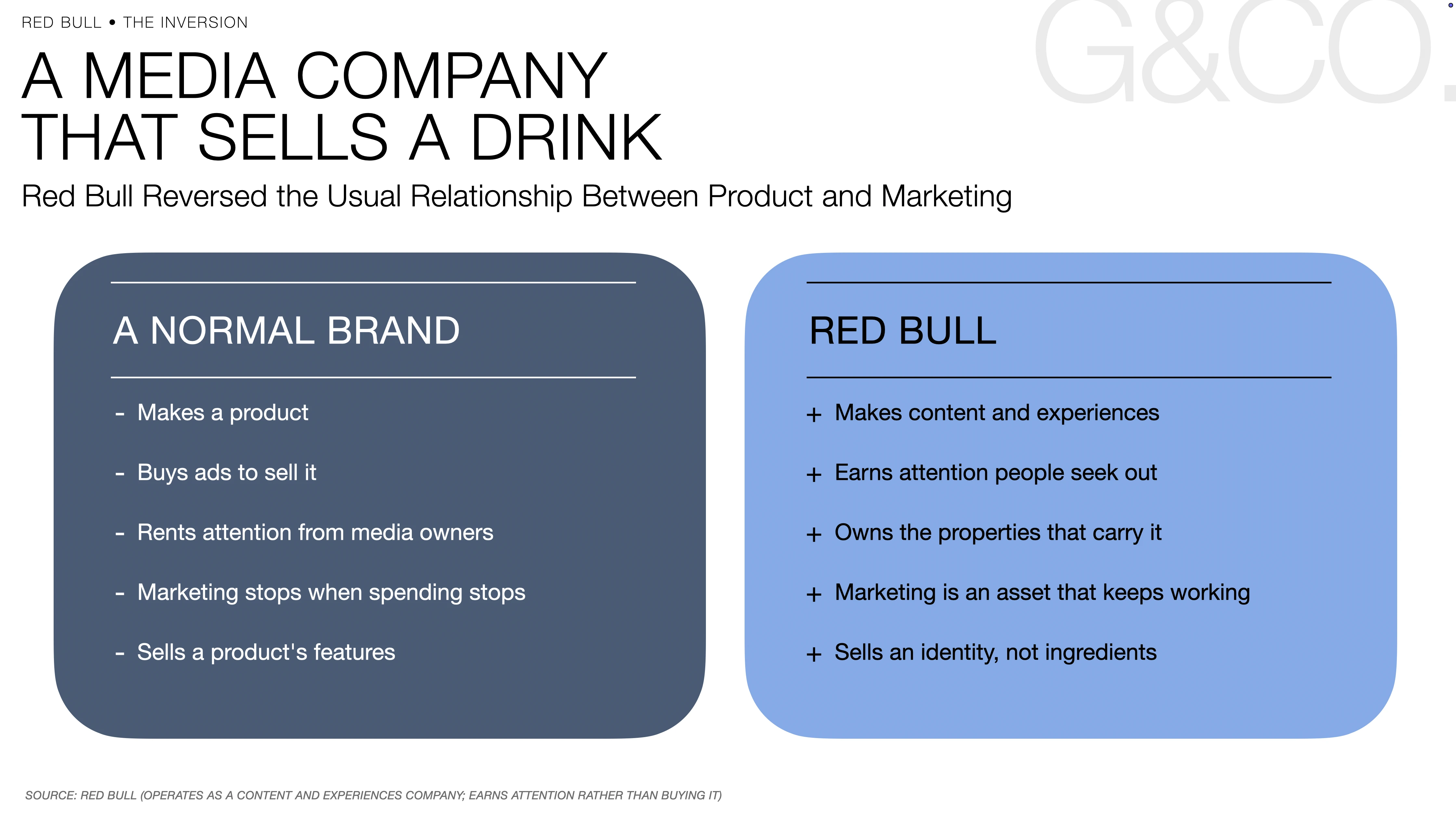
Most consumer companies make a product and then buy advertising to sell it. Red Bull does something closer to the reverse: it produces content and experiences that people genuinely want, films, events, record-breaking stunts, sports teams, and the energy drink comes along for the ride. Red Bull is often described as a media company that happens to sell a drink, and the description is not a clever line; it is an accurate account of how the business actually works.
This case study looks at how Red Bull built one of the most admired marketing machines in the world by becoming a content and experiences company, earning attention rather than buying it, and attaching its drink to an identity rather than a set of product claims. For enterprise leaders, the lesson reaches well beyond energy drinks. It is about turning marketing from a cost you spend into an asset you own, by making content people seek out instead of ads they avoid.
Key Points
- Red Bull operates as a media company that happens to sell a drink. Through its own content studio and a vast slate of events, films, and sports, it produces branded content and experiences, not just advertising.
- The content is the marketing, and people seek it out. Instead of buying attention, Red Bull earns it with spectacles and stories, extreme sports, record-setting stunts, a top Formula 1 team, content marketing audiences actually want to watch.
- It sells an identity, not a beverage. Red Bull's brand marketing attaches the drink to energy, adventure, and youth culture through relentless brand storytelling, so the can stands for a lifestyle rather than a list of ingredients.
- Experiential and owned events build a durable audience. Experiential marketing, owned events, teams, and franchises gives Red Bull a permanent, global audience no single ad campaign could buy.
- The payoff is category dominance built on brand, not price. Red Bull commands a large share of the global energy-drink market and sells billions of cans a year, on a brand built by content rather than discounts.
Why This Matters
For CEOs, CMOs, and brand leaders, Red Bull is the definitive example of a company that turned marketing into an asset rather than an expense. Most marketing is a cost that produces attention only while the spending continues; Red Bull built owned content, events, and intellectual property that keep generating attention, audience, and even revenue long after they are created. In an era when people increasingly avoid advertising, a brand that makes content people choose to watch has an advantage in brand marketing that money alone cannot buy.
The timing makes it sharper. Traditional advertising keeps losing effectiveness as audiences fragment and skip ads, while demand for genuine content and experiences keeps rising. The brands winning attention are increasingly those that act like media companies and creators rather than advertisers. Red Bull has been doing this for decades and remains the benchmark. For any leader whose advertising is getting more expensive and less effective, Red Bull shows a fundamentally different model: earn the attention by making something worth seeking out.





Let’s kickstart the conversation and design stuff people will love.

The Retail & Consumer Index


Strategic Context
Energy drinks are, on the shelf, a commodity: sugar, caffeine, and similar formulas in similar cans, a category where it would be easy to compete only on price, promotion, and distribution. A company that defined itself as a beverage maker in that category would be locked into a grinding fight for shelf space and margin, buying advertising to push a product that is hard to differentiate on its merits.
Red Bull's founding insight was that it was not really selling a drink; it was selling an identity, energy, daring, pushing limits, and that identity could be built far more powerfully through content and experiences than through conventional advertising. If the brand could become synonymous with adventure and adrenaline by creating and owning the moments that embody them, the drink would become the emblem of that world rather than just another can. The strategic choice at the heart of this case is that Red Bull decided to compete as a content and experiences company rather than a beverage marketer, building an identity people want to belong to instead of buying ads for a product people would otherwise ignore.
Company Response
Become a content company, not an advertiser.
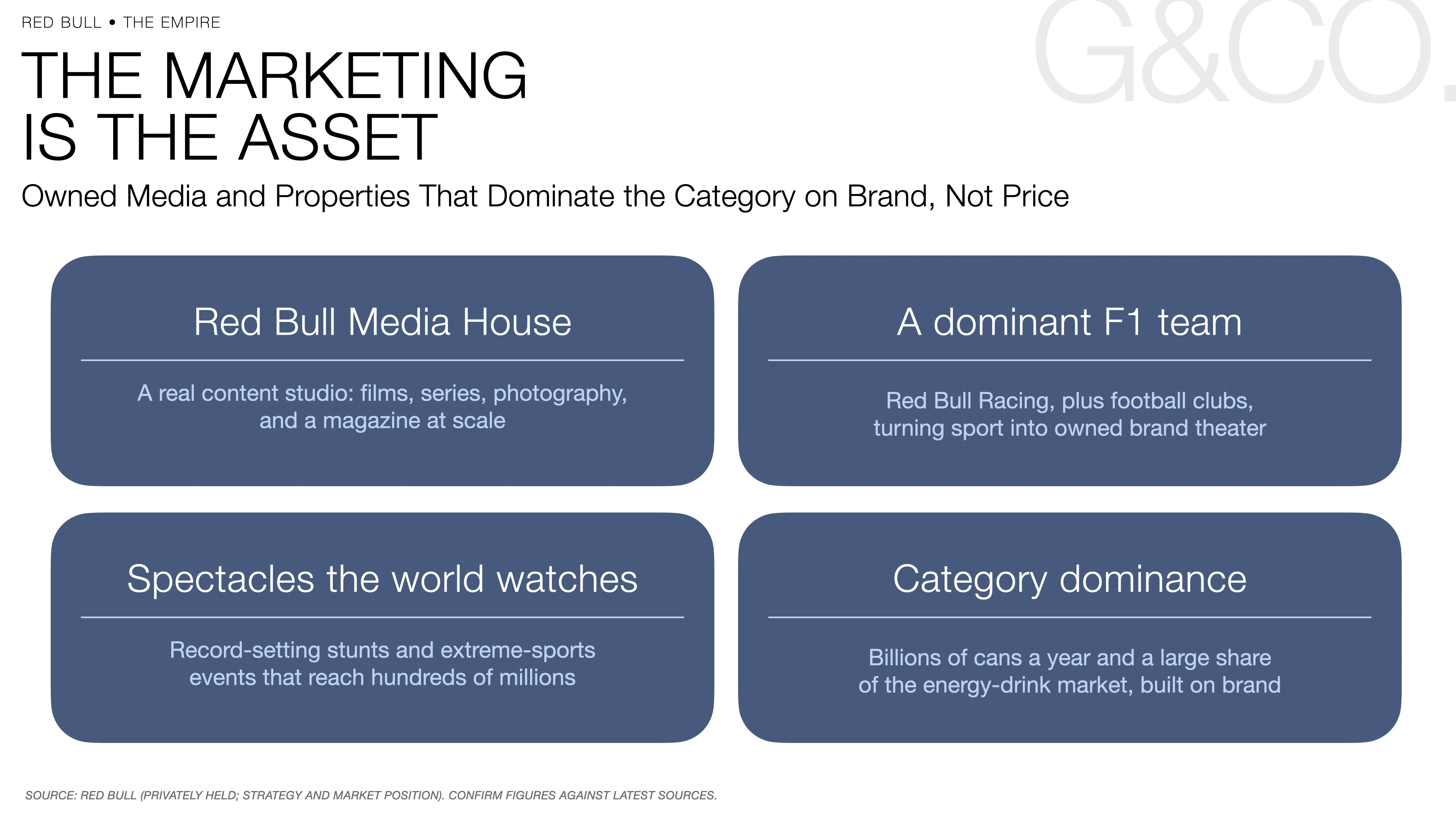
Red Bull built a genuine content operation, a media house that produces films, series, photography, a magazine, and video on a professional scale, creating material people actively seek out rather than ads they skip past. Its most famous moments, like sending a skydiver to the edge of space in a record-breaking jump watched live by millions, were not commercials; they were events the world wanted to watch, with the brand as the author. This is content marketing in its fullest form: the company earns attention by making genuinely compelling branded content, so its marketing is something audiences choose to consume rather than something they tolerate. The content is not about the drink at all, which is precisely why it works.
Own the experiences and the properties.
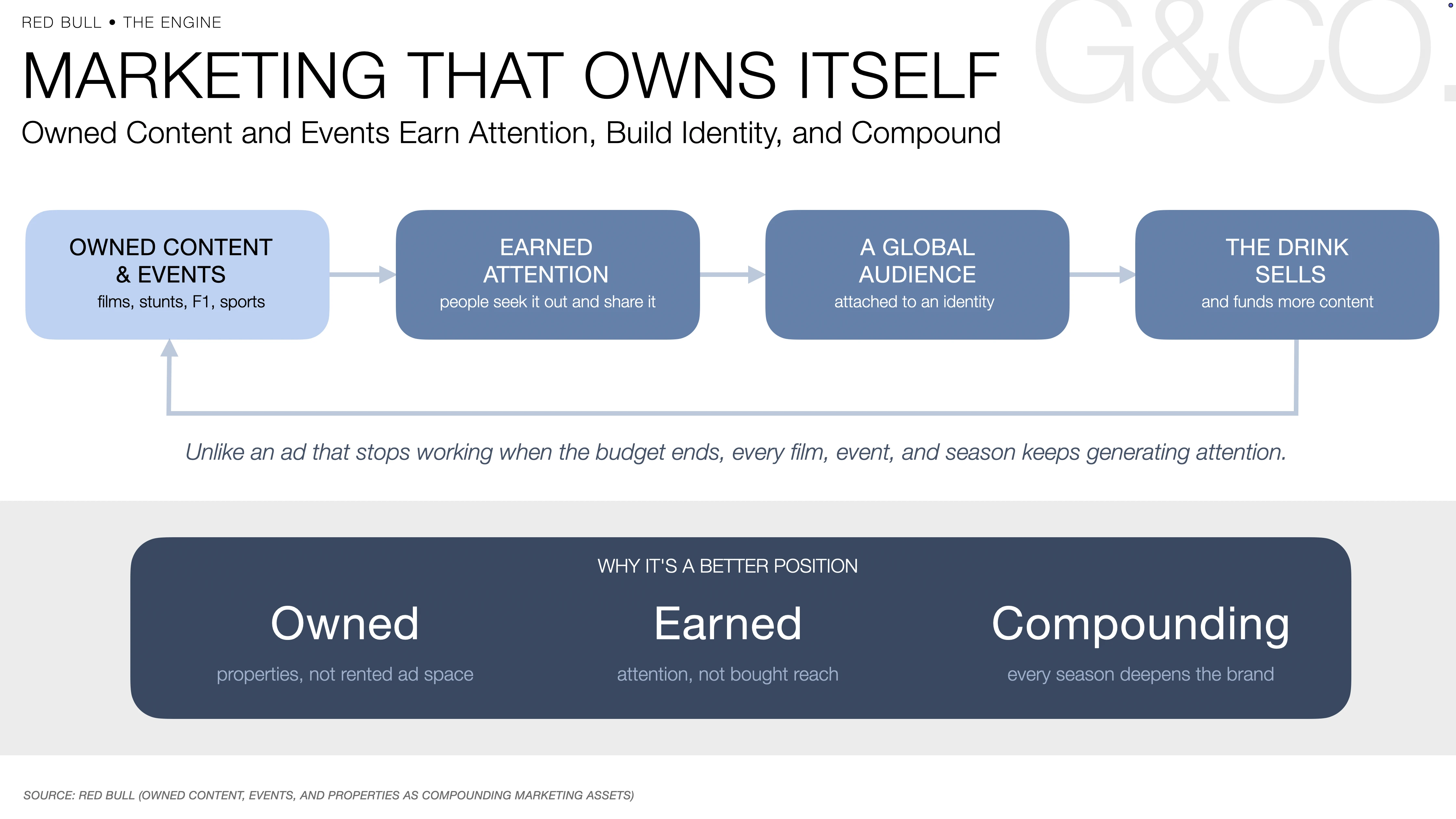
Beyond media, Red Bull owns and sponsors a vast portfolio of events, teams, and spectacles, a dominant Formula 1 team, football clubs, and a calendar of extreme-sports competitions from cliff diving to mountain biking to air racing. This experiential marketing does two things: it embodies the brand's identity in real, thrilling events, and it gives Red Bull permanent, owned properties that generate attention and audience year after year, rather than campaigns that end when the budget does. Owning the experiences, rather than renting ad space around someone else's, turns marketing into a durable asset on the balance sheet of attention.
Tie it all to one consistent identity.
The thread connecting the films, the stunts, the teams, and the events is a single, disciplined identity, energy, adventure, and pushing human limits, expressed through consistent brand storytelling. Every property reinforces the same story, so the drink becomes the symbol of a coherent world rather than a product with scattered ads. This consistency is what turns a collection of content and events into a brand: the Red Bull marketing strategy is not a series of campaigns but the sustained authorship of an identity that the drink then represents. The can is, in effect, merchandise for a lifestyle the content created.
The approach carries real tension. Producing world-class content and owning teams and events is expensive and demands genuine creative and operational excellence, this is not cheap, and doing it badly would be worse than conventional advertising. It is also hard to copy precisely because it requires decades of consistent investment and authentic commitment to the identity, not a quick campaign. And the brand must keep the content genuinely compelling, because the moment it feels like an ad, the advantage evaporates. But that difficulty is exactly why Red Bull's position is so durable: competitors can match the formula in the can far more easily than the media empire around it.
Always-On Customer Intelligence
Turn your own customer data into foresight — validate, simulate, and sense every major decision before you commit.


Results and Evidence
The evidence is in the category dominance and the nature of the asset Red Bull built. Red Bull sells billions of cans a year and commands a large share of the global energy-drink market, leadership built not on being cheapest or most widely distributed but on being the most powerful brand in the category, which is the clearest proof that the content-and-identity strategy translates into commercial dominance. The deeper evidence is the owned-media empire itself: a content studio, a dominant Formula 1 team, football clubs, and a global slate of events that generate enormous attention, much of it earned and shared rather than paid for, and that persist as assets year after year. Red Bull's stunts and events routinely reach audiences in the hundreds of millions, a scale of attention that would cost extraordinary sums to buy and that Red Bull instead created. As a privately held company, Red Bull does not disclose detailed financials, so these points describe its strategy and market position rather than audited results, and specific figures should be confirmed against the latest available sources before publishing.
Strategic Implications
Read at scale, Red Bull is a case about turning marketing into an owned asset by becoming a content and experiences company, and it connects to the broader shifts in content marketing, brand marketing, brand storytelling, and the decline of interruptive advertising. The pattern is repeatable well beyond beverages: a brand in a commoditized category can escape the fight on price and product claims by building an identity through content and experiences people actually want, earning attention instead of buying it, and owning the properties that generate that attention rather than renting ad space. Red Bull did not make a better energy drink; it made a better story, and let the drink represent it.
The deeper implication is the difference between marketing as a cost and marketing as an asset. Conventional advertising produces attention only while the money flows; Red Bull's content, events, and properties keep producing attention, audience, and identity long after they are made, and some even generate revenue directly. That is a structurally better position, and it compounds: every film, event, and season deepens the identity and the audience. For enterprise leaders, the takeaway is to ask whether your brand could create content and experiences people would genuinely seek out, whether you could own the properties that carry your identity rather than buy ads around others', and whether marketing could become something you build and own rather than something you rent and spend. In a world that avoids advertising, the brands that win attention are the ones that make something worth paying attention to.
What Enterprise Leaders Can Learn
- Make content people seek out, not ads they skip.
Red Bull earns attention by producing genuinely compelling content. In a world that avoids advertising, that is a durable advantage money cannot simply buy. - Sell an identity, not a product.
Attaching the brand to a story and a way of life, through consistent brand storytelling, lifts a commoditized product above a fight on price and features. - Own your properties, don't just rent ad space.
Owned content, events, and franchises are assets that keep generating attention year after year, unlike campaigns that stop when the budget does. - Be relentlessly consistent.
The power comes from every film, stunt, and team reinforcing one identity. Scattered content is just marketing; consistent content becomes a brand. - Treat marketing as an asset to build, not only a cost to spend.
The Red Bull model turns marketing into owned intellectual property and audience, a structurally stronger position than renting attention.
Conclusion
Red Bull's story is not really about energy drinks. It is about turning marketing from a cost into an owned asset. Rather than make a drink and buy ads to sell it, Red Bull built a media and experiences company, films, record-breaking spectacles, a dominant racing team, a calendar of owned events, that produces content people actively want and attaches the drink to an identity of energy and adventure. The marketing is not an expense that stops working when the spending stops; it is a growing library of owned branded content and properties and a global audience that keep generating attention and meaning for the brand. That is why Red Bull dominates its category on the strength of its brand rather than its price. For enterprise leaders, the transferable lesson is to stop thinking of marketing as advertising you buy and start thinking of it as content and experiences you own, because in an age that skips the ads, the brands that win are the ones that make something worth watching.
Through the Acumen platform, G&CO. gives enterprise brands the intelligence to turn marketing into an owned asset: where content and experiences could earn attention your advertising now buys, how to build an identity audiences want to belong to, and where owned properties would create lasting brand value. G&CO. is a certified minority business enterprise through the National Minority Supplier Development Council (NMSDC). For enterprise organizations with diversity inclusion requirements in their procurement process, G&CO. meets the criteria for MBE-qualified partner status.
G&CO. works with enterprise brands on the content, brand, and experience strategy that turns marketing from a cost into an owned asset. If this Red Bull case study raises questions about your own content marketing, brand storytelling, or experiential marketing, submit an inquiry to G&CO. on our contact page or click the blue "Click to Contact Us" button in the bottom right corner of your screen. We look forward to hearing from you.
Frequently Asked Questions
What is the Red Bull marketing strategy?
The Red Bull marketing strategy is to operate as a content and experiences company rather than a conventional advertiser. Instead of buying ads to push a drink, Red Bull produces films, events, record-breaking stunts, and owns sports teams and competitions that people genuinely want to watch, and attaches its drink to an identity of energy and adventure. It earns attention by making compelling content rather than buying it, and owns the properties that generate that attention year after year. The drink becomes the emblem of a lifestyle the content created, which is why Red Bull is often called a media company that happens to sell a drink.
How does Red Bull use content-led marketing?
Red Bull built a genuine content operation, a media house producing films, series, photography, a magazine, and video at professional scale, creating material audiences actively seek out rather than ads they skip. Its signature moments, such as sending a skydiver to the edge of space in a record-breaking live event watched by millions, are not commercials but events the world wanted to see, authored by the brand. That is content-led marketing in its fullest form: the content is compelling in its own right and often is not about the drink at all, which is exactly why people choose to consume it, and why it builds the brand so effectively.
What role does experiential marketing play for Red Bull?
A central one. Beyond media, Red Bull owns and sponsors a vast portfolio of events, teams, and spectacles, a dominant Formula 1 team, football clubs, and extreme-sports competitions from cliff diving to mountain biking. This experiential marketing embodies the brand's identity in real, thrilling events and gives Red Bull permanent, owned properties that generate attention and audience every year, rather than campaigns that end when the budget runs out. Owning the experiences, instead of renting ad space around someone else's, is how Red Bull turns marketing into a durable asset rather than a recurring cost.
Why is Red Bull described as a media company that sells a drink?
Because that is how the business actually works. Red Bull invests in producing content and owning experiences on a scale and quality more typical of a media or sports company than a beverage brand, and much of that content is not about the drink at all. The energy drink is the commercial engine, but the brand is built, and the attention is earned, through films, events, teams, and stunts. The drink functions almost as merchandise for the lifestyle and identity the content creates. Describing Red Bull as a media company that happens to sell a drink captures the inversion of the normal relationship between product and marketing.
What can enterprise leaders learn from the Red Bull case study?
The central lesson is to turn marketing from a cost into an owned asset by becoming a content and experiences company. Red Bull's repeatable playbook: make content people genuinely seek out rather than ads they skip, sell an identity rather than a product, own the properties (events, teams, media) that carry your brand rather than just renting ad space, and be relentlessly consistent so everything reinforces one identity. Above all, treat marketing as intellectual property and audience you build and own, which keeps generating value, rather than attention you rent and must keep paying for. In an age that avoids advertising, that is a structurally stronger position.