
T-Mobile Case Study: How the "Un-carrier" Challenger Won
This T-Mobile case study examines one of the most effective challenger brand plays in modern business. Stuck as a distant third in U.S. wireless, T-Mobile stopped competing on the incumbents' terms and reinvented itself as the "Un-carrier," attacking the industry's most hated practices, contracts, overage fees, and international roaming charges, and siding with customers against the giants. That brand repositioning, powered by a loud, anti-establishment identity, drove years of market share growth that turned a struggling also-ran into a leader. The T-Mobile case study shows how a challenger wins not by matching incumbents but through competitive differentiation and a disruptive strategy that changes the game.
T-Mobile went from a distant third to a wireless leader by rebranding as the "Un-carrier," attacking the industry's most hated practices, contracts, overage fees, and fine print, and siding with customers against the incumbents.
A decade ago, T-Mobile was losing. In U.S. wireless, it was a weak third behind Verizon and AT&T, with a smaller network, fewer customers, and no obvious way to close the gap by playing the same game the giants played. Competing head-to-head on coverage and conventional marketing against far larger, entrenched rivals is a fight a distant challenger does not win. So T-Mobile stopped playing that game and started a different one.
This case study looks at how T-Mobile reinvented itself as the "Un-carrier," a brand that defined itself against its own industry's most disliked practices and positioned itself as the customer's champion, and how that bold repositioning turned a struggling third-place carrier into a market leader. For enterprise leaders, the lesson reaches well beyond telecom. It is about how a challenger beats entrenched incumbents not by matching them, but by changing the terms of competition.
Key Points
- T-Mobile was a distant also-ran before it reinvented itself. Stuck a weak third behind Verizon and AT&T, it needed to change the game, not just compete harder on the incumbents' terms.
- The "Un-carrier" repositioning attacked the industry's own worst habits. It killed contracts, overage fees, and international roaming charges, the practices customers hated most, and cast itself as their champion against the giants.
- Disruption, not better specs, was the differentiation. Rather than match Verizon and AT&T on coverage claims, T-Mobile competed on being different and customer-friendly, transparent, generous, and on the customer's side, a clear competitive differentiation.
- A bold brand persona made it impossible to ignore. A loud, anti-establishment identity, magenta everywhere, publicly roasting the incumbents, turned a brand repositioning into a movement and earned enormous attention cheaply.
- The payoff was years of market share growth. T-Mobile added customers quarter after quarter, overtook AT&T, and, bolstered by the Sprint merger and a 5G lead, became a wireless leader on roughly $80 billion in revenue.
Why This Matters
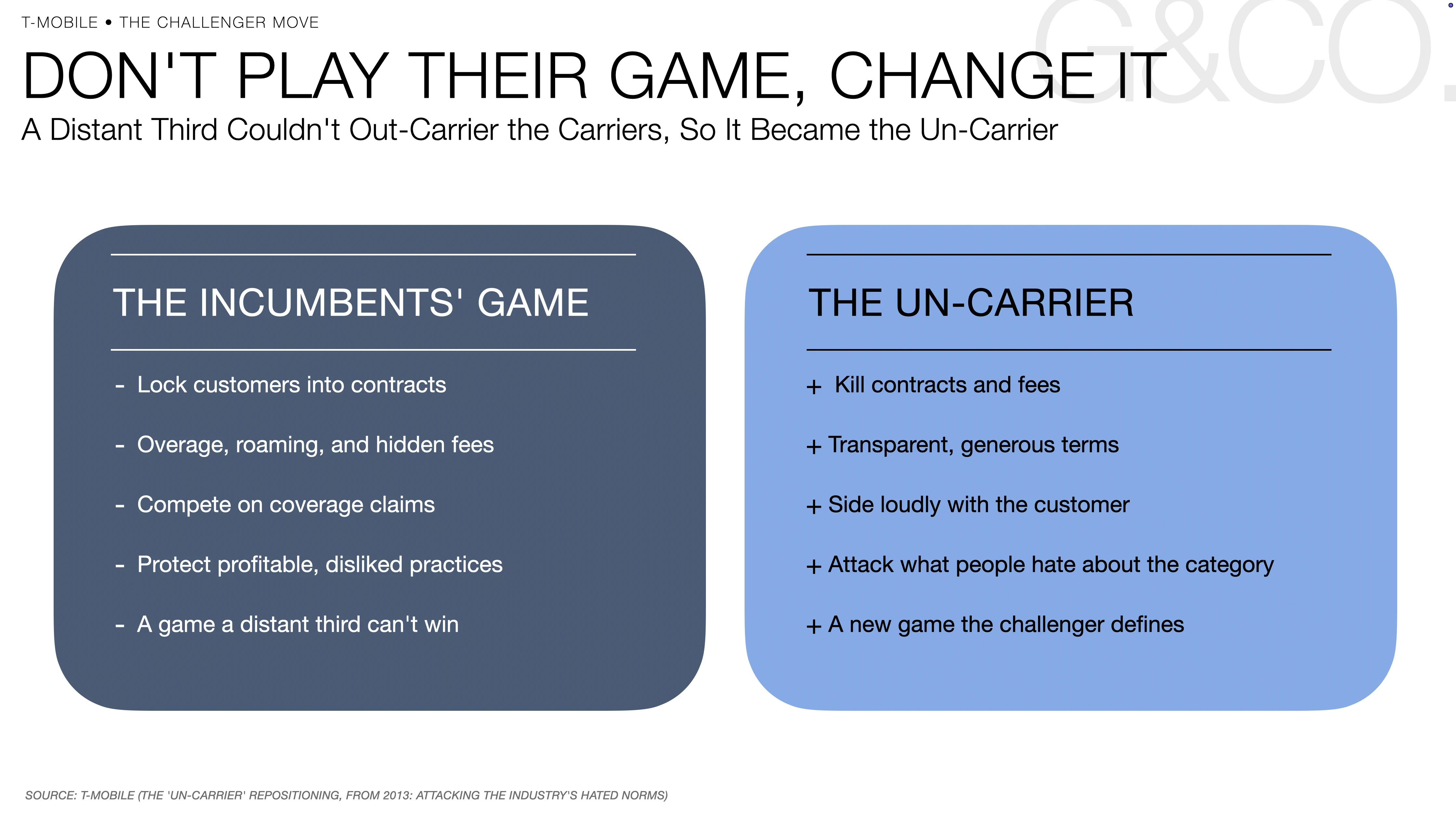
For CEOs, CMOs, and anyone trying to grow against bigger, entrenched competitors, T-Mobile is a textbook example of winning as a challenger by refusing to fight on the incumbents' terms. The temptation for a third-place player is to imitate the leaders, a slightly cheaper, slightly smaller version of the same thing, which almost never works because the leaders have more scale, budget, and inertia on their side. T-Mobile did the opposite: it found what customers hated about the entire category and attacked it, turning the incumbents' own practices into its competitive weapon. That is one of the few reliable ways a challenger overtakes a leader.
The relevance is broad. Many industries have entrenched leaders protected by scale and habit, and many challengers waste themselves trying to out-execute them at their own game. T-Mobile shows the alternative: reposition around the customer's frustrations with the category, differentiate through boldness rather than specs, and make the incumbents' complacency the story. For any leader in a challenger position, or any incumbent who could be attacked this way, the Un-carrier playbook is essential study.






Let’s kickstart the conversation and design stuff people will love.

The Retail & Consumer Index


Strategic Context
In a market dominated by a few entrenched giants, the hardest position to be in is a distant challenger. The leaders have the biggest networks, the largest marketing budgets, and the inertia of customers who see little reason to switch. A smaller rival that competes on the same dimensions, coverage, conventional advertising, me-too plans, is simply outgunned, and will keep losing slowly. That was T-Mobile's situation: a credible but third-place carrier with no path to the top by playing the incumbents' game better than the incumbents.
T-Mobile's strategic insight was that the entire industry was widely disliked, and that its own worst practices, long contracts, confusing fees, overage charges, international roaming bills, fine print, were a shared vulnerability the giants were too comfortable to abandon. If T-Mobile attacked those practices and positioned itself unmistakably on the customer's side, it could differentiate not by being a better version of a carrier, but by being an "un-carrier," the anti-establishment alternative to an industry people resented. The strategic choice at the heart of this case is that T-Mobile stopped trying to win the incumbents' game and changed the game itself, turning the category's hated norms, and the incumbents' reluctance to give them up, into its own disruptive strategy.
Company Response
Attack the hated practices, one by one.
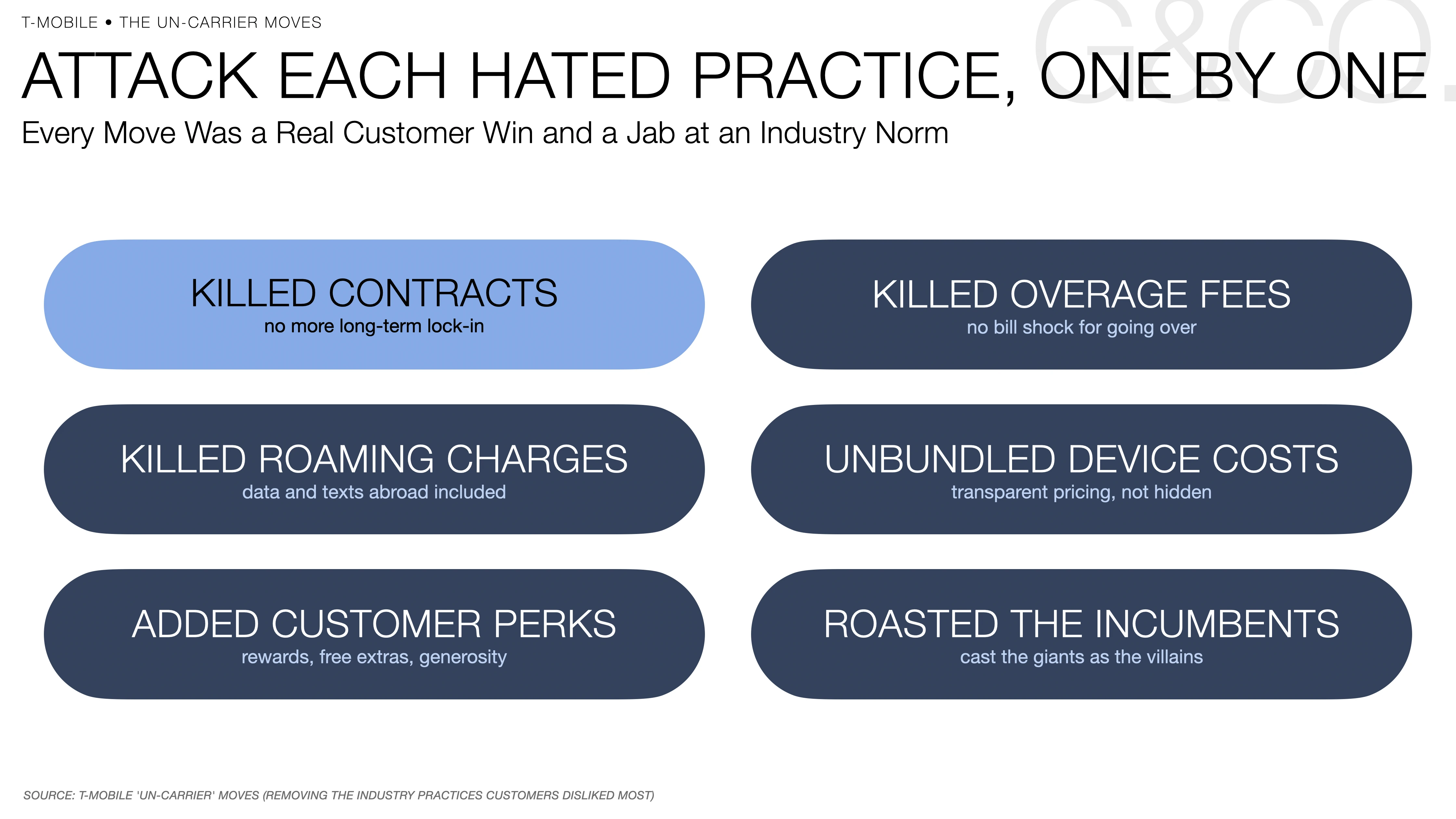
Beginning with its first "Un-carrier" move, T-Mobile systematically eliminated the things customers hated most about wireless: it abolished the standard long-term service contract, then went after overage fees, international roaming charges, the opaque bundling of device costs into plans, and more, rolling out change after change that each removed a specific, well-known customer grievance. Every move was both a genuine customer benefit and a pointed attack on an industry norm the incumbents still relied on, which made T-Mobile the obvious choice for anyone frustrated with the status quo. This was brand repositioning executed through real product and policy changes, not just advertising.
Make the customer the hero and the incumbents the villains.
T-Mobile wrapped the moves in an unmistakable identity: loud, irreverent, and openly combative toward Verizon and AT&T, which it mocked as out-of-touch giants (its leadership famously ridiculed them in blunt terms). T-Mobile's brand positioning placed it squarely as the customer's champion against an industry that took them for granted, and its bold, magenta-soaked, anti-establishment persona made it impossible to ignore and generated enormous earned attention. This gave the repositioning emotional force: T-Mobile was not just offering better terms, it was leading a revolt against a disliked industry, and customers wanted to join. The persona turned a set of policy changes into a challenger brand with a cause.
Back it with network investment and scale.
A bold brand would not have lasted without the substance to support it, so T-Mobile paired the Un-carrier positioning with heavy investment in its network, and, crucially, its merger with Sprint, which gave it the spectrum and scale to build a genuinely competitive, and in 5G a leading, network. This closed the one gap that could have undermined the whole strategy, the perception that the challenger's network was inferior, and turned T-Mobile from a plucky underdog into a leader that could win on experience as well as attitude. The brand got attention; the network made the switch stick.
The approach carries real tension. A challenger brand built on attacking the establishment has to keep its edge and avoid becoming the complacent incumbent it mocked, especially now that it is a leader. The disruptive moves compressed industry margins, including its own, in the short term. And sustaining differentiation gets harder once rivals copy the popular changes, as they did with unlimited plans and the retreat from contracts. But by the time competitors matched the moves, T-Mobile had already won the brand position, the customer's champion, that the moves were designed to establish.
Always-On Customer Intelligence
Turn your own customer data into foresight — validate, simulate, and sense every major decision before you commit.


Results and Evidence
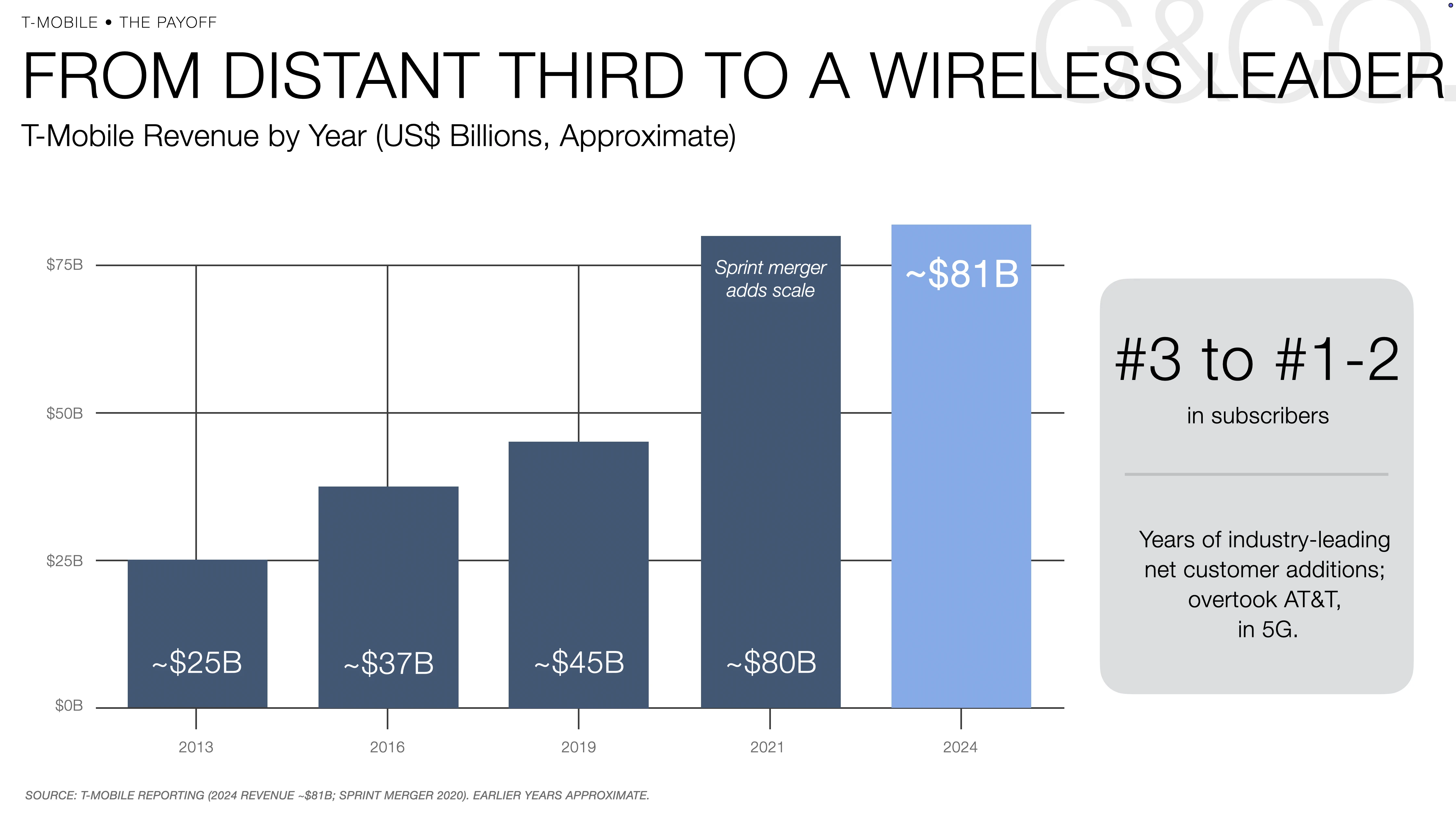
The evidence is in the market share growth and the reversal of position. T-Mobile went from a distant third to a wireless leader, adding customers quarter after quarter for years, consistently leading the industry in new customer additions, overtaking AT&T in total subscribers, and closing on or rivaling Verizon, a dramatic change in standing for a company that had been losing before the Un-carrier era. Its revenue grew to roughly $80 billion, and the Sprint merger gave it the scale and spectrum to lead in 5G, converting brand momentum into network leadership. The clearest proof that the strategy worked is the pattern of sustained net customer additions in a mature, saturated market where share is normally hard to move: customers actively switched to T-Mobile, which is exactly what a successful challenger repositioning is supposed to produce. These figures come from T-Mobile's public reporting and are worth confirming against the latest results before publishing, since this names a real company and the numbers update each quarter.
Strategic Implications
Read at scale, T-Mobile is a case about winning as a challenger by changing the terms of competition, and it connects to the broader questions of brand positioning, competitive differentiation, and disruptive strategy. The pattern is repeatable across industries: a challenger that cannot beat entrenched incumbents at their own game can often beat them by attacking what customers hate about the whole category, especially the practices the leaders are too comfortable or too dependent on to abandon, and by positioning itself unmistakably as the customer's champion. T-Mobile did not out-carrier the carriers; it became the un-carrier, and let the incumbents' own complacency be the opening.
The deeper implication is that a challenger's best weapon is often the incumbent's own behavior. Entrenched leaders are vulnerable precisely where they are comfortable, in the profitable, customer-unfriendly practices they assume are permanent, and a challenger willing to give those up can seize the customer-champion position the leaders have vacated. For enterprise leaders, the takeaway runs both ways: if you are a challenger, look for the category norms customers resent and the incumbents will not surrender, and attack there rather than imitating the leaders; if you are an incumbent, recognize that your most profitable, most disliked practices are exactly where a challenger will come for you. Differentiation built on being genuinely on the customer's side, against an industry that is not, is one of the hardest positions to defend against.
What Enterprise Leaders Can Learn
- Don't fight incumbents on their own terms.
A distant challenger that imitates the leaders stays a distant challenger. Change the terms of competition instead of competing harder on the old ones. - Attack what customers hate about the whole category.
The practices the incumbents are too comfortable to give up are a shared vulnerability. Eliminating them is both a real benefit and a pointed differentiator. - Make the repositioning real, not just advertising.
T-Mobile changed actual policies and products, not only its messaging. A challenger brand is credible only when the substance backs the stance. - Give the brand a cause and an edge.
Positioning as the customer's champion against a disliked industry gives differentiation emotional force and earns enormous attention cheaply. - Back boldness with substance.
The Sprint merger and network investment closed the one gap, perceived inferior quality, that could have sunk the strategy. Attitude wins attention; substance makes it stick.
Conclusion
T-Mobile's story is not really about wireless plans. It is about how a challenger beats entrenched incumbents, by refusing to play their game and changing it instead. Stuck a distant third with no path to the top on the giants' terms, T-Mobile found what customers hated about the entire industry, abolished those practices one by one, and repositioned itself through a brand positioning that cast it loudly and unmistakably as the customer's champion against an establishment that had grown complacent. It backed the bold brand with real network investment and the scale of the Sprint merger, so the challenger could win on experience as well as attitude. The result was years of market share growth that turned an also-ran into a leader. For enterprise leaders, the transferable lesson is that the way to beat a bigger, entrenched competitor is rarely to out-execute it at its own game; it is to attack what customers resent about the category, stand genuinely on their side, and change the terms of competition. The challenger that redefines the game can beat incumbents who only know how to play the old one.
Through the Acumen platform, G&CO. gives enterprise brands the intelligence to compete as a challenger, or defend against one: where customers resent the norms of your category, where an incumbent is vulnerable in its most profitable practices, and how a repositioning around the customer could change the terms of competition. G&CO. is a certified minority business enterprise through the National Minority Supplier Development Council (NMSDC). For enterprise organizations with diversity inclusion requirements in their procurement process, G&CO. meets the criteria for MBE-qualified partner status.
G&CO. works with enterprise brands on the positioning, differentiation, and competitive strategy that lets a challenger change the terms of competition, or an incumbent defend them. If this T-Mobile case study raises questions about your own challenger brand, brand repositioning, or competitive differentiation, submit an inquiry to G&CO. on our contact page or click the blue "Click to Contact Us" button in the bottom right corner of your screen. We look forward to hearing from you.
Frequently Asked Questions
What was T-Mobile's "Un-carrier" strategy?
The Un-carrier strategy was T-Mobile's repositioning, starting in 2013, from a distant third-place carrier into the anti-establishment champion of wireless customers. Instead of competing with Verizon and AT&T on their terms, T-Mobile systematically eliminated the industry practices customers hated most, long-term contracts, overage fees, international roaming charges, and opaque device-and-plan bundling, rolling out a series of "Un-carrier" moves that each removed a specific grievance. It wrapped these changes in a loud, combative brand that mocked the incumbents and sided openly with customers. The strategy turned T-Mobile's challenger position into an advantage and drove years of market share growth.
How did T-Mobile differentiate as a challenger?
Through competitive differentiation based on being different and customer-friendly, not on matching the incumbents' specs. Rather than claim slightly better coverage or slightly cheaper plans, T-Mobile attacked the whole category's disliked norms and positioned itself as the customer's champion against an industry people resented. It made real policy changes (killing contracts and fees), backed them with a bold, magenta, anti-establishment identity, and cast Verizon and AT&T as complacent giants. That combination, genuine customer benefits plus an unmistakable brand stance, is what set T-Mobile apart and made switching to it feel like joining a cause.
Why did attacking its own industry's practices work so well?
Because those practices were a shared vulnerability the incumbents were too comfortable, and too financially dependent, to abandon. Customers across the whole category resented contracts, fees, and fine print, but the leaders kept them because they were profitable and assumed permanent. By being the one carrier willing to give them up, T-Mobile seized the customer-champion position the incumbents had effectively vacated, turning the industry's own norms, and the giants' reluctance to change them, into its disruptive strategy. It is far easier to win customers by removing what they hate than by claiming to be marginally better at what everyone already does.
What role did the Sprint merger play?
A crucial one: it gave the bold brand the substance to last. A challenger built on attitude would have been undermined if customers believed its network was inferior, so T-Mobile paired the Un-carrier positioning with heavy network investment and, in 2020, its merger with Sprint, which provided the spectrum and scale to build a genuinely competitive and, in 5G, a leading network. That closed the one gap that could have sunk the strategy and turned T-Mobile from a plucky underdog into a leader able to win on network experience as well as brand. Attitude earned attention; the network made the switch stick.
What can enterprise leaders learn from the T-Mobile case study?
The central lesson is that a challenger beats entrenched incumbents by changing the terms of competition, not by imitating the leaders. T-Mobile's repeatable playbook: find what customers hate about the whole category, especially the practices incumbents are too comfortable to abandon, and attack there; make the repositioning real through actual policy and product changes, not just advertising; give the brand a cause and an edge by standing as the customer's champion; and back the boldness with the substance (here, network investment and scale) that makes the stance credible. The flip side matters too: incumbents should recognize that their most profitable, most disliked practices are exactly where a challenger will attack.