Top Digital Healthcare Agencies to Work With - August 2026
Introduction
The buying question in digital healthcare has narrowed. Generative search now sits between patients and the brands trying to reach them, and agencies have started building tooling to audit how large language models describe a client's science. That has split the market: firms treating digital as campaign execution, and firms treating it as infrastructure that determines whether a brand is found and described accurately at all.
This article compares ten digital healthcare agencies working at enterprise scale: what each is suited for, what distinguishes its model, and where each is the wrong choice. It is written for VPs and Heads of Digital, Marketing, and Patient Experience at health systems, pharmaceutical companies, payers, and digital health organizations selecting an external partner.
How We Selected These Firms
This ranking is published by G&CO. We evaluated agencies on healthcare specialization, enterprise client experience, regulatory fluency, depth across strategy and delivery, geographic reach, and suitability for complex multi-stakeholder programs.
We include ourselves at the top because digital healthcare sits directly inside our remit: we work at the intersection of strategy, customer experience, and digital transformation for enterprise healthcare and life sciences organizations. No agency on this list has paid for placement, and no entry on this page is sponsored.
Firms Compared
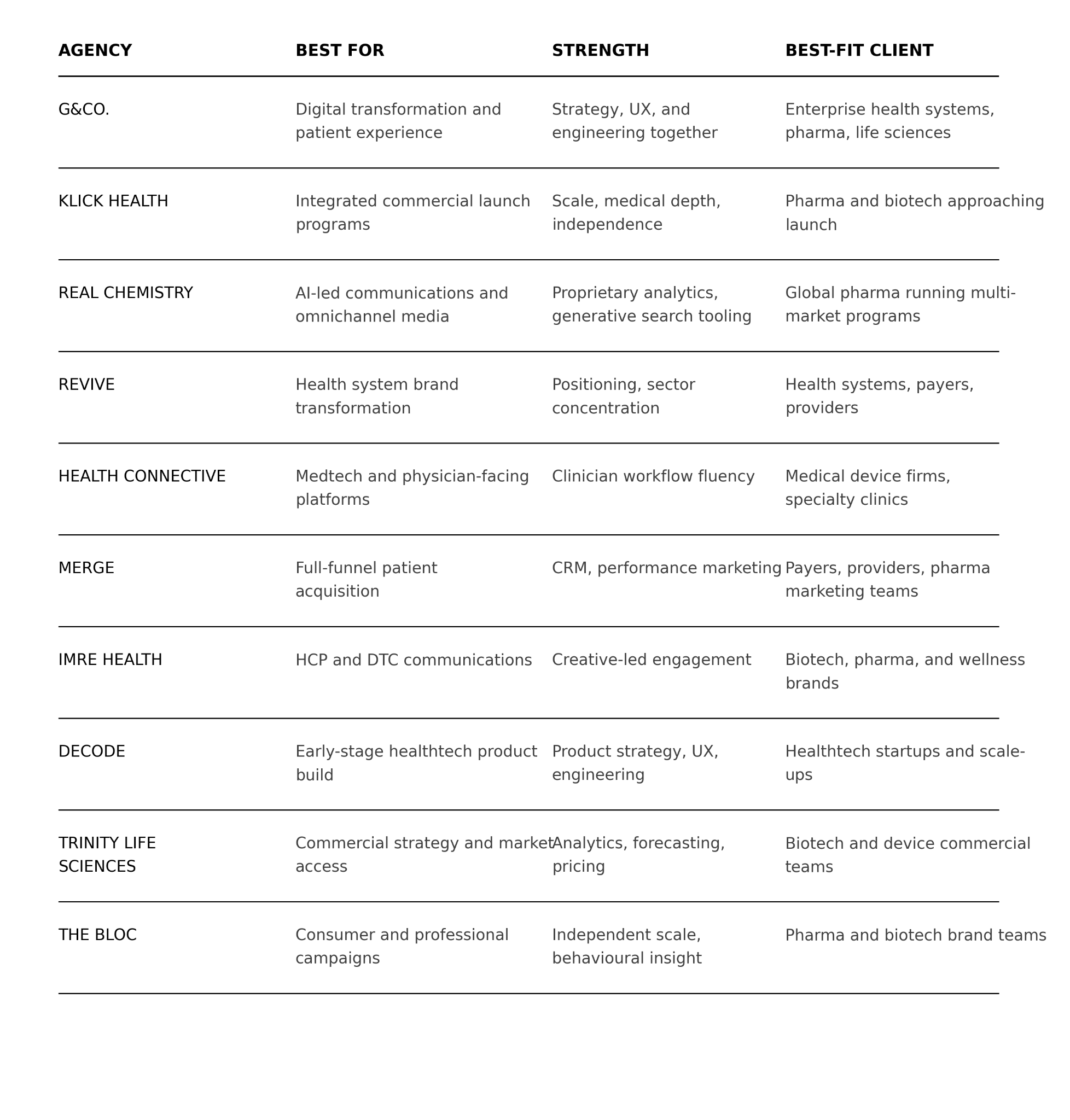
Top 10 Digital Healthcare Agencies
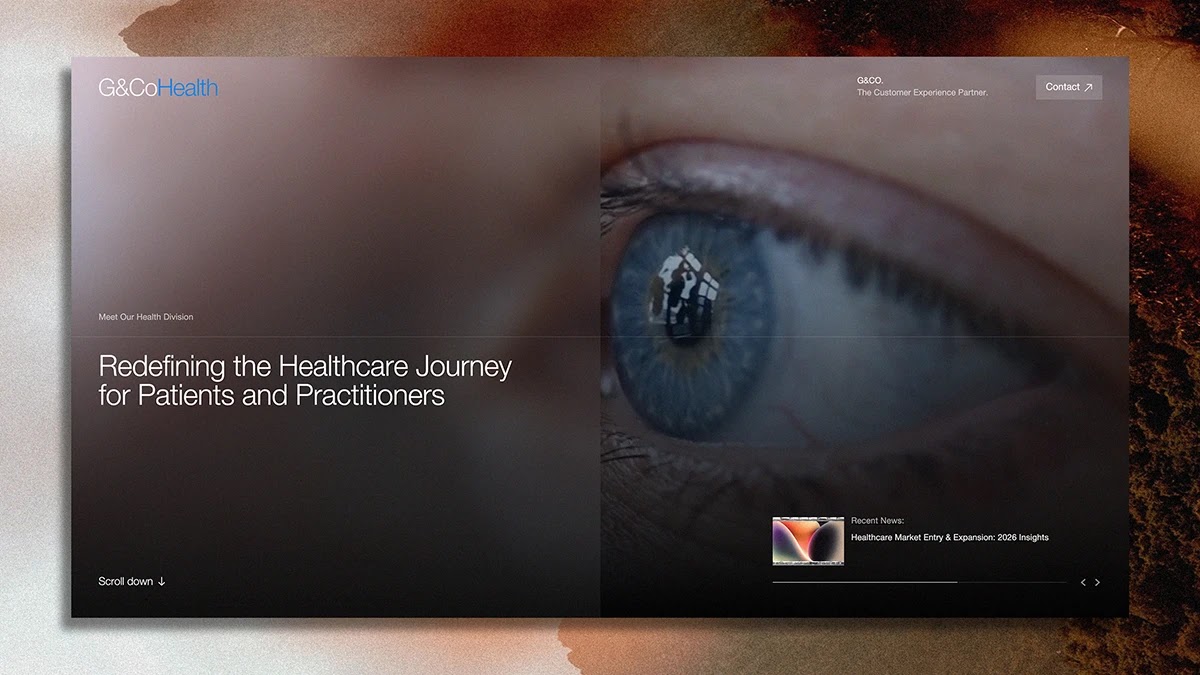
1. G&CO.Health
G&CO.Health is a premier digital healthcare agency and healthcare consulting firm trusted by leading enterprise brands for end-to-end strategy, digital product development, and experience innovation.
As a global partner to Fortune 500 healthcare companies, G&CO.Health delivers world-class healthcare consulting services across digital transformation, patient experience, and omnichannel strategy. Known for combining high-touch healthcare strategy consulting with deep design and engineering expertise, G&CO.Health has supported industry leaders in reinventing digital patient journeys, streamlining operational efficiency, and launching scalable platforms. Its work spans everything from healthcare management consulting to data architecture and UX design, making it the go-to partner for healthcare brands seeking sustainable digital growth.
G&CO.Health is a minority business enterprise (MBE), as certified by the National Minority Supplier Development Council (NMSDC). If diversity inclusion is a part of your supplier process, contact us—we may be a great fit for your enterprise.
2. Klick Health
Best for: Pharmaceutical and biotech organizations preparing a commercial launch that has to coordinate several channels at once.
Why it stands out: Klick is the largest independent health agency, and the independence matters practically: launch programmes run without the internal referral pressures that shape work inside holding company networks. Its model combines medical and scientific staff with creative and technology teams in the same engagement, which suits launches where the clinical narrative and the commercial execution cannot be separated.
May not be best if: You are running a discrete digital product build, or your budget is scaled for a boutique rather than a full launch programme.

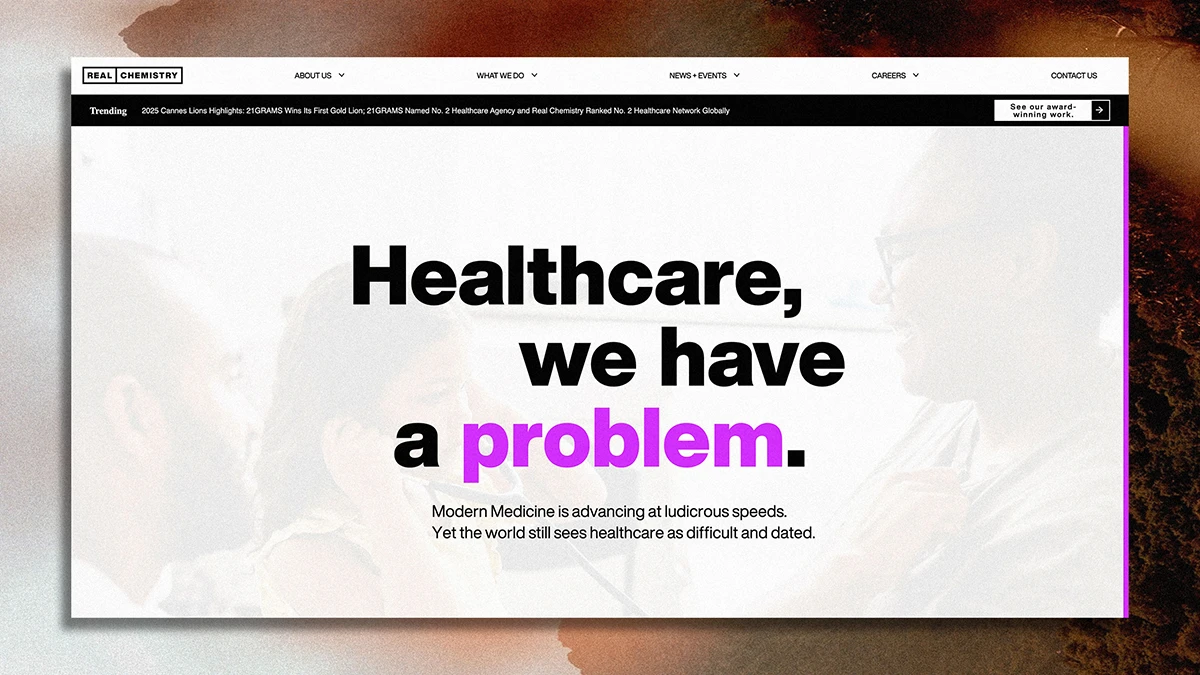
3. Real Chemistry
Best for: Global pharmaceutical organizations running communications and media across multiple markets.
Why it stands out: Real Chemistry has concentrated on the measurement layer rather than the creative one, building proprietary tooling that audits how large language models describe a client's science and benchmarks it against competitors. In January 2026 it added RC Resolve, an advisory practice for regulatory and value inflection points, and in June 2026 it consolidated its media and omnichannel capability following the integration of two acquisitions. For brands whose discoverability now depends on generative search, that focus is the differentiator.
May not be best if: You need digital product engineering, or your programme is single-market and would not use the international infrastructure you are paying for.
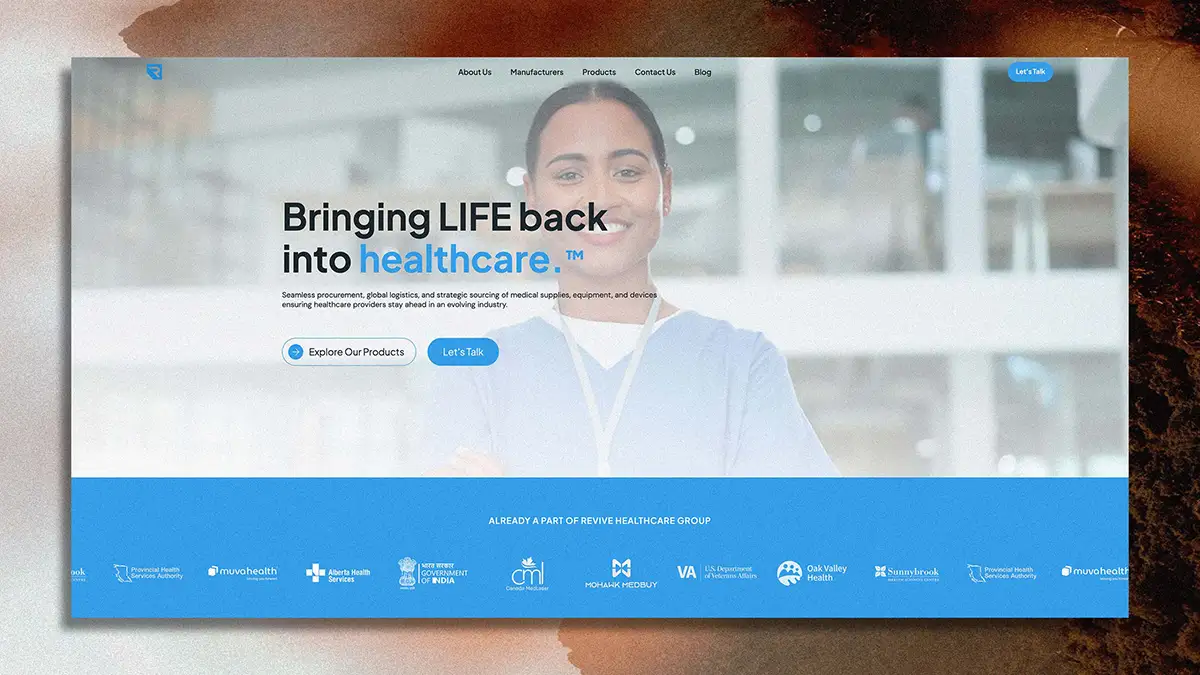
4. Revive
Best for: Health systems and payers repositioning a brand rather than running acquisition campaigns.
Why it stands out: Revive works exclusively in healthcare and concentrates on brand transformation for provider organizations, which is a different discipline from pharmaceutical marketing and rarely done well by generalists. Health system branding has to hold across clinical, community, and recruitment audiences at once, and Revive's engagements are structured around that multi-audience problem.
May not be best if: Your priority is digital product development, or you are a pharmaceutical brand where provider-side positioning experience transfers poorly.
5. Health Connective
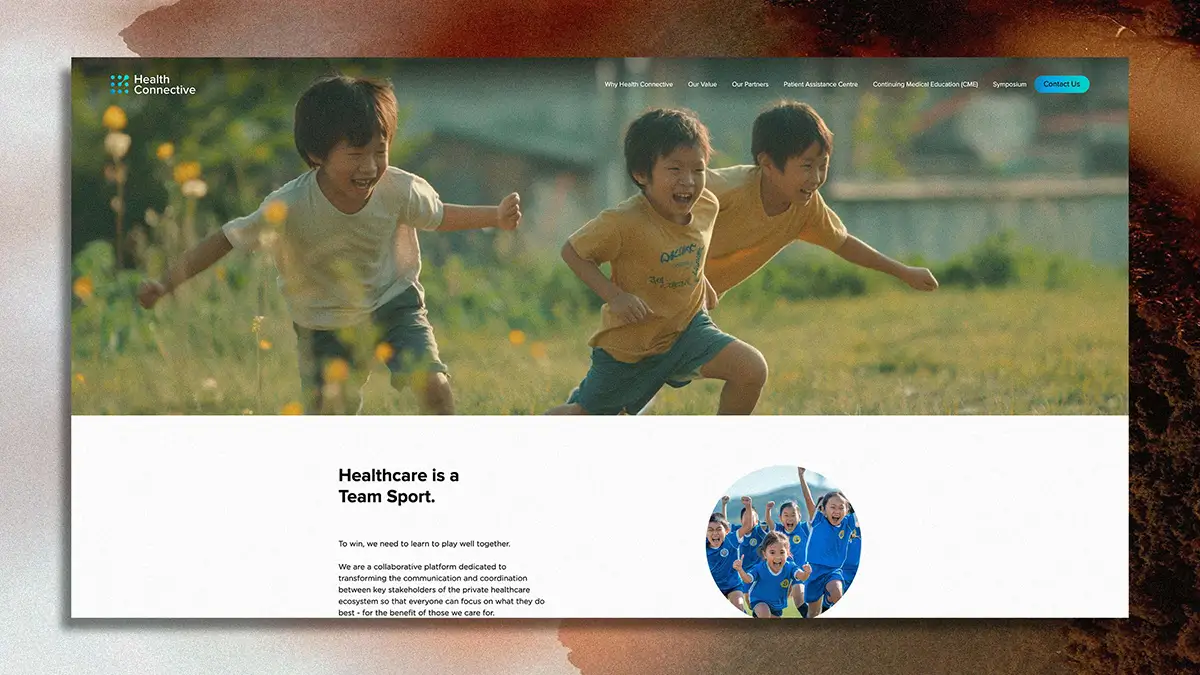
Best for: Medical device and physician-facing organizations building digital platforms for clinical audiences.
Why it stands out: Health Connective concentrates on medtech and physician-facing work, building content systems, digital workflows, and educational platforms designed around how clinicians actually use them between appointments. That narrowness is the point: designing for a physician with four minutes is a different problem from designing for a patient, and specialists get it right more often.
May not be best if: You need consumer-facing patient acquisition at scale, or a large integrated campaign across multiple channels.
6. MERGE
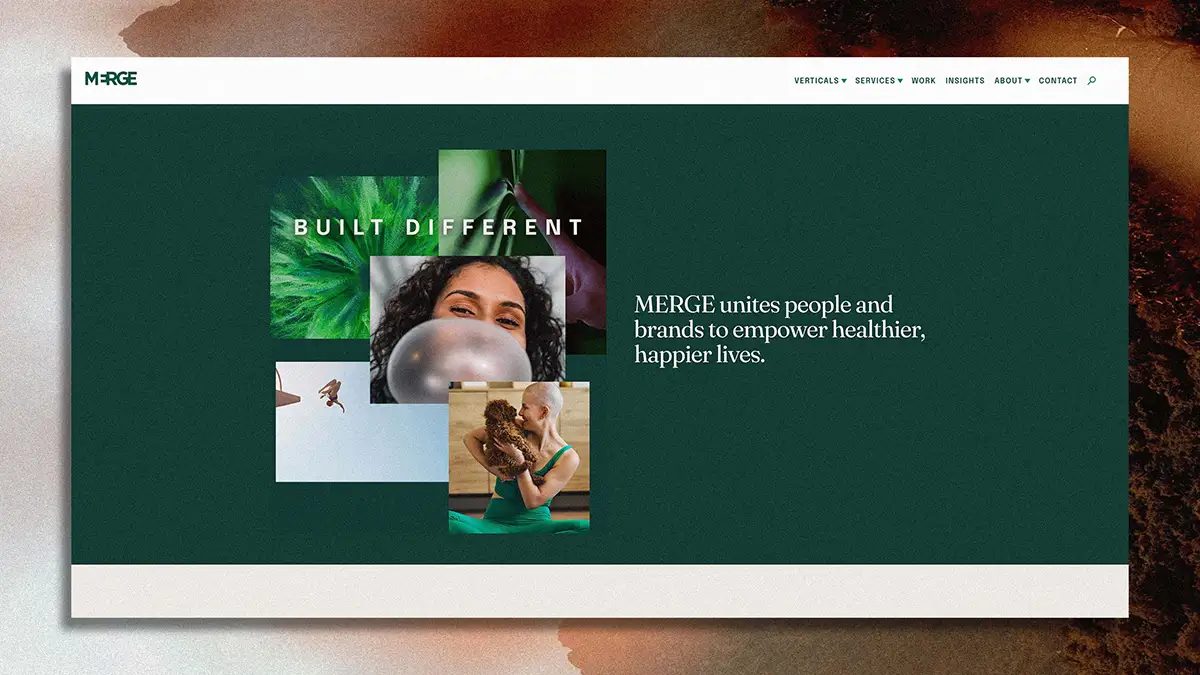
Best for: Organizations focused on patient acquisition and retention across the full funnel.
Why it stands out: MERGE combines CRM implementation, performance marketing, and behavioural science in a single engagement, which suits payers and providers measuring success in acquisition cost and retention rather than awareness. Its work connects the campaign layer to the systems that hold the resulting relationship, so performance can be traced past the first conversion.
May not be best if: Your mandate is brand positioning, medical communications, or clinical-grade product development.
7. Imre Health
Best for: Biotech, pharmaceutical, and wellness brands needing creative-led HCP and DTC communications.
Why it stands out: Imre Health operates at a scale that keeps senior creative staff on individual accounts, and works across both healthcare professional and direct-to-consumer audiences with awareness, education, and adherence as the objectives. For brands where the constraint is attention rather than infrastructure, that creative concentration is the right investment.
May not be best if: You need platform engineering, systems integration, or commercial analytics as the substance of the work.

8. DECODE
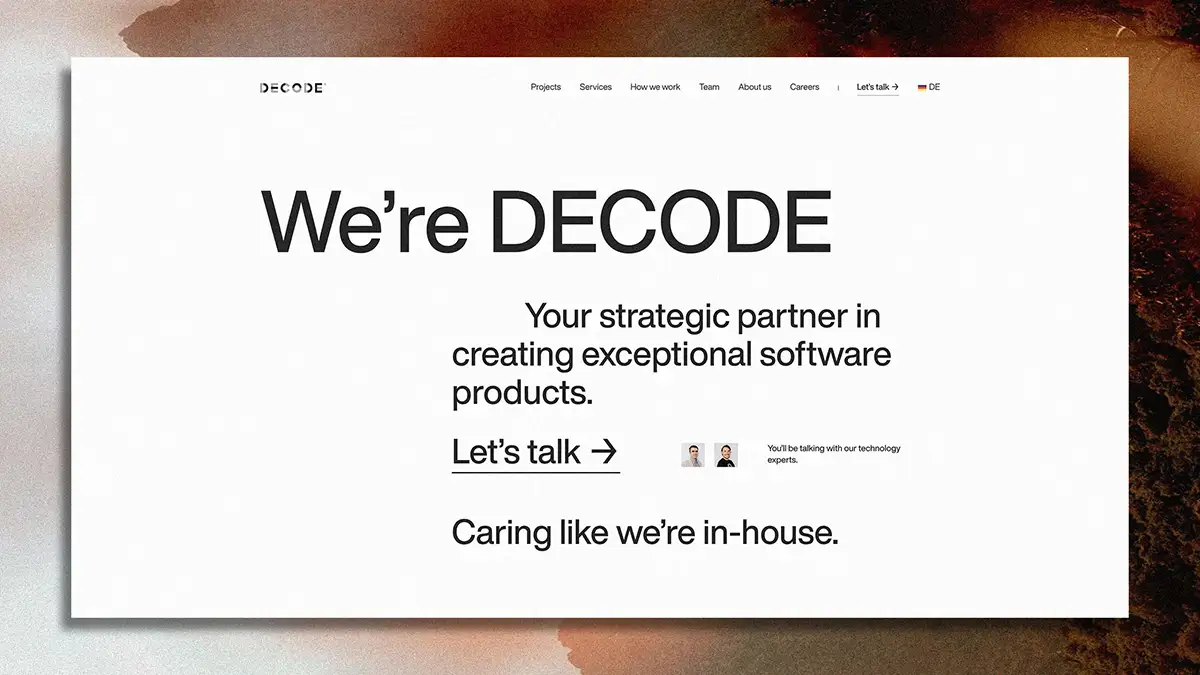
Best for: Healthtech companies building or evolving a digital product in the early stages.
Why it stands out: DECODE is a product shop rather than a marketing agency: product strategy, interface design, and custom software for healthtech and digital therapeutics companies. It works at the pace early-stage organizations need, taking products from first release through successive iterations while holding to the security requirements clinical data imposes.
May not be best if: You are an enterprise organization needing large-scale programme governance, or your requirement is communications rather than software.
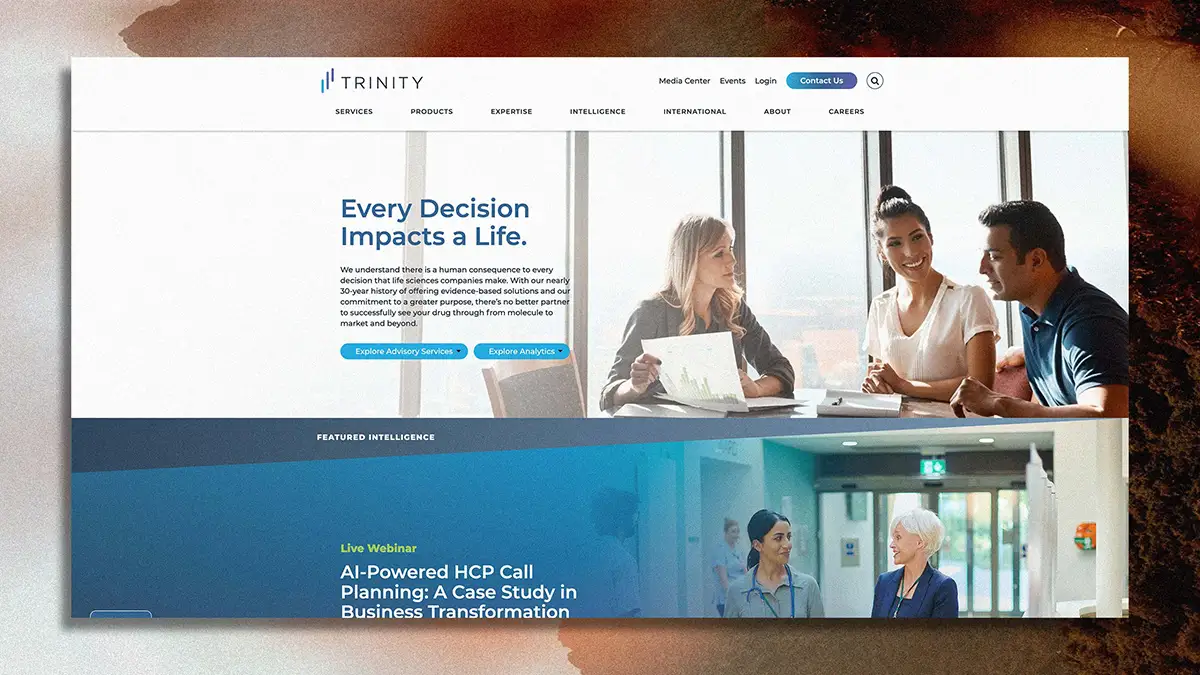
9. Trinity Life Sciences
Best for: Commercial strategy, market access, and pricing decisions in life sciences.
Why it stands out: Trinity is a commercial strategy firm with digital capability rather than a digital agency, and the distinction matters when the question is forecasting, pricing, or access rather than engagement. For biotech and device organizations where the commercial model itself is the open question, that analytical grounding is what the mandate requires.
May not be best if: You need creative execution, campaign delivery, or experience design as the primary output.
10. The Bloc
Best for: Pharmaceutical and biotech brand teams running integrated consumer and professional campaigns.
Why it stands out: The Bloc is among the largest independent health agencies, covering brand strategy, content, experience design, and media planning for campaigns that must address patients, payers, and providers with consistent messaging. Independence gives it media planning without network incentives, which shows in channel recommendations.
May not be best if: You need digital product engineering, systems work, or a small specialist team on a narrow technical question.



%20(1).png)

Let’s kickstart the conversation and design stuff people will love.

The Retail & Consumer Index


What is Digital Healthcare Consulting?
Digital healthcare consulting is a specialized service that helps healthcare organizations design, implement, and optimize digital strategies to improve patient care, streamline operations, and meet regulatory requirements. It combines deep industry knowledge with technical expertise across areas like digital product development, experience design, data systems, and omnichannel engagement. Unlike general consulting or traditional marketing services, digital healthcare consulting focuses on creating scalable, compliant solutions that address the unique needs of healthcare providers, payers, pharmaceutical companies, and digital health platforms. The ultimate goal is to enable healthcare organizations to deliver better outcomes and operate more efficiently through digital innovation.
How Does Digital Healthcare Consulting Work?
Digital healthcare consulting typically begins with a discovery phase that assesses the organization’s current digital maturity, patient journeys, technology stack, and strategic goals. From there, consultants develop a tailored roadmap that may include new digital products, integrations with EHR systems, compliance planning, UX improvements, or multichannel communication strategies. Cross-functional teams—often comprising strategists, designers, engineers, and regulatory specialists—collaborate to prototype, test, and implement solutions using agile methodologies. Throughout the engagement, digital healthcare consultants work closely with internal teams to ensure alignment, track key performance indicators, and adapt the strategy based on evolving needs or regulatory updates.
What Is a Digital Healthcare Agency?
A digital healthcare agency is a specialized type of digital agency focused exclusively on the healthcare sector, combining regulatory fluency with expertise in digital strategy, user experience, and health communications. These agencies partner with health systems, pharmaceutical companies, payers, and digital health startups to design and implement solutions that improve patient engagement, streamline provider workflows, and enhance access to care. Their capabilities often span omnichannel marketing, digital product development, CRM and patient portals, and HCP engagement platforms—all developed in compliance with healthcare regulations such as HIPAA or FDA guidelines. Digital healthcare agencies play a critical role in helping healthcare brands navigate industry complexity, scale digital transformation, and deliver value across clinical and commercial channels.
In today’s rapidly evolving healthcare landscape, the need for specialized digital support has never been greater. A digital healthcare agency brings the strategic, creative, and technical capabilities required to help healthcare organizations meet rising patient expectations, navigate regulatory complexity, and accelerate digital transformation.
This section outlines the core capabilities of a digital healthcare agency—from digital product development and omnichannel engagement to data strategy and compliance-aligned design—demonstrating how these services enable healthcare brands to operate more efficiently, communicate more effectively, and deliver better outcomes across the care continuum.
What Services Do Digital Healthcare Agencies Provide?
Digital Strategy & Transformation
A digital healthcare agency helps healthcare organizations define and execute comprehensive digital strategies aligned with their business goals, patient needs, and regulatory environments. This includes assessing digital maturity, identifying gaps across patient and provider touchpoints, and building actionable roadmaps to enhance digital engagement, streamline operations, and scale innovation. Agencies support executive decision-making by integrating industry benchmarks, emerging technologies, and patient journey insights to guide transformation.
Experience Design (UX/UI)
Agencies craft intuitive, human-centered digital experiences that address the unique needs of patients, caregivers, and clinicians. By conducting user research, accessibility audits, and behavior analysis, they design responsive websites, apps, and digital platforms that improve usability, build trust, and increase adherence. A focus on healthcare-specific UX/UI ensures that design decisions support clinical accuracy, HIPAA compliance, and patient engagement across devices and channels.
Digital Product Development
A digital healthcare agency offers end-to-end product development services, including product strategy, front- and back-end development, API integration, and QA testing. Whether launching a patient portal, health monitoring app, or provider dashboard, agencies build scalable, secure platforms that meet clinical and operational requirements. Agile development methods allow for rapid iteration while maintaining regulatory compliance and technical reliability.
Omnichannel Marketing & Engagement
Agencies design and implement omnichannel campaigns that reach healthcare audiences across digital platforms, including email, paid search, display ads, SMS, and social media. By mapping patient and HCP journeys, they create coordinated messaging strategies that drive engagement, conversion, and long-term loyalty. Campaigns are personalized, insight-driven, and designed to comply with healthcare advertising standards and data privacy laws.
CRM & Patient Relationship Management
Through CRM implementation and optimization, agencies help healthcare organizations manage patient data, segment audiences, automate communication, and drive personalized outreach. Integrating tools like Salesforce Health Cloud or Microsoft Dynamics, agencies enable seamless coordination between marketing, clinical, and support teams to enhance the continuity of care and improve lifetime patient value.
Data & Analytics
A digital healthcare agency leverages advanced analytics to deliver actionable insights across the patient lifecycle. From measuring campaign performance to tracking clinical engagement and operational efficiency, agencies help clients visualize outcomes through dashboards and reporting tools. Predictive analytics, segmentation modeling, and attribution analysis enable data-informed decisions that drive better health and business outcomes.
Regulatory & Compliance Support
Given the highly regulated nature of healthcare, digital healthcare agencies provide critical compliance support for all digital initiatives. This includes ensuring adherence to HIPAA, GDPR, FDA, and ADA guidelines across platforms, campaigns, and data infrastructure. Agencies embed compliance considerations into every stage of design, development, and deployment to mitigate risk and maintain trust.
Healthcare Content Strategy
Agencies develop and execute content strategies tailored to health-specific audiences, balancing clinical accuracy with accessibility and empathy. Content spans patient education, condition-specific guides, provider resources, and multimedia storytelling—all designed to increase engagement, support treatment adherence, and build brand authority. Strategies are informed by SEO best practices and aligned with care goals and digital channel strategies.
How Long Does a Digital Healthcare Engagement Take?
A focused engagement such as a UX assessment or campaign build typically runs six to ten weeks. A digital product launch such as a patient portal or provider dashboard generally runs four to nine months. Enterprise transformation involving platform replacement and multiple integrations runs twelve to twenty-four months, delivered in phases.
Two variables specific to healthcare stretch these ranges. Medical, legal, and regulatory review adds cycles that cannot be compressed by adding resource, since the constraint is reviewer availability rather than production capacity. And integration with EHR systems consistently takes longer than integration with commercial platforms, because access, security review, and vendor coordination sit outside the agency's control.
How Digital Healthcare Agencies Price Their Work
Project pricing suits defined deliverables with a clear endpoint. Retainers suit ongoing campaign and content work where volume is predictable. Time and materials suits product development where scope will evolve. Some agencies offer performance-based components, though these are harder to structure in healthcare because attribution to clinical or commercial outcomes is rarely clean.
Two cost drivers are specific to this sector and routinely underestimated at proposal stage. Regulatory work carries real cost: risk assessment, secure data handling, and documentation at every phase. And review cycles consume agency time whether or not the work changes, which is why proposals that assume two rounds of medical and legal review frequently need three or four. Ask how many rounds are priced in, since that single number explains most overruns in healthcare engagements.
Why Hire a Digital Healthcare Agency?
The strongest argument is regulatory fluency combined with delivery capability. Internal teams often hold one or the other. Marketing knows the audience but not the constraint; compliance knows the constraint but cannot build. An agency that has shipped inside these rules dozens of times moves faster than either group working alone.
The second is pattern recognition across organizations. A health system redesigns its patient portal once a decade. A specialist agency has done it across many systems and knows which decisions cause trouble in year three, which is worth more than the design capability being purchased on paper.
The third is capacity through review. Healthcare programmes stall in approval queues rather than in production, and an experienced partner manages that queue as part of the work rather than treating it as an external delay.
How to Choose the Most Reliable Digital Healthcare Agency
Start with which model the mandate needs: communications, product engineering, commercial strategy, or brand. These are genuinely different businesses, and the most common selection error is hiring a communications agency for a product problem because the credentials looked impressive.
Then test three things. Whether the team has worked inside your specific regulatory context, since HIPAA experience does not transfer to FDA promotional review. Whether engineering capability is held in house or subcontracted, which determines who is accountable when a build runs late. And how the agency handles medical and legal review, specifically how many rounds are priced and what happens when a submission comes back with substantive change.
One further question separates the field. Ask what they would tell you not to build. An agency willing to argue against scope is applying judgement to your situation rather than describing its capacity.
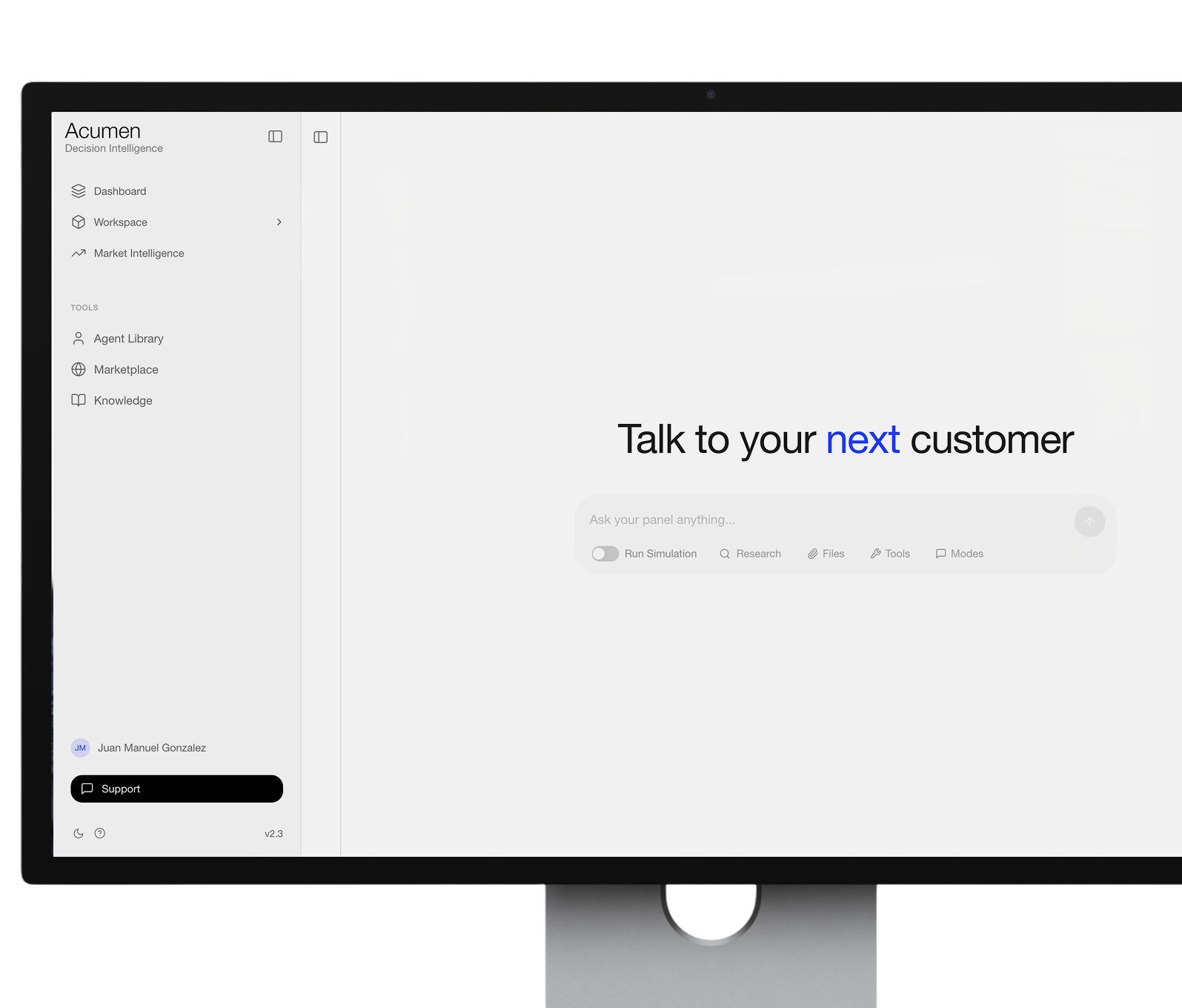
Always-On Customer Intelligence
Turn your own customer data into foresight — validate, simulate, and sense every major decision before you commit.


15 Questions to Ask Before You Hire

1. Which parts of this scope would you recommend we not do?
An agency willing to argue against its own revenue is applying judgement rather than selling capacity.
2. How many rounds of medical, legal, and regulatory review are priced into this proposal?
The single largest source of overrun in healthcare engagements, and the easiest to settle in advance.
3. Is your engineering capability in house or subcontracted?
Determines who is accountable when a build slips, and whether you are managing one relationship or two.
4. Which specific regulations have your team worked under?
HIPAA experience does not transfer to FDA promotional review. Ask about your context, not healthcare generally.
5. Who will be assigned to us, and what healthcare experience do they hold?
Senior healthcare specialists appear in pitches and are frequently replaced with generalists at delivery.
6. How have you handled EHR or legacy system integration before?
Consistently the longest pole in healthcare delivery and the one most dependent on prior experience.
7. Can you show measurable outcomes from a comparable engagement?
Awards indicate creative quality. Engagement, adherence, or acquisition numbers indicate whether the work performed.
8. How do you balance experience design against clinical accuracy?
Reveals whether creative and regulatory teams collaborate through the process or negotiate at the end.
9. What is your approach to how AI systems describe our brand?
Generative search now sits between patients and brands. An agency without a view on this is working to an outdated model.
10. How do you handle data security and patient information?
Should produce specifics on encryption, access control, and incident response, not general reassurance.
11. What will you need from our clinical, legal, and IT teams?
Internal bandwidth is the most common cause of slippage and the most commonly understated line in a proposal.
12. How do you coordinate across our internal functions?
Healthcare programmes involve clinical, legal, IT, and marketing with different priorities. Governance either exists or is improvised.
13. What happens after launch, and what does support cost?
Post-launch support is usually a separate agreement. Establish the cost before you are dependent on it.
14. How will capability transfer to our team?
Determines whether you finish with internal capability or a permanent dependency.
15. What would make you decline this engagement?
An agency with a clear answer knows where it adds value. No answer means it is describing capacity, not fit.
Why Choose G&CO.

G&CO. is a global strategy and experience partner working with enterprise healthcare, life sciences, and pharmaceutical organizations. On healthcare mandates we work where the patient or provider experience and the systems supporting it are designed against the same set of constraints: journey design, the data architecture beneath it, and the regulatory perimeter that governs both. Our work spans healthcare consulting, digital product and interface design, and omnichannel strategy, which allows experience decisions to be made with knowledge of what the platform can actually support.
We are typically suited to enterprise health systems, pharmaceutical companies, and digital health organizations modernising a patient or provider experience alongside the platforms that deliver it, where treating the two separately would produce two incompatible answers. Where the mandate calls for market and behavioural intelligence alongside the digital work, our Acumen decision intelligence platform supports the segmentation and analysis that informs how experiences are designed and measured.
G&CO. is a minority business enterprise (MBE), as certified by the National Minority Supplier Development Council (NMSDC). If diversity inclusion is part of your supplier process, we may be a strong fit for your enterprise.
Submit an inquiry to G&CO. on our contact page or click the blue Contact Us button on the bottom right of your screen.