Shopify Case Study: Building the Retail Operating System
This Shopify case study examines how Shopify turned itself from an ecommerce platform into a retail operating system: one connected system that runs a merchant's entire business, online store, checkout, payments, point of sale, shipping, and apps, so sellers do not have to build or stitch the technology together themselves. The Shopify business model is built to grow with its merchants: it lands them on a subscription, then earns more as their sales grow through payments and other services. With millions of merchants across 175-plus countries and hundreds of billions of dollars in sales flowing through it each year, Shopify shows the power of selling the infrastructure others build their businesses on.
Shopify gives millions of merchants a single retail operating system to run their whole business, online, in store, payments, and shipping, instead of stitching together a dozen separate tools.
Running a modern retail business takes a dozen different systems: a website, a checkout, a payment processor, a point-of-sale for the shop floor, inventory, shipping, and a way to sell on social media and marketplaces too. For most sellers, wiring all of that together is expensive, technical, and fragile. Shopify's answer was to build it once, as one connected system, and rent it to everyone.
This case study looks at how Shopify grew from a simple online-store builder into the retail operating system for millions of businesses, and how its business model is designed so that Shopify makes more money only when its merchants do. For enterprise leaders, the lesson has nothing to do with selling online specifically. It is about the durable advantage of becoming the infrastructure other companies build on, rather than competing as one of those companies.
Key Points
- Shopify is an operating system for commerce: one system that runs a merchant's whole business. Storefront, checkout, payments, point of sale, shipping, and apps live in one place, so a seller does not have to stitch separate tools together.
- Shopify lands a merchant on a subscription, then earns more through payments and services as that merchant's sales grow, so its revenue rises with its merchants' volume rather than at their expense.
- It unifies online, in-store, social, and B2B into one back end. That omnichannel commerce lets a merchant manage every channel from a single system, instead of running separate platforms that do not talk to each other.
- An open ecommerce API and app store extend it further. Developers build apps and custom storefronts on Shopify's platform, so it keeps expanding without Shopify building every feature itself.
- Shopify powers millions of merchants across 175-plus countries and handles hundreds of billions of dollars in sales a year, roughly a tenth of U.S. ecommerce.



.png)
%20(1).png)

Let’s kickstart the conversation and design stuff people will love.

The Retail & Consumer Index


Why This Matters
For CEOs, CIOs, chief digital officers, and anyone deciding whether to build or buy the systems their business runs on, Shopify is a clear demonstration of the value in being the platform rather than the participant. Millions of businesses concluded it was smarter to rent Shopify's infrastructure than to build their own, and Shopify built a very large, durable company by being what they rent.
The timing matters. Commerce has fractured across channels, a brand now sells on its own site, in stores, on social apps, through marketplaces, and directly to other businesses, and keeping all of that running on separate systems has become unmanageable for most companies. The demand is for one system that ties it together. Shopify is the clearest example of a company that built that system and turned it into a platform others depend on, which makes it instructive for any leader weighing the same build-versus-rent question in their own industry.
Strategic Context

For most of retail's history, the technology to run a store, especially an online one, had to be assembled from many separate pieces, each from a different vendor, each needing to be integrated and maintained. That worked for large companies with engineering teams, but it locked out the millions of smaller merchants who could not afford to build it. Even large brands found that stitching together a website, a payment system, a point-of-sale, and a shipping operation produced a brittle patchwork that broke as they grew or added channels.
Shopify was built on a different premise: that the underlying systems every merchant needs are largely the same, so they could be built once, as one platform, and offered to everyone. That reframed the problem from "help each merchant build their store" to "become the system all merchants run on." The strategic choice at the heart of this case is that Shopify did not set out to be the best online-store builder; it set out to be the operating system for commerce, the layer a business runs on the way a computer runs on an operating system, and then to make money as its merchants grew on top of it.
Company Response
Bundle the whole stack into one system.
Rather than sell a website tool and leave the rest to the merchant, Shopify built or absorbed every core piece a business needs, storefront and checkout, Shopify Payments, point-of-sale hardware and software for physical shops, shipping and fulfillment, and business financing, into a single system. A merchant runs online sales, in-store sales, and everything behind them from one back end. This is what makes Shopify a operating system for commerce rather than just an ecommerce platform: the merchant does not integrate a dozen vendors, they turn on modules of one platform.
Make the business model grow with the merchant.
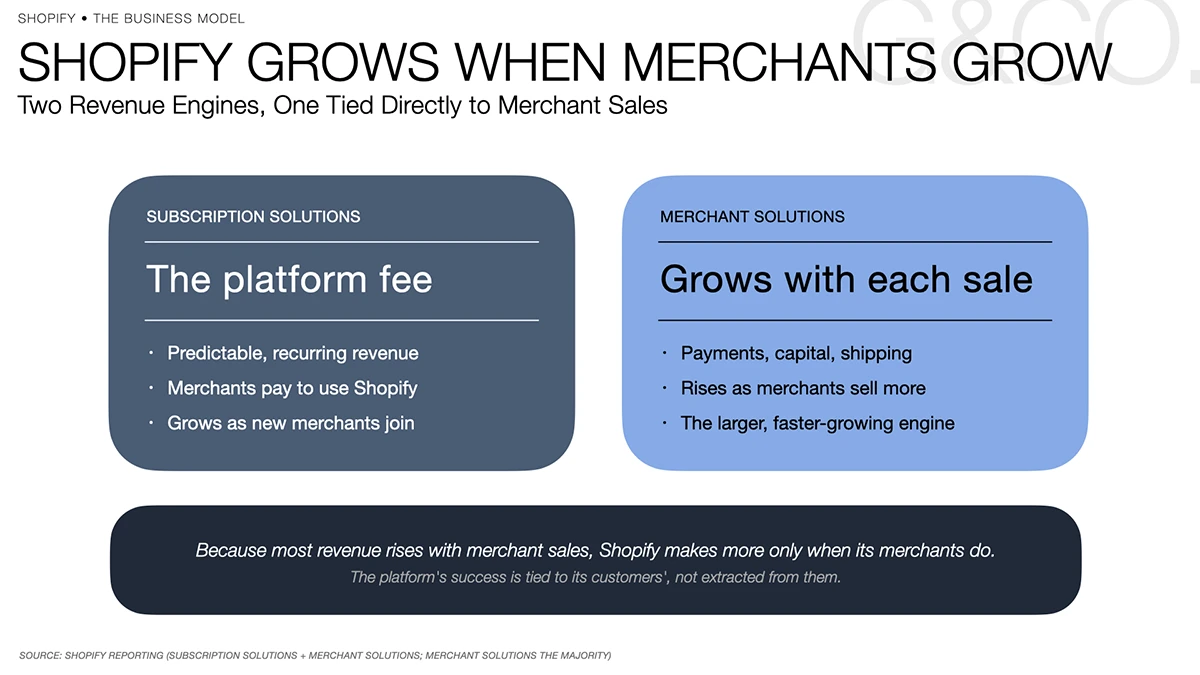
Shopify earns money two ways, and the mix is the point. Subscription Solutions is the predictable fee merchants pay to use the platform. Merchant Solutions, the larger and faster-growing part, is everything that scales with a merchant's sales: payments, capital, shipping, and more. Because Merchant Solutions revenue rises as a merchant sells more, Shopify's income is tied to its merchants' success rather than extracted at their expense. Shopify grows when its merchants grow, which aligns the platform with the people on it and is the core of the Shopify business model.
Unify every channel and open the platform.
Shopify pulled online, in-store, social, marketplace, and business-to-business selling into one system, so a merchant manages all of it, and sees all of it, in one place. That is real omnichannel commerce, not a set of disconnected tools. And through an open ecommerce API, an app store, and developer tools, Shopify let outside developers build apps, integrations, and custom storefronts on top of the platform. That ecosystem extends Shopify's capabilities far beyond what it could build alone and makes the platform stickier: the more a merchant relies on apps built on Shopify, the harder it is to leave.
The approach carries real tension.
Bundling everything into one system means Shopify must keep every piece competitive, from payments to point-of-sale, against specialists who do only one thing. And as Shopify moves upmarket to win larger enterprise brands (through Shopify Plus), it takes on bigger, more demanding customers with complex needs, a different challenge from serving small merchants at scale. But the breadth is also the moat: a competitor can beat one module, but not easily replace the whole operating system a merchant's business runs on.
Always-On Customer Intelligence
Turn your own customer data into foresight — validate, simulate, and sense every major decision before you commit.


Results and Evidence
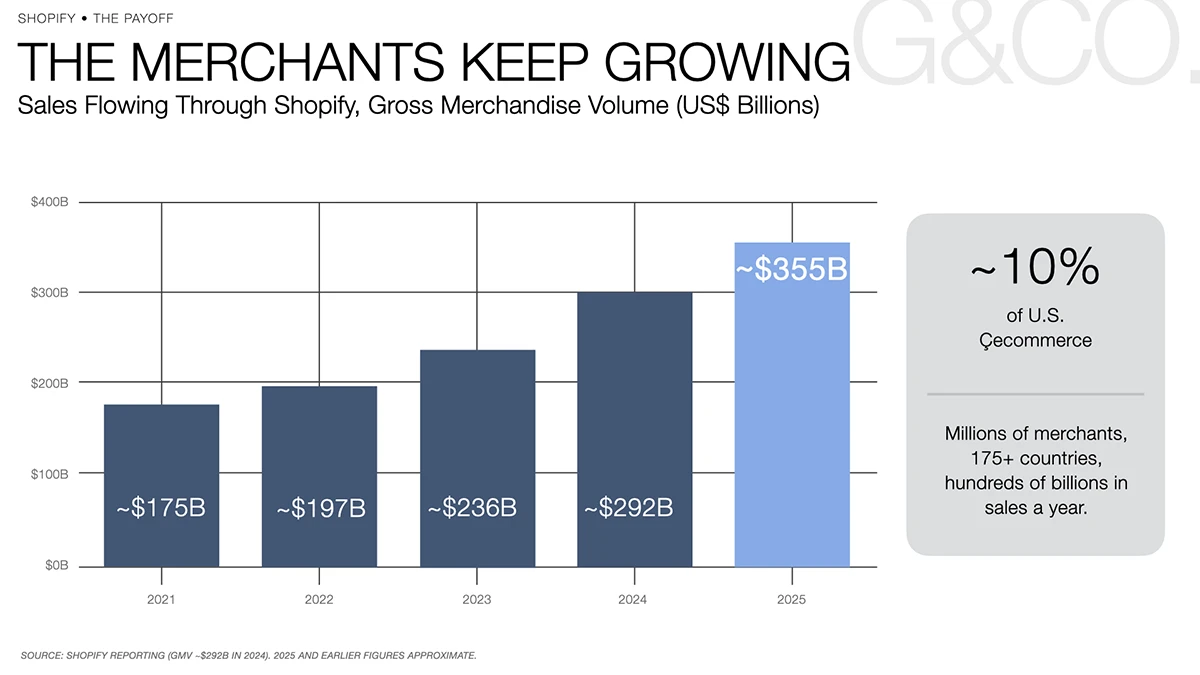
The evidence is in the scale and the revenue mix. Shopify powers millions of merchants across more than 175 countries and processes hundreds of billions of dollars in sales (gross merchandise volume) each year, an amount that has kept growing at double-digit rates and represents roughly a tenth of U.S. ecommerce. Revenue has grown accordingly, into the range of roughly $9 billion to $11 billion a year, and the tell is which part is growing fastest: Merchant Solutions, the revenue that scales with merchants' sales, now makes up the large majority of the total, which is the clearest proof that the model of growing with merchants is working. Shopify Payments handles a large and rising share of the sales on the platform, deepening both the revenue and the integration. Shopify has also moved successfully upmarket, winning large enterprise brands onto Shopify Plus, which shows the operating system can serve the top of the market as well as the bottom. These figures come from Shopify's public reporting and are worth confirming against the latest results before publishing, since this names a real company and the numbers update each quarter.
Strategic Implications
Read at scale, Shopify is a case about becoming the operating system for an industry, and it connects to the broader shifts in enterprise architecture, digital transformation, platform economics, and omnichannel commerce. The pattern is repeatable well beyond retail: in many industries, every participant needs the same underlying systems, and a company that builds those systems once and offers them as one platform can capture value from the entire industry rather than competing within it. Shopify did not try to be the best store; it became the thing every store runs on.
The deeper implication is the alignment built into the model. Because Shopify makes more only when its merchants sell more, it has an incentive to keep making its merchants successful, which keeps them on the platform, which compounds. This is the opposite of a zero-sum vendor relationship, and it is why the platform is so durable. For enterprise leaders, the takeaway is to look for the layer in their own industry that everyone needs and no one wants to build, and to consider whether owning that layer, and tying their success to their customers' success on top of it, is a stronger position than competing as one more participant. The companies that become the operating system others depend on tend to outlast the companies that merely run on one. The same own-the-layer strategy drives Wise's payment rails, Nvidia's CUDA platform, and Figma's design platform.
What Enterprise Leaders Can Learn
- Find the layer everyone needs and no one wants to build.
Shopify's opportunity was the common infrastructure every merchant required; owning that layer is more durable than competing on top of it. - Bundle into one system where integration is the pain.
When customers struggle most with stitching tools together, a single connected platform is worth more than any individual best-in-class tool. - Align your revenue with your customers' success.
A model that earns more only when customers grow (like Merchant Solutions) builds loyalty a zero-sum pricing model cannot. - Open the platform to extend it.
An ecommerce API and app ecosystem let others add value you would never build yourself, and every app built on your platform raises the cost of leaving. - Decide deliberately about moving upmarket.
Serving enterprise customers is a different business from serving small ones; the operating system can stretch, but the demands and support change.
Conclusion
Shopify's story is not really about building online stores. It is about the difference between selling a product to an industry and becoming the system that industry runs on. By bundling everything a merchant needs into one connected platform, tying its own revenue to its merchants' growth, and opening the system to a developer ecosystem, Shopify made itself the operating system for commerce for millions of businesses, and built a very large company by being the infrastructure they rent rather than a competitor they fight. For enterprise leaders, the transferable lesson is to look past competing within an industry and ask whether there is a layer of common infrastructure worth owning, and whether tying your success to your customers' success on top of it is the more durable position. In most industries, the company that becomes the operating system outlasts the ones that merely run on it.
Through the Acumen platform, G&CO. gives enterprise brands the intelligence to make platform and infrastructure decisions with evidence: where the common layer in your industry is, what customers struggle most to build themselves, and whether owning that layer is a stronger position than competing on top of it. G&CO. is a certified minority business enterprise through the National Minority Supplier Development Council (NMSDC). For enterprise organizations with diversity inclusion requirements in their procurement process, G&CO. meets the criteria for MBE-qualified partner status.
G&CO. works with enterprise brands on the architecture, commerce, and platform strategy that turns fragmented systems into one connected operating system for the business. If this Shopify case study raises questions about your own operating system for commerce, ecommerce platform, or omnichannel commerce strategy, submit an inquiry to G&CO. on our contact page or click the blue "Click to Contact Us" button in the bottom right corner of your screen. We look forward to hearing from you.
Frequently Asked Questions
What does it mean that Shopify is a operating system for commerce?
It means Shopify is not just a tool for building an online store; it is the single system a merchant runs their whole business on. Storefront, checkout, Shopify Payments, point-of-sale for physical shops, shipping, financing, and apps all live in one connected platform, the way programs run on a computer's operating system. A merchant turns on the modules they need rather than integrating a dozen separate vendors, which is what separates a operating system for commerce from a basic ecommerce platform.
How does the Shopify business model make money?
Shopify earns money two ways. Subscription Solutions is the recurring fee merchants pay to use the platform. Merchant Solutions, the larger and faster-growing part, is everything that scales with a merchant's sales: payments, capital, shipping, and more. Because Merchant Solutions revenue rises as merchants sell more, Shopify grows when its merchants grow, rather than making money at their expense. That alignment, Shopify succeeding only when its customers succeed, is the core of the Shopify business model and a big reason the platform is so durable.
How does Shopify support omnichannel commerce?
Shopify pulls a merchant's online store, physical shops (through its point-of-sale), social channels, marketplaces, and business-to-business selling into one back end, so the merchant manages and sees every channel in one place. That is true omnichannel commerce: inventory, orders, and customer data stay unified across channels rather than living in separate systems that do not talk to each other. For a growing business, that single view is often the main reason to move onto Shopify.
What role does the Shopify ecommerce API and app ecosystem play?
Shopify's open ecommerce API, app store, and developer tools let outside developers build apps, integrations, and custom storefronts on top of the platform. This extends Shopify's capabilities far beyond what it could build itself, so merchants can add almost any function they need, and it makes the platform stickier, because the more a merchant relies on apps built on Shopify, the harder it is to switch away. The ecosystem is a big part of why Shopify functions as an operating system rather than a fixed product.
What can enterprise leaders learn from the Shopify case study?
The core lesson is the durable advantage of becoming the infrastructure an industry runs on, rather than competing as one participant. Shopify found the common systems every merchant needed, built them once as one platform, tied its revenue to its merchants' growth, and opened the platform so others could extend it. The transferable playbook: look for the layer in your industry that everyone needs and no one wants to build, bundle it where integration is the real pain, align your success with your customers' success, and open it to an ecosystem. The company that becomes the operating system tends to outlast the ones that merely run on it.