Figma Case Study: How Product-Led Growth Made Design a Team Sport
This Figma case study examines how Figma turned design from a solo task into a real-time team activity in the browser, and grew through product-led growth rather than traditional enterprise sales. By making collaborative design the default, letting a whole team work in the same file at once, Figma spread from individual designers to entire product teams, then to most of the Fortune 500. Its design systems and end-to-end design workflow make it hard to leave, which is why Adobe tried to buy it for $20 billion before regulators blocked the deal and Figma went public instead.
Figma made design a real-time, browser-based team activity, and product-led growth spread it from single designers to most of the Fortune 500.
For most of its history, digital design was a solo activity. A designer worked in a file on their own computer, then exported images and handed them off to teammates and developers, who could not see the work until it was finished. Every change meant a new export, a new version, and another round of handoffs. Figma looked at that and asked a simple question: what if design worked like a shared document, where the whole team could be in the same file at the same time?
This case study looks at how Figma turned design into a collaborative, browser-based team activity, and how that collaboration fueled a product-led growth engine that spread the tool from individual designers to whole companies without a traditional sales force. For enterprise leaders, the lesson has nothing to do with design software specifically. It is about how making a product genuinely collaborative can turn its own users into its growth engine.
Key Points
- Figma made design collaborative and browser-based. Instead of a file on one designer's computer, a whole team works in the same design in real time from any browser, the way multiple people edit one shared document.
- It grew through bottom-up adoption, not enterprise sales. A free tier let individual designers adopt Figma on their own, then spread it to their teams and companies from the bottom up, so the product did the selling.
- It expanded beyond designers to the whole product team. Whiteboarding (FigJam) and design-to-developer handoff (Dev Mode) pulled in developers and product managers, so much of a company's product work now runs through Figma.
- Design systems make it sticky. Teams build shared component libraries, their design systems, in Figma that become the single source of truth, which is very hard to move off once a company standardizes on it.
- The stakes are real. Figma is used across most of the Fortune 500; Adobe agreed to buy it for $20 billion before regulators blocked the deal, and Figma went public in 2025 instead.


%20(1).png)

Let’s kickstart the conversation and design stuff people will love.

The Retail & Consumer Index


Why This Matters
For CEOs, chief product officers, heads of design, and any leader thinking about how software actually gets adopted, Figma is one of the clearest examples of bottom-up adoption working at scale. It grew into most large companies not through top-down enterprise sales but from the bottom up, one user at a time, because the product was good enough and collaborative enough to spread on its own. That is a fundamentally different, and often cheaper, way to build a software business.
The timing matters. Work has become collaborative and remote, and tools that assume a single user working alone increasingly feel broken. At the same time, buyers are tired of long enterprise sales cycles and want to try software before they commit. Figma sits at the intersection of both shifts: a genuinely collaborative product that sells itself through use. For any leader weighing how to build or buy software, and how adoption really happens inside their own organization, Figma is instructive.
Strategic Context
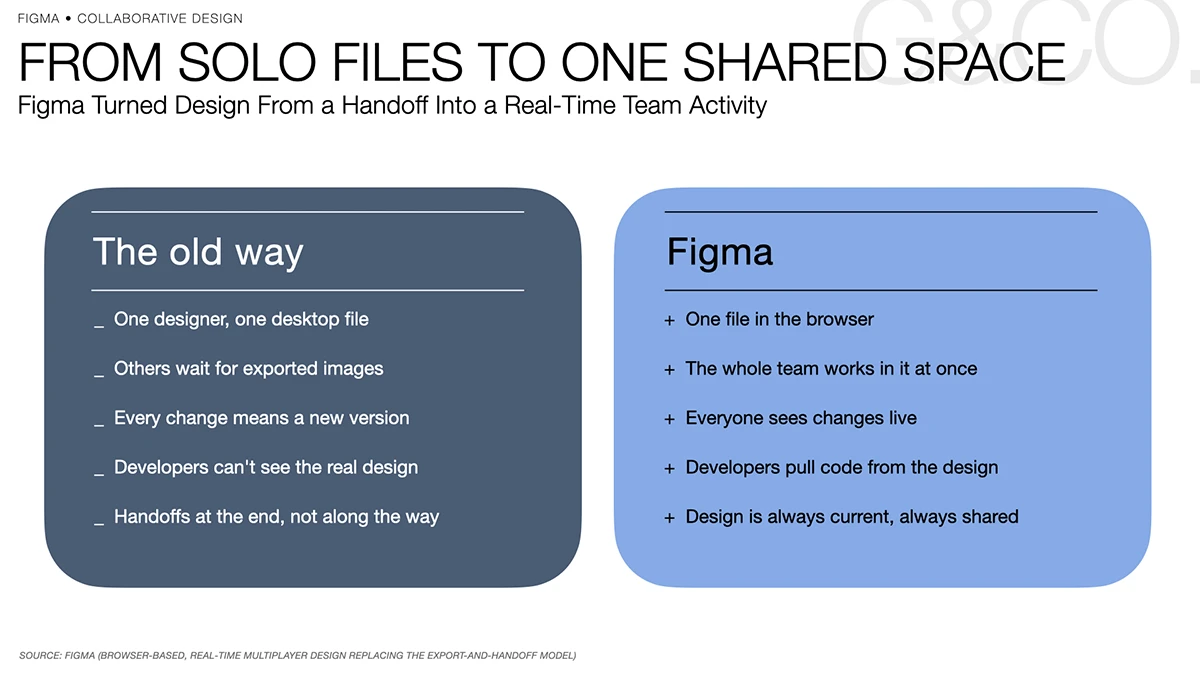
Design software was built around a single expert working alone. The tools were powerful but desktop-bound and solitary: one designer, one machine, one file, with everyone else waiting for an exported picture of the work. That created friction everywhere, designers could not easily work together, developers could not see the real design, and product managers were shut out until the end. As product teams grew and went remote, that model became a serious bottleneck.
Figma's founding insight was that design did not have to be solitary. If it ran in the browser and let people work in the same file at once, the way a shared document does, it could turn design from a solo craft into a team activity. That was a hard technical problem, running a fast, professional design tool inside a web browser, and Figma spent years solving it before the product was ready. The strategic choice at the heart of this case is that Figma did not try to build a slightly better version of the existing solo tools; it changed what a design tool is, from a program one person runs to a shared space a team works in, and that change is what made everything else, the growth, the stickiness, the expansion, possible.
Company Response
Make it collaborative and put it in the browser.
The core of Figma is real-time collaborative design: multiple people work in the same file simultaneously, seeing each other's cursors and changes live, from any device with a browser. This removed the export-and-handoff cycle entirely, the design is always live, and anyone with a link can see the current version. Making UX/UI design a shared, always-current activity rather than a solo file is the foundation everything else is built on, and it is why the whole team, not just designers, ended up in the tool.
Let the product sell itself through bottom-up adoption.
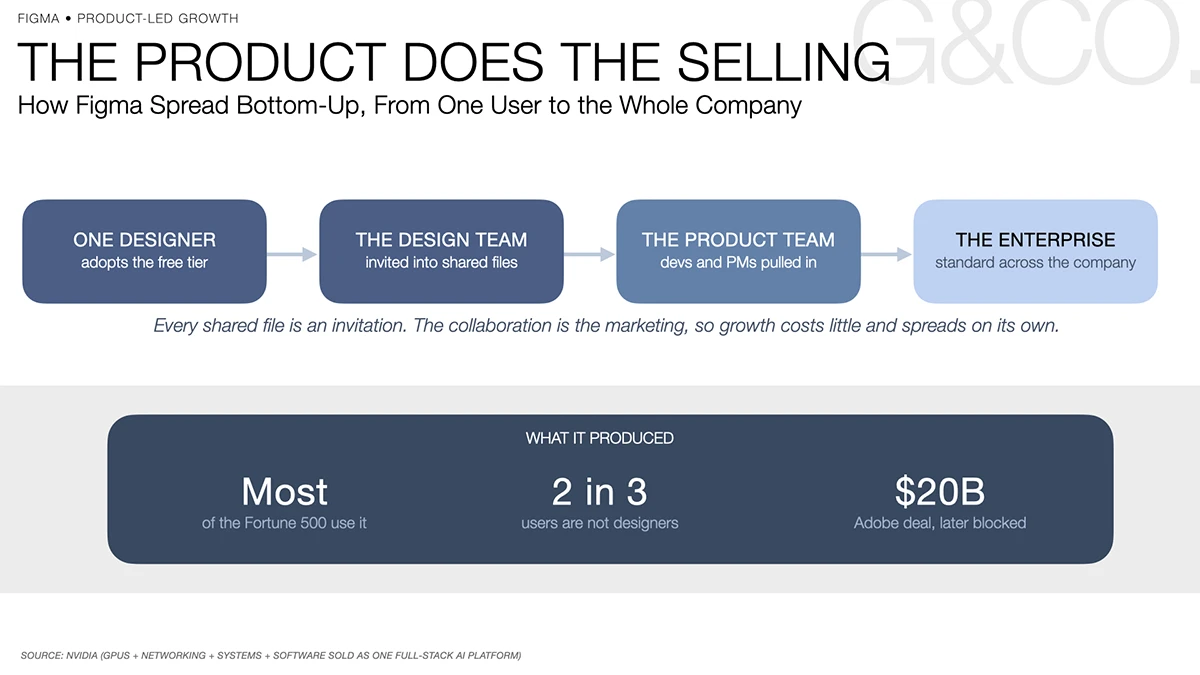
Figma offered a free tier and made it trivially easy to start and to invite others, so a single designer could adopt it, share a file with a colleague, and pull that colleague in, who then pulled in their team. Growth came from use, not from a sales team: the collaboration was the marketing, because every shared file was an invitation. This bottom-up adoption is how Figma spread into large companies from the inside, arriving through the people who use it rather than through a procurement decision at the top, which is far cheaper than a traditional enterprise sales motion and much harder for a competitor to dislodge.
Expand from designers to the whole product team, and make it sticky with design systems.
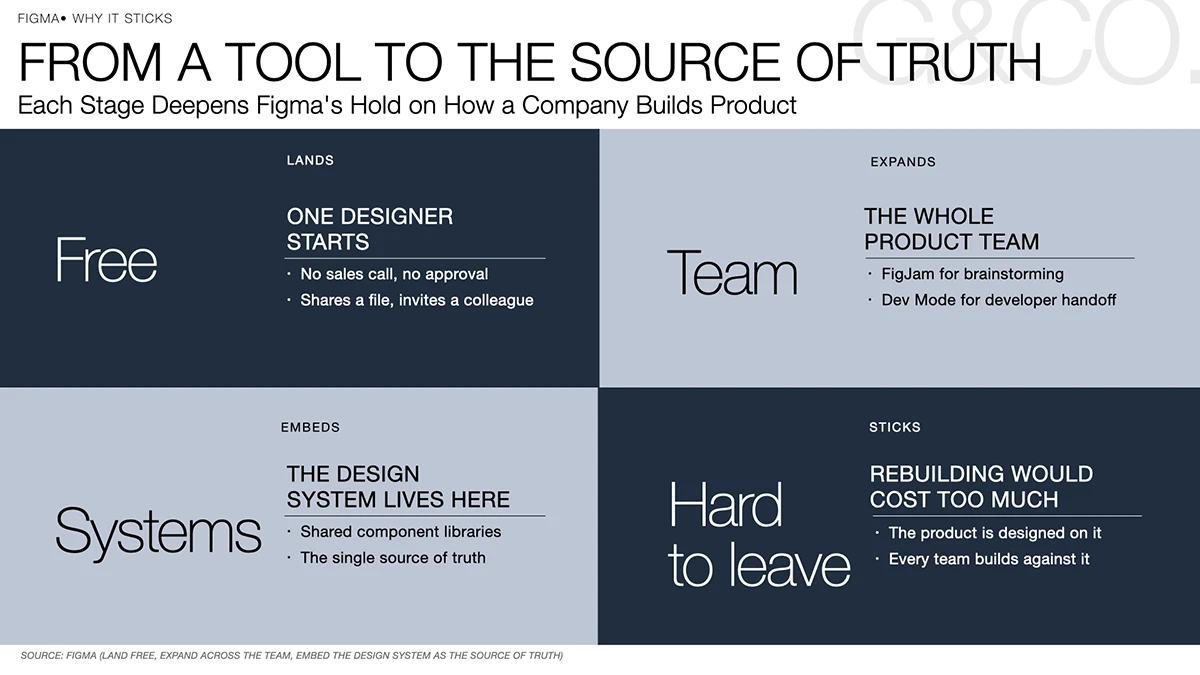
Once designers were in, Figma widened the tent: FigJam brought in whiteboarding and brainstorming for the whole team, and Dev Mode gave developers a clean way to turn designs into code, connecting the design workflow end to end from idea to build. Crucially, teams use Figma to build design systems, shared libraries of reusable components and styles that keep a company's product consistent. Once an organization's design system lives in Figma and every team builds against it, Figma becomes the single source of truth, and leaving would mean rebuilding that foundation from scratch. The expansion widens the footprint; the shared component libraries make it permanent.
The approach carries real tension. A free tier and bottom-up adoption mean Figma has to convert free users into paying teams, and defend its position as larger rivals build competing tools. And its dominance drew the ultimate validation and threat at once: Adobe, the incumbent it was displacing, agreed to acquire it for about $20 billion in 2022, a deal that regulators in Europe and the U.K. ultimately blocked, leaving Figma to remain independent and go public in 2025. Staying independent means Figma now has to keep growing on its own, against Adobe and a wave of AI-driven design tools, which is the next chapter of the story.
Always-On Customer Intelligence
Turn your own customer data into foresight — validate, simulate, and sense every major decision before you commit.


Results and Evidence
The evidence is in how widely and deeply Figma spread. It is now used across the large majority of the Fortune 500 and by millions of people monthly, and, tellingly, a majority of its users are not designers at all, they are developers, product managers, marketers, and others pulled in by the collaboration. That mix is the clearest proof that Figma succeeded in becoming the whole team's tool, not just the designer's. The market's valuation of the model is just as striking: Adobe's willingness to pay about $20 billion for Figma, an enormous sum for a company its size, was a direct measure of how threatening product-led, collaborative design had become to the incumbent, and when that deal was blocked, Figma went public in 2025 to strong demand. The durability shows in the expansion: because companies build their shared component libraries and run their design workflow inside Figma, the tool is embedded in how they work, not just installed on a designer's laptop. These figures come from public reporting and are worth confirming against the latest disclosures before publishing, since this names a real company and the numbers update over time.
Strategic Implications
Read at scale, Figma is a case about collaboration as a growth strategy, and it connects to the broader shifts in bottom-up adoption, digital collaboration, and how enterprise software is actually adopted. The pattern is repeatable beyond design: a product that is genuinely collaborative turns every user into a recruiter, because inviting a colleague is part of using it, and that built-in sharing is a growth engine competitors relying on sales teams cannot easily match. The collaboration is not a feature on top of the product; it is the distribution model.
The deeper implication is how the model compounds into lock-in. Bottom-up adoption gets the tool in the door cheaply; expanding from designers to the whole product team widens its role; and shared component libraries make it the shared foundation a company cannot easily leave. Each stage reinforces the next, which is why a bottom-up tool ended up more entrenched in large enterprises than many products sold top-down. For enterprise leaders, the takeaway is to ask whether their product could grow through use rather than through sales, whether making it collaborative would turn users into a distribution channel, and whether there is a "design system" equivalent in their category, a shared foundation that, once a customer builds on it, makes leaving prohibitively costly. The products that spread through collaboration and embed themselves as the source of truth are among the hardest to displace. The same platform-and-lock-in dynamic drives Nvidia's developer ecosystem, Shopify's merchant platform, and Nubank's app-led growth.
What Enterprise Leaders Can Learn
- Make collaboration the distribution model.
When inviting a colleague is part of using the product, every user becomes a recruiter, and growth stops depending on a sales team. - Let the product do the selling.
A free tier and easy onboarding let software spread bottom-up into large companies far more cheaply than top-down enterprise sales, and more durably. - Expand from the specialist to the whole team.
Figma grew by pulling in developers, product managers, and others around the original designer; widening who uses the tool widens its role and revenue. - Find your "design system" lock-in.
The stickiest position is becoming the shared source of truth a customer builds on; identify the equivalent foundation in your own product. - Solve the hard technical problem that changes the category.
Figma's browser-based, real-time engine was expensive to build, and it is exactly what competitors could not quickly copy.
Conclusion
Figma's story is not really about design software. It is about what happens when you make a product genuinely collaborative: the collaboration becomes the growth engine. By turning design from a solo file into a shared space a whole team works in, Figma removed the friction of the old handoff model and, in the same stroke, gave itself a bottom-up adoption machine, because every shared file was an invitation to the next user. Then it widened from designers to entire product teams and embedded itself through shared component libraries, until leaving meant rebuilding the foundation a company's product is built on. The $20 billion Adobe was willing to pay, and the blocked deal that sent Figma to the public markets instead, are both measures of how powerful that combination proved to be. For enterprise leaders, the transferable lesson is to stop thinking of collaboration as a feature and start thinking of it as a distribution strategy, and to build toward becoming the shared source of truth that customers cannot easily leave. The products that grow through use and embed themselves as the foundation are the ones that last.
Through the Acumen platform, G&CO. gives enterprise brands the intelligence to build products that grow through use: where collaboration could become a distribution channel, how adoption really spreads inside an organization, and where to build the shared foundation that makes a product hard to leave. G&CO. is a certified minority business enterprise through the National Minority Supplier Development Council (NMSDC). For enterprise organizations with diversity inclusion requirements in their procurement process, G&CO. meets the criteria for MBE-qualified partner status.
G&CO. works with enterprise brands on the design, product, and experience strategy that turns collaboration into growth and a tool into a team's source of truth. If this Figma case study raises questions about your own product-led growth, collaborative design, or design systems, submit an inquiry to G&CO. on our contact page or click the blue "Click to Contact Us" button in the bottom right corner of your screen. We look forward to hearing from you.
Frequently Asked Questions
What is Figma's bottom-up adoption strategy?
Figma's bottom-up adoption strategy is to let the product spread itself through use rather than through a traditional sales force. A free tier and easy onboarding let an individual designer start using Figma on their own, and because it is collaborative, sharing a file with a colleague pulls that colleague in, who pulls in their team. Growth comes from the bottom up, one user at a time, which is how Figma spread into most of the Fortune 500 without leading with top-down enterprise sales. The collaboration is what makes the bottom-up adoption work: every shared file is effectively an invitation.
How does real-time collaboration work in Figma?
Figma runs in the browser and lets multiple people work in the same design file at the same time, seeing each other's cursors and changes live, the way several people can edit one shared document. This replaced the old model, where a designer worked alone in a desktop file and exported static images to share, with an always-live design anyone can open with a link. Making UX/UI design a real-time, shared activity is the foundation of Figma's whole approach, and it is why not just designers but developers, product managers, and others end up working in the tool.
Why are shared component libraries important to Figma's stickiness?
Shared component libraries are shared libraries of reusable components and styles that keep a company's product visually and functionally consistent. Teams build and maintain these shared component libraries inside Figma, and once an organization's system lives there and every team builds against it, Figma becomes the single source of truth for how the product looks and works. That makes it extremely hard to leave, switching tools would mean rebuilding the entire foundation the company's product is designed on, which is a major reason Figma stays embedded once adopted.
What happened with Adobe's attempt to buy Figma?
In 2022, Adobe, the incumbent whose design tools Figma was displacing, agreed to acquire Figma for about $20 billion. That price was a direct measure of how threatening Figma's collaborative, product-led model had become. Regulators in Europe and the U.K. ultimately blocked the deal over competition concerns, and it was abandoned in late 2023. Figma remained independent and went public in 2025 instead. The episode is notable because it shows both the value the market placed on the model and the risk of dominance drawing regulatory scrutiny.
What can enterprise leaders learn from the Figma case study?
The central lesson is that collaboration can be a distribution strategy, not just a feature. When using a product means inviting others, every user becomes a recruiter, and the product grows through use rather than through expensive sales cycles. Figma's playbook is repeatable: solve the hard technical problem that changes the category, make the product collaborative so it spreads on its own, expand from the original specialist to the whole team, and become the shared source of truth (its shared component libraries) that customers cannot easily leave. Leaders should ask whether their product could grow bottom-up the same way, and where their own "source of truth" lock-in could be.