Wise Case Study: Owning the Rails of Cross-Border Payments
This Wise case study examines how Wise built its own cross-border payments infrastructure, connecting directly into countries' local payment systems instead of routing through the slow, expensive correspondent-banking chain, to move money faster and cheaper. Through Wise Platform, it now sells that same infrastructure to the banks it competes with, including Standard Chartered, Morgan Stanley, and Itaú. The bet is paying off: Wise moved roughly $243 billion across borders in FY2026, up about 31%, on £1.36 billion of income, with a business increasingly built on embedded finance and B2B payments, not just consumer transfers.
Wise built its own cross-border payment network by plugging directly into countries' local payment systems; that infrastructure is sold to banks through Wise Platform.
Sending money across borders has been slow and expensive for decades, not because the technology is hard, but because the money hops through a chain of middleman banks (called correspondent banking), each taking a cut and adding a delay. Most companies that move money internationally simply rent that chain. Wise decided to replace it.
This case study looks at how Wise built its own global payments infrastructure, wiring itself directly into the local payment systems of country after country so a transfer lands like a domestic payment, and then turned that infrastructure into a product it sells to other banks. For enterprise leaders, the lesson has nothing to do with money transfer specifically. It is about the difference between renting the infrastructure your business depends on and owning it, and what becomes possible once you do.
Key Points
- Wise built its own payment rails instead of renting the banking system's. It connects directly into local payment networks in Japan, Brazil, the Philippines, and a growing list of countries, skipping the correspondent-banking chain that most cross-border payments still run through.
- That infrastructure is now a product, Wise Platform. Banks and fintechs, including Standard Chartered, Morgan Stanley, and Itaú, plug into Wise's network through an API to give their own customers fast, cheap transfers, a form of embedded finance and banking as a service.
- Wise moved roughly $243 billion across borders in FY2026, up about 31%, on £1.36 billion of income and 15.6 million active customers, with business (B2B) payments its fastest-growing segment.
- A flywheel keeps pushing the price down. More volume brings scale, which Wise reinvests in lower prices and better infrastructure (its average fee is down to about 0.5%), which draws still more volume.



.png)
%20(1).png)

Let’s kickstart the conversation and design stuff people will love.

The Retail & Consumer Index


Why This Matters
For CEOs, CFOs, chief digital officers, and anyone whose business depends on infrastructure they do not own, Wise is a clear test of a strategic question: when the systems you rely on are slow, costly, and controlled by others, is it worth the years and expense to build your own? Wise answered yes, and the payoff is now visible in its growth and margins.
The timing matters. Global payments are shifting away from traditional banking routes as businesses and consumers demand the speed and price they get from domestic digital payments. At the same time, banks that once saw fintechs as threats are now paying to use their infrastructure. Wise sits on both sides of that shift, competing with banks for customers while selling the same banks the rails they cannot easily build themselves. For any leader weighing whether to build or rent a critical capability, Wise shows what owning it can unlock.
Strategic Context
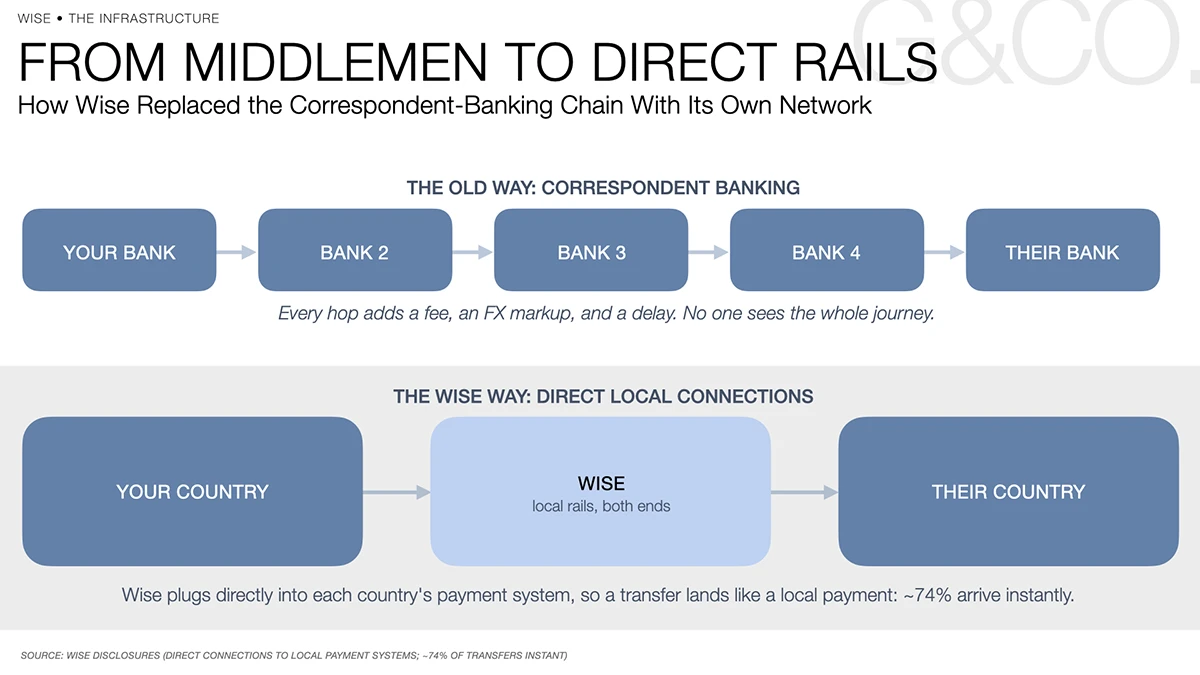
The correspondent-banking system has moved international money for generations, and it has always carried the same problems: a payment passes through several banks, each adding a fee, an exchange-rate markup, and a delay, and no single party can see the whole journey. The cost is largely hidden in the exchange rate, so customers rarely know what they paid. For banks, this opacity has been profitable; industry estimates put the pool of revenue banks earn from foreign-exchange margins at well over £100 billion a year.
Wise was built to attack exactly that pool. Its founders' insight was that the slowness and cost of cross-border payments were not laws of nature but the result of an outdated system, and that a company willing to build direct connections into each country's own payment network could move money far faster and cheaper. That is a much harder path than renting the correspondent chain, it means obtaining licences, meeting regulators, and integrating with domestic systems country by country, but it is also the only way to remove the middlemen for good. The strategic choice at the heart of this case is that Wise chose to build the hard thing, the infrastructure, rather than compete on marketing or price alone on top of someone else's pipes.
Company Response
Own the rails.
Rather than route payments through other banks, Wise connects directly into countries' domestic payment systems, so money moving in and out of a country travels as a local payment rather than an international one. It has secured direct access to instant-payment infrastructure in markets including Japan, Brazil, and the Philippines, and is pursuing the same in the United States (through a national trust bank charter and a Federal Reserve account) and Canada. These direct connections are the source of Wise's speed and low cost: about 74% of its transfers now arrive instantly, and its average fee has fallen to roughly 0.5%. This is a legacy-to-modern infrastructure story, replacing a decades-old chain with a purpose-built global payments network.
Turn the infrastructure into a product.
Having built the network for its own customers, Wise now sells access to it through Wise Platform, its B2B business. Banks, fintechs, and large companies plug into Wise's rails through an API and offer their own customers international transfers without building the capability themselves. Partners include Standard Chartered, Morgan Stanley, UniCredit, and Itaú. This is embedded finance and banking as a service in practice: the bank keeps its customer relationship and brand, while Wise provides the movement of money underneath. It lets Wise capture cross-border volume from institutions it could never sign up as retail customers, and Wise Platform is already about 5% of its cross-border volume and growing fast.
Reinvest through a flywheel.
Wise runs a deliberate loop: more volume produces scale efficiencies and gross profit, which it reinvests into lower prices, better infrastructure, and more direct connections, which lower cost further and attract still more volume. It has cut its take rate repeatedly rather than bank the margin, betting that lower prices grow volume faster than they shrink revenue. That discipline is why B2B payments, its fastest-growing segment, and consumer transfers can both expand while prices keep falling.

The approach carries real tension. Building direct connections country by country is slow and capital-intensive, each market means licences, compliance, and integration, and The platform partnerships with banks often take years to close and integrate. And competing with banks while selling to them is a delicate balance. But those same difficulties are the moat: they are exactly why a rival cannot quickly copy what Wise has built.
Always-On Customer Intelligence
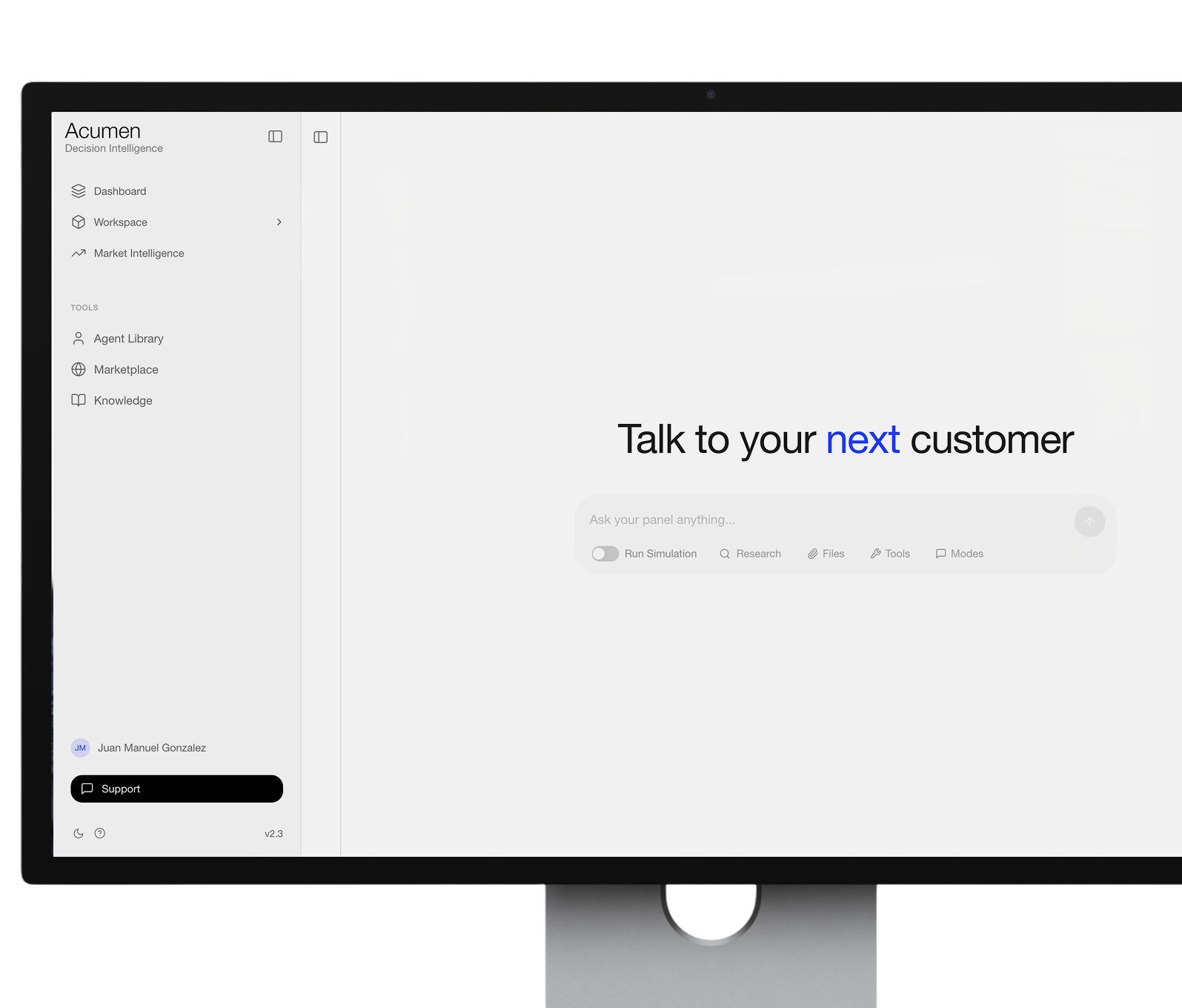
Turn your own customer data into foresight — validate, simulate, and sense every major decision before you commit.


Results and Evidence

The evidence shows the infrastructure bet compounding. In FY2025, Wise's underlying income reached £1.36 billion, up about 16%, on cross-border volume of £145.2 billion (up 23%), with 15.6 million active customers and an underlying pre-tax margin of 21%, above its medium-term target. In FY2026, cross-border volume climbed to roughly $243 billion, up about 31%, and Wise completed a Nasdaq listing alongside its London one to fund U.S. expansion. The platform continued to scale, reaching about 5% of cross-border volume and adding partners including Standard Chartered and Morgan Stanley, while business customers grew faster than consumers, with business cross-border revenue up in the high-30s percent range. The operating signal that best captures the strategy is the take rate: Wise has steadily cut it, to around 0.5%, while volume and profit rose, proof that owning the rails lets it lower prices and still make money, the opposite of the hidden-margin model it set out to disrupt. These figures come from Wise's public reporting and are worth confirming against the latest results before publishing, since this names a real company and the numbers update each reporting period.
Strategic Implications
Read at scale, Wise is a case about infrastructure ownership as strategy, and it connects to the broader shifts in enterprise architecture, digital transformation, embedded finance, and platform economics. The pattern is repeatable well beyond payments: a company that depends on slow, costly infrastructure it does not control can, if it is willing to make a multi-year investment, build its own and turn a cost center into a competitive advantage, and then a revenue stream. Wise did not just cut out the middlemen for itself; it became the infrastructure other companies now build on.
The deeper implication is the shift from renting to owning the critical layer, and then renting it back out. Once Wise owned the rails, selling access through The platform followed a logic familiar from cloud computing: build infrastructure for your own needs, prove it at scale, then offer it to others as a service, generating revenue that grows without a matching rise in cost. The companies most exposed are the ones whose margins depend on the opacity Wise removes, and the ones best positioned are those willing to own the hard infrastructure layer rather than compete only on the surface. In a digital economy, the durable advantage increasingly belongs to whoever controls the pipes, not whoever rents them. The same infrastructure-ownership logic appears in Shopify's retail operating system, Mastercard's payment-data services, and Nvidia's platform moat.
What Enterprise Leaders Can Learn
- Decide build-versus-rent on the critical layer, not the whole stack.
Wise rented nothing on the part that mattered most, the payment rails, and that is where its advantage lives. Identify the one layer worth owning. - Infrastructure investment is slow, and that is the point.
The years and licences it took to build direct connections are exactly what competitors cannot shortcut, which is what makes the moat durable. - Owned infrastructure can become a product.
Once you have built a capability at scale for yourself, selling access to it (as The platform does) turns a cost into a high-margin revenue stream. - Use a price-led flywheel where you have a cost advantage.
If owning the infrastructure lowers your cost, reinvesting that into lower prices can grow volume faster than holding the margin would. - You can compete with customers and serve them at once.
Selling infrastructure to the same institutions you compete with is delicate, but it captures volume you could never win directly.
Conclusion
Wise's story is not really about sending money abroad. It is about the choice between renting the infrastructure your business runs on and owning it. Wise chose the harder path, building direct connections into the world's payment systems one country at a time, and that choice is what lets it move money faster and cheaper than the banks, cut its prices year after year, and still grow its margins. Then it turned the infrastructure itself into a product, selling the rails to the very banks it competes with. For enterprise leaders, the lesson is transferable to any industry that runs on infrastructure controlled by someone else: owning the critical layer is expensive and slow, but it can convert a permanent cost into a lasting advantage, and eventually into a business of its own. In a world where most companies rent their pipes, the ones that own them set the terms.
Through the Acumen platform, G&CO. gives enterprise brands the intelligence to make build-versus-own decisions with evidence: which layer of your infrastructure is worth owning, where customers feel the cost of the systems you rent, and where owning the critical layer would create a durable advantage. G&CO. is a certified minority business enterprise through the National Minority Supplier Development Council (NMSDC). For enterprise organizations with diversity inclusion requirements in their procurement process, G&CO. meets the criteria for MBE-qualified partner status.
G&CO. works with enterprise brands on the architecture, platform, and data strategy that turns critical infrastructure from a rented cost into an owned advantage. If this Wise case study raises questions about your own approach to cross-border payments, embedded finance, or infrastructure ownership, submit an inquiry to G&CO. on our contact page or click the blue "Click to Contact Us" button in the bottom right corner of your screen. We look forward to hearing from you.
Frequently Asked Questions
What is Wise's strategy in cross-border payments?
Wise's strategy is to own the infrastructure that moves money across borders rather than rent it. Instead of routing payments through the correspondent-banking chain of middleman banks, Wise connects directly into countries' domestic payment systems, so a transfer behaves like a local payment. That is what lets it move money faster (about 74% of transfers arrive instantly) and cheaper (an average fee near 0.5%) than traditional cross-border payments, and it is the foundation for everything else Wise does.
What is The platform, and how does it relate to embedded finance?
The platform is Wise's B2B business: it lets banks, fintechs, and large companies plug into Wise's payment network through an API and offer their own customers international transfers, without building the infrastructure themselves. This is embedded finance and banking as a service in practice, the partner keeps its brand and customer relationship while Wise moves the money underneath. Partners include Standard Chartered, Morgan Stanley, UniCredit, and Itaú, and The platform is already about 5% of Wise's cross-border volume.
How does Wise make money while cutting prices?
Wise runs a flywheel: more volume creates scale efficiencies and gross profit, which it reinvests into lower prices and better infrastructure, which attracts still more volume. Because owning the rails gives it a real cost advantage, Wise can keep cutting its take rate (now around 0.5%) and still grow both volume and margin. In FY2025 it reported an underlying pre-tax margin of 21%, above its own target, even as prices fell, evidence that the model works.
How big is Wise, and how fast is it growing?
In FY2025, Wise reported underlying income of £1.36 billion (up about 16%) and cross-border volume of £145.2 billion (up 23%), with 15.6 million active customers. In FY2026, cross-border volume reached roughly $243 billion, up about 31%, and Wise added a Nasdaq listing alongside its London listing to fund U.S. expansion. Business (B2B) payments are its fastest-growing segment. These figures are from Wise's public reporting and should be confirmed against the latest results.
What can enterprise leaders learn from the Wise case study?
The core lesson is about owning versus renting critical infrastructure. Wise shows that a company willing to make a slow, expensive, multi-year investment to build its own version of the systems it depends on can turn a cost center into a competitive advantage, and then into a product it sells to others. The playbook is repeatable in any industry that runs on infrastructure controlled by someone else: identify the one layer worth owning, build it, use the cost advantage to compete on price, and eventually sell access to the same infrastructure, the way The platform does.