Pharma Product Launch FAQs | Strategy, Process & Checklist
Introduction
A pharma product launch is the structured introduction of a new drug, therapy, or medical device to market, spanning regulatory compliance, clinical validation, market access, positioning, and commercial execution. It has become higher-stakes and faster-moving in 2026: agentic AI is compressing launch planning from months to weeks, while drug price reforms like the Inflation Reduction Act shorten the profitable commercial window and push payer and access work earlier. This guide explains pharma product launch strategy, the value of a launch checklist, and how to launch a new pharma product with confidence.
Launching a new pharmaceutical product is one of the most complex, high-stakes undertakings for any enterprise, and missteps can cost millions, damage reputation, and delay patient access. This article is written for enterprise pharma leaders who want a clear, structured view of the process and what it takes to get it right.
Market Context: Disruption & Opportunity
The pharmaceutical industry is changing rapidly. Heightened regulatory scrutiny, evolving patient expectations, and accelerating competition from generics and biosimilars are reshaping how enterprises approach a launch, while digital transformation makes omnichannel outreach and data-driven insight essential rather than optional.
The stakes have never been higher. Industry analyses show most launches underperform: IQVIA finds fewer than 10% of launches achieve international excellence across two or more countries, over half generate less than $5 million in their first year in the top markets, and roughly 80% of launches stay on the trajectory set in their first six months, so a slow start usually stays slow. Two 2026 forces intensify the pressure. First, IRA Medicare negotiation compresses the profitable commercial lifespan, with significant industry revenue at risk from patent cliffs by 2030, making speed to market a survival requirement. Second, agentic AI is compressing launch timelines dramatically, with planning that once took 12 to 18 months now completing in weeks. In this environment, a clear pharma product launch strategy is not a differentiator but a necessity.
FAQs Snapshot

What is a pharma product launch?
A pharma product launch is the structured introduction of a new drug, therapy, or medical device to the market. It involves regulatory compliance, clinical validation, market positioning, and commercial execution. Unlike other industries, the process is tightly regulated and requires extensive cross-functional collaboration across regulatory, clinical, market access, and commercial teams to ensure safety and adoption.
Why is a pharma product launch strategy important?
A well-defined strategy ensures enterprises maximize market potential while maintaining compliance. Without a strategic plan, new products often miss sales targets, face slower adoption, and risk reputational setbacks, a serious danger given that most launches underperform and that early trajectory is hard to reverse. Strategy aligns scientific value with market demand, helping companies compete in a crowded field.
How to launch a new pharma product effectively?
Effective launches align regulatory, clinical, market access, commercial, and digital teams early, well before approval. They rely on robust data analytics, payer and patient engagement models, and a detailed launch checklist, and increasingly on AI to forecast demand and optimize omnichannel outreach. Because early trajectory tends to persist, leaders must also prioritize post-launch monitoring to adapt quickly to real-world performance.
What is included in a pharma product launch checklist?
A launch checklist typically includes regulatory approvals, pricing and reimbursement planning, market access and payer strategy, supply chain readiness, salesforce training, digital and omnichannel engagement, and risk management. Following a checklist minimizes oversights and ensures each critical milestone is addressed systematically, which matters more as timelines compress.
How is agentic AI changing pharma product launches?
Agentic AI is compressing commercial timelines, with launch planning that took 12 to 18 months now completing in weeks and territory alignment shrinking from weeks to minutes. Multi-agent systems monitor formulary changes, analyze prescribing patterns, and surface competitive intelligence in real time, and in early field deployments have delivered around 27% time savings in call preparation and 15% or more increases in omnichannel-equivalent calls. The caution: roughly 40% of AI projects fail when treated as experiments rather than governed enterprise infrastructure, so speed without governance creates risk.
How do drug pricing reforms like the IRA affect a pharma product launch?
Price reforms have become central to launch strategy. IRA Medicare negotiation shortens the profitable commercial lifespan of many products, and Most-Favored-Nation pricing adds international reference pressure, so companies must model pricing scenarios and engage payers earlier than ever. This raises the importance of a strong value narrative and evidence at launch, and of protecting global pricing corridors rather than optimizing each market in isolation.
What are the risks of a new product launch in the pharma industry?
Risks include regulatory delays, limited payer coverage, inadequate physician adoption, and patient hesitancy, compounded in 2026 by price-reform pressure and the failure risk of poorly governed AI. The complexity of the process means even small errors can have outsized, hard-to-reverse consequences. Enterprises mitigate these risks with a robust strategy that anticipates setbacks and starts access planning early.
How does digital transformation impact a pharma product launch?
Digital tools have transformed launches, from predictive analytics for forecasting to omnichannel engagement with healthcare providers. Companies that leverage technology achieve stronger market penetration and sustained growth, and the shift is now toward continuous, data-driven launch performance management rather than one-time milestone planning, supported by real-world evidence and AI-driven insight.
Benefits of a Pharma Product Launch Strategy
A strong pharma product launch strategy provides enterprises with a repeatable framework for success. It ensures compliance, drives patient and physician adoption, and reduces time-to-market.
Specific benefits include higher launch success rates, improved payer negotiations, more effective stakeholder engagement, optimized resource allocation, and long-term brand loyalty. With the right approach, and increasingly with AI accelerating planning and execution, companies not only secure immediate sales but also establish a platform for future innovation.
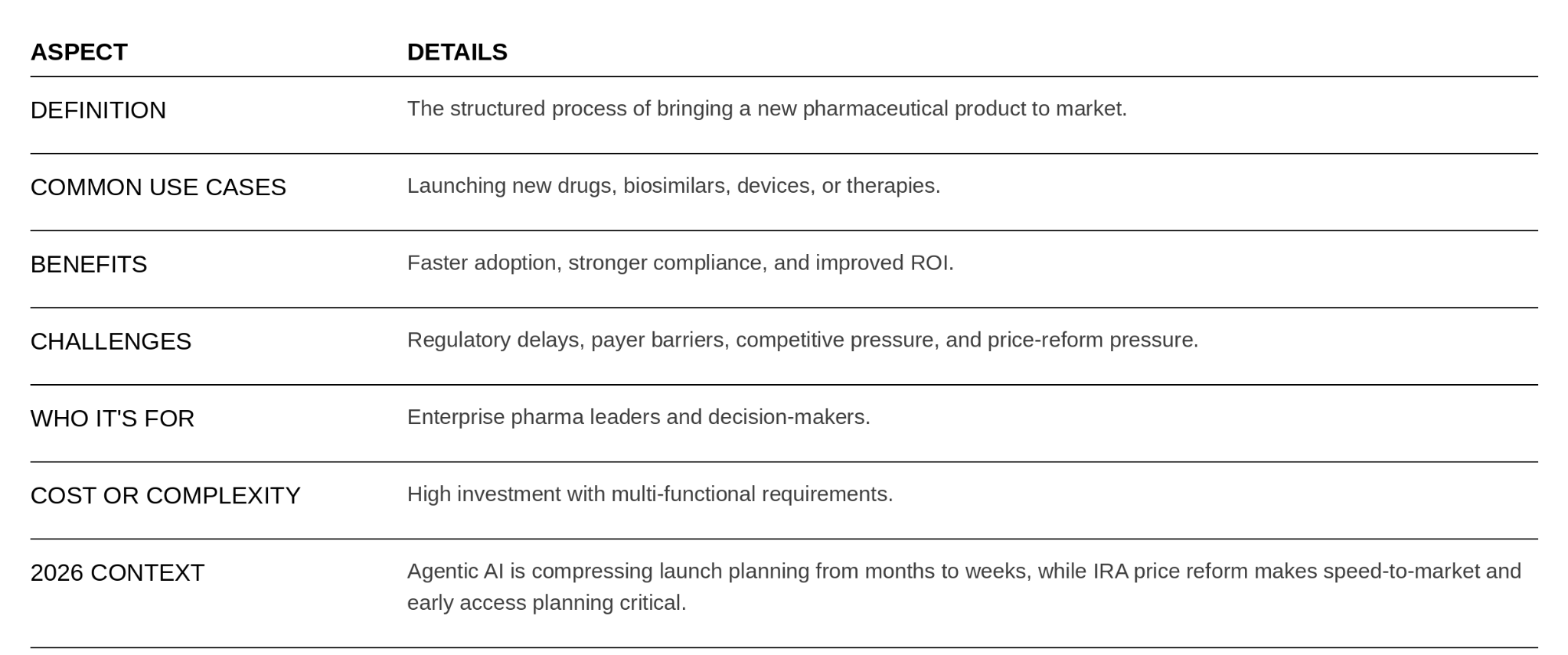
Quick Summary Table


%20(1).png)

Let’s kickstart the conversation and design stuff people will love.

The Retail & Consumer Index


Deep-Dive Sections

What It Is & Why It Matters
A pharma product launch is not just a sales event; it is a coordinated strategy combining regulatory, clinical, market access, and commercial execution. Its importance lies in the fact that a successful launch determines a product's trajectory, and with most launches underperforming and early momentum hard to reverse, mastering the process is critical to competitive advantage and to delivering on both business and patient outcomes.
How It Works
The process begins years before approval, as early clinical trials feed regulatory submissions while commercial and market access teams prepare positioning, evidence, and payer strategy. Post-approval, enterprises deploy launch campaigns, train field teams, and engage payers and providers. The best strategies integrate these functions, and increasingly use agentic AI to compress analysis cycles and coordinate cross-functional work, for seamless execution and measurable results.
When to Use It (and When Not To)
A full launch strategy is essential whenever an enterprise introduces a new treatment, device, or therapy. Smaller lifecycle updates or line extensions may not require a full-scale launch and can use streamlined versions of the checklist. Companies should assess the scope and potential of each product, and the competitive and pricing environment, before deciding the level of investment.
Tools or Platforms Involved
Enterprises rely on regulatory submission systems, CRM and omnichannel engagement platforms, predictive analytics, and real-world evidence tools. A defining 2026 shift is agentic analytics layers and multi-agent systems that read across syndicated data, CRM, and forecasting feeds to explain launch performance in real time and support reps, key account managers, and medical science liaisons directly in their workflow.
Cost Considerations
Pharma launches are expensive, often requiring investments in the hundreds of millions across clinical trials, regulatory submissions, marketing, and distribution. While high, these investments are necessary to maximize impact, and a structured checklist plus AI-driven efficiency can reduce waste. The shortening profitable window under price reform makes disciplined, ROI-focused spend more important than ever.
Integration or Setup Requirements
Integration across departments is critical, with commercial, regulatory, R&D, market access, and IT aligned from the earliest stages under a centralized governance model and strong project management. Scaling AI adds a further requirement: a unified data foundation and clear governance, since fragmented data is the primary bottleneck to AI adoption and a leading cause of failed AI initiatives.
Scalability & Flexibility
A well-executed strategy is scalable across geographies and product types, and flexibility is essential to adapt to regulatory changes, pricing dynamics, or unexpected market responses. Enterprises should design for adaptability, with the ability to pivot post-launch as real-world evidence and performance data come in.
Alternatives or Comparisons
Some enterprises consider licensing agreements or partnerships as alternatives to a full-scale launch. While these reduce upfront investment, they often limit control and profitability. A dedicated launch strategy, though resource-intensive, delivers stronger long-term results, particularly when speed and differentiation matter in a compressed commercial window.
Trends
Emerging trends include agentic AI for launch planning and field enablement, AI-driven market forecasting, real-world evidence for post-launch evaluation, continuous launch performance management, and digital-first HCP engagement. Together these make the launch process more data-driven, patient-centered, and efficient, provided AI is deployed with proper governance.
Pros and Cons
Pros of a well-run launch include faster patient access, market leadership, and increased revenue. Cons include high cost, complex compliance, and significant risk if execution falters, now heightened by price reform and the governance demands of AI. Enterprises that follow a clear checklist and govern their AI carefully mitigate many of these drawbacks.
How G&CO.Health Can Help

At G&CO.Health, we understand the complexity of a new product launch in the pharma industry and have guided global enterprises through every stage. Our consulting expertise helps brands design and execute a tailored launch strategy, ensuring compliance and accelerating market success, including navigating price reform and adopting AI responsibly. With deep insight into what works and what does not, we partner with leaders to integrate digital tools, optimize cross-functional collaboration, and maximize ROI.
Talk to us to clarify your pharma product launch process and move forward with confidence.
Conclusion & Next Steps
Pharma product launches demand precision, foresight, and cross-functional execution, more than ever in a year shaped by agentic AI and price reform. This article clarified how to launch a new pharma product, why a clear strategy matters, and how a launch checklist minimizes risk. Leaders who embrace structured planning, early access strategy, and well-governed AI are best positioned to deliver patient value while capturing competitive advantage.
At G&CO.Health, we have partnered with enterprise clients to turn complex launches into measurable success. Still have questions? Reach out and let's solve them together.
Always-On Customer Intelligence
Turn your own customer data into foresight — validate, simulate, and sense every major decision before you commit.