
Healthcare Market Access FAQs: Strategy, Pricing & Solutions
Introduction
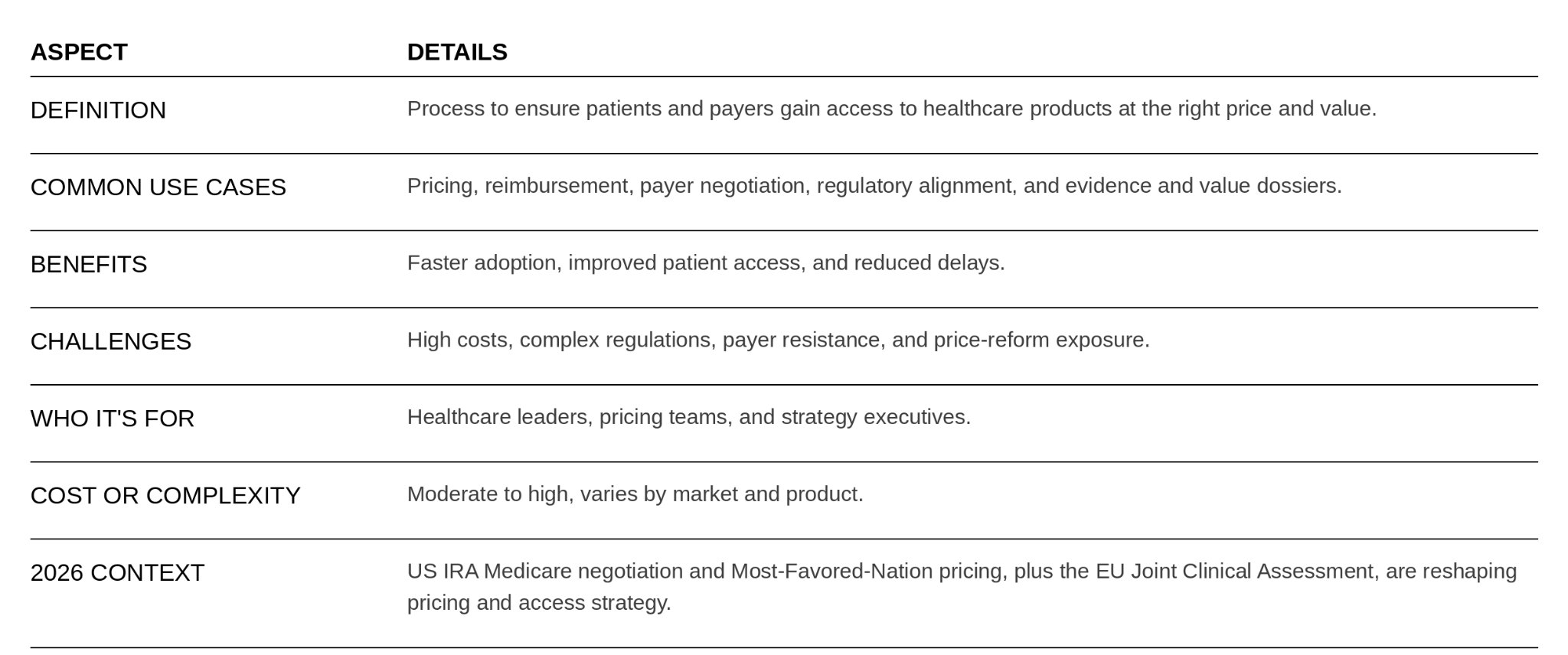
Market access in healthcare is the process of ensuring patients, providers, and payers can obtain a medical product at the right price and value, spanning pricing, reimbursement, evidence, and distribution decisions. It is being reshaped in 2026 by intensifying price reform: the first negotiated Medicare drug prices under the US Inflation Reduction Act have taken effect, Most-Favored-Nation pricing is drawing new scrutiny, and the EU's Joint Clinical Assessment now applies a single shared clinical evaluation across member states. This guide explains what healthcare market access means, why it matters, and how strategy, consulting, and solutions help.
Healthcare leaders often struggle with market access, and the challenge is not just about pricing but about aligning value, patient needs, and regulatory requirements. Many enterprise healthcare companies face delays, lost opportunities, or unclear strategies. Directors, VPs, and other senior leaders will leave with clarity on the fundamentals, strategy options, and practical next steps for building stronger healthcare market access approaches.
Market Context: Disruption & Opportunity
Healthcare market access is no longer a simple process of bringing a product to market. Rising costs, payer demands, global competition, and shifting regulations are forcing enterprise healthcare companies to rethink their strategies, and stakeholders increasingly expect transparency in healthcare pricing and access.
In 2026, this pressure is more concrete than ever. In the United States, the first negotiated Medicare drug prices under the Inflation Reduction Act have taken effect, with further negotiation cycles underway for 2027 and 2028, and renewed Most-Favored-Nation proposals are drawing attention to how US prices compare with those abroad. In Europe, the Joint Clinical Assessment now applies a single, shared clinical evaluation across member states, beginning with oncology medicines and advanced therapies, reshaping how manufacturers plan evidence. Cost-containment measures are tightening across major markets even as payers experiment with new access pathways.
These pressures create both challenges and opportunities. Companies that embrace healthcare market access consulting and solutions gain insight into pricing, strategy, and reimbursement models that help them stay competitive. Those that delay risk falling behind peers who are adapting faster.
FAQs Snapshot
What is market access in healthcare?
Market access in healthcare is the process that ensures patients, providers, and payers can access a medical product at the right price and value. It includes pricing, reimbursement, evidence, and distribution decisions. For enterprise organizations, market access strategies are essential for sustainable product launches and for reaching patients quickly.
Why is healthcare market access important?
Healthcare market access is important because it defines how quickly treatments reach patients and how well they are adopted. Without a strong strategy, even innovative products can face delays, restricted formularies, or poor uptake, which affects both patient outcomes and business performance. In 2026, direct price reform makes early, evidence-based access planning more critical still.
How is drug price reform affecting healthcare market access in 2026?
Price reform is now a central force in access strategy. In the US, the first Medicare-negotiated drug prices under the Inflation Reduction Act took effect in 2026, with cycles for 2027 and 2028 underway, and Most-Favored-Nation proposals tie US prices to lower international benchmarks. In the EU, the Joint Clinical Assessment standardizes how clinical benefit is evaluated. Together these push companies to protect global pricing corridors and build stronger value evidence earlier.
What is healthcare market access consulting?
Healthcare market access consulting helps organizations design strategies, analyze pricing models, and identify reimbursement pathways. Consultants bring expertise in healthcare pricing and market access, and increasingly in navigating price reform such as the IRA, Most-Favored-Nation pricing, and EU health technology assessment. This support helps leaders reduce risk and improve outcomes.
How does a healthcare market access strategy work?
A healthcare market access strategy aligns pricing, payer engagement, evidence, and regulatory compliance, setting clear steps for entering markets while addressing local and global requirements. The most effective organizations treat market access as a strategic function embedded early, aligning health economics, regulatory, legal, and communications teams and building the value narrative alongside clinical development rather than after it.
What are common healthcare market access solutions?
Healthcare market access solutions include data-driven pricing tools, payer negotiation frameworks, real-world evidence platforms, and digital systems for tracking market readiness, increasingly supported by human-in-the-loop AI analytics. These solutions give leaders visibility and control across markets, helping them increase efficiency and reduce uncertainty.
What is value-based or outcomes-based access?
Value-based or outcomes-based access ties a product's price or reimbursement to the results it delivers in the real world, rather than to volume alone. It includes outcomes-based agreements and managed-entry pathways that share the financial risk of high-cost therapies between manufacturers and payers. These models are growing in 2026 as payers seek to manage uncertainty while still enabling patient access.
What role does pricing play in healthcare market access?
Healthcare pricing and market access are directly linked. Pricing decisions influence payer acceptance, patient affordability, and overall access, and in an era of international reference pricing and government negotiation, a price set in one market can ripple across others. A clear strategy ensures value is communicated effectively, costs are managed, and patients benefit from timely access.
Benefits of Healthcare Market Access

Healthcare market access helps enterprise companies achieve sustainable growth, improve patient reach, and secure payer support. It aligns pricing, regulation, and value delivery into one framework.
Organizations benefit through faster product adoption, reduced delays in reimbursement, and stronger relationships with payers. Healthcare market access consulting adds expertise, while healthcare market access solutions provide tools that improve efficiency. A strong strategy creates stability and positions organizations for long-term success, even as price reform reshapes the landscape.
Quick Summary Table


%20(1).png)

Let’s kickstart the conversation and design stuff people will love.

The Retail & Consumer Index


Deep-Dive Sections
What It Is & Why It Matters
Healthcare market access is the framework that connects innovation with adoption. It matters because without it, even advanced treatments can remain unavailable. Enterprise organizations need market access strategies to bridge the gap between product development and patient access, supporting financial sustainability while ensuring treatments reach those who need them.
How It Works
Market access works by aligning product value with payer requirements. Leaders define a pricing model, prepare evidence for value claims, and engage with regulators. The most effective organizations now embed market access early, aligning cross-functional teams across health economics, regulatory, legal, and communications, and building the value narrative alongside clinical development rather than after it. Consulting helps identify barriers, while solutions provide the data and tools to support decisions, reducing delays and improving efficiency.
When to Use It (and When Not To)
Healthcare market access should be applied before launching a product to secure early alignment with payers and regulators, and it is also useful for adjusting existing pricing models or entering new markets. It may be less critical for smaller, low-cost products with minimal regulatory oversight, but for enterprise companies it is almost always essential.
Tools or Platforms Involved
Healthcare market access solutions often include pricing analytics platforms, reimbursement tracking systems, and data visualization tools, increasingly supported by real-world evidence and AI-driven analytics used with human oversight. These tools give leaders visibility into payer behavior, patient needs, and market readiness, and help teams prepare for evidence-heavy frameworks such as the EU Joint Clinical Assessment. They are essential for organizations operating across multiple geographies.
Cost Considerations
Healthcare pricing and market access involve costs related to research, compliance, and consulting. While investment can be significant, the return comes through faster adoption and stronger payer relationships. Enterprise healthcare companies benefit when these costs are planned as part of a long-term strategy rather than treated as a launch afterthought.
Scalability & Flexibility
Healthcare market access strategies scale across global markets when supported by flexible tools. A strategy designed for one region may need adjustments in others, but a scalable framework ensures consistency. As pricing decisions become more interconnected through international reference pricing and joint assessments, this flexibility lets enterprise organizations adapt without starting from scratch in each market.
Trends
Trends in healthcare market access include intensifying price reform, the growing influence of value on access, and greater use of data and AI. In the US, Medicare price negotiation and Most-Favored-Nation pressure are reshaping launch and pricing strategy, while in Europe the Joint Clinical Assessment is standardizing how clinical benefit is evaluated. Leaders are focusing more on value-based and outcomes-based agreements that tie pricing to results, alongside managed-entry and alternative access pathways for high-cost therapies. Human-in-the-loop AI is increasingly used to strengthen evidence generation, payer analytics, and pricing decisions.
How G&CO.Health Can Help

G&CO.Health, G&CO.'s healthcare division, helps enterprise healthcare leaders build and execute effective market access strategies. Our team has guided brands through pricing, reimbursement, and payer engagement challenges, including the pressures of price reform.
We provide healthcare market access consulting and digital solutions that simplify decision-making. With experience across global markets, we help clients adopt strategies that work in practice, not just on paper. Talk to us to clarify your strategy and move forward with confidence.
Conclusion & Next Steps
This article explained what market access in healthcare means, why it matters, and how strategies, consulting, and solutions support success, in a year when drug price reform and evidence standardization are reshaping the field. You learned about pricing, tools, and the trends shaping healthcare market access today.
At G&CO.Health, we have worked alongside clients to implement these shifts, whether through digital strategy, healthcare pricing and market access optimization, or platform modernization. Our expertise enables brands to translate insight into competitive advantage.
Still have questions? Reach out and let's solve them together.
Always-On Customer Intelligence
Turn your own customer data into foresight — validate, simulate, and sense every major decision before you commit.