
AI in Payments: FAQs on Banking, Processing & Future Use
Introduction
AI in payments is the use of artificial intelligence to process, verify, secure, and increasingly execute transactions, spanning fraud detection, risk scoring, automation, and now autonomous agentic checkout. The defining shift in 2026 is that AI has moved from an assistive layer that flags fraud to an execution layer that can hold payment credentials and complete purchases: Visa confirmed hundreds of transactions fully initiated and settled by AI agents in late 2025, and Visa, Mastercard, and others have launched agentic commerce rails. This guide explains how AI in payments works, why it matters, and what leaders should know.
This article is written for executives in enterprise finance who want clear insight to guide decisions. You will leave with answers to common questions, practical context, and clarity on the future of AI in payments.
Market Context: Disruption & Opportunity
The payments industry is changing rapidly. Digital transactions are rising as cash usage declines, fraud and security threats keep growing in scale and complexity, and customers expect real-time approvals and smooth digital experiences.
AI in payment processing offers both disruption and opportunity. It reduces fraud, increases transaction speed, and supports better decisions with predictive insight, while generative AI opens new possibilities for personalized customer interaction and back-office automation. The most consequential 2026 development is agentic commerce, where an AI agent completes a purchase on a consumer's behalf under preset rules. Card networks are building the rails fast: Visa's Intelligent Commerce and Mastercard's Agent Pay bind tokenized credentials to specific agents and consent policies, and Visa research finds 77% of businesses are already using or piloting AI in operations while 71% are willing to optimize their products and offers for AI agents.
For enterprise companies, AI in payments is becoming a key driver of growth, cost efficiency, and customer loyalty. Leaders who adopt early position themselves ahead of slower competitors, provided they also prepare their fraud tools and checkout for a world where the buyer may be a machine.
FAQs Snapshot

What is AI in payments?
AI in payments refers to the use of artificial intelligence to improve how transactions are processed, verified, and managed. It includes fraud detection, predictive analytics, and process automation, and in 2026 increasingly extends to autonomous execution, where AI agents complete transactions. It helps banks and enterprises streamline approvals, reduce errors, and secure customer trust.
How is AI being used in payments today?
AI is used to detect fraud, assess risk, and accelerate transaction approvals, and it powers chatbots that handle customer queries and automate compliance, reconciliation, and reporting. The newest use is execution: in late 2025 Visa confirmed hundreds of purchases initiated, authenticated, and completed entirely by AI agents, with no human pressing a button at checkout.
What is agentic commerce in payments?
Agentic commerce is when an AI agent completes a purchase on a consumer's behalf, researching, selecting, and paying under spending rules the consumer sets in advance, without clicking through a traditional checkout. It is live in limited deployments, including Europe's first end-to-end AI-agent payment by Banco Santander and Mastercard in March 2026, though most analysts expect mainstream consumer adoption to arrive in 2027 or 2028.
Why is AI important in the payments industry?
AI in the payments industry matters because it addresses rising fraud, growing transaction volumes, and increasing customer expectations. With AI, banks and enterprises can make faster decisions and protect digital channels, and generative AI enables customized experiences that build stronger relationships. As agentic commerce grows, AI also becomes the infrastructure that lets businesses transact with a customer's AI agent at all.
What are common AI use cases in payments?
AI use cases include fraud prevention, customer authentication, payment routing, credit scoring, and dispute resolution, plus digital assistants for customer service. Visa, for example, processed more than 106 million disputes globally in 2025 and has deployed AI tools to resolve them faster. Each use case reduces cost while improving accuracy and trust.
How is AI changing payment fraud and security?
AI is shifting fraud prevention from reactive defense to proactive identity verification, cryptographically validating legitimate AI agents rather than guessing which traffic is malicious. It is also an arms race: Visa documented a more than 450% increase in dark web discussions of AI agents and a 25% rise in malicious bot-initiated transactions over six months. New standards like the Trusted Agent Protocol, tokenized agent credentials, and behavioral intelligence are being built specifically to secure agent-driven payments.
What is the future of AI in payments?
The future involves deeper automation, stronger fraud defense, and broader use of generative and agentic AI. Enterprise finance teams will see greater personalization and more predictive risk modeling, and AI is set to become central to payment infrastructure rather than a supporting tool, extending to continuous agent-to-agent and machine microtransactions.
How does generative AI in payments differ from traditional AI?
Traditional AI analyzes patterns and makes decisions based on data, such as scoring a transaction for fraud. Generative AI goes further by creating new content, like customer communication templates, reports, or chatbot responses, and underpins the conversational agents now used in agentic checkout. Together they improve both efficiency and customer engagement.
Benefits of AI in Payments
AI in payments delivers faster approvals, stronger fraud prevention, and cost savings, helping enterprises scale digital payments securely while improving customer experience.
For example, AI enables real-time fraud detection that reduces chargebacks, improves compliance checks and reporting accuracy, and supports personalized customer communication through generative AI. As agentic commerce matures, AI also positions brands to be discoverable and transactable by the AI agents that will increasingly shop on customers' behalf. The result is lower cost, greater speed, and stronger competitiveness.
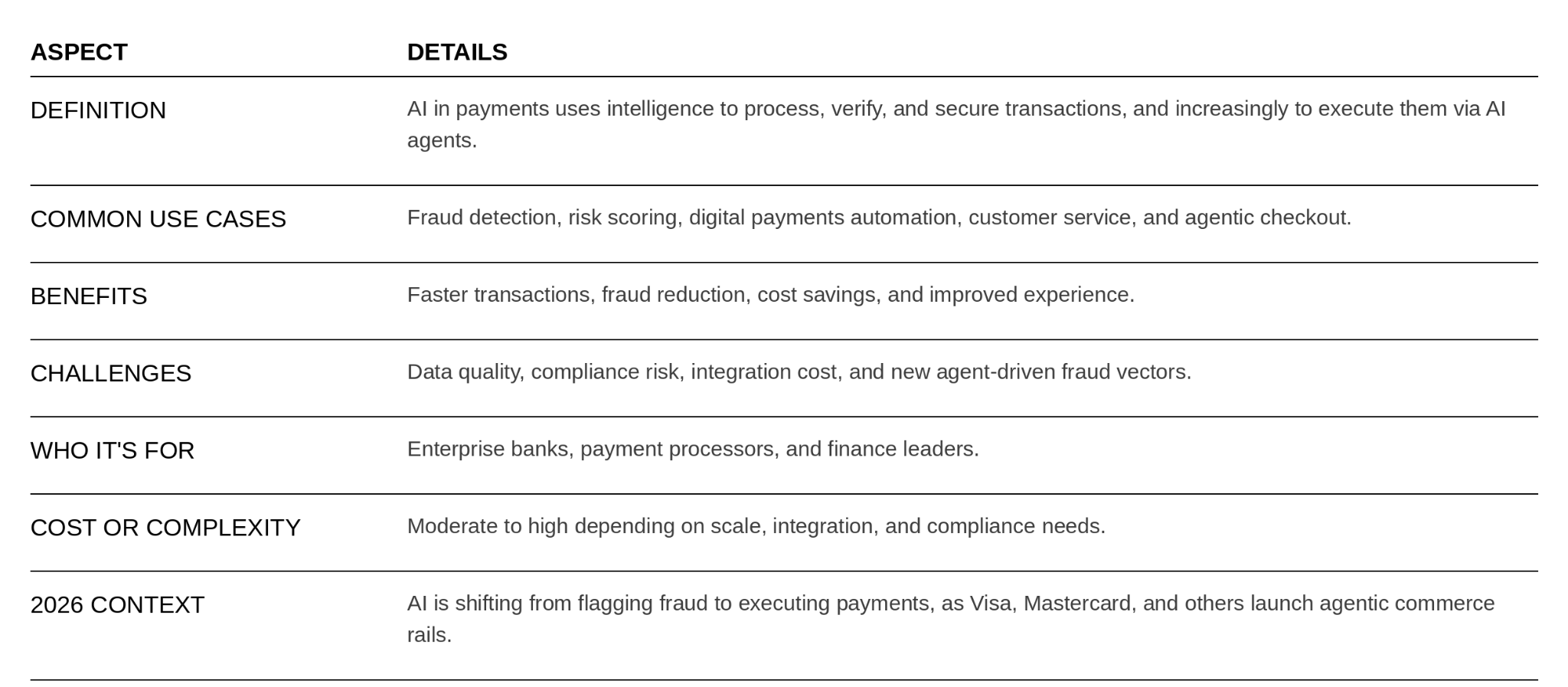
Quick Summary Table


%20(1).png)

Let’s kickstart the conversation and design stuff people will love.

The Retail & Consumer Index


Deep-Dive Sections

What It Is & Why It Matters
AI in payments is the application of machine learning, automation, and intelligence to payment systems. It matters because it strengthens fraud prevention and improves transaction speed, and supports compliance by identifying unusual behavior. In 2026 its role expands from analyzing payments to executing them, which makes it central to how enterprises will win or lose customers in an agent-mediated market. For enterprises, this translates to lower risk, improved margins, and a stronger customer experience.
How It Works
AI in payment processing works by analyzing large volumes of transaction data in real time, identifying patterns that may signal fraud, delays, or errors. Generative AI adds a layer by automating customer communication and internal reporting, while agentic systems can hold tokenized credentials, interpret spending rules, navigate merchant checkouts, and settle transactions. Together these tools improve decision-making and efficiency across the payments industry.
When to Use It (and When Not To)
AI in payments is most valuable when fraud risk is high, payment volumes are large, or customer expectations demand speed. Enterprises benefit most when use cases align with business priorities like security or customer service. AI may not be worth implementing in low-volume, low-risk environments where manual processes remain cost-effective, though the rise of agentic commerce is lowering that threshold.
Tools or Platforms Involved
AI in digital payments is powered by platforms combining machine learning, cloud processing, and API integration, and payment processors often embed AI directly into their services. For agentic commerce, card networks provide the rails: Visa Intelligent Commerce, whose partner program includes AI providers such as Anthropic, OpenAI, Microsoft, and Perplexity, and Mastercard Agent Pay, which binds tokenized credentials to specific agents. Choosing the right tools depends on scale, budget, and compliance needs.
Cost Considerations
The cost of AI in payments depends on scope and integration requirements. Enterprises often face upfront costs for platforms, data preparation, and training, with long-term savings from fraud reduction, faster approvals, and lower operational costs. Generative AI also improves efficiency in communication, reducing service costs, while preparing for agentic checkout is an emerging investment line.
Integration or Setup Requirements
AI in payment processing requires clean, reliable transaction data and strong integration with existing payment systems. Enterprises may need APIs, cloud infrastructure, or partnerships with specialist vendors, and increasingly support for agentic payment protocols and tokenized agent credentials. Setup complexity grows with system size and compliance obligations.
Scalability & Flexibility
AI in payments scales effectively with enterprise needs. As transaction volumes rise, models adapt and continue improving fraud detection and speed, and generative AI adds flexibility by automating custom processes across departments. Agentic infrastructure extends this further toward continuous, machine-driven microtransactions, a key reason AI in the payments industry is gaining momentum.
Alternatives or Comparisons
Alternatives to AI in payments include traditional fraud detection, manual reviews, and rule-based automation. These approaches are less adaptive and slower to respond, and they cannot validate or transact with AI agents. Compared to them, AI-driven solutions learn continuously, offering more accurate and efficient results and the ability to participate in agentic commerce.
Trends
The clear 2026 trend is agentic commerce, with every major network shipping agent checkout rails, alongside broader generative AI use, improved risk models, and the shift of fraud prevention toward proactive identity verification. Enterprises adopting AI in digital payments now benefit from early efficiency gains and position themselves for an agent-driven future.
Pros and Cons
Pros of AI in payments include fraud reduction, faster processing, improved compliance, and customer satisfaction. Cons include upfront cost, data quality demands, regulatory challenges, and new agent-driven fraud vectors that require new defenses. Enterprises must weigh these carefully when adopting AI in banking and payments.
How G&Co. Can Help

At G&CO., we help enterprise finance leaders understand and implement AI in payments with confidence. We bring experience in strategy, integration, and optimization, and our consultants know what works, what fails, and how to build AI solutions that create measurable value, including preparing for agentic commerce.
We work with brands to align AI in digital payments with business goals, reduce implementation risk, and accelerate adoption. Talk to us to clarify your strategy and move forward with confidence.
Conclusion & Next Steps
AI in payments is transforming banking, processing, and customer experience. Finance leaders now have a clear understanding of how AI in payment processing works, the benefits it brings, and where the future is heading, as AI shifts from flagging transactions to executing them through agentic commerce.
At G&CO., we have partnered with enterprise clients on similar initiatives, from digital transformation to customer journey modernization. Our expertise helps brands convert AI opportunities into competitive advantage. Still have questions? Reach out and let's solve them together.

Always-On Customer Intelligence
Turn your own customer data into foresight — validate, simulate, and sense every major decision before you commit.