Pharmaceutical Market Access FAQs | Pharma Market Access Guide
Introduction
Pharmaceutical market access is the process of ensuring patients can obtain a drug at the right time, in the right setting, and at a price payers will reimburse, by aligning regulatory approval, payer negotiations, and patient affordability. It has become the toughest strategic challenge in pharma in 2026, as the US Inflation Reduction Act begins negotiating Medicare prices, with the first ten negotiated prices cut 38% to 60% below list and taking effect in January 2026, Most Favored Nation pricing reshapes global reference points, and the EU rolls out its Joint Clinical Assessment. This guide answers the most common questions and explains what leaders must do now.
This article is written for Directors, SVPs, VPs, and Heads in the pharmaceutical industry. You will gain clarity on what market access is, why it matters, and how to build a strong, evidence-based market access strategy for pharma in a far more demanding pricing environment.
Market Context: Disruption & Opportunity
Market access in pharmaceutical industry settings has shifted dramatically. Regulatory frameworks are more demanding, payers are stricter, and healthcare providers expect clear evidence of value before approving drugs. In 2026, pricing pressure has moved from cyclical to structural: the Inflation Reduction Act introduced Medicare price negotiation, with the first ten drugs including Eliquis, Jardiance, and Januvia seeing prices reduced by an average of 38% to 60% below 2023 list prices, and further cycles covering 15 drugs each for 2027 and 2028. In parallel, Most Favored Nation pricing, launched by executive order in 2025, ties US prices to lower international benchmarks and can supersede IRA-negotiated prices, while the EU's Joint Clinical Assessment adds a new layer of centralized clinical evaluation.
This disruption also creates opportunity. Companies can no longer treat the US as a global price safety net, so the winning strategy shifts from maximizing list price market by market to protecting pricing corridors globally, backed by strong real-world evidence and early payer engagement. Enterprise leaders who embrace modern pharmaceutical market access consulting can position their organizations for long-term advantage, while those who ignore these changes risk launch delays, restricted access, or market exclusion.
FAQs Snapshot

What is market access in pharma?
Market access in pharma refers to the process of ensuring patients can obtain a drug at the right time, in the right setting, and at a price payers are willing to reimburse. It involves aligning regulatory approval, payer negotiations, and patient affordability. Pharmaceutical market access is not limited to approvals but also includes ongoing strategies to maintain access across markets.
Why is pharmaceutical market access important?
Pharmaceutical market access is important because even the most effective treatments cannot succeed if patients and payers cannot access them. For enterprise pharma leaders, market access strategy directly affects revenue, reputation, and long-term growth. Without a clear strategy, companies may face restricted formularies, delayed launches, or poor uptake in critical regions, and in 2026 they face direct price reform exposure.
How does the Inflation Reduction Act affect pharmaceutical market access?
The IRA lets Medicare negotiate prices for selected high-spend drugs, setting a maximum fair price manufacturers must accept. The first ten negotiated prices took effect on January 1, 2026, reduced 38% to 60% below 2023 list prices, with 15 more drugs negotiated for 2027 and another 15 announced in January 2026 for 2028. Even for drugs not yet in scope, the signal is clear: high-spend products face earlier scrutiny and greater sensitivity to launch prices and post-launch increases.
What is Most Favored Nation (MFN) drug pricing?
Most Favored Nation pricing, introduced by US executive order in 2025, ties the price Americans pay to the lowest price charged in comparable developed countries. It matters for market access because CMS has indicated MFN prices can supersede IRA-negotiated prices, and early deals show its reach, such as Novo Nordisk offering Wegovy to Medicare at $245 per month. MFN increases international reference pricing exposure and is pushing companies to rethink global launch sequencing.
What is the EU Joint Clinical Assessment (JCA)?
The Joint Clinical Assessment is a centralized EU evaluation of a therapy's relative clinical effectiveness and safety, introduced under the EU HTA Regulation and applied first to oncology medicines and advanced therapy medicinal products. It aims to reduce duplication across member states, though its practical impact depends on how consistently national HTA bodies integrate it into local reimbursement decisions.
What is market access in pharmaceutical industry strategy?
Market access strategy means building a framework that integrates clinical value, pricing models, and payer relationships. It requires data-driven evidence, health economics modeling, and negotiation expertise. Enterprise brands use pharmaceutical market access strategy to secure sustainable pricing and broader patient adoption, increasingly by protecting global price corridors rather than optimizing each market in isolation.
What are the benefits of market access pharma consulting?
Market access pharma consulting helps companies understand payer expectations, build value and evidence models, and design practical launch and negotiation strategies. Consulting firms provide insight into regulatory shifts like the IRA, MFN, and EU HTA, and into payer priorities. With this guidance, pharma leaders can avoid costly missteps, prepare for negotiation windows, and accelerate drug uptake.
How does pharma market access strategy development work?
Strategy development begins with research into payer requirements, competitor positioning, and patient needs, then designs pricing, reimbursement, and distribution models supported by value dossiers and real-world evidence. A successful strategy also stress-tests the value narrative before negotiation and monitors post-launch outcomes and reference-price spillover to maintain favorable access.
What challenges exist in market access for pharma?
Challenges include structural pricing pressure from the IRA and MFN, stricter health technology assessments like the EU JCA, stronger PBM contracting, and growing demand for real-world evidence earlier in the lifecycle. Companies without strong strategies risk market exclusion, unsustainable discounts, or damaging spillover across reference markets. Effective, early planning helps avoid these pitfalls.
Benefits of Pharmaceutical Market Access
Pharmaceutical market access provides clear advantages for enterprise organizations, especially leadership teams focused on launch success, market share growth, and payer alignment. Patients also benefit, as strong market access ensures treatments reach them faster and at more affordable costs.
For companies, market access strategies reduce delays in product launches and strengthen relationships with regulators and payers. Pharmaceutical market access consulting helps firms build realistic pricing and reimbursement frameworks and prepare for IRA negotiation and MFN exposure. With strong strategy development, leaders can expand into new markets, improve patient outcomes, and protect long-term profitability.
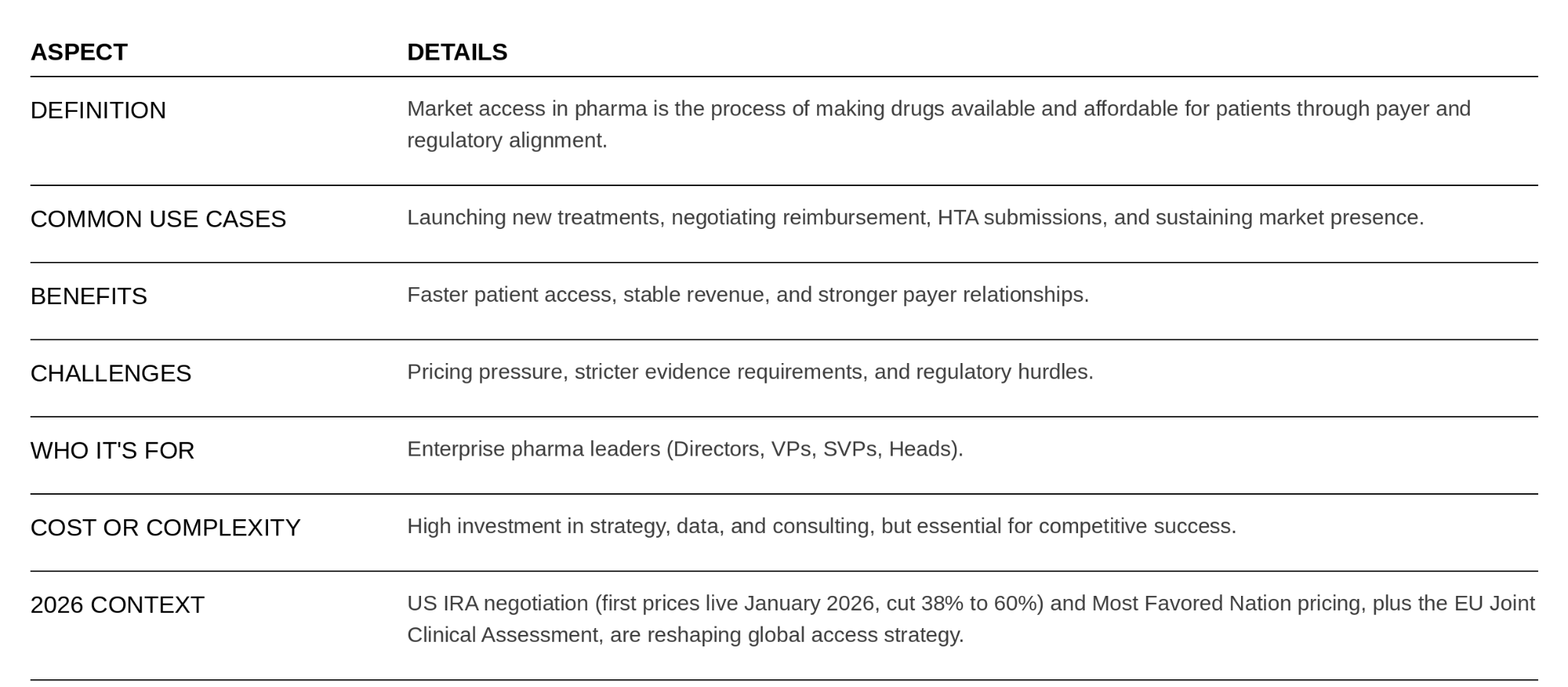
Quick Summary Table



.png)
%20(1).png)

Let’s kickstart the conversation and design stuff people will love.

The Retail & Consumer Index


Deep-Dive Sections

What It Is & Why It Matters
Market access in pharmaceutical industry terms defines how treatments reach patients in a sustainable way. It matters because approval alone is not enough to guarantee adoption. Enterprise pharma leaders must secure reimbursement and demonstrate value to payers. Without a clear pharmaceutical market access strategy, companies risk revenue loss and delayed impact.
How It Works
Market access pharma strategies work by aligning regulatory clearance, payer expectations, and patient affordability. This involves submitting value dossiers, engaging with payer advisory boards, and using real-world data. Consulting partners often guide teams through pharma market access strategy development to ensure successful execution.
When to Use It (and When Not To)
Market access in pharma should be developed early in the drug lifecycle, ideally before regulatory submission. Companies that delay strategy may face post-approval access barriers. The only time market access planning may not be necessary is for internal R&D without commercial intent. For all other launches, pharmaceutical market access consulting is critical.
Tools or Platforms Involved
Tools supporting pharma market access strategy include health economics models, real-world evidence platforms, and payer engagement systems. Data visualization dashboards and pricing analytics tools help leaders track outcomes. Pharmaceutical market access consulting partners often bring these tools and frameworks to enterprise clients.
Cost Considerations
Developing a pharmaceutical market access strategy requires investment in analytics, consulting, and payer engagement. While upfront costs are high, the alternative is greater: failed launches or restricted access. Market access for pharma ensures revenue protection and improved ROI.
Integration or Setup Requirements
Pharma market access strategy development requires cross-functional collaboration. Regulatory, clinical, commercial, and market access teams must work together. Consulting firms streamline integration by aligning workflows and data systems. Pharmaceutical market access consulting makes implementation smoother across global markets.
Scalability & Flexibility
A strong pharmaceutical market access strategy is scalable across different regions and adaptable to regulatory changes. Leaders must build frameworks that adjust to payer requirements over time. Scalability ensures drugs can expand beyond initial launch markets.
Alternatives or Comparisons
Without market access pharma planning, companies rely on traditional sales or pricing approaches. These often fail in modern payer-driven environments. Pharmaceutical market access consulting provides structured, data-backed alternatives. Compared to ad-hoc methods, pharma market access strategy offers sustainability and long-term alignment.
Trends
Current trends in pharmaceutical market access include digital payer engagement, real-world evidence integration, and patient affordability programs. Pharma market access strategy development is moving toward data-driven, AI-supported modeling. Leaders who adopt these trends gain an advantage in payer negotiations.
Pros and Cons
Pros of pharmaceutical market access strategy include better patient outcomes, stronger payer trust, and sustainable pricing. Cons include high upfront costs, time-intensive data collection, and the need for ongoing adjustment. However, the benefits far outweigh the risks for enterprise leaders.
How G&CO.Health Can Help

At G&CO.Health, we help enterprise pharma companies design and implement effective market access strategies. Our experience in pharmaceutical market access consulting covers pricing, payer engagement, and digital strategy, including preparing for IRA negotiation, MFN exposure, and evolving HTA requirements. We guide leaders through strategy development with insights grounded in real-world outcomes.
Our consulting team ensures market access in pharma is not left to chance. We deliver strategy, integration, and optimization support to help enterprise brands secure patient reach and revenue growth. Talk to us to clarify your pharmaceutical market access strategy and move forward with confidence.
Conclusion & Next Steps
Pharmaceutical market access is no longer optional. Enterprise brands need clear, data-driven strategies to secure payer approval, improve patient affordability, and protect revenue growth in an environment reshaped by the IRA, Most Favored Nation pricing, and EU health technology assessment. This article explained what market access in pharma is, why it matters, and how strategy development and consulting create competitive advantage.
At G&CO.Health, we have worked alongside clients to implement these shifts, whether through digital strategy, market access consulting, or commercial optimization. Our expertise enables enterprise pharma leaders to turn awareness into tangible market advantage. Explore how G&CO.Health can support your market access pharma strategy and prepare your brand for long-term success.
Always-On Customer Intelligence
Turn your own customer data into foresight — validate, simulate, and sense every major decision before you commit.