Pfizer’s AI Transformation: How Connected AI Is Rebuilding the Pharmaceutical Patient and HCP Experience
This Pfizer AI transformation case study examines how Pfizer is connecting AI across its entire business, from drug discovery and manufacturing to how it works with doctors and patients, so every stage supports one trusted relationship rather than a set of disconnected tools. It is a study in AI in pharma and in pharmaceutical digital transformation done as one connected system. A $62.6 billion company with more than 80,000 employees, Pfizer built AI into discovery (saving scientists 16,000 hours a year), manufacturing, clinical work, and its content platform, Charlie. The early payoff includes roughly $4.5 billion in cost savings through 2025, much of it reinvested into new medicines.
Pfizer is building AI into its whole business by matching the tool to the job: VOX for its scientists, Charlie for its marketers, and Microsoft Copilot for general office productivity.
Pfizer is not running an AI productivity project. It is rebuilding how a drug brand earns trust with patients and doctors at every stage, from discovery through ongoing care. Entering 2026 as a $62.6 billion company with more than 80,000 employees, Pfizer had long struggled with a scattered experience: brands communicating in silos, content that took too long to produce for launch windows, and no single AI system linking its business intelligence to how it engages patients.
Its response, this Pfizer AI transformation, treats AI as the connection between everything, not a pile of separate tools. Where most large drug companies bolt AI onto individual functions and celebrate the local time savings, Pfizer is wiring it across discovery, manufacturing, and marketing so the whole patient and doctor relationship holds together from end to end. That difference is the point, and it is harder to pull off than it sounds. For pharmaceutical leaders, the lesson is structural, not technical: the experience patients see is only as strong as the evidence and reliability behind it.
Key Points
- Pfizer is wiring AI across its entire business: Discovery, manufacturing, clinical work, and marketing are connected so the experience for doctors and patients holds together end to end.
- Its content platform, Charlie, is the piece that reaches doctors and patients. Trained on Pfizer's own approved clinical and brand material, it drafts compliant content, flags legal-review needs, and personalizes messaging in a way a generic AI can't.
- AI helped drive about $4.5 billion in cost savings through 2025, including 16,000 scientist hours a year saved in discovery and a manufacturing program targeting $1.5 billion by end of 2027.
- Pfizer's rules for responsible AI keep recommendations traceable and privacy-safe, because in pharma the trust that governance creates is what decides whether anyone engages at all.


%20(1).png)

Let’s kickstart the conversation and design stuff people will love.

The Retail & Consumer Index


Why This Case Study Matters
Every major pharmaceutical enterprise in 2026 faces the same problem Pfizer set out to solve. Patients and clinicians now expect the personalization and responsiveness they get from consumer technology platforms, yet pharma commercial operations remain fragmented across therapeutic areas, each with its own content workflows, segmentation models, and feedback loops. The question is no longer whether to deploy AI, but how to architect it as connective tissue rather than a scatter of isolated tools.
For CEOs, CMOs, chief digital officers, and heads of innovation in life sciences, Pfizer is the most instructive model available at this scale. It shows what AI-enabled experience design looks like inside a compliance environment that consumer brands never face, where promotional content must clear medical, legal, and regulatory review, adverse-event summaries must meet FDA pharmacovigilance standards, and engagement content must satisfy HIPAA.
Strategic Context
Pfizer enters 2026 generating $62.6 billion in FY2025 revenue across dozens of therapeutic areas and global markets. As at other large enterprises, that scale has been as much a liability as an advantage. A brand manager in oncology and a brand manager in vaccines could operate with entirely different content workflows, HCP segmentation models, digital experience platforms, and patient-journey feedback loops, producing inconsistent experiences for clinicians and patients who expect coherence.
What makes pharmaceutical experience design uniquely difficult is that the patient journey intersects simultaneously with clinical evidence, regulatory compliance, insurance authorization, provider communication, and ongoing adherence, and every touchpoint sits under intense regulatory scrutiny. The compliance architecture is not a constraint on the experience; it is part of the experience, because patients and providers who do not trust a brand’s regulatory integrity will not engage with its clinical messaging no matter how well designed it is. That is precisely why solving AI-enabled experience inside this environment, building systems that are personalized, clinically credible, compliant, and fast at once, creates a capability less integrated competitors cannot replicate. Chief AI, Data and Analytics Officer Jeremy Forman, elevated to the role in January 2026, frames the program as infrastructure for more meaningful patient and provider relationships, not as a cost-efficiency play.
Company Response
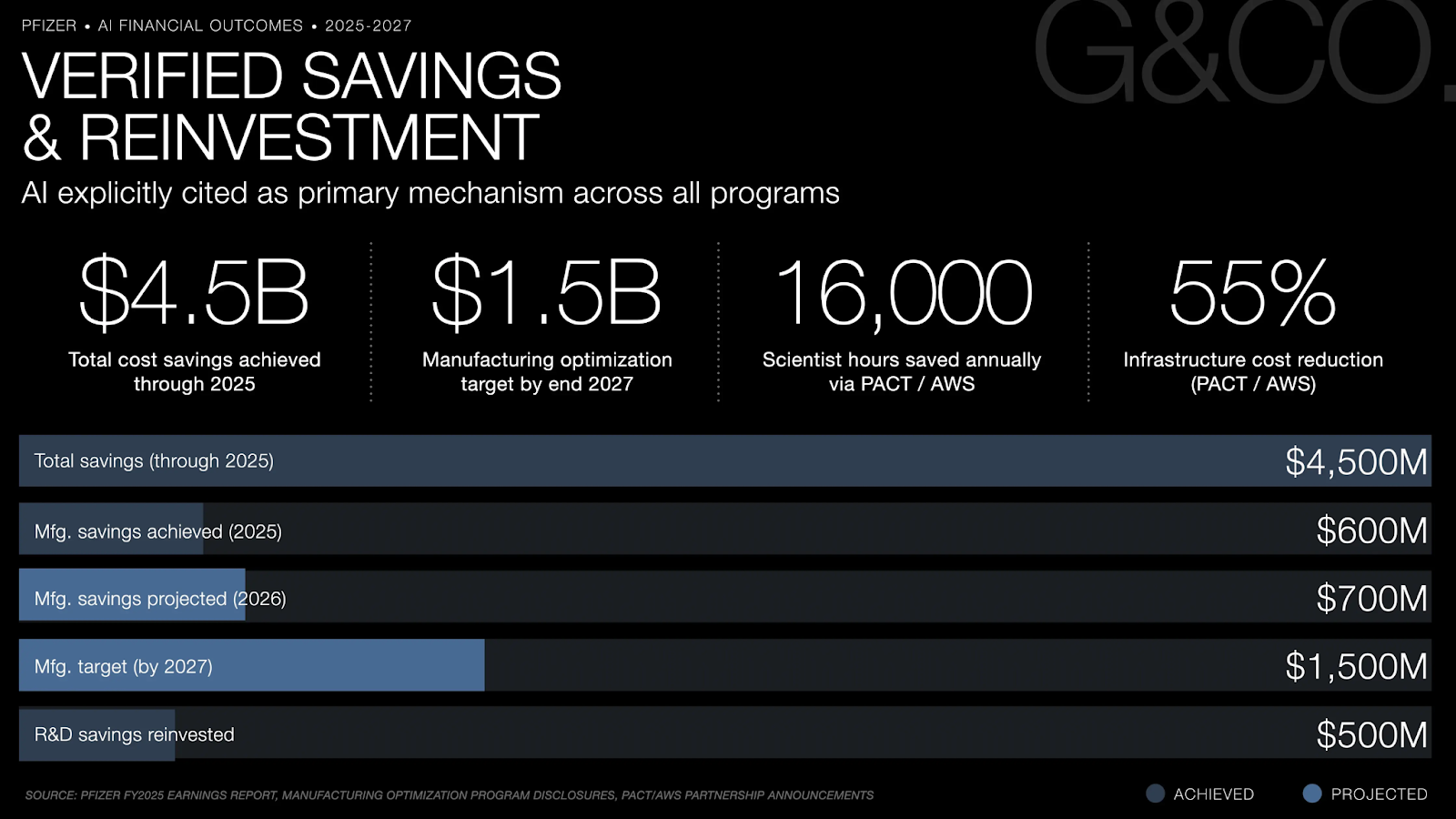
Pfizer's answer runs across four connected layers, each strengthening the others.
Discovery.
Working with Amazon (AWS), Pfizer has run more than a dozen AI and machine-learning projects that save scientists 16,000 hours a year while cutting infrastructure costs by 55%. A series of partnerships with biotech and AI firms extends its own clinical-research foundation, from AI models of biology (with Pfizer keeping ownership of the compounds) to data agreements for training AI on disease biology. The experience patients eventually see is only as strong as this research foundation beneath it.
Manufacturing.
Pfizer's manufacturing program targets $1.5 billion in savings by the end of 2027, with about $600 million reached through 2025. Its "Golden Batch" approach uses AI to find and repeat the exact conditions that produce the highest-quality batches, shifting manufacturing from managing variation to repeating excellence. For patients on complex medicines, that consistency is not an abstract number; it is the reliability of the drug they depend on.
Clinical work.
AI drafts the tables, reports, and summaries that speed up regulatory submissions, while AI applied to drug-safety monitoring spots safety signals faster, a compliance-critical job where quicker detection protects patients and keeps doctors' trust. The work with AWS also cuts the time to build a working clinical AI tool to as little as six weeks, and $500 million in research savings flows straight back into developing new medicines, turning efficiency into faster patient access.
Marketing (Charlie).
Launched in February 2024 and named for co-founder Charles Pfizer, Charlie is the connection between clinical evidence, brand strategy, the rules, and the content that reaches doctors and patients. Built with an outside technology partner, it is used by hundreds in central marketing and thousands across brand teams. It creates and edits content, checks clinical facts, flags legal-review needs with a simple traffic-light system, and analyzes media, collapsing a multi-week, multi-team approval process into a system that drafts compliant content, flags risk in real time, and learns from approved work. Trained on approved content organized by treatment area and product, plus audience models, Charlie is built to produce several times more content while making the messaging more precise for a specialty, a disease stage, or a given insurance situation.
Underpinning all four is the human layer: an enterprise-wide rollout of AI tools (Microsoft Copilot), AI training sessions across seven countries, and basic AI skills built across the workforce, so every field team member, patient-services coordinator, and brand manager can deliver a more responsive interaction.
Results and Evidence
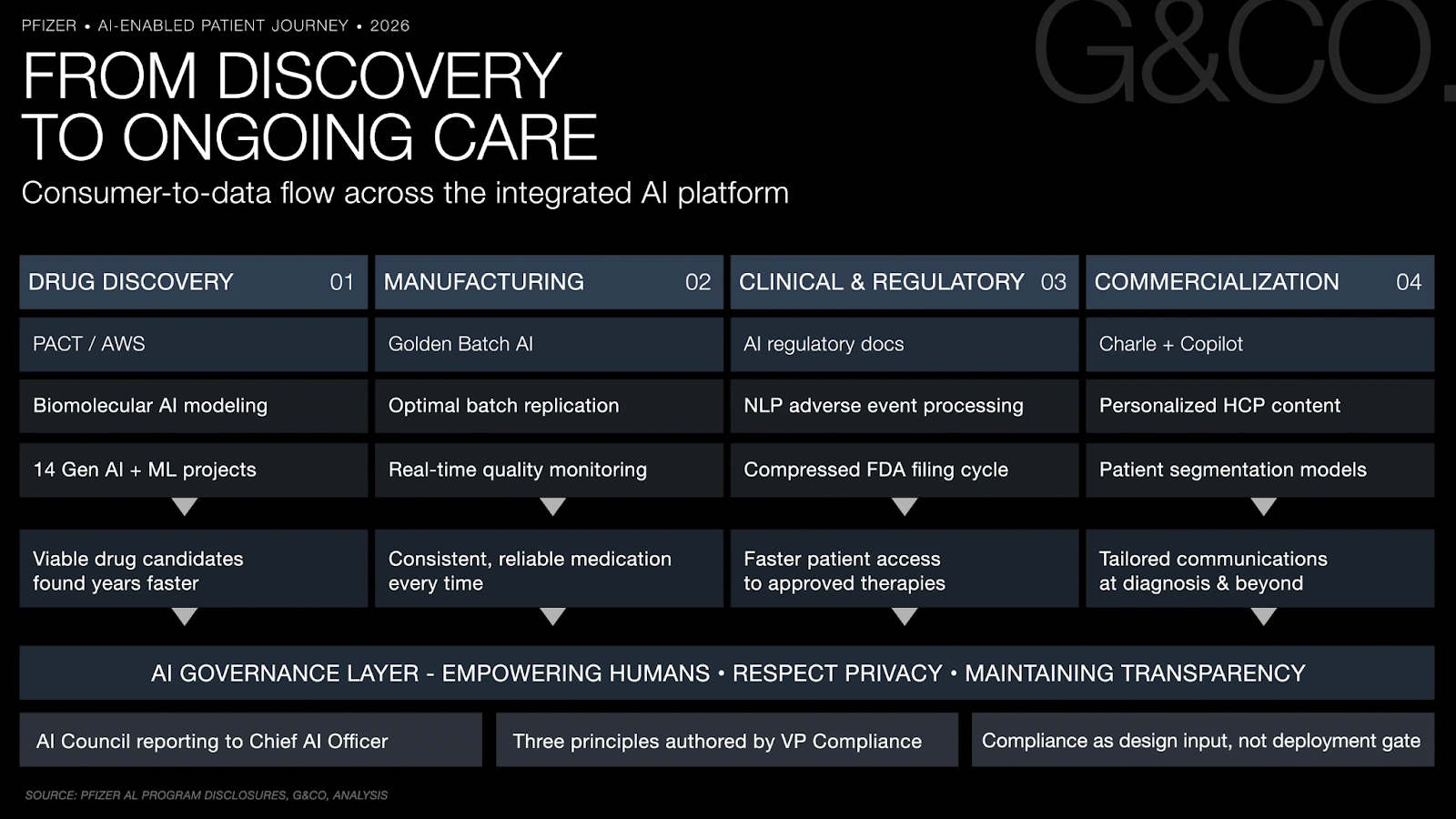
The financial evidence is substantial and explicitly tied to AI. Pfizer realized approximately $4.5 billion in total net cost savings through 2025, with AI cited as a primary mechanism, and reinvested a meaningful share into the pipeline and patient-experience infrastructure rather than returning it all to the bottom line. The Manufacturing Optimization Program remains on track for $1.5 billion by end of 2027, with $0.7 billion projected for 2026. The PACT/AWS collaboration saves 16,000 scientist hours annually and reduces infrastructure costs by 55%, and $500 million in R&D savings flows directly back into the pipeline.
The deeper proof point is qualitative but structural: a patient diagnosed with a rare autoimmune disease in 2026 encounters Pfizer’s AI investment at every stage, usually without knowing it. The candidate was identified faster through AI-assisted molecular modeling, manufactured under Golden Batch optimization, supported by AI-accelerated regulatory documentation, and matched to a patient-support program personalized through Charlie’s segmentation. That connected journey, not any single tool, is what competitors who deployed AI in one or two functions cannot reproduce.
Governance is the enabling condition. VP of Compliance for AI Lucy Muzzy authored Pfizer’s first AI governance policy and its Three Principles of Responsibility (empowering humans, respecting privacy, maintaining transparency), and the AI Council, reporting through Jeremy Forman, ensures governance and technology decisions are made simultaneously rather than sequentially. The trust this generates is itself a patient-experience asset, because every other element of the journey depends on it.
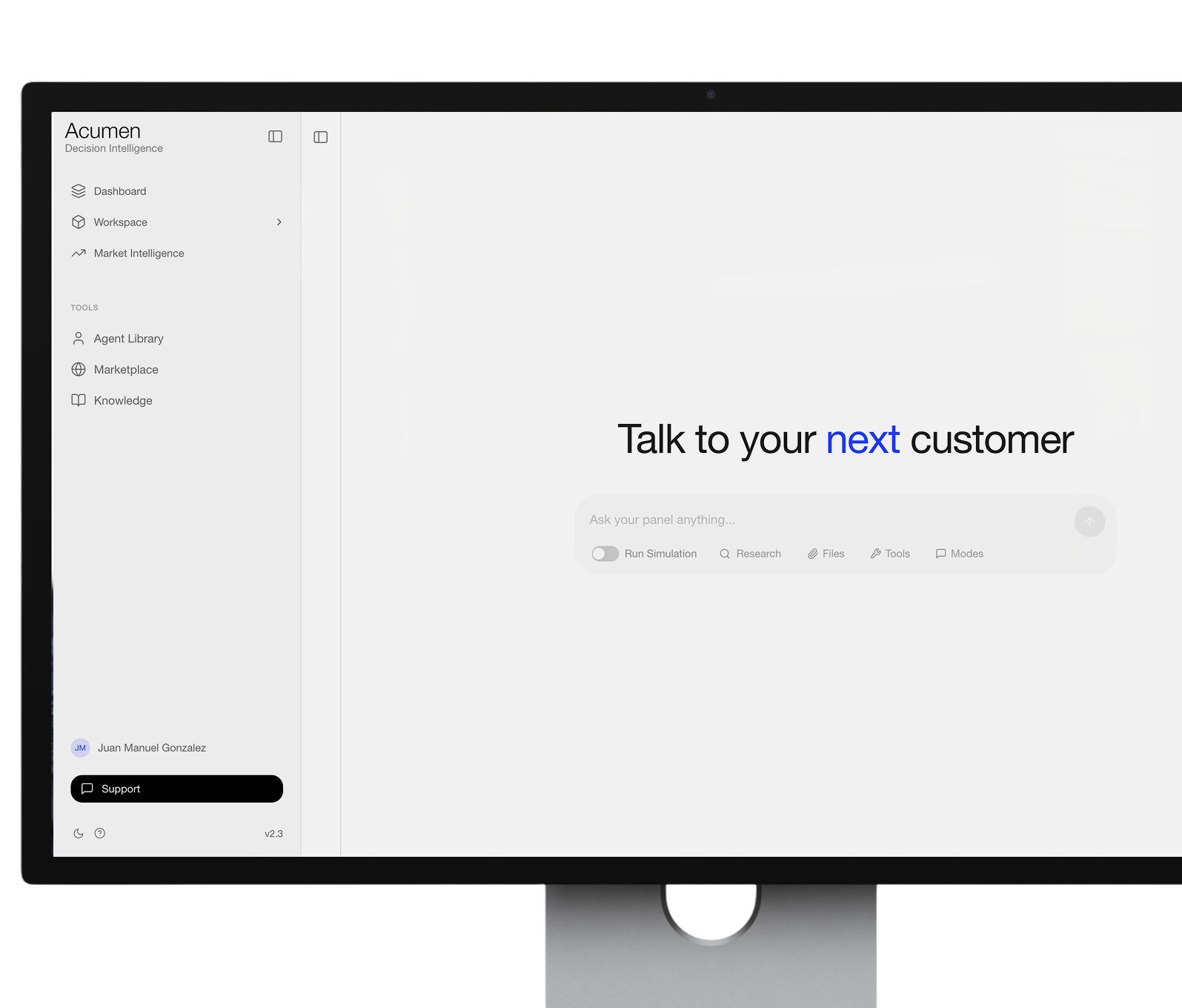
Always-On Customer Intelligence
Turn your own customer data into foresight — validate, simulate, and sense every major decision before you commit.


Strategic Implications
Read at scale, Pfizer reframes pharmaceutical AI from a productivity question into an experience-architecture question, and the pattern generalizes well beyond life sciences. Across AI, customer experience, digital transformation, personalization, and data strategy, the same hierarchy holds: tools that are not connected by a governed data layer produce efficiency without trust. The organizations that win are those that turn proprietary evidence into personalized, compliant communication through one coherent system.
The structural forces behind Pfizer’s move, patent-cliff pressure demanding faster commercial velocity, patient expectations set by consumer technology, HCP preferences shifting toward personalized digital engagement, and regulators demanding transparency in AI-assisted communication, define the operating reality for every major pharmaceutical and life-sciences enterprise. The advantage compounds: better data generates better personalization, which deepens engagement, which generates richer data. The window to establish that compounding advantage narrows each year as first movers build relationships that are progressively harder to displace. The same connected-AI approach appears in Sanofi's data-led pharma transformation, AstraZeneca's post-prescription platform, and CVS Health's combined healthcare data platform.
What Enterprise Leaders Can Learn
- Build the connected system first.
A credible experience depends on the clinical evidence and reliable operations beneath it, so AI has to span the full journey from discovery to marketing. - Train on your own data.
AI for pharmaceutical experience has to learn from approved clinical and brand content to reach the accuracy and compliance that doctors and patients require. - Treat governance as an enabler.
Principles like Pfizer's are trust-building promises to patients and doctors, not just internal policy, and they should be designed in, not bolted on. - Fund the human layer.
AI skills across the whole workforce, not just among data scientists, are what make AI-enabled customer experiences consistently helpful and credible at scale. - Respect the order.
Evidence before experience and compliance before scale are what separate a durable advantage from polished content nobody trusts.
Conclusion
Pfizer's AI transformation captures the central challenge for pharmaceutical and life-sciences leaders in 2026. The companies that will lead patient and doctor experience over the next decade are not the ones with the most impressive individual tools. They are the ones that connect those tools into one coherent experience that earns clinical trust, delivers real personalization, and runs reliably inside the rules that make engagement meaningful rather than transactional. The lasting lesson is not really about artificial intelligence. It is about what healthcare should be: an experience built around real people facing real challenges, designed with empathy and delivered with clinical integrity. Playing out at $62.6 billion in annual revenue across dozens of treatment areas, Pfizer's transformation shows that this level of coherence is achievable even at the highest level of pharmaceutical complexity. What remains is the commitment to treat AI as the infrastructure for trust, not just a productivity tool.
Through the Acumen platform, G&CO.Health gives enterprise pharmaceutical and healthcare brands the intelligence to make AI-driven experience pay off: where connected AI creates real trust and value, how patients and doctors want to engage, and which investments most improve outcomes. G&CO.Health is a certified minority business enterprise through the National Minority Supplier Development Council (NMSDC). For enterprise organizations with diversity inclusion requirements in their procurement process, G&CO.Health meets the criteria for MBE-qualified partner status.
G&CO.Health works with enterprise pharmaceutical and healthcare brands on the AI, data, and experience strategy that connects clinical evidence to compliant, personalized communication across the whole patient and doctor journey. If this Pfizer case study raises questions about your own AI transformation or patient engagement, submit an inquiry to G&CO.Health on our contact page or click the blue "Click to Contact Us" button in the bottom right corner of your screen. We look forward to hearing from you.
Frequently Asked Questions
How is Pfizer using AI to improve patient and doctor experience?
Pfizer's AI spans the full journey. Its work with Amazon (AWS) generates the clinical evidence behind credible communications, its Golden Batch manufacturing AI ensures the drug-quality consistency that defines the patient's experience, its Charlie platform personalizes and speeds up compliant content for doctors and patients, and an enterprise-wide rollout of AI tools builds AI capability into every workflow that touches the experience. The point is that these connect into one relationship, rather than working in isolation.
How does Pfizer govern AI in a regulated environment?
Pfizer built compliance into the design of its AI program through three principles for responsible AI: empowering people, respecting privacy, and staying transparent. An internal AI council ensures technology and compliance decisions are made at the same time rather than one after the other. This makes governance both a regulatory requirement and a trust-building promise to patients and doctors, which is essential because every other part of the experience depends on that trust.
What are the financial results of Pfizer's AI transformation?
Pfizer achieved roughly $4.5 billion in total net cost savings through 2025, with AI cited as a main driver. Its manufacturing program is on track for $1.5 billion in savings by the end of 2027, its work with AWS saves 16,000 scientist hours a year and cuts infrastructure costs by 55%, and $500 million in research savings has been reinvested into developing new medicines. Much of the saving is reinvested rather than returned to profit, turning efficiency into faster patient access.
What is Charlie, Pfizer's AI platform?
Charlie, named after co-founder Charles Pfizer and launched in February 2024, is Pfizer's content platform and the connection between clinical evidence, brand strategy, the rules, and the content that reaches doctors and patients. It creates and edits content, checks clinical facts, flags legal-review needs, and analyzes media, turning a slow, multi-team approval process into a system that drafts compliant content, flags risk in real time, and learns from approved work. Because it is trained on Pfizer's approved content, it can personalize messaging accurately while staying compliant.
What can pharmaceutical leaders learn from the Pfizer AI case study?
The main lesson is structural. Companies that connect AI into one system, linking clinical evidence to communication to patient support through a well-governed AI layer, build relationships that grow more valuable over time and are hard to copy. Using AI in isolated functions produces speed without trust and efficiency without the clinical credibility that decides whether patients and doctors engage at all. Evidence before experience, and compliance before scale, are the two rules that make the difference.