Starbucks’ Operational AI: How a Four-Layer Store Operating System Rebuilt the In-Store Experience
This Starbucks case study examines how the coffee giant used operational AI to fix the store logistics that a decade of mobile-order growth had broken. By FY2024, mobile orders were overwhelming baristas and producing the worst quarterly traffic in company history. Under CEO Brian Niccol, Starbucks built a layered system, demand forecasting (Deep Brew), order sequencing (SmartQ), an AI assistant for baristas (Green Dot Assist), and inventory AI, so machines handle the logistics and baristas focus on the coffee and the customer. Most café orders now finish in under four minutes, and Q4 FY2025 brought the first sales growth in seven quarters, on $37.2 billion in revenue.
Starbucks created Deep Brew, an AI platform that forecasts demand and coordinates store operations, to fix the in-store bottlenecks its own mobile-ordering boom generated.
Starbucks built a $37.2 billion brand on a paradox: a coffeehouse at industrial scale, 40,000 stores and a standardized menu engineered to feel handcrafted. By FY2024, a decade of unchecked mobile-order growth had broken that paradox, turning coffeehouses into logistics bottlenecks and producing the worst quarterly traffic in company history.
Its response is a lesson in fixing operations: not automating the experience, but using machines to manage the logistics that were getting in the way of it. The idea is precise, and a little counterintuitive for a company built on human warmth: every task the AI takes on is a task handed back to human craft. That is why Starbucks operational AI is better understood as an operating system for the store than as a set of features, and why the order in which it was built matters as much as the technology itself. For enterprise leaders, this is a blueprint for resolving the tension between digital convenience and human connection.
Key Points
- A decade of mobile-order growth broke Starbucks' stores, producing its worst quarterly U.S. traffic on record in FY2024. The problem was store execution, not the app.
- New CEO Brian Niccol paused a planned machine overhaul to invest in software and staffing first, so AI handles the logistics and baristas handle the coffee and the customer.
- Four connected layers do the work: Deep Brew (demand forecasting on its own data), SmartQ (order sequencing across café, drive-thru, and mobile), Green Dot Assist (an AI helper for baristas), and inventory AI.
- The early results are a turnaround in progress: Most café orders now finish in under four minutes, and Q4 FY2025 delivered the first global comparable-sales growth in seven quarters, on $37.2 billion in revenue.


%20(1).png)

Let’s kickstart the conversation and design stuff people will love.

The Retail & Consumer Index


Why This Case Study Matters
The conditions that forced Starbucks to act, digital ordering outpacing store execution, peak-hour demand volatility, and consumer expectations set by platforms with no physical constraints, describe nearly every large physical retailer, hospitality operator, and high-volume healthcare provider in 2026. Starbucks is the clearest large-scale demonstration of what happens when a beloved digital channel quietly becomes an operational liability, and how to resolve it without sacrificing the experience that built the brand.
For CEOs, chief digital officers, heads of customer experience, and operations leaders, the value is in the sequencing insight. The organizations deploying operational AI now are building the data assets and system intelligence that will define their execution capability for the next decade. Those deploying it reactively, after the traffic collapse and the brand damage, buy the same capability at higher cost and lower differentiation.
Strategic Context
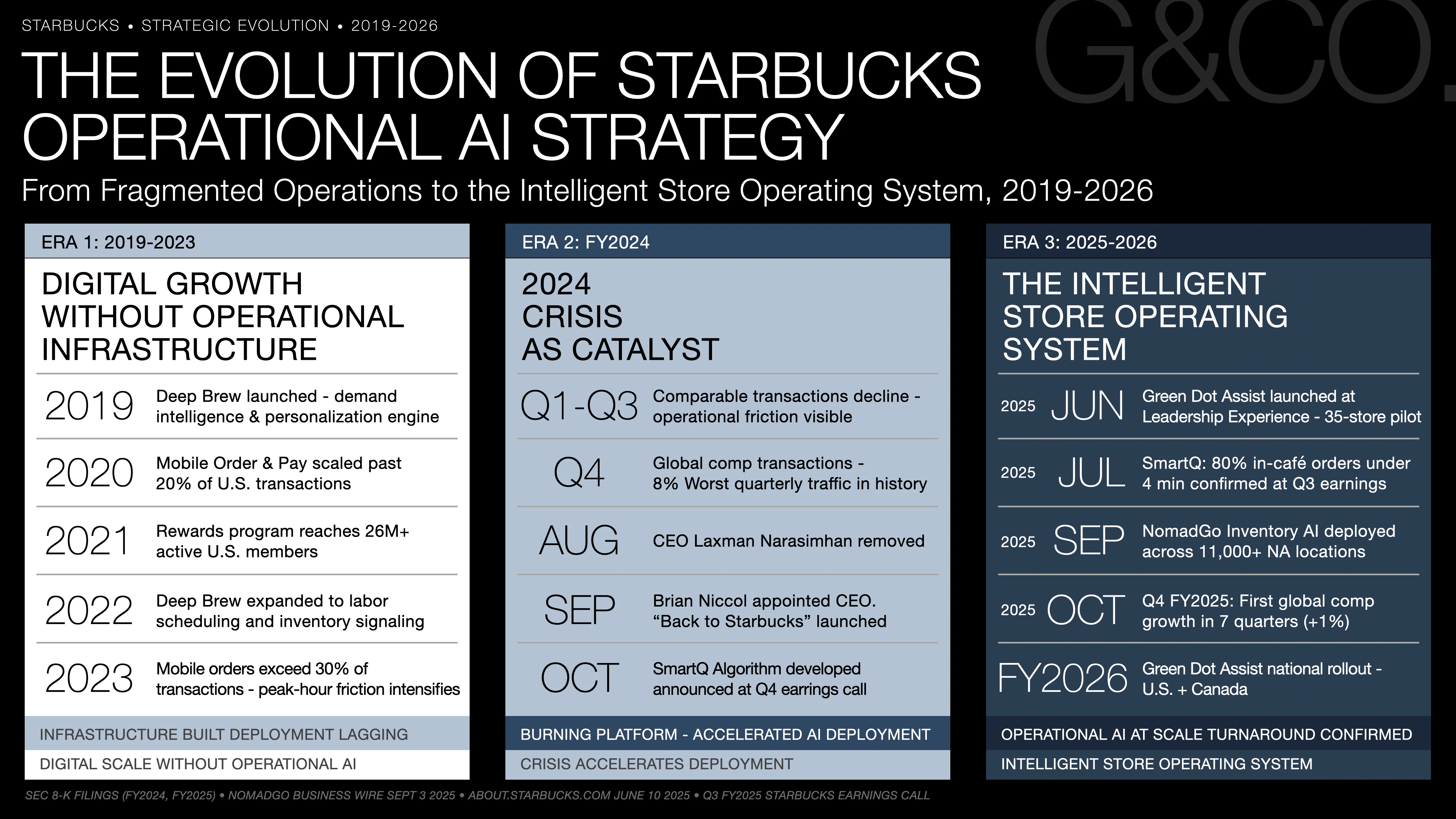
For a decade, mobile ordering appeared to strengthen Starbucks. The app amassed 34.6 million active U.S. Rewards members, Mobile Order and Pay scaled past 30% of all U.S. transactions, and Starbucks became a reference case in digital customer experience strategy. Then the seams showed. By FY2024, the same infrastructure that drove digital growth had become the primary operational liability: peak-hour order floods overwhelmed baristas, café and drive-thru queues merged into a single point of friction, and mobile orders arrived faster than they could be sequenced and fulfilled.
The numbers were stark. Global comparable transactions fell 4% for the year, with Q4 down 8%, the worst quarterly traffic performance in company history. The problem was not the technology; it was that Starbucks had scaled a digital experience without engineering the store-level operational infrastructure to deliver it. The gap between the promise of the app and the reality of the pickup counter had become the brand’s defining liability, and closing it required treating execution, not strategy, as the actual problem.
Company Response
Brian Niccol's appointment as CEO in September 2024 brought the key reframe at the heart of this case: Starbucks did not have a digital strategy problem, it had an execution problem. The response was to treat each coffeehouse not as a store with a digital add-on, but as a node in a smart operating system where AI handles the logistics so human partners concentrate on craft and connection. This is the essence of the Starbucks AI strategy.
The trade-off was deliberate and little discussed. Starbucks put the Siren System, a big hardware overhaul meant to speed up drink production mechanically, on hold, because Niccol concluded that smarter software and better staffing deliver a better experience than new equipment alone. The judgment was to fix the system before replacing the machinery, recognizing that the real constraint was not the speed of the equipment but the intelligence coordinating it across simultaneous digital and in-store demand.
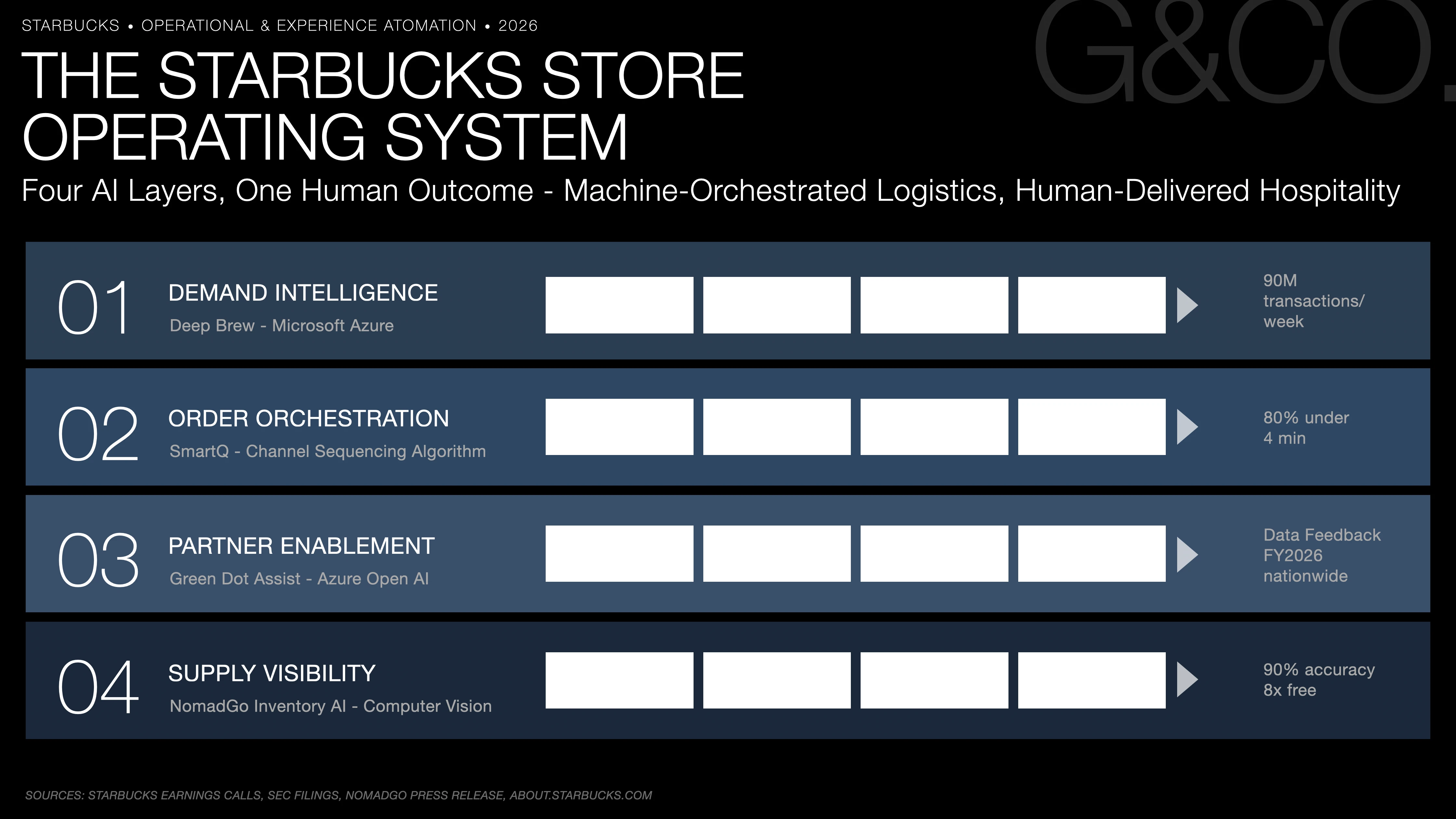
The system runs across four connected layers, a practical set of AI tools for restaurant operations:
Deep Brew, Starbucks' own AI platform on Microsoft Azure (launched 2019), is the demand engine. It processes transaction data, local weather, store traffic, and purchase history to personalize Rewards offers, build better staff schedules, and coordinate restocking across the network. Being its own platform rather than a licensed one is the point: it gives Starbucks a data asset that grows with every transaction and cannot be copied without the same scale and time.
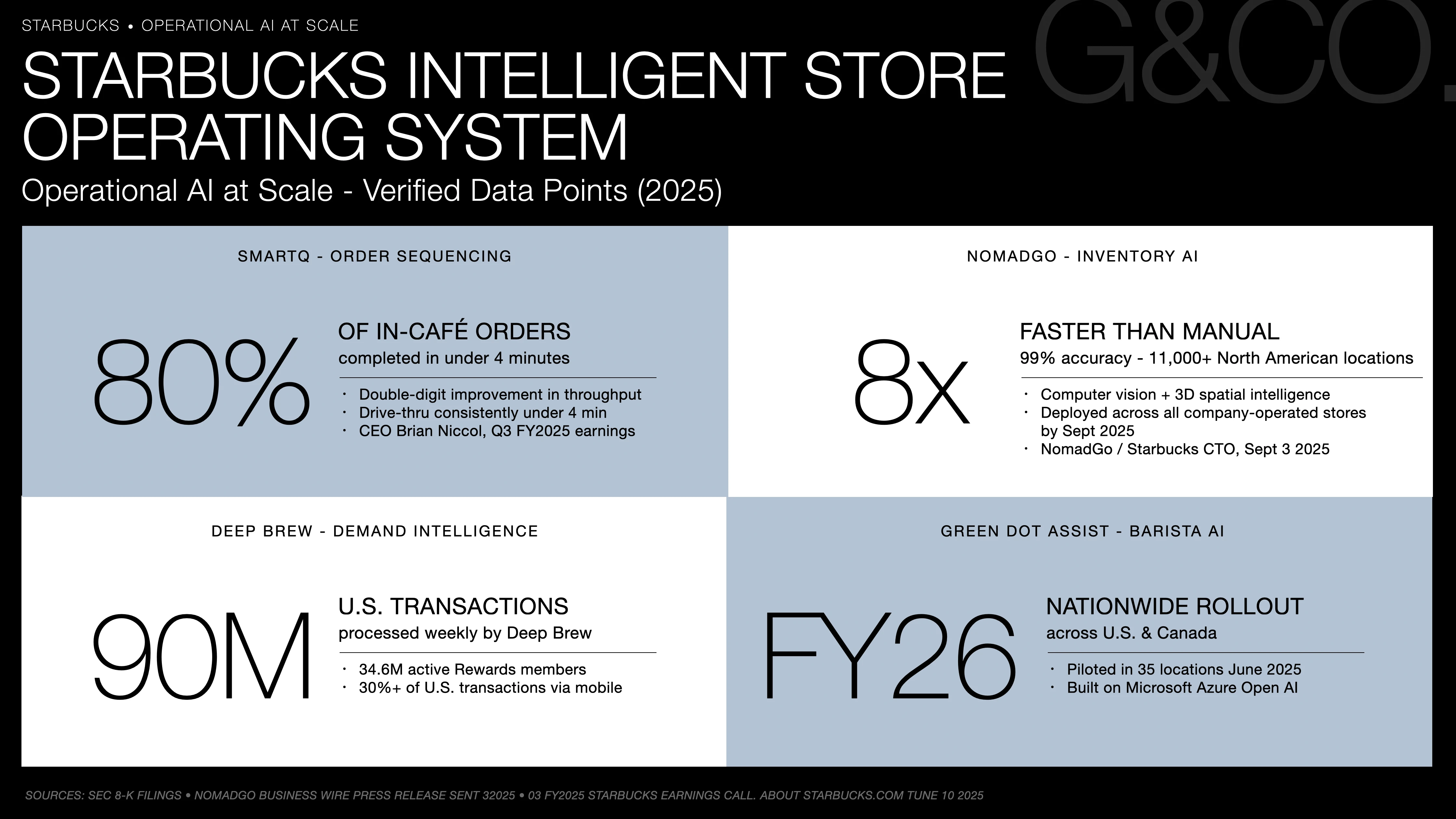
SmartQ, the order-sequencing system, attacks the most visible failure: the peak-hour collision of mobile, café, and drive-thru orders. It coordinates orders across all channels and produces a smarter production sequence, so a simple drip coffee is not stuck behind a complex custom drink. In pilots, SmartQ produced a double-digit improvement in café orders handed off under four minutes, with 80% meeting that target and drive-thru times settling consistently under four minutes.
Green Dot Assist, announced June 2025 and built on Azure OpenAI, is an AI helper on in-store iPads. It answers barista questions in plain language, gives recipe guidance, helps troubleshoot equipment, suggests shift coverage, and files IT tickets. It is the first generative AI tool Starbucks has put at the point of service, built on the idea that AI should absorb the mental load in the back so the barista's judgment stays focused on the customer.
Inventory AI closes the loop. Starbucks added computer-vision inventory counting to replace slow manual counts, aiming for far higher accuracy far more often, which gives Deep Brew the real-time stock visibility it needs to manage restocking. (The specific tool Starbucks first used for this, NomadGo, has since been discontinued, but automated, real-time inventory remains part of the system.)
The binding constraint is behavioral, not technical. Four systems can be deployed precisely, but getting 200,000-plus baristas to trust and use them consistently is the harder task, especially in a high-turnover workforce (U.S. hourly turnover reached a record-low 49.1% under Niccol, with shift completion at a record-high 98.2%). Menu complexity adds to it: mobile orders with four or more modifiers grew to 37% of drinks in FY2024, and even the best sequencing system still depends on baristas carrying out the sequence it generates. That is the frontier no technology roadmap fully resolves, where the software meets human judgment.
Results and Evidence
The signals are directionally strong but should be read as a turnaround in progress. Q4 FY2025 delivered global comparable store sales growth of 1%, the first positive comparable growth in seven quarters, and FY2025 revenue reached $37.2 billion, up 2.8% over FY2024. These are stabilization signals rather than breakthrough metrics, consistent with a company rebuilding operational reliability as the precondition for growth instead of forcing growth through promotion before the foundation is sound.
The most meaningful evidence comes from the operational layer itself. SmartQ’s double-digit improvement in sub-four-minute café completion represents a measurable recovery of the throughput mobile ordering had degraded. NomadGo’s 8x counting frequency creates the real-time visibility that reduces stockouts, the single most damaging in-store failure in a beverage-led model. And Green Dot Assist, while too early for outcome metrics, targets the training friction that historically required managers to spend nearly 20% of their shifts coaching new partners, time that now converts directly into customer interaction. Each layer also feeds Deep Brew, so the system’s precision compounds with every transaction, count, and query.
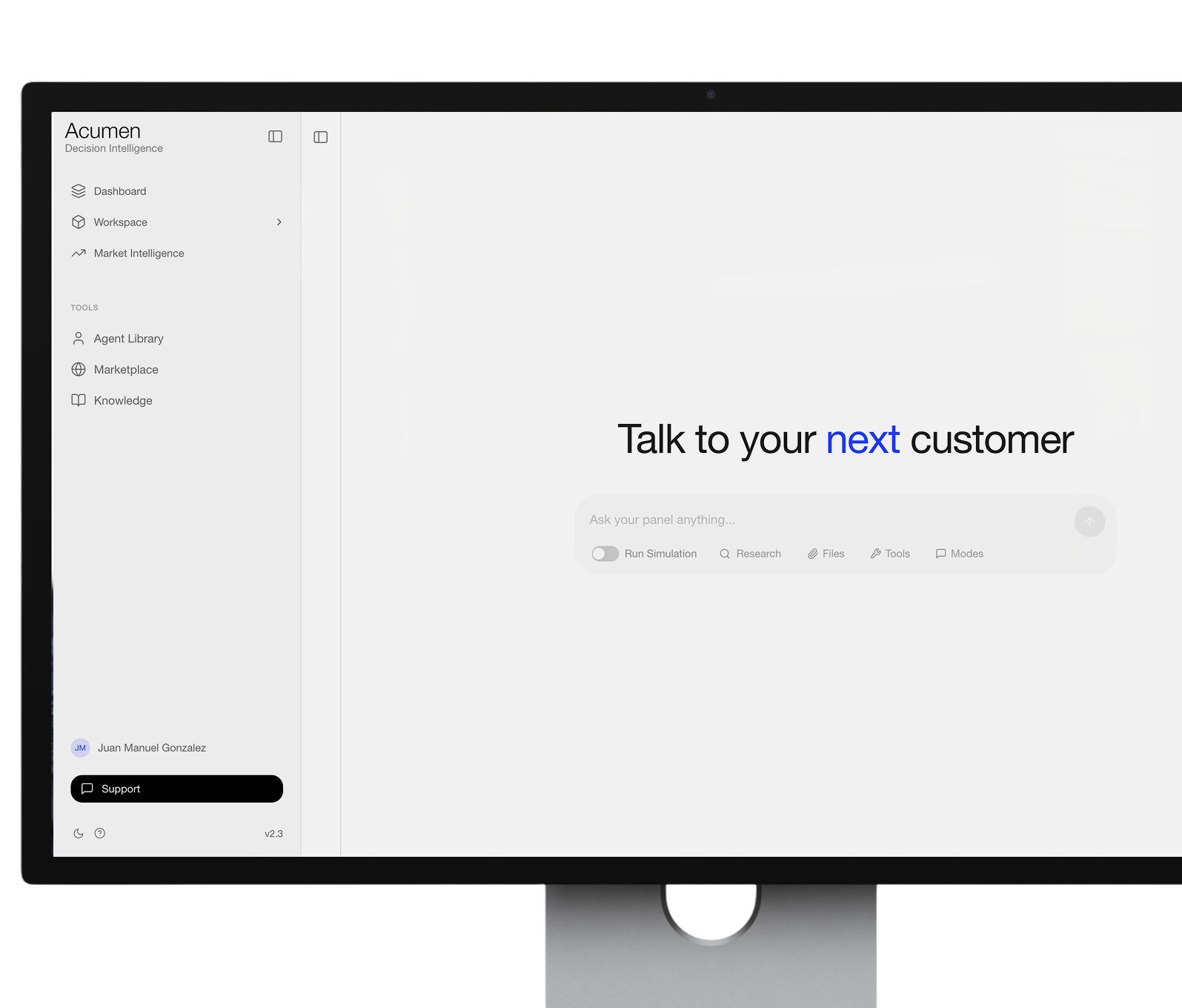
Always-On Customer Intelligence
Turn your own customer data into foresight — validate, simulate, and sense every major decision before you commit.


Strategic Implications
The consensus frames this as a QSR efficiency play. That understates it. Each of the four layers generates data that feeds Deep Brew and improves the next decision cycle: SmartQ’s order patterns refine forecasting, NomadGo’s frequency improves replenishment modeling, and Green Dot Assist’s logs surface the knowledge gaps training needs to close. The store operating system is not a static deployment but a learning infrastructure that compounds in precision with every transaction. This connects to the broader currents reshaping retail and beyond, AI, customer experience, digital transformation, and data strategy, where the durable advantage is a compounding data asset rather than any single feature.
That compounding dynamic is the moat. A competitor can deploy a sequencing algorithm or license computer-vision inventory tools, but cannot replicate six years of Deep Brew’s proprietary training data drawn from 90 million weekly transactions across 40,000 stores without matching the time and scale. The organizations that should study this most closely are not other coffee chains; they are any enterprise running a large physical footprint with a high-volume digital ordering channel, fast casual, grocery, convenience, and pharmacy among them, where the promise of digital experience is only as good as the operational intelligence delivering it at the point of service. It is the same reinvention behind Domino's tech turnaround, Tesla's connected vehicle, and CVS Health's data platform.
What Enterprise Leaders Can Learn
- Build the operational layer alongside the digital channel.
Scaling digital ordering without store-level AI creates a problem that grows with every new digital user. - Choose coordination over equipment automation.
AI-coordinated logistics with human-delivered hospitality produces more durable results than a mechanical redesign, because it works with the staff and equipment you already have. - Own your data.
A platform built on your own transaction data creates an advantage that grows over time; licensing generic tools gives you efficiency without the defensible data. - Plan for adoption, not just deployment.
In high-turnover workplaces, the gap between what a system can do and whether the frontline trusts it is the main risk. - Respect the order.
Fixing the system before replacing the machinery delivers faster results when your staff and equipment are already in place.
Conclusion
Starbucks’ operational AI transformation resolves a tension every large physical retailer with a high-volume digital channel will eventually face: the moment digital demand outpaces what manual store operations can fulfill without degrading the experience that made the brand worth returning to. Its answer, four AI layers orchestrating logistics so baristas can focus on craft and connection, is structurally replicable wherever that dynamic applies.
The enduring lesson is not about technology. It is about the sequencing discipline to treat operational AI as a precondition for digital experience delivery rather than a follow-on investment. Organizations that build the intelligent store operating system before scaling the digital channel hold an advantage that compounds with every transaction. Those that scale digital first and retrofit operations later end up managing a brand crisis and an infrastructure deficit at the same time, the most expensive possible sequence, as this case demonstrates in precise and measurable terms.
Through the Acumen platform, G&CO. gives enterprise retail and restaurant brands the intelligence to make operational AI pay off: where digital demand is outpacing store execution, which investments most improve speed and reliability, and how to use AI to protect the experience rather than dilute it. G&CO. is a certified minority business enterprise through the National Minority Supplier Development Council (NMSDC). For enterprise organizations with diversity inclusion requirements in their procurement process, G&CO. meets the criteria for MBE-qualified partner status.
G&CO. works with enterprise retail and restaurant brands on the AI, operations, and customer-experience strategy that keeps a high-volume digital channel from breaking the in-store experience. If this Starbucks case study raises questions about your own operational AI or digital customer experience strategy, submit an inquiry to G&CO. on our contact page or click the blue "Click to Contact Us" button in the bottom right corner of your screen. We look forward to hearing from you.
Frequently Asked Questions
What is the Starbucks AI strategy and how does it work in stores?
Starbucks operates a layered store operating system built on four AI platforms: Deep Brew (demand intelligence and personalization on Microsoft Azure), SmartQ (order sequencing across café, drive-thru, and mobile), Green Dot Assist (a generative AI barista companion on Azure OpenAI, piloted June 2025), and NomadGo Inventory AI (computer vision counting deployed across 11,000-plus North American locations by September 2025). Each layer handles a specific operational task so baristas can focus on craft and connection.
Why did Starbucks pursue operational automation as part of its digital transformation?
FY2024’s 8% Q4 decline in comparable transactions, the worst quarterly traffic in company history, revealed that digital ordering growth had outpaced store execution capacity. With Mobile Order and Pay above 30% of transactions, peak-hour floods overwhelmed manual operations. Operational automation closed the gap between the digital experience strategy and the store reality degrading it.
What results has Starbucks seen from SmartQ and its other AI tools?
In pilots, SmartQ produced a double-digit improvement in café orders handed off under four minutes, with 80% meeting that target and drive-thru times consistently under four minutes. NomadGo delivers 99% accuracy at 8x the counting frequency of manual methods across 11,000-plus locations. Q4 FY2025 delivered the first global comparable sales growth in seven quarters.
What is Deep Brew and how does it support the digital customer experience strategy?
Deep Brew is Starbucks’ proprietary AI platform (2019, on Microsoft Azure) and the demand intelligence engine of the store operating system. It processes transaction data, weather, traffic, and purchase history to personalize Rewards offers, optimize labor schedules, and coordinate replenishment across 40,000-plus locations. Built on Starbucks’ own data, it creates a compounding asset competitors cannot replicate without equivalent scale.
What can enterprise leaders learn from the Starbucks operational AI case study?
The primary lesson is sequencing: digital experience strategies require simultaneous investment in store-level operational AI as a prerequisite, not a follow-on. The secondary lesson is architectural: a store operating system where AI orchestrates logistics and humans deliver hospitality produces more durable experience returns than equipment automation, because it acts on existing workforce capability.