Generative AI for Enterprise: Trends, Use Cases & Industry Analysis
Introduction
Generative AI has crossed the inflection point from experimentation to production. The application layer of generative AI captured $19 billion in enterprise spending in 2025, more than half of all generative AI investment, and worker access to AI rose 50% in 2025 alone. The number of companies with 40% or more of their AI projects in active production is expected to double within six months. Yet the defining gap of 2026 is not between organizations that have adopted AI and those that have not, it is between those generating transformative business outcomes and those stuck in perpetual proof-of-concept cycles. Industry research estimates that generative AI could add $2.6 to $4.4 trillion annually to the global economy, but only 34% of enterprises are genuinely reimagining their business models around it. Understanding the trends separating leaders from laggards is now one of the most strategically important questions facing enterprise CDOs, CIOs, and transformation leaders.
Market Context: Disruption & Opportunity

The enterprise generative AI landscape has fundamentally transformed in the past eighteen months. What began as a proliferation of standalone copilots and chatbots is now evolving into a more architecturally sophisticated model: agentic systems that reason across data sources, make decisions, and execute multi-step workflows autonomously, with humans auditing outcomes rather than initiating every step. This shift from reactive generative AI to proactive agentic AI is the most consequential structural change in enterprise technology since the cloud transition.
The business case is strengthening across every function. Enterprises deploying AI for code generation are reporting 40% productivity improvements. Agentic customer service systems are handling end-to-end query resolution, Klarna's AI assistant now handles over 65% of customer service chats, with the company reporting $40 million in annual profit improvement. JPMorgan Chase is scaling internal AI use cases to 1,000 by 2026, with a significant focus on code modernization and developer efficiency. The companies generating the highest ROI share a common characteristic: they started with specific, well-defined problems and the data infrastructure to support AI before selecting a model or vendor. The AI integration challenge in 2026 is not access to models, it is the governance, data architecture, and organizational capability required to deploy them at enterprise scale with consistent, trustworthy results.


%20(1).png)

Let’s kickstart the conversation and design stuff people will love.

The Retail & Consumer Index


Top 7 Generative AI Trends for Enterprise Brands in 2026

- Agentic AI moves from pilot to production infrastructure
- From horizontal to vertical AI: industry-specific models gain ground
- Enterprise knowledge management becomes an AI-first function
- AI-powered software engineering reshapes the development lifecycle
- Generative AI enters the customer experience at every touchpoint
- Data governance and AI ethics become competitive differentiators
- The AI skills gap emerges as the primary scaling barrier
Trend Breakdown: Context & Competitive Insight
Agentic AI Moves from Pilot to Production Infrastructure
The most significant architectural shift in enterprise AI in 2026 is the transition from standalone generative AI models to agentic systems: AI that can reason across multiple data sources, plan multi-step actions, and execute complex workflows with limited human intervention. Twenty-three percent of organizations are already scaling agentic AI in at least one business function, with an additional 39% experimenting. Industry analysts predict that 40% of enterprise applications will include agentic AI by the end of 2026. The deployment patterns are consolidating around customer service, IT service management, knowledge management, and supply chain operations, functions where multi-step, data-intensive workflows benefit most from autonomous execution. Enterprises that treat agentic AI as a capability infrastructure investment, rather than a series of individual projects, are building compounding advantages as each deployment generates the organizational learning required to accelerate the next. G&CO.'s LLM Strategy & Implementation capability is designed specifically to help enterprise brands make this transition from isolated pilots to production-grade agentic systems.
From Horizontal to Vertical AI: Industry-Specific Models Gain Ground
Vertical AI: models trained or fine-tuned on industry-specific data, grew from $1.2 billion in enterprise investment in 2024 to $3.5 billion in 2025, nearly tripling in a single year. Healthcare alone captures approximately $1.5 billion of that vertical AI spend, more than tripling from $450 million the year prior. Financial services, legal, and manufacturing are the next highest-investment verticals. The driver is well-understood: general-purpose models hallucinate at significantly higher rates for domain-specific queries, up to 69–88% for specific legal questions, making precision and compliance requirements in regulated industries unachievable without domain adaptation. The competitive implication for enterprise brands is that deploying general-purpose models for specialized functions is increasingly a strategic liability, while early investment in fine-tuned or vertical-specific models creates a data advantage that compounds over time as proprietary workflows generate training signals.
Enterprise Knowledge Management Becomes an AI-First Function
Knowledge management has emerged as one of the fastest-growing AI adoption categories in the enterprise, and one of the highest-ROI deployments. The use case is well-suited to AI: synthesizing large volumes of unstructured internal documentation, policies, technical specifications, and institutional knowledge into queryable, real-time responses that employees can access through natural language. Recent enterprise research identifies knowledge management as now among the top three business functions reporting AI use, alongside IT and marketing. The architecture that makes this work is Retrieval-Augmented Generation (RAG), connecting large language models to internal knowledge bases so responses are grounded in proprietary, up-to-date information rather than general training data. Organizations that build robust AI-powered knowledge infrastructure are seeing measurable improvements in employee productivity, faster onboarding, and reduced dependence on individual institutional expertise.
AI-Powered Software Engineering Reshapes the Development Lifecycle
Software development has become the largest single category of enterprise AI spending, capturing $4.0 billion, 55% of all departmental AI investment in 2025. The use case has proven faster and more measurable than most AI applications: code generation, automated testing, documentation, and legacy code refactoring all deliver immediate productivity gains that are straightforward to quantify. Early adopters report a 40% increase in developer productivity, and research estimates that generative AI could automate 20–45% of software engineering functions. The more strategically significant development in 2026 is the shift from code assistance to full development lifecycle orchestration: AI systems that handle requirement analysis, generate architecture proposals, write and test implementation, and manage deployment pipelines with minimal human initiation. For enterprises carrying significant technical debt in legacy codebases, AI-powered modernization represents one of the most compelling near-term ROI opportunities available.
Generative AI Enters the Customer Experience at Every Touchpoint
Customer experience has become one of the most active deployment areas for generative AI across industries, driven by the combination of measurable ROI and clear customer benefit. Conversational AI interfaces are enabling a 5.4 times increase in self-service adoption in financial services; personalization engines powered by generative AI are delivering AI-driven recommendations that Charles Schwab reports contributed to a 30% increase in customer engagement; and content generation capabilities are enabling personalized marketing at scales that were previously impossible to staff. The most advanced enterprise deployments are moving beyond single-touchpoint AI toward full journey orchestration: AI systems that maintain context across digital and human interactions, anticipate customer needs based on behavioral signals, and adapt communication in real time. Underpinning this capability is a continuous understanding of how brand perception shifts across consumer audiences, something platforms like Acumen, G&CO.'s simulation-driven consumer intelligence platform, deliver by tracking trust, relevance, and experience signals in real time, giving enterprise teams the consumer intelligence layer that makes AI-driven journey orchestration genuinely responsive rather than just automated. G&CO.'s Personalization & Clienteling capability helps enterprise brands deploy this kind of AI-powered experience architecture across both digital channels and associate-led interactions.
Data Governance and AI Ethics Become Competitive Differentiators
As generative AI moves from experimentation to production, governance has become the factor that separates enterprises scaling successfully from those stalling out. Enterprises where senior leadership actively shapes AI governance achieve significantly greater business value than those delegating it to technical teams. The governance imperatives are multiple: data quality and provenance (AI is only as trustworthy as the data it operates on), output monitoring and human oversight (autonomous systems require audit trails and escalation protocols), privacy and regulatory compliance (GDPR, EU AI Act, and sector-specific regulations are shaping what can be deployed and how), and ethical guardrails for high-stakes decisions in areas like credit, healthcare, and employment. In 2026, the organizations treating governance as a competitive investment, building it into AI architecture from the beginning rather than retrofitting it, are demonstrably outperforming those that treat it as a compliance cost.
The AI Skills Gap Emerges as the Primary Scaling Barrier
Across enterprise AI research in 2026, the AI skills gap is consistently identified as the single biggest barrier to integration, cited more frequently than technology limitations, budget constraints, or data quality. The skills requirement is not homogeneous: technical teams need depth in model evaluation, integration architecture, and MLOps; business teams need sufficient AI fluency to direct AI systems, audit outputs critically, and redesign workflows around AI capability; and leadership teams need strategic clarity on where AI creates durable competitive advantage versus where it is a productivity tool. Organizations investing in AI fluency across all three layers consistently see shorter time-to-value on every subsequent deployment. The implication for enterprise transformation strategy is that AI capability building is as much a people and organizational investment as it is a technology investment.
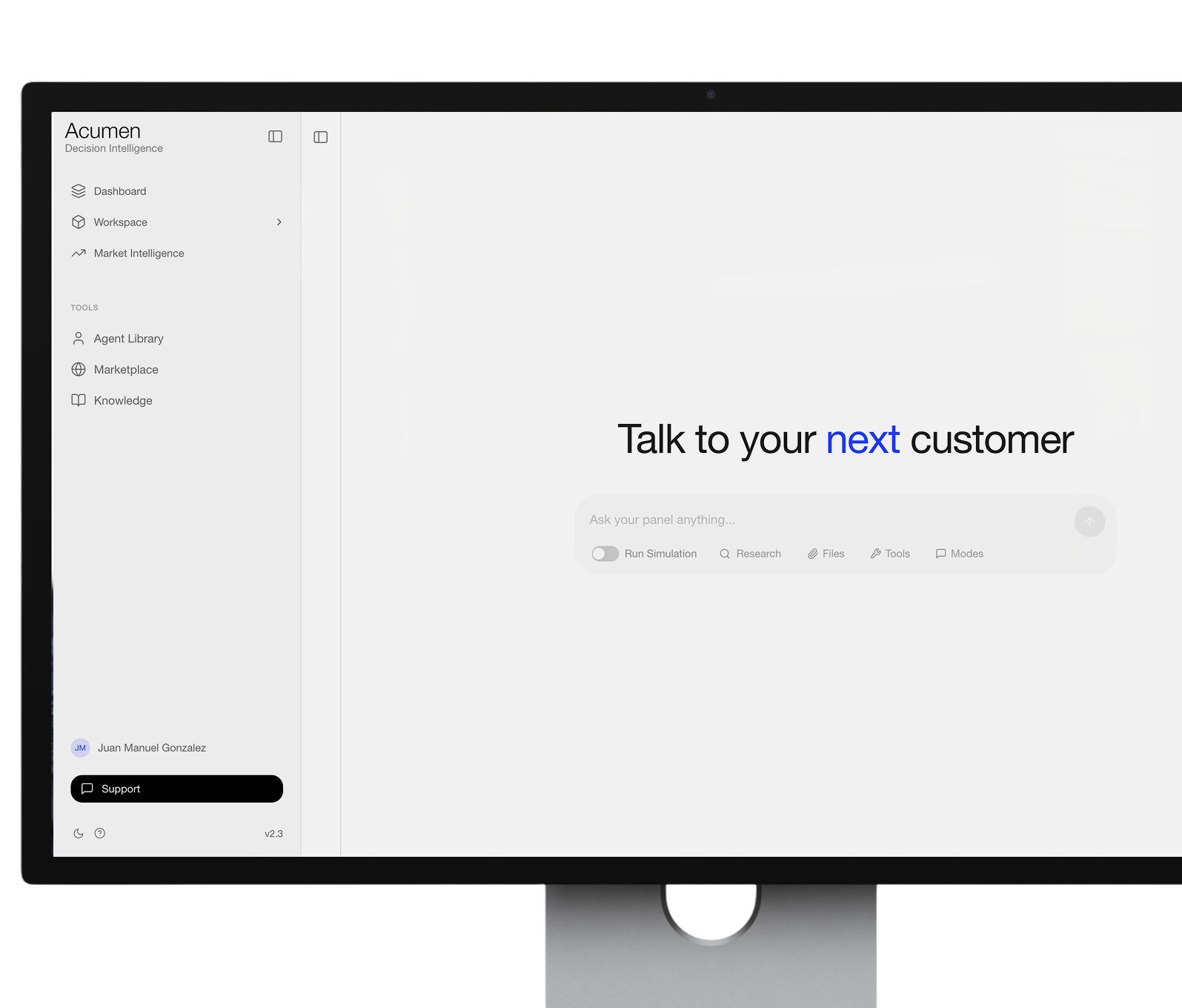
Always-On Customer Intelligence
Turn your own customer data into foresight — validate, simulate, and sense every major decision before you commit.


What Leading Brands Are Doing

The most commercially sophisticated enterprises in 2026 are distinguished not by which AI models they use but by how deeply they have restructured specific workflows around AI capability. Financial services institutions are deploying agentic workflows that automatically capture meeting actions, draft follow-up communications, and track commitment fulfillment, eliminating entire categories of administrative overhead. Manufacturers are using multimodal generative AI to create digital twins that simulate thousands of production scenarios, compressing planning cycles from weeks to hours. Retailers are orchestrating personalized customer journeys through AI that adapts content, offers, and communication cadence in real time based on behavioral signals across every channel. Media and marketing organizations are using generative AI to scale content production without proportional headcount growth, with some agencies reporting a 50% reduction in content production time.
At G&CO., we've worked alongside enterprise clients to implement similar shifts — whether through AI integration strategy, experience redesign, or platform modernization across their enterprise architecture. Our expertise enables brands to translate generative AI awareness into tangible market advantage.
Risks, Blind Spots & What to Avoid
Risk 1: Treating AI as a technology project rather than a business transformation. The most common enterprise AI failure mode is deploying AI tools without redesigning the underlying workflows, governance structures, and organizational capabilities required to use them effectively. Organizations that launch AI initiatives without cross-functional ownership and executive governance consistently produce isolated productivity gains that do not compound into competitive advantage.
Blind spot: The tendency to measure AI success at the tool level, prompt quality, model accuracy, adoption rates, rather than at the business outcome level. The measure that matters is not how many employees use the AI tool; it is whether the workflow it supports is delivering materially better business results.
Risk 2: Underestimating data readiness requirements. Generative AI is only as useful as the data it operates on. Enterprises that deploy AI on top of fragmented, ungoverned, or low-quality data consistently produce unreliable outputs that erode trust and slow adoption. The data infrastructure investment required to support production-grade AI is frequently larger than the model or application investment, and underestimating it is the most common cause of AI project failure.
Blind spot: The assumption that cloud-based AI services eliminate data infrastructure requirements. They reduce infrastructure costs but not data governance obligations, and for regulated industries, data residency, privacy, and compliance requirements add significant complexity that must be addressed before deployment.
Risk 3: Scaling before governance is established. The pressure to demonstrate AI ROI quickly creates the temptation to scale deployments before the governance infrastructure, output monitoring, audit trails, human oversight protocols, escalation pathways, is in place. This is particularly acute in customer-facing and high-stakes decision applications where AI errors have direct business and reputational consequences. Enterprises that scale governance alongside deployment consistently achieve better outcomes than those that retrofit governance after problems emerge.
Blind spot: The misconception that governance slows AI deployment. Well-designed governance architecture accelerates sustainable scaling by creating the trust and reliability that allow AI systems to take on progressively more complex and autonomous tasks over time.
The Role of Generative AI Implementation Firms
Generative AI implementation firms help enterprise organizations navigate the full journey from strategic clarity to production-grade deployment, a journey that most enterprises cannot make effectively with internal resources alone. The value of selecting the right partner is greatest at three specific inflection points: at the strategy stage, where the critical decisions are which use cases to prioritize, what data architecture is required, and how to sequence deployment across functions to build compounding organizational capability; at the implementation stage, where the technical complexity of integrating AI with enterprise systems, governing outputs, and managing change across business units requires cross-functional expertise that takes years to accumulate internally; and at the scaling stage, where the governance, evaluation, and continuous improvement frameworks required to operate AI at enterprise scale go beyond what most organizations have built. G&CO.'s Generative AI for Enterprise practice brings strategy, technology, and experience design together, ensuring that AI capability is built in the context of the business outcomes it is intended to serve, not as a standalone technology initiative. G&CO. is a minority business enterprise (MBE), as certified by the NMSDC. If diversity inclusion is part of your supplier process, contact us.
Conclusion & Strategic Outlook
These seven trends are not passing phases, they reflect a fundamental shift in how enterprise organizations operate, compete, and create value. The window for building AI capability ahead of competitors is not permanently open: organizations that are already in production are compounding data advantages, organizational fluency, and workflow efficiency that will be increasingly difficult to replicate. The enterprises that will lead in 2026 and beyond are those that move from viewing generative AI as a set of tools to treating it as a core capability infrastructure, one that requires the same strategic investment, governance rigor, and organizational alignment as any other foundational enterprise platform. At G&CO., we bring the strategic clarity and executional power needed to translate generative AI awareness into business impact, across AI integration, experience strategy, and enterprise architecture. Let's explore what's next, together.