Tesla’s Vertical Integration Strategy: How Owning Every Layer Turns a Car Into a Platform
This Tesla case study examines how Tesla turned the car from a one-time sale into the start of an ongoing, paid relationship, by owning every layer around it: the sale, the charging network, the software updates, the driver profile, and the energy products. That vertical integration lets Tesla keep the data its products generate and build a recurring revenue model on top. In FY2024, non-automotive revenue (energy, services, and Full Self-Driving subscriptions) reached roughly $20.6 billion, growing far faster than the car business, with FSD subscriptions alone generating about $1.1 billion in recurring revenue.
Tesla built a connected system that controls the software, charging, and services around the car, to turn a one-time sale into an ongoing paid relationship.
Tesla stopped selling cars as one-off transactions and started using them as the entry point to an ongoing, data-generating service relationship. That shift, from selling a product to signing up a customer, is what turned an automaker into a technology platform, and it is the part rivals have struggled to copy even after matching Tesla on the car itself.
This Tesla vertical integration strategy is usually read as a manufacturing story about controlling the supply chain. But the more useful lens is commercial: Tesla integrated so it could own the data its products generate, not just control how they are built. The result is product experience management at a depth no ordinary EV can match. For enterprise leaders weighing their own digital experience platform and omnichannel investments, the transferable lesson is not technological. It is that owning the data, not the front-end experience, is what creates a durable advantage.
Key Points
- Tesla treats a car as the start of a relationship, not a one-time sale. It owns every layer around the vehicle, sales, Supercharging, over-the-air software, the driver profile, and energy products, instead of handing them to dealers or third parties.
- Owning those layers means owning the data and the recurring revenue. A car sold years ago keeps generating income through software like the $99-a-month Full Self-Driving subscription, which Tesla reports brought in about $1.1 billion in FY2024.
- It deliberately traded car profit for scale. Price cuts pushed vehicle margins down on purpose, because a bigger fleet generates more data and more subscription revenue over time.
- The non-car business is now the growth engine. Energy and services reached about $20.6 billion in FY2024, growing far faster than the car business, and the June 2025 robotaxi launch adds a third recurring layer.

Why This Case Study Matters
The DXP market is consolidating under a new dynamic. Brands that spent 2020 to 2023 selecting composable commerce architectures are finding that integration complexity stretched implementations to 18 months and absorbed as much as 40% of program budgets, deferring the personalization returns that justified the spend. At the same time, hyperscale cloud providers are embedding DXP capabilities directly into infrastructure, compressing the differentiation available from standalone platform vendors. The window in which a well-selected DXP delivers genuine advantage is narrowing, and what replaces it is exactly what Tesla demonstrates: the proprietary data relationship built through infrastructure ownership.
For CEOs, chief digital officers, and heads of customer experience in retail, financial services, luxury, and healthcare, the urgency is real. Customer expectations have been calibrated by Tesla and by precision-personalized commerce. Brands that meet those expectations through first-party data infrastructure will earn the retention that justifies the investment. Brands that meet them through third-party data and vendor-delivered personalisation will find their experience indistinguishable from competitors drawing on the same vendor’s data pool.
Strategic Context
The automotive industry hit a structural inflection in the early 2020s as electrification eliminated the service revenue (oil changes, transmission work, exhaust repairs) that sustained franchise dealership economics for decades. Legacy manufacturers, who had distributed the entire customer relationship to third-party dealers, found themselves without a direct data connection to the vehicles they sold or the people who drove them. As software-defined capabilities became a primary purchase consideration, the absence of a direct customer relationship turned from operational preference into structural liability.
Tesla had made the opposite decision from inception: no franchise dealers, no third-party service networks, no intermediaries between the company and the customer’s ongoing experience of the product. More than 1,200 company-owned locations gave it direct visibility into every interaction, service event, and complaint, and the Supercharger network, built at significant capital cost before generating direct revenue, gave it control of the most consequential post-purchase touchpoint in EV ownership. These were infrastructure investments that made every later platform layer possible. The competitive consequence is asymmetric and compounding: a rival can source cells, hire engineers, and build a comparable EV, but cannot quickly replicate fleet-scale data infrastructure, a charging network, a direct customer relationship, or an energy platform that took a decade to establish. The industry’s Moment of Inertia is structural, created by a commercial architecture decision rather than a product design one.



.png)
%20(1).png)

Let’s kickstart the conversation and design stuff people will love.

The Retail & Consumer Index


Company Response
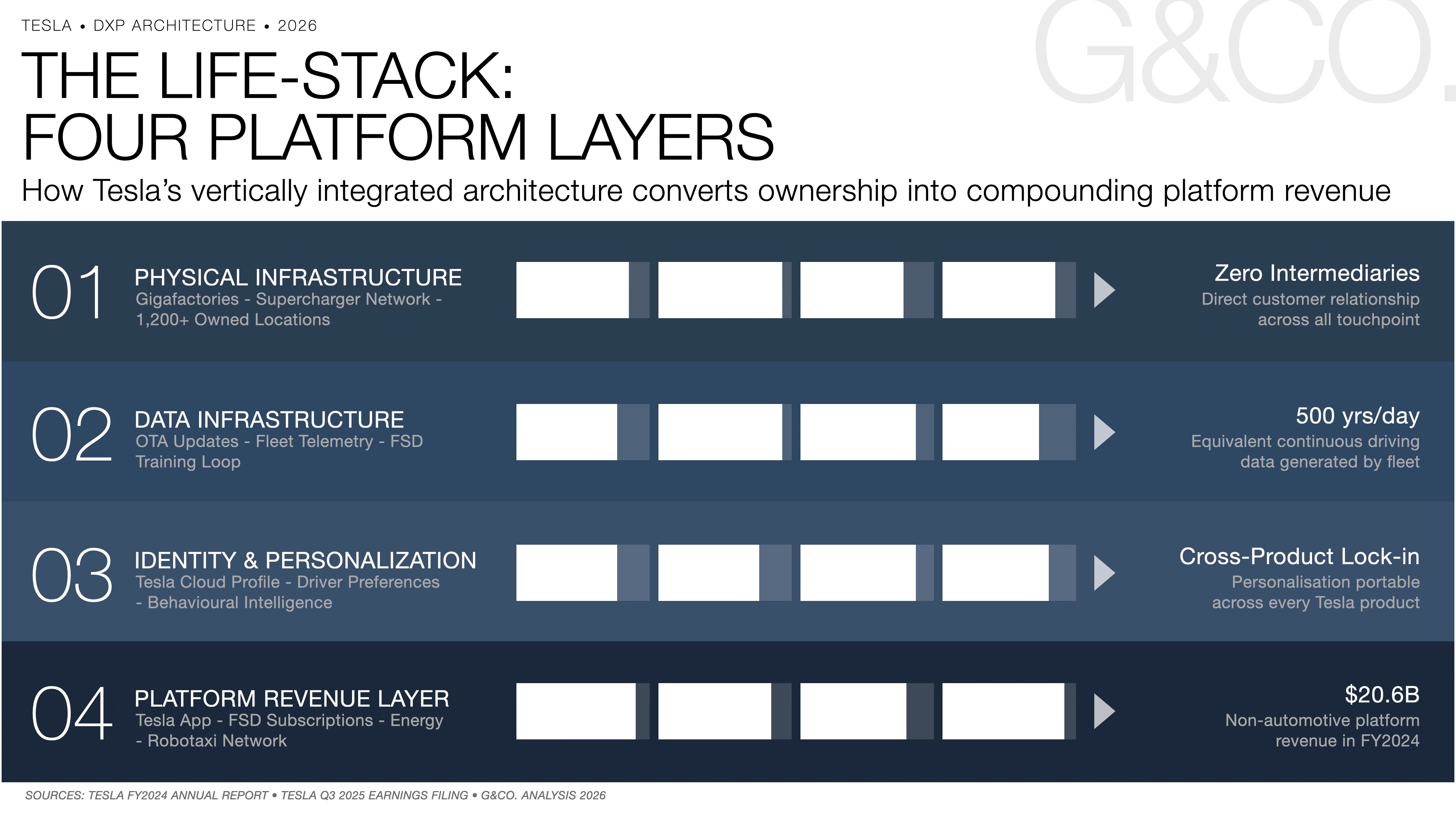
Leadership made a sustained choice to deprioritize horizontal feature expansion in favor of deepening vertical ownership of each layer of the customer relationship. Where competitors licensed voice assistants, navigation data, and insurance from third parties, Tesla built or acquired each capability in-house and connected it to the same authenticated data environment. Owning the stack rather than extending it is the architectural commitment the “Life-Stack” represents, and it has five layers:
- Physical infrastructure: Gigafactories, the Supercharger network, and service and delivery locations, the expensive foundation competitors cannot replicate by picking a vendor.
- Data infrastructure: the over-the-air update system, fleet data, and the Full Self-Driving training loop that processes the equivalent of more than 500 years of driving data per day.
- Identity: the Tesla cloud profile, which stores every driver preference and recreates a customer's settings in any Tesla they use.
- Platform: the Tesla app, a single digital experience platform that by 2025 managed the vehicle, energy, grid participation, and autonomous rides through one login.
- Revenue: what the four layers below enable, namely FSD subscriptions, energy services, Supercharger fees, insurance, and the robotaxi network that launched in June 2025.
What leadership chose to deprioritize is equally instructive. Tesla consistently sacrificed short-term automotive margin to preserve the fleet scale that makes the platform viable. Compressing average selling prices across 2023 and 2024, which reduced automotive gross margins from above 25% to the mid-to-high teens, was a deliberate investment in scale, because a larger fleet generates more driving data, more FSD conversion, more Supercharger utilization, and more Powerwall cross-sell. For brands evaluating their own commerce strategy, accepting hardware margin compression to build the data substrate that justifies platform revenue is the most transferable lesson here.
Three interlocking mechanisms turn ownership into a managed platform relationship.
First, over-the-air updates as a commercial model: Tesla pushes 12 to 15 updates a year to the entire fleet with no service visit, so a car typically has superior capabilities two years after purchase. FSD Version 13 (late 2024) was trained on 4.2 times more data than its predecessor with a 2x reduction in photon-to-control latency, and Version 14 (2025) brought the robotaxi fleet’s neural network architecture to consumer vehicles, so commercial improvements flow to private cars simultaneously. The FSD subscription converts this into recurring revenue: at $99 per month in the U.S., it generated $1.1 billion in FY2024, attached to hardware already sold.
Second, cloud profiles as individual-level personalization: preferences, seat and mirror positions, climate, navigation history, and assistant interactions follow the owner into any Tesla within seconds of authentication, and that profile data also generates the behavioral intelligence that informs upsell sequencing and product priorities.
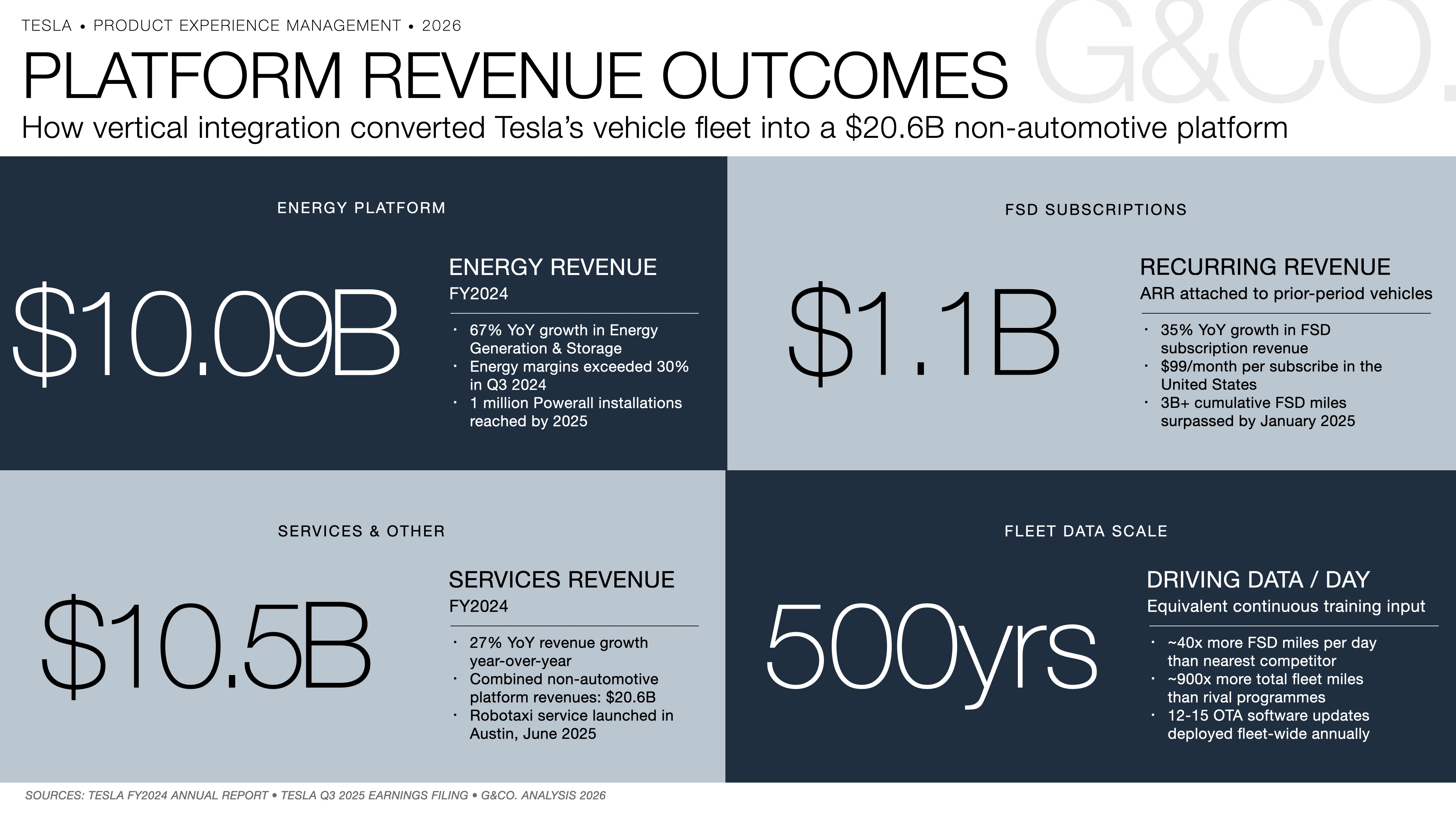
Third, the Tesla app as a unified DXP: a single application manages preconditioning, charging, remote control, Powerwall and solar management, Virtual Power Plant participation, software updates, and, since June 2025, robotaxi booking, connecting previously discrete relationships into one data environment and generating switching costs across every category at once. Energy revenue alone reached $10.09 billion in FY2024, up 67%, with margins above 30% in Q3 2024, and Tesla installed its one-millionth Powerwall in 2025.
Underneath all of it, fleet data functions as infrastructure. Tesla’s global fleet generates the equivalent of more than 500 years of driving data per day, roughly 40 times the daily FSD miles of its nearest competitor and about 900 times more total miles, with cumulative FSD miles passing 3 billion by January 2025. That self-reinforcing loop is what competitors cannot close through model architecture alone.
Results and Evidence
The financial signature is the divergence between revenue streams. Total automotive revenue declined 6% year over year to $77.1 billion in FY2024, driven by deliberate price reductions. Energy generation and storage grew 67% to $10.09 billion, with storage deployments reaching 31.4 gigawatt-hours, a 114% increase over 2023. Services and Other grew 27% to $10.5 billion. Combined, non-automotive revenue reached roughly $20.6 billion, growing at rates no established automaker’s services division approaches, and FSD subscriptions alone generated $1.1 billion in recurring revenue, up 35%.
The robotaxi launch in Austin in June 2025, using modified Model Y vehicles at $4.20 flat fares, represents the third platform layer becoming commercially active, with Cybercab (priced under $30,000) scheduled for volume production in Q2 2026. The owner-participation model expected in 2026 will let FSD-equipped personal vehicles join the robotaxi network during idle periods, turning every FSD-equipped car already sold into a potential revenue-generating node with no additional capital. That is the architecture expressing its full logic: a vehicle sold years ago, managed through a cloud profile, updated by OTA, and now deployable as a commercial asset through the app.
The model also carries real tension. Services and energy together were about 21% of total revenue in FY2024, meaningful but not yet enough to offset automotive margin pressure, so the inflection point has not arrived. And the OTA model introduces quality-control dynamics with no precedent in traditional manufacturing: the 2025.20.6 update caused backup-camera failures and navigation freezes in a subset of vehicles, requiring rollbacks and hotfixes. Tesla’s graduated deployment (factory employees first, then roughly 1% of the fleet, then broader rollout) manages this operationally, but rapid release applied to safety-critical hardware carries a risk profile legacy QA frameworks were not designed for, and one that any enterprise adopting continuous delivery in physical products will encounter.
Always-On Customer Intelligence
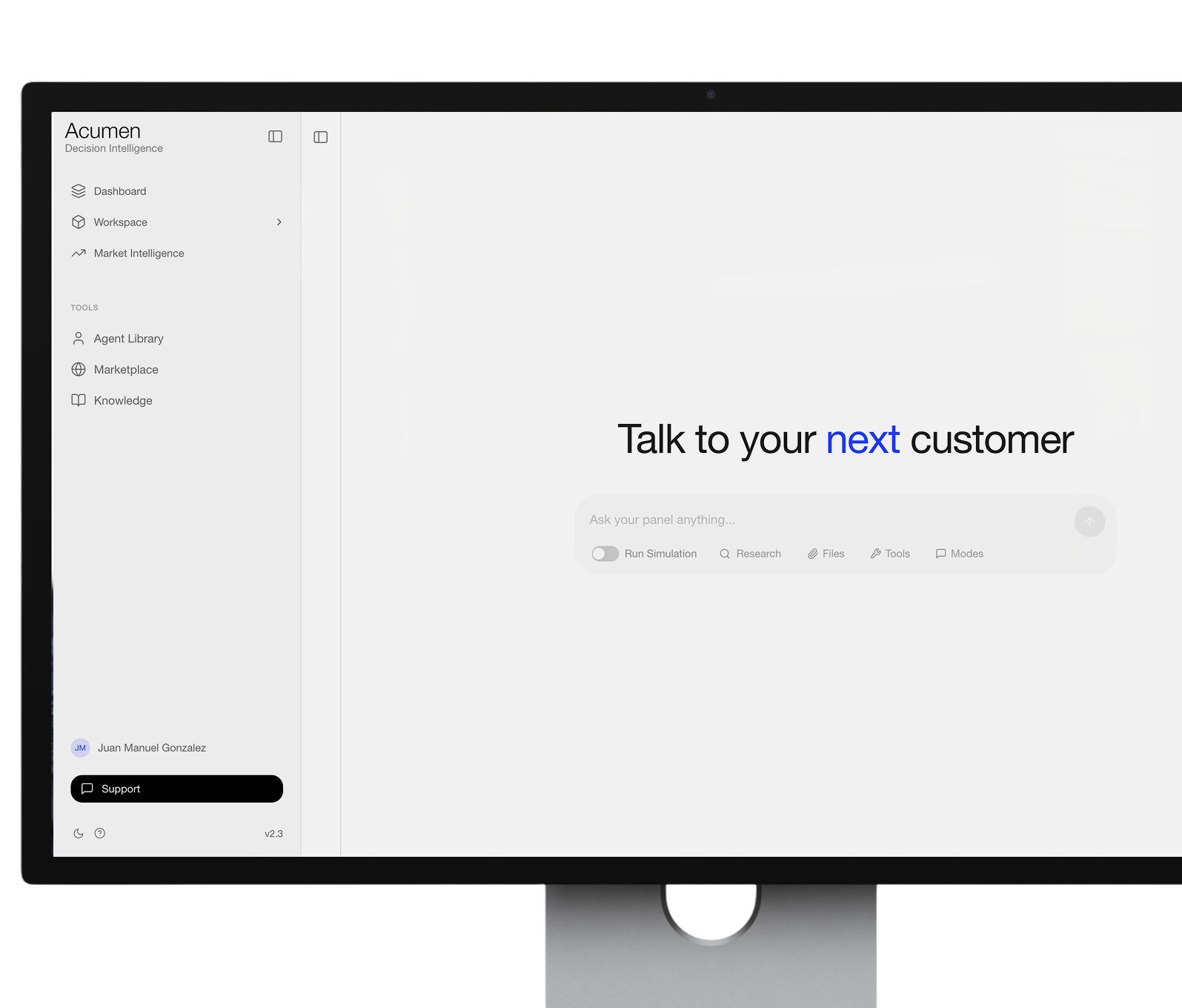
Turn your own customer data into foresight — validate, simulate, and sense every major decision before you commit.


Strategic Implications
The conventional framing is technological: a software company that happens to make cars. That is accurate but insufficient. The deeper reframe is commercial: Tesla is the first enterprise to apply platform economics to a durable-goods category. The compounding return when each new user makes the platform more valuable for all users, and each interaction generates intelligence that improves the next, was previously confined to software and marketplaces. Tesla shows it applies to physical products too, provided the manufacturer keeps control of the data infrastructure mediating the relationship. This connects directly to the broader enterprise currents of AI, customer experience, digital transformation, personalisation, commerce, data strategy, and product strategy, where the durable edge is an owned data relationship rather than a configured front end.
The implication is direct. Most large organizations built their infrastructure, data governance, and commercial models around the assumption that the sale is the primary value event and the post-sale relationship is a cost to minimize. Tesla’s trajectory shows that assumption inverts the real value distribution: the sale is the lowest-value event in the lifecycle, and every later interaction is higher-margin. Organizations that have not designed for this inversion should not be asking which DXP to select. They should be asking what infrastructure they need to own to make the inversion possible, because a composable DXP on best-of-breed vendors delivers integration flexibility but not the data sovereignty that makes personalisation commercially sustainable over time. The same start-of-a-relationship logic appears in Samsung's connected appliances, Wise's owned payment rails, and Disney's subscription model.
What Enterprise Leaders Can Learn
- Own the data, not just the interface.
You cannot generate individual-level intelligence from products whose after-sale data belongs to a third party. - Design the main product as a starting point.
Later products should add layers to one data system, not operate as separate businesses. - Plan for the gap.
The shift to recurring revenue needs a scale threshold; assuming platform revenue will offset lower margins right away leads to underinvesting in the scale that makes the shift possible. - Choose your risk on purpose.
Owning everything carries cost and quality risk; using many vendors carries the risk of fragmented data. Decide which long-term risk you would rather own. - Treat infrastructure as a strategic asset.
The technology you pick matters less than owning your own data; the real question is what you must own to make leaving genuinely costly for the customer.
Conclusion
The lesson Tesla encodes is not about electric vehicles or autonomous driving. It is about the commercial architecture decision that determines whether a brand owns its customers’ long-term value or merely captures the first transaction. Tesla made that decision early: own every layer of the relationship, absorb the capital cost of the required infrastructure, and design each later product as a deepening of the same data relationship. The results of 2024 and 2025 have begun to confirm the compounding returns that architecture generates.
For leaders evaluating DXP investments, omnichannel architecture, or product experience management builds, the benchmark is clear. Brands that build their own data infrastructure generate compounding returns; brands that rent it generate comparable experiences and no durable advantage. The organizations that will earn equivalent returns in retail, financial services, luxury, and healthcare are those that make the same foundational decision now: treat the primary product as an enrollment mechanism, build the infrastructure to own the data it generates, and design commerce technology around the data they intend to own, not the experience they intend to deliver. That is a commercial strategy decision, not a technology one, and the window in which making it first confers advantage is narrowing.
Through the Acumen platform, G&CO. gives enterprise brands the intelligence to build an owned data relationship rather than a rented one: where to invest in infrastructure, how to turn a one-time sale into an ongoing relationship, and where owning your data creates a durable advantage. G&CO. is a certified minority business enterprise through the National Minority Supplier Development Council (NMSDC). For enterprise organizations with diversity inclusion requirements in their procurement process, G&CO. meets the criteria for MBE-qualified partner status.
Ready to build the infrastructure that makes your product experience management strategy commercially sustainable? Submit an inquiry to G&Co. on our contact page or click on the blue 'Click to Contact Us' button on the bottom right corner of your screen for your convenience. We look forward to hearing from you.
Frequently Asked Questions
What did Tesla do to turn its vehicles into a digital experience platform?
Tesla built a vertically integrated architecture in which the vehicle is the entry point rather than the primary commercial event. By owning the sale, the charging network, the software update infrastructure, the cloud profile system, and the energy platform, and connecting them through a single app and data architecture, Tesla turned a one-time hardware transaction into a managed, data-generating service relationship. Every update, charging session, and energy interaction deepens platform integration and generates behavioral data that improves the next experience. The result: automotive revenue is a declining share of the total, while energy and services grow at 27% to 67% annually.
How do Tesla cloud profiles enable product experience management at scale?
Cloud profiles store every driver preference, seat position, climate setting, navigation history, and assistant interaction in the owner’s account, retrievable in any Tesla they access, making individual-level personalization portable across a physical product. The commercial value goes beyond experience: profile data generates the behavioral intelligence that informs FSD upsell, capability development, and fleet deployment decisions. It is product experience management operating as a commercial intelligence function, made possible by the infrastructure-ownership decision that ensured the data would never be mediated by a third party.
Why has Tesla’s product integration strategy proven difficult for competitors to replicate?
Because the advantage is infrastructural, not technological. A competitor can match battery chemistry, software capability, and manufacturing efficiency without accessing Tesla’s fleet data moat, the switching costs embedded in its energy and charging infrastructure, or the recurring revenue attached to its existing fleet. Replicating the architecture requires building, not licensing, the full commercial stack at once, including retail, charging, energy products, and the connecting software platform. The capital, timeline, and loss of dealership revenue that funds traditional operations effectively prevent late entry at the same structural depth.
What were the results of Tesla’s vertical integration and product experience management strategy?
Energy generation and storage reached $10.09 billion in FY2024, up 67%, with margins above 30% in Q3 2024. Services and Other reached $10.5 billion, up 27%. FSD subscriptions generated $1.1 billion in recurring revenue, up 35%, attached to vehicles delivered earlier. Combined, the platform layers represented more than $20.6 billion in FY2024. The June 2025 robotaxi launch introduced a third platform layer, and the owner fleet-participation model expected in 2026 will activate every FSD-equipped vehicle sold to date as a potential commercial asset.
What can enterprise brands learn from Tesla’s product experience management approach?
Three structural lessons. First, infrastructure ownership precedes and determines personalization capability; you cannot generate individual-level intelligence from products whose post-sale data belongs to a third party. Second, design the primary product as an enrollment mechanism into a data architecture, with later products adding layers rather than operating as separate units. Third, the recurring-revenue transition requires a scale threshold and a planned gap period between infrastructure investment and platform return; assuming platform revenue immediately offsets margin compression leads to underinvesting in the fleet scale that makes the inflection reachable.