Click to
The Retail & Consumer Index
Keeping Retail Leaders Up to Date with Customer Experience Insights
Get Insights Retail & Consumer Leaders Listen To & Take Action On
Subscribed
Oops! Something went wrong while submitting the form.
Direct to Consumer
Retail
eCommerce
Luxury
Consumer

Samsung Case Study: Bespoke AI and the Personalisation of the Physical Product 2026

Strategic Overview

Samsung's Bespoke AI strategy is the first successful disruption of the appliance industry's century-old commercial logic at consumer scale. By embedding AI chips, cameras, Voice ID, SmartThings connectivity, and an OTA software update infrastructure into household appliances, Samsung converted a commodity durable goods transaction into the enrollment mechanism for a managed, data-generating household intelligence relationship. Bespoke AI Laundry sold 1,000 units within three days of launch in South Korea and exceeded 10,000 units in its first year. Samsung ranked highest in 10 of 11 segments in the J.D. Power 2024 U.S. Home Appliance Satisfaction Study, the most awarded brand for the second consecutive year. The enterprise implication is direct: any brand that sells a physical product capable of generating behavioral data is operating a sell-and-forget commercial model that is structurally inferior to the enrollment model Samsung has built, and the gap between those two models will widen as AI infrastructure becomes a baseline consumer expectation.

The Century-Old Problem With Selling Appliances: Why the Transaction Model Was Always Commercially Inferior

The home appliance industry has operated on a remarkably stable commercial logic since the introduction of electric household devices in the early twentieth century. A manufacturer designs a product, builds it, sells it through a retailer or direct channel, and then waits, typically seven to fifteen years, for the replacement cycle. The customer relationship, such as it is, exists entirely in the purchase moment. Once the appliance leaves the showroom, the manufacturer has no visibility into how it is being used, no mechanism for improving the experience it delivers, no channel for communicating with the customer, and no commercial relationship to deepen. Every appliance sold is, from the manufacturer's perspective, a closed transaction.

The structural consequence of this model is that brand loyalty in appliances is extraordinarily shallow. A customer who has owned a Samsung washing machine for eight years and had a satisfactory experience with it is only marginally more likely to replace it with another Samsung than a first-time buyer, because the experience of ownership has not deepened the relationship. There is no loyalty data, no behavioral signal, no personalised interaction, and no commercial relationship to leverage at the point of replacement. The only mechanism available to drive loyalty is the quality of the original product and the absence of a memorable failure. This is the commercial equivalent of a retailer that never captures a customer's name, never builds a purchase history, and never sends a single communication after the transaction closes.

Samsung's leadership identified this structural problem clearly. The appliance category's market dynamics, intense price competition, commoditised core functionality, and replacement cycles that offer only one or two commercial opportunities per customer per decade, made the sell-and-forget model increasingly unsustainable as Chinese manufacturers compressed margins on standard appliances. The strategic response was not to compete harder on specification or price. It was to redesign the commercial architecture of the product itself: to make the appliance purchase the beginning of a relationship rather than the entirety of one. Bespoke AI is the execution of that redesign at consumer scale.

The Enrollment Architecture: How Samsung Redesigned the Appliance as a Data-Generating Platform

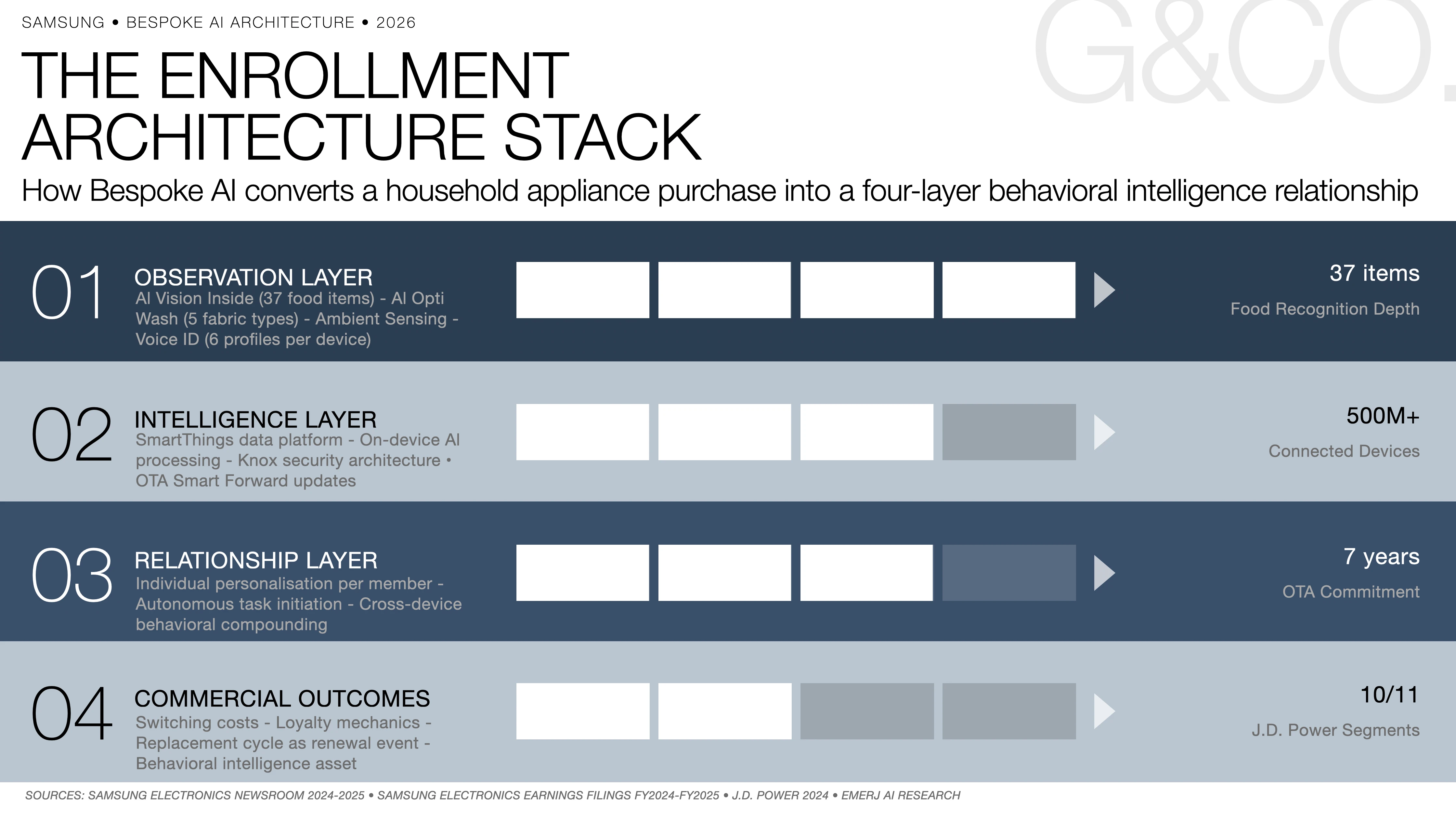
Samsung's Bespoke AI architecture rests on three foundational technology decisions that collectively convert a passive durable good into an active, continuously learning behavioral data system. Each decision is individually significant; together they constitute the enrollment architecture that makes individual-level personalisation commercially sustainable in a physical product category.

AI Vision Inside: the observing product

AI Vision Inside embeds cameras inside refrigerators that continuously observe the contents of the appliance, recognise 37 distinct food items including fresh produce and processed foods, track expiration dates, update a digital food inventory in the SmartThings app, and generate recipe recommendations based on what is available. The refrigerator is no longer a passive storage unit, it is a continuously observing sensor that generates individual household behavioral data about food purchasing patterns, dietary preferences, consumption rhythms, and meal planning habits. This data does not exist in any other commercial dataset available to Samsung, a retailer, or a food brand. It exists only because Samsung designed the product to generate it.

The commercial value of AI Vision Inside data is not in the recipe recommendations it enables, it is in the behavioral intelligence it produces about the specific household using the appliance. A household that consistently stocks particular ingredients, consumes them within specific timeframes, and follows distinct meal preparation patterns is providing Samsung with the kind of individual-level consumer intelligence that brands in retail and financial services spend significant sums attempting to approximate through transaction data, panel surveys, and third-party data enrichment. For enterprise brands evaluating their own AI and data evolution strategy, the AI Vision Inside model reveals a foundational principle: the behavioral data that enables genuine individual-level personalisation does not need to be purchased or inferred. It can be designed into the product itself.

Voice ID: individual identity in a shared physical environment

Voice ID, deployed across the 2025 Bespoke AI lineup, addresses the most structurally challenging problem in household AI personalisation: the shared environment. A household appliance is used by multiple people, different family members with different preferences, different schedules, different accessibility needs, and different behavioral patterns. Segment-level personalisation, which most enterprise AI programs deliver, cannot distinguish between them. Voice ID can. By recognising individual voices among up to six registered household members, Bixby automatically switches to the speaking individual's Samsung account, surfaces their personal calendar, serves their preferred content, and, critically, syncs their accessibility settings from their Galaxy smartphone to the appliance screen without any manual input. A family member who uses large print mode on their phone will see the same display adaptation on the refrigerator screen the moment they speak.

The commercial architecture Voice ID enables goes well beyond the convenience it provides to individual users. It creates a verified individual identity layer on a shared physical asset, solving, in a household context, exactly the same identity problem that makes United Airlines' MileagePlus data commercially superior to retail media audiences. When a specific person addresses a Bespoke AI appliance, Samsung knows precisely who is speaking, what their preferences are, what their schedule contains, and what their interaction history with the device looks like. This is individual-level personalisation and clienteling applied to a physical product,  a capability that most enterprise digital platforms have not delivered in software environments, let alone in the shared, ambient context of a household.

SmartThings and OTA: the enrollment infrastructure

SmartThings is the connective tissue that converts individual Bespoke AI appliances from isolated data-generating devices into nodes in a unified household intelligence network. Connecting 500 million devices globally across 360 million users, SmartThings Ambient Sensing uses the existing sensors embedded across Samsung's device ecosystem, cameras, microphones, motion detectors, to detect occupancy, infer routine patterns, and respond to environmental conditions without requiring dedicated sensor hardware. Appliances initiate maintenance tasks, drum cleaning, floor vacuuming, automatically when GPS data from a household member's smartphone confirms the home is empty. The washing machine knows when no one is home. The robot vacuum knows when to start. The refrigerator compressor adjusts its cycle based on the household's energy consumption patterns and local utility rates. None of this requires a conscious instruction from the user. The home has become a continuously sensing, continuously adapting environment.

The Smart Forward OTA update service delivered more than 50 major feature updates to Samsung appliances in 2024 alone, available to products launched as far back as 2017. Updates are committed for up to seven years from each product's launch date. One UI,  previously Samsung's mobile and display operating system, is being extended to home appliances in 2025 and 2026, creating a unified software layer across the entire device portfolio. The commercial implication is structurally identical to Tesla's OTA model: a product sold years ago is a fundamentally different, more capable product today than it was at the point of purchase, and that improvement deepens the customer's relationship with the product and the brand without requiring a replacement purchase. For enterprise brands building their own product experience management capability, the Smart Forward architecture demonstrates that the enrollment model is not primarily a hardware story, it is a software infrastructure story.

At G & Co.
We Solve
Problems Through Strategy,
Design and Technology.
*Full Name
*Email
*Company
Message
Submit
Thank you for contacting G & Co.
We’ll be in touch shortly.

The Retail & Consumer Index

Keeping Retail Leaders Up to Date with Customer Experience Insights
Subscribed
Oops! Something went wrong while submitting the form.
Direct to Consumer
Retail
eCommerce
Luxury
Consumer
Oops! Something went wrong while submitting the form.
The Retail & Consumer Index
Keeping Retail Leaders Up to Date with Customer Experience Insights
Subscribed
Oops! Something went wrong while submitting the form.
Direct to Consumer
Retail
eCommerce
Luxury
Consumer

From Transaction to Relationship: What the Enrollment Model Generates

The commercial returns of Samsung's enrollment architecture are visible in three distinct dimensions that the sell-and-forget model structurally cannot produce: behavioral intelligence, switching costs, and loyalty mechanics. Each dimension compounds over time in a way that makes the enrollment model more commercially valuable the longer a customer remains within it.

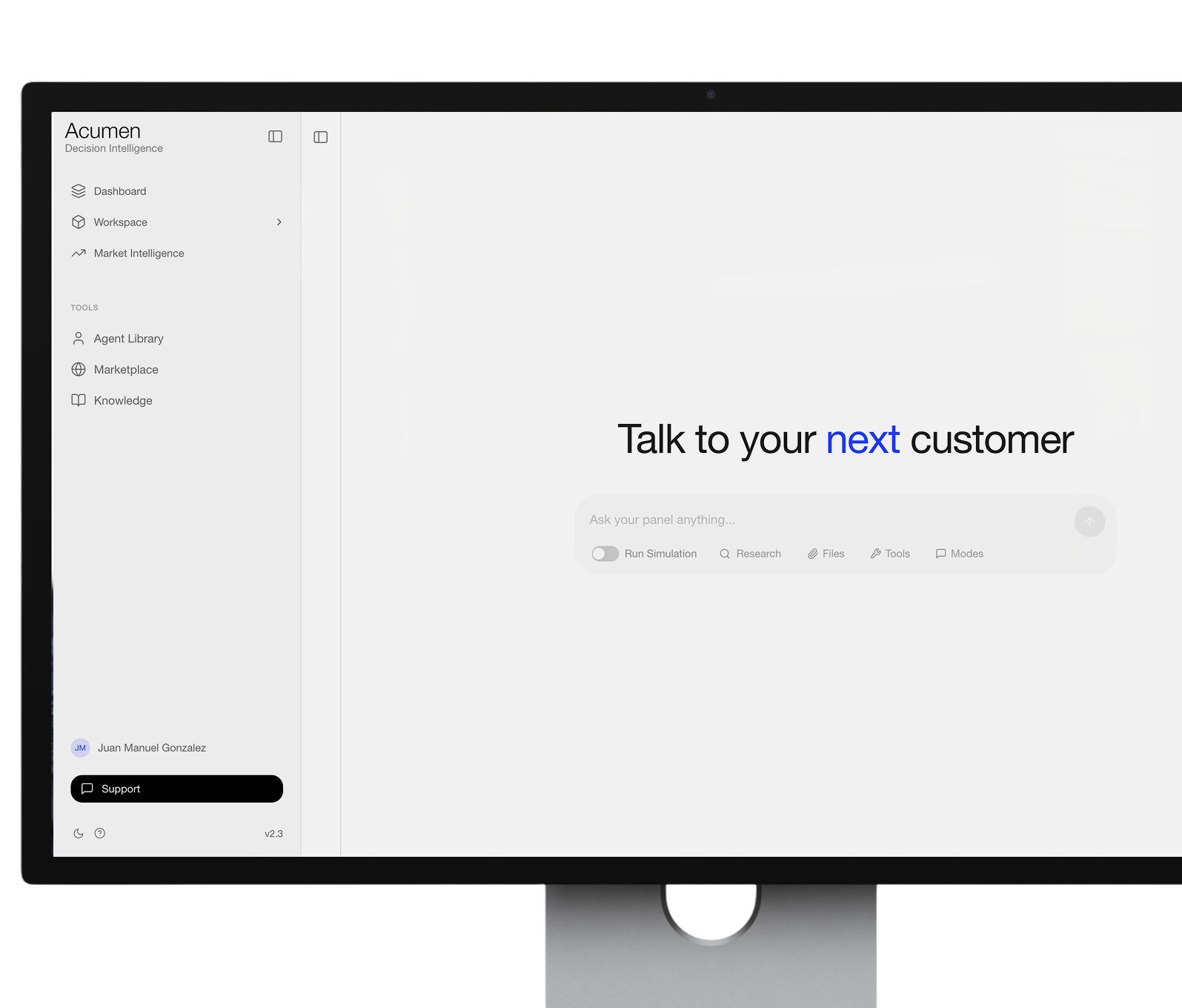
Behavioral intelligence is the most commercially significant return. A household that has used Bespoke AI appliances for three years has generated a behavioral dataset, food purchasing patterns, energy consumption rhythms, laundry habits, household occupancy schedules, voice interaction history, appliance usage patterns, that no CRM program, no loyalty card scheme, and no third-party data purchase can replicate. This data is proprietary to Samsung, specific to the individual household, and continuously updated. It is the kind of individual-level intelligence that G&Co.'s Acumen platform provides for brand strategy decisions, grounded in real behavioral data rather than demographic proxies and self-reported survey responses.

Switching costs in the enrollment model are infrastructural rather than habitual. A household with a Bespoke AI refrigerator, washer, dryer, and robot vacuum connected to SmartThings, with Voice ID profiles configured for each family member and Smart Forward updates maintaining seven years of software improvement, faces a genuinely high cost of switching to a competitor brand. The switching cost is not brand loyalty, it is the loss of a behaviorally calibrated household intelligence network that has been learning their specific patterns for years. This is the same switching cost structure that Tesla has built through cloud profiles and energy platform integration, and that Samsung has now replicated in the home appliance category.

Loyalty mechanics operate through the SmartThings ecosystem's cross-product dependencies. A household enrolled in the Bespoke AI ecosystem is not a customer of individual appliances,  they are a node in a network where each additional Samsung product deepens the intelligence available to every other product. The washing machine's knowledge of laundry habits informs energy management. The refrigerator's food tracking informs the cooking appliances. The robot vacuum's occupancy data informs the climate system. Each product purchased makes the entire ecosystem more valuable to the household, and correspondingly more costly to leave. For enterprise brands evaluating their commerce excellence strategy, the Bespoke AI ecosystem demonstrates the commercial architecture of genuine customer lifetime value, not the metric as it is typically calculated (average order value multiplied by purchase frequency), but the structural design of a product and data relationship that makes the customer's world genuinely harder to replicate elsewhere.

The Friction of the Investment Phase: Margin Compression and the Trust Imperative

Samsung's Digital Appliances and Visual Display businesses posted an operating loss of KRW 0.6 trillion in Q4 2025, despite record satisfaction scores, market-leading J.D. Power rankings, and a tripling of AI appliance model count within twelve months. The pattern mirrors Tesla's vehicle margin compression and United Airlines' Kinective investment phase: the capital cost of redesigning the product for the enrollment model, AI chips, cameras, sensors, screens, connectivity modules, and the OTA software infrastructure, is running ahead of the incremental revenue those features generate at current penetration levels. Embedding a 9-inch AI Home screen, an internal camera system, a dedicated AI chip, and full Wi-Fi connectivity into a refrigerator adds meaningful unit cost. That cost is partially offset by premium pricing, but the margin returns from the enrollment model's behavioral intelligence and switching costs compound over time rather than at launch.

The behavioral data that makes Bespoke AI commercially powerful is also the source of its primary trust risk. AI Vision Inside observes household contents continuously. Voice ID registers biometric voice profiles for up to six individuals. SmartThings Ambient Sensing monitors occupancy and routine patterns using cameras, microphones, and motion sensors across the home. Family Care sends alerts when household member movement is not detected within expected timeframes. The depth of this behavioral surveillance is commercially extraordinary,  and it is precisely the depth that makes individual-level personalisation genuine rather than approximated. Samsung's response to this tension is architectural: Knox Matrix applies blockchain-based security across connected devices; Knox Vault stores sensitive user data in dedicated hardware chips; post-quantum cryptography is applied to screen-equipped appliances; and on-device AI processing keeps sensitive behavioral data local rather than transmitting raw signals to the cloud. The trust architecture is not a compliance response, it is a commercial necessity, because the enrollment model's value depends entirely on the household's willingness to allow the behavioral observation that generates its intelligence.

Business Impact: J.D. Power, 10,000 Units, and the Galaxy AI Signal

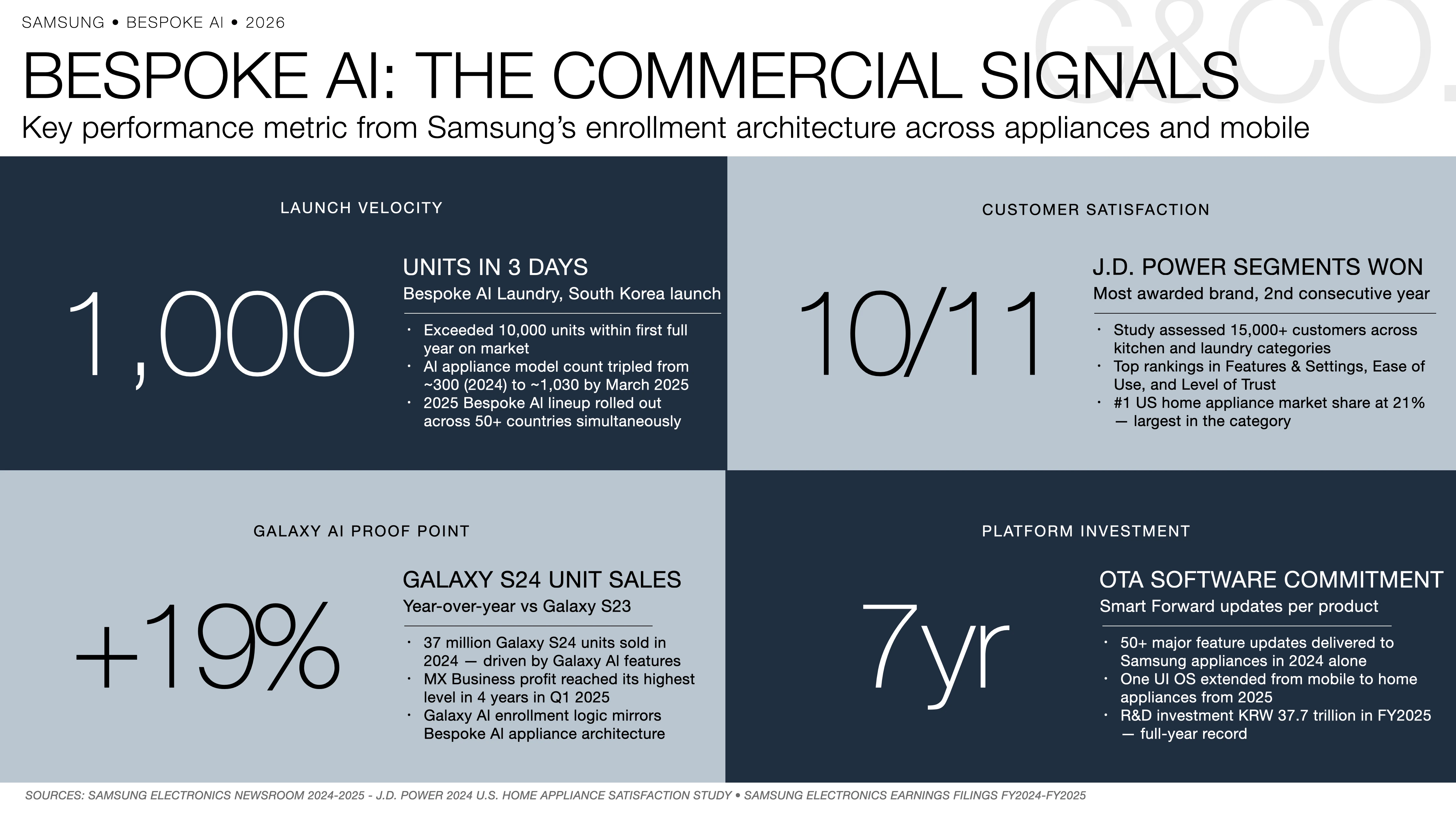
The commercial signals from Samsung's Bespoke AI strategy are concentrated in brand and satisfaction metrics rather than in appliance division operating profit, which remains under pressure from the investment phase costs. Bespoke AI Laundry Combo sold 1,000 units within three days of launch in South Korea and exceeded 10,000 units in its first year, a result that Samsung's EVP of Software Development described as demonstrating measurable differentiation in a market where consumer perception directly correlates with pricing power. Samsung ranked highest in 10 of 11 segments in the J.D. Power 2024 U.S. Home Appliance Satisfaction Study, the most awarded brand for the second consecutive year across a study of more than 15,000 customers. The satisfaction dimensions that drove these rankings,  Features and Settings, Ease of Use, and Level of Trust, are precisely the dimensions that the AI personalisation architecture addresses. Traditional commodity appliance competition produces rankings on Durability and Performance; Bespoke AI produces rankings on the dimensions that determine brand loyalty and pricing power.

The most commercially significant data point in the Samsung case study is not in the appliance division, it is in the mobile division. The Galaxy S24 series, Samsung's first flagship built around the Galaxy AI experience (Circle to Search, Live Translate, Generative Edit, AI-powered photo editing), sold 37 million units in 2024, a 19% increase year-over-year compared to the Galaxy S23 series. The MX Business achieved its highest profit level in four years in Q1 2025 on the back of Galaxy S25 momentum. Samsung's total FY2025 revenue reached KRW 333.6 trillion ($231 billion), a record, with record R&D investment of KRW 37.7 trillion. The Galaxy AI commercial signal is the clearest available demonstration that the enrollment architecture generates measurable unit economics improvement in categories where it has reached sufficient scale. The Bespoke AI appliance strategy is following the same investment and return curve, at an earlier stage of the cycle.

Samsung's decision to triple its AI appliance model count from approximately 300 in 2024 to 1,030 by March 2025, and its commitment to extend the Smart Forward OTA update service for up to seven years across that product range, represents the most significant infrastructure investment in the appliance category's history. The commercial thesis is explicit in Samsung's strategic communications: the goal is zero housework, appliances that understand users and act on their behalf autonomously. The route to that goal is not faster motors or better insulation. It is the behavioral intelligence infrastructure built through AI Vision Inside, Voice ID, SmartThings Ambient Sensing, and the OTA update layer that makes each year of ownership more capable than the last.

What This Case Reveals at Scale: The Enrollment Model as Enterprise Strategy

Samsung's Bespoke AI strategy encodes a commercial architecture principle that applies to every enterprise brand that sells a physical product or manages an ongoing service relationship: the purchase is not the primary commercial event. It is the enrollment mechanism. Brands that treat the transaction as the goal of their commercial model are choosing to operate without the behavioral intelligence, the switching costs, and the loyalty mechanics that the enrollment model generates, and as AI infrastructure becomes a baseline consumer expectation across product categories, that choice will become increasingly difficult to sustain commercially. For enterprise brands evaluating their own AI and data evolution investments, the Samsung case study poses a direct strategic question: what would it mean to redesign the data architecture of the products and services we already sell, so that the first moment of use is the beginning of a behavioral intelligence relationship rather than the end of a transaction?

The enterprise lesson is not about appliances, and it is not about Voice ID or AI Vision Inside as specific technologies. It is about the sequencing of the strategic decision. Samsung did not add AI features to existing appliances and call it personalisation. It redesigned the product from the data architecture up, deciding first what behavioral intelligence the enrollment relationship needed to generate, then determining what hardware, software, connectivity, and security infrastructure was required to generate it, and then building or acquiring every layer of that infrastructure internally. The commercial performance of Bespoke AI in its investment phase is modest at the division level. The commercial performance of the same architectural logic applied to Samsung's mobile division, Galaxy AI driving a 19% unit sales increase, confirms that the enrollment model generates measurable commercial returns when deployed at scale. The appliance division's investment phase is the mobile division's 2019 equivalent: the infrastructure build that precedes the commercial inflection.

Strategic Reframe: The Death of the Replacement Cycle as the Primary Commercial Event

The appliance industry's entire commercial model, product development cycles, retail channel economics, warranty and service structures, marketing investment timing, is built around the replacement cycle as the primary commercial event. A household replaces a washing machine every ten to fifteen years. That replacement moment is the one commercial opportunity the manufacturer has. Every strategic and operational decision in the category is oriented toward winning that moment when it arrives. Samsung's Bespoke AI strategy makes the replacement cycle commercially secondary to the enrollment relationship. A household that enrolled in the Bespoke AI ecosystem when it purchased a washing machine in 2024 will have generated ten years of behavioral intelligence by the time it considers replacement in 2034. That intelligence gives Samsung a commercial advantage at the replacement moment that no competitor entering the relationship at the point of consideration can match. The replacement cycle is still important, but it is now the renewal of an enrollment relationship, not the primary commercial event.

The implication for enterprise brands in retail, luxury, and financial services is the same one that Tesla demonstrated in automotive and United Airlines demonstrated in travel media: the brands generating the highest lifetime value are those that make the first transaction structurally different from all subsequent ones. Not better, different. The first transaction is the enrollment. Every subsequent interaction is a deepening of the behavioral intelligence relationship that the enrollment initiated. Brands that have not yet redesigned their commercial architecture around this principle should not be asking which personalisation platform to select or which AI model to deploy. They should be asking what they would need to change about the products and services they already sell to make the first moment of use the beginning of a relationship rather than the end of a transaction.

Executive Takeaways

— Brands that treat the product purchase as the primary commercial event are choosing to operate without the behavioral intelligence, switching costs, and loyalty mechanics that the enrollment model generates, and as AI infrastructure becomes a baseline consumer expectation, this architectural choice will increasingly determine margin and retention outcomes.

— Individual-level personalisation in shared physical environments requires an identity layer, Voice ID, authenticated accounts, biometric recognition, that segment-level AI programs cannot provide; the gap between segment-level approximation and individual-level relevance is an infrastructure problem, not a model quality problem.

— The behavioral data that enables genuine individual-level personalisation does not need to be purchased or inferred from third-party signals, it can be designed into the product itself, provided the hardware, connectivity, and security architecture required to generate and protect it is treated as a strategic investment rather than a product cost.

— Operating loss at the division level during the enrollment model's investment phase is not a signal of strategic failure, it is the predictable pattern of building the data infrastructure and switching costs that generate compounding commercial returns after the inflection point; brands that exit the investment phase prematurely based on short-term margin metrics consistently fail to reach the inflection.

— The replacement cycle does not disappear in the enrollment model, it becomes a renewal event rather than a primary commercial event, which is structurally more valuable because the brand enters the renewal moment with a decade of behavioral intelligence about the specific customer, while any competitor entering at that moment has none.

Why This Matters Now

The consumer expectation of individual-level personalisation, calibrated by a decade of streaming platforms, ride-hailing networks, and e-commerce recommendation engines, is migrating from digital products to physical ones. A consumer who receives individually tailored content from their streaming service, individually tailored routes from their navigation app, and individually tailored recommendations from their e-commerce platform will increasingly experience the absence of equivalent personalisation in their physical product interactions as a failure rather than a norm. Samsung's Bespoke AI strategy is the first successful response to this migration at consumer scale. The brands that respond to it second will face a consumer expectation that has been set by Samsung, and a switching cost structure that Samsung has spent years building into the product architecture.

For enterprise brands in retail, luxury, and financial services, categories where G&Co. operates most extensively, the window to design behavioral intelligence into existing product and service relationships is narrowing. The brands that are currently investing in customer data platforms, identity infrastructure, and product-level data architecture are building the Bespoke AI of their respective categories. Those that are not are deferring an architectural decision that becomes harder and more expensive to execute with each year that passes, because the behavioral intelligence they are not collecting today is the competitive asset they will not have available when the enrollment model becomes the category standard rather than the category exception.

Conclusion

The lesson Samsung's Bespoke AI strategy encodes for enterprise brands is not about refrigerators or washing machines. It is about the commercial architecture decision that determines whether a physical product generates a one-time transaction or a compounding behavioral intelligence relationship. Samsung made that decision explicitly, redesigning the appliance from the data architecture up, embedding the hardware, software, connectivity, and security infrastructure required to make individual-level personalisation possible in a shared physical environment, and committing to a seven-year OTA update lifecycle that converts the enrollment relationship from a point-in-time product experience into a continuously improving service. For enterprise leaders evaluating their own AI and data evolution investment, personalisation and clienteling capability, or product experience management strategy, the Samsung case study offers the same analytical position as Tesla and United Airlines before it: the brands generating the strongest lifetime value in the next decade will be those that treat the first transaction as an enrollment mechanism rather than a commercial endpoint, and the infrastructure required to make that enrollment commercially meaningful must be designed into the product, not bolted onto it after the sale.

The appliance division's investment phase operating loss is the honest signal of what the enrollment model costs before it compounds. The Galaxy AI mobile division's record profits are the honest signal of what it returns when it does. The commercial gap between those two data points is time, infrastructure, and the willingness to treat the sell-and-forget model as the structural liability it has always been.

Ready to redesign the data architecture of your products and services so that the first moment of use becomes the beginning of a behavioral intelligence relationship? Submit an inquiry to G&Co. on our contact page or click on the blue "Click to Contact Us" button on the bottom right corner of your screen for your convenience. We look forward to hearing from you.

Frequently Asked Questions

What is Samsung Bespoke AI and how does it differ from standard smart appliances?

Samsung Bespoke AI is a line of home appliances, refrigerators, washers, dryers, dishwashers, robot vacuums, ovens, and air conditioners, that combines AI chips, internal cameras, voice recognition, SmartThings connectivity, and OTA software updates to generate and act on individual household behavioral data. Where standard smart appliances offer remote control and basic automation, Bespoke AI appliances learn from the specific household using them: AI Vision Inside identifies 37 food items and tracks consumption patterns in the refrigerator; AI Opti Wash detects fabric type, load weight, and soil level to optimise wash cycles; Voice ID recognises individual household members and switches to their personal account and preferences automatically. The distinction is the difference between a connected product and a learning product, one responds to explicit commands, the other adapts to observed behavior.

How does Samsung use household behavioral data to personalise the appliance experience?

Samsung collects behavioral data through three primary mechanisms in the Bespoke AI lineup. AI Vision Inside uses internal cameras to observe refrigerator contents continuously, building a food inventory, tracking expiration dates, and generating usage patterns that inform recipe recommendations and grocery planning suggestions. Voice ID registers biometric voice profiles for up to six household members, allowing each appliance to serve personalised information,  calendar, photos, preferences, accessibility settings, to the specific individual speaking. SmartThings Ambient Sensing uses the existing sensors across connected devices to detect occupancy patterns, routine schedules, and environmental conditions, enabling appliances to initiate tasks autonomously when household conditions indicate the appropriate moment. This data is processed primarily on-device through Samsung's AI chips, with Knox Matrix security ensuring behavioral data remains protected through blockchain-based cross-device monitoring.

Why did Samsung commit to seven years of OTA software updates for Bespoke AI appliances?

Samsung's seven-year OTA update commitment transforms the appliance from a fixed-capability product into a continuously improving service relationship. More than 50 major feature updates were delivered to Samsung appliances in 2024 alone, including improvements to AI Vision Inside, SmartThings routines, and Voice ID capabilities. The commercial logic mirrors Tesla's OTA model: a product sold in 2024 will have materially better capabilities in 2031 than it did at the point of purchase, which deepens the customer relationship, increases switching costs, and justifies the premium price positioning of the Bespoke AI lineup. The extension of One UI, previously Samsung's mobile and display operating system, to home appliances from 2025 creates a unified software layer across the full Samsung device portfolio, further deepening the behavioral intelligence available across the household ecosystem.

What were the commercial results of Samsung's Bespoke AI strategy?

Bespoke AI Laundry sold 1,000 units within three days of its South Korean launch and exceeded 10,000 units in its first year. Samsung ranked highest in 10 of 11 segments in the J.D. Power 2024 U.S. Home Appliance Satisfaction Study, the most awarded brand for the second consecutive year, across the dimensions of Features and Settings, Ease of Use, and Level of Trust, which directly reflect the AI personalisation architecture. The Digital Appliances division remained in an investment phase as of Q4 2025, with an operating loss reflecting the unit cost of embedding AI infrastructure in each appliance. The clearest commercial validation of the enrollment architecture comes from Samsung's mobile division: the Galaxy S24 series, built on the equivalent Galaxy AI logic, sold 37 million units in 2024, a 19% increase year-over-year,  and drove MX Business profit to its highest level in four years in Q1 2025.

What can enterprise brands learn from Samsung's Bespoke AI approach to personalisation?

Enterprise brands can extract three structural lessons from Samsung's Bespoke AI strategy. First, individual-level personalisation requires designing behavioral intelligence into the product itself, not purchasing it from a third-party data provider or inferring it from transaction records. The data that drives genuine individual-level relevance is generated through the product's ongoing use, which means the hardware, software, and connectivity architecture of the product determines the depth of the personalisation possible. Second, the enrollment model generates switching costs that the sell-and-forget model structurally cannot produce, and those switching costs compound over time, making each year of the customer relationship more valuable than the last. Third, the investment phase operating loss is not a signal of strategic failure, it is the predictable cost of building the data infrastructure and switching costs that generate commercial returns after the inflection point, and the brands that exit the investment phase prematurely based on short-term margin metrics consistently fail to reach it.

The Retail & Consumer Index
Keeping Retail Leaders Up to Date with Customer Experience Insights
Subscribed
Oops! Something went wrong while submitting the form.
Direct to Consumer
Retail
eCommerce
Luxury
Consumer

Conclusion

The lesson Samsung's Bespoke AI strategy encodes for enterprise brands is not about refrigerators or washing machines. It is about the commercial architecture decision that determines whether a physical product generates a one-time transaction or a compounding behavioral intelligence relationship. Samsung made that decision explicitly, redesigning the appliance from the data architecture up, embedding the hardware, software, connectivity, and security infrastructure required to make individual-level personalisation possible in a shared physical environment, and committing to a seven-year OTA update lifecycle that converts the enrollment relationship from a point-in-time product experience into a continuously improving service. For enterprise leaders evaluating their own AI and data evolution investment, personalisation and clienteling capability, or product experience management strategy, the Samsung case study offers the same analytical position as Tesla and United Airlines before it: the brands generating the strongest lifetime value in the next decade will be those that treat the first transaction as an enrollment mechanism rather than a commercial endpoint, and the infrastructure required to make that enrollment commercially meaningful must be designed into the product, not bolted onto it after the sale.

The appliance division's investment phase operating loss is the honest signal of what the enrollment model costs before it compounds. The Galaxy AI mobile division's record profits are the honest signal of what it returns when it does. The commercial gap between those two data points is time, infrastructure, and the willingness to treat the sell-and-forget model as the structural liability it has always been.

Ready to redesign the data architecture of your products and services so that the first moment of use becomes the beginning of a behavioral intelligence relationship? Submit an inquiry to G&Co. on our contact page or click on the blue "Click to Contact Us" button on the bottom right corner of your screen for your convenience. We look forward to hearing from you.

Frequently Asked Questions

What is Samsung Bespoke AI and how does it differ from standard smart appliances?

Samsung Bespoke AI is a line of home appliances, refrigerators, washers, dryers, dishwashers, robot vacuums, ovens, and air conditioners, that combines AI chips, internal cameras, voice recognition, SmartThings connectivity, and OTA software updates to generate and act on individual household behavioral data. Where standard smart appliances offer remote control and basic automation, Bespoke AI appliances learn from the specific household using them: AI Vision Inside identifies 37 food items and tracks consumption patterns in the refrigerator; AI Opti Wash detects fabric type, load weight, and soil level to optimise wash cycles; Voice ID recognises individual household members and switches to their personal account and preferences automatically. The distinction is the difference between a connected product and a learning product, one responds to explicit commands, the other adapts to observed behavior.

How does Samsung use household behavioral data to personalise the appliance experience?

Samsung collects behavioral data through three primary mechanisms in the Bespoke AI lineup. AI Vision Inside uses internal cameras to observe refrigerator contents continuously, building a food inventory, tracking expiration dates, and generating usage patterns that inform recipe recommendations and grocery planning suggestions. Voice ID registers biometric voice profiles for up to six household members, allowing each appliance to serve personalised information,  calendar, photos, preferences, accessibility settings, to the specific individual speaking. SmartThings Ambient Sensing uses the existing sensors across connected devices to detect occupancy patterns, routine schedules, and environmental conditions, enabling appliances to initiate tasks autonomously when household conditions indicate the appropriate moment. This data is processed primarily on-device through Samsung's AI chips, with Knox Matrix security ensuring behavioral data remains protected through blockchain-based cross-device monitoring.

Why did Samsung commit to seven years of OTA software updates for Bespoke AI appliances?

Samsung's seven-year OTA update commitment transforms the appliance from a fixed-capability product into a continuously improving service relationship. More than 50 major feature updates were delivered to Samsung appliances in 2024 alone, including improvements to AI Vision Inside, SmartThings routines, and Voice ID capabilities. The commercial logic mirrors Tesla's OTA model: a product sold in 2024 will have materially better capabilities in 2031 than it did at the point of purchase, which deepens the customer relationship, increases switching costs, and justifies the premium price positioning of the Bespoke AI lineup. The extension of One UI, previously Samsung's mobile and display operating system, to home appliances from 2025 creates a unified software layer across the full Samsung device portfolio, further deepening the behavioral intelligence available across the household ecosystem.

What were the commercial results of Samsung's Bespoke AI strategy?

Bespoke AI Laundry sold 1,000 units within three days of its South Korean launch and exceeded 10,000 units in its first year. Samsung ranked highest in 10 of 11 segments in the J.D. Power 2024 U.S. Home Appliance Satisfaction Study, the most awarded brand for the second consecutive year, across the dimensions of Features and Settings, Ease of Use, and Level of Trust, which directly reflect the AI personalisation architecture. The Digital Appliances division remained in an investment phase as of Q4 2025, with an operating loss reflecting the unit cost of embedding AI infrastructure in each appliance. The clearest commercial validation of the enrollment architecture comes from Samsung's mobile division: the Galaxy S24 series, built on the equivalent Galaxy AI logic, sold 37 million units in 2024, a 19% increase year-over-year,  and drove MX Business profit to its highest level in four years in Q1 2025.

What can enterprise brands learn from Samsung's Bespoke AI approach to personalisation?

Enterprise brands can extract three structural lessons from Samsung's Bespoke AI strategy. First, individual-level personalisation requires designing behavioral intelligence into the product itself, not purchasing it from a third-party data provider or inferring it from transaction records. The data that drives genuine individual-level relevance is generated through the product's ongoing use, which means the hardware, software, and connectivity architecture of the product determines the depth of the personalisation possible. Second, the enrollment model generates switching costs that the sell-and-forget model structurally cannot produce, and those switching costs compound over time, making each year of the customer relationship more valuable than the last. Third, the investment phase operating loss is not a signal of strategic failure, it is the predictable cost of building the data infrastructure and switching costs that generate commercial returns after the inflection point, and the brands that exit the investment phase prematurely based on short-term margin metrics consistently fail to reach it.

More Resources

Ready to unlock growth?
Contact Us