
Moderna’s Personalization Strategy: Why the Product, Not the Wrapper, Is the Competitive Moat
This Moderna case study examines the Moderna personalisation strategy: building the product itself around each individual, not just the marketing around it. With mRNA-4157, its individualized cancer vaccine developed with Merck, Moderna makes a different vaccine for every patient, each dose built from that person's own tumor and produced in about six weeks. It is a study in individual-level personalization, product architecture, and the AI infrastructure and data infrastructure that make personalization at scale possible, with a lesson for any brand whose personalization has stopped creating advantage.
Moderna takes personalization further than marketing and into the product itself, making each patient a cancer vaccine from their own tumor rather than giving everyone the same drug.
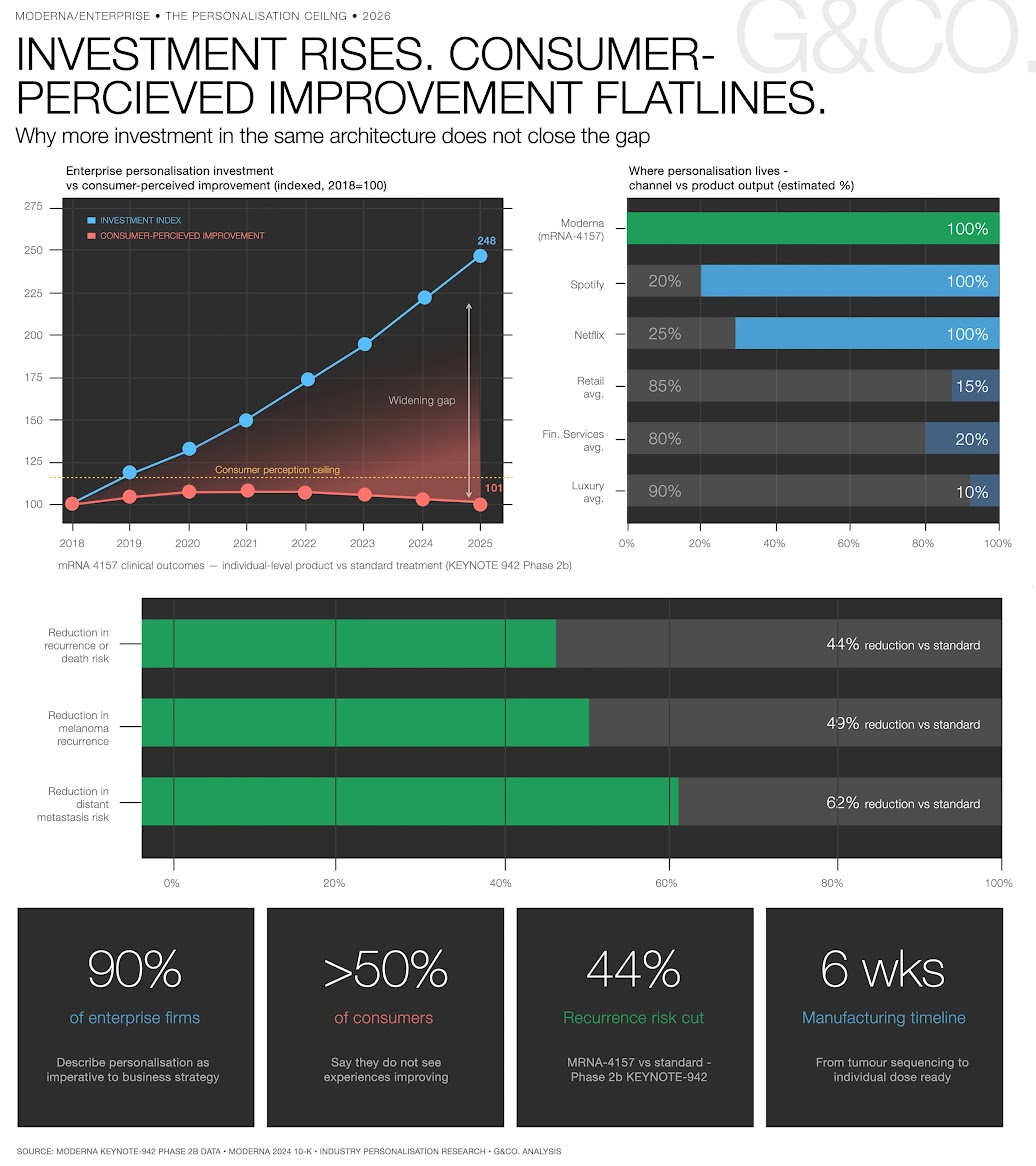
Nine out of ten enterprise firms call personalization essential to their strategy, yet more than half of consumers say their experiences are not actually improving. That gap is not a technology or data problem; it is a design one. Most brands personalize the wrapper around a standardized product, better-targeted messaging, better-timed offers, better-curated content, while the product itself stays the same for everyone. The personalization lives in the channel, not in what the customer actually receives.
Moderna made a different decision. With mRNA-4157, its individualized cancer vaccine developed with Merck, it did not build a better drug and then personalize the delivery; it built a manufacturing platform that produces a fundamentally different product for every patient, each dose derived from that individual's tumor mutation profile and made in about six weeks. This Moderna personalisation strategy points to a lesson with nothing to do with oncology: when personalizing the experience around your product stops creating advantage, the next move is to personalize the product itself.
Key Points
- Moderna personalizes the product itself, not the marketing around it, its cancer vaccine, mRNA-4157, is built from each individual patient's tumor, so no two doses are the same.
- The differentiation lives inside the manufacturing, because the vaccine is a process run on one person's data, not a molecule anyone else can make.
- It works because the infrastructure makes individual output possible at scale: sequencing each tumor, an algorithm picking up to 34 targets, and a six-week manufacturing run turn one patient's data into one dose.
- In a Phase 2b trial with Merck, adding mRNA-4157 to standard treatment cut the risk of melanoma returning or death by 44% versus treatment alone.


%20(1).png)

Let’s kickstart the conversation and design stuff people will love.

The Retail & Consumer Index


Why This Matters
The personalization investment cycle that began when enterprise brands first adopted CRM and data platforms is now old enough to show a measurable outcome: across industries, the gap between personalization investment and consumer-perceived improvement is widening rather than closing. Brands are spending more, and consumers are experiencing less distinction. The model, not the technology, is the constraint, and Moderna is the clearest available demonstration of the alternative model.
For CEOs, CMOs, chief digital officers, and heads of innovation in retail, financial services, luxury, and healthcare, the relevance is that every category will eventually face the question Moderna answered for medicine: when personalizing the experience around your product stops producing advantage, can you personalize the product itself? Moderna's Phase 3 program is also the first randomized clinical evidence that an individual-level product architecture produces outcomes segment-level approaches cannot match, which makes it an unusually concrete proof point for an abstract strategic argument.
Strategic Context
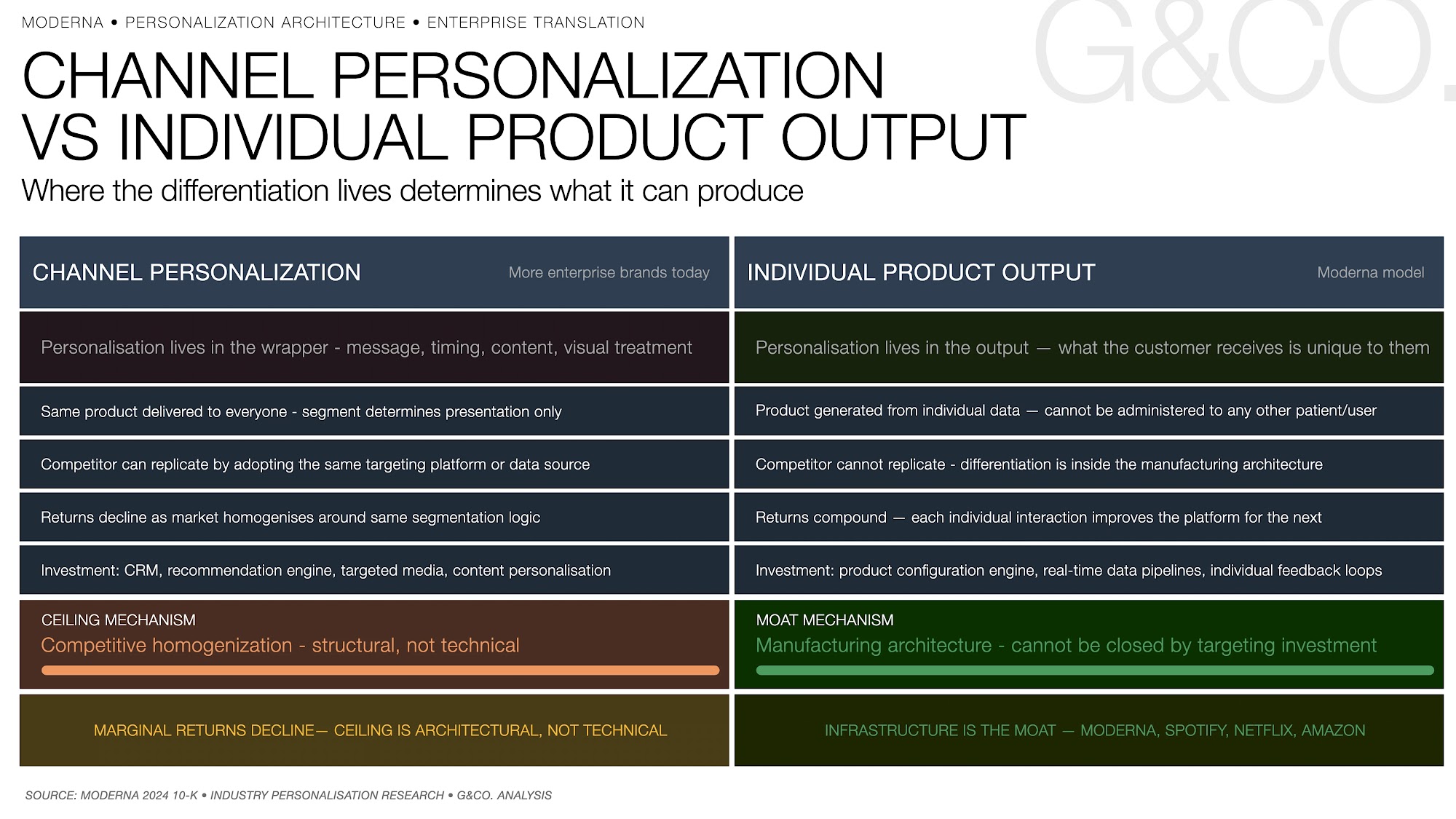
Most firms direct personalization investment at the same approach: better segmentation of a standardized product, delivered through more precisely targeted channels. The logic is coherent, divide customers into groups, tailor to each group, measure the lift, and it usually works. But the improvement runs into a ceiling most brands hit without naming it. That ceiling arrives when every competitor uses the same data sources, platforms, and segmentation logic, and personalization itself becomes a commodity. At that point the brands that invested most face a paradox: they have better data, faster targeting, and more sophisticated modeling, yet they produce experiences that feel, to the consumer, indistinguishable from everywhere else. The investment bought competitive parity at higher cost, not differentiation.
In retail, where personalization investment has been highest and longest-running, brands with sophisticated recommendation engines are finding that the return on additional investment has fallen to the point where it no longer produces meaningful revenue lift. The market has converged around segment-level targeting, and the next real differentiation is not a better recommendation engine. It is a product that is genuinely different for the person who receives it. That is the question Moderna answered for medicine, and the question every enterprise brand will eventually answer for its own product.
Company Response
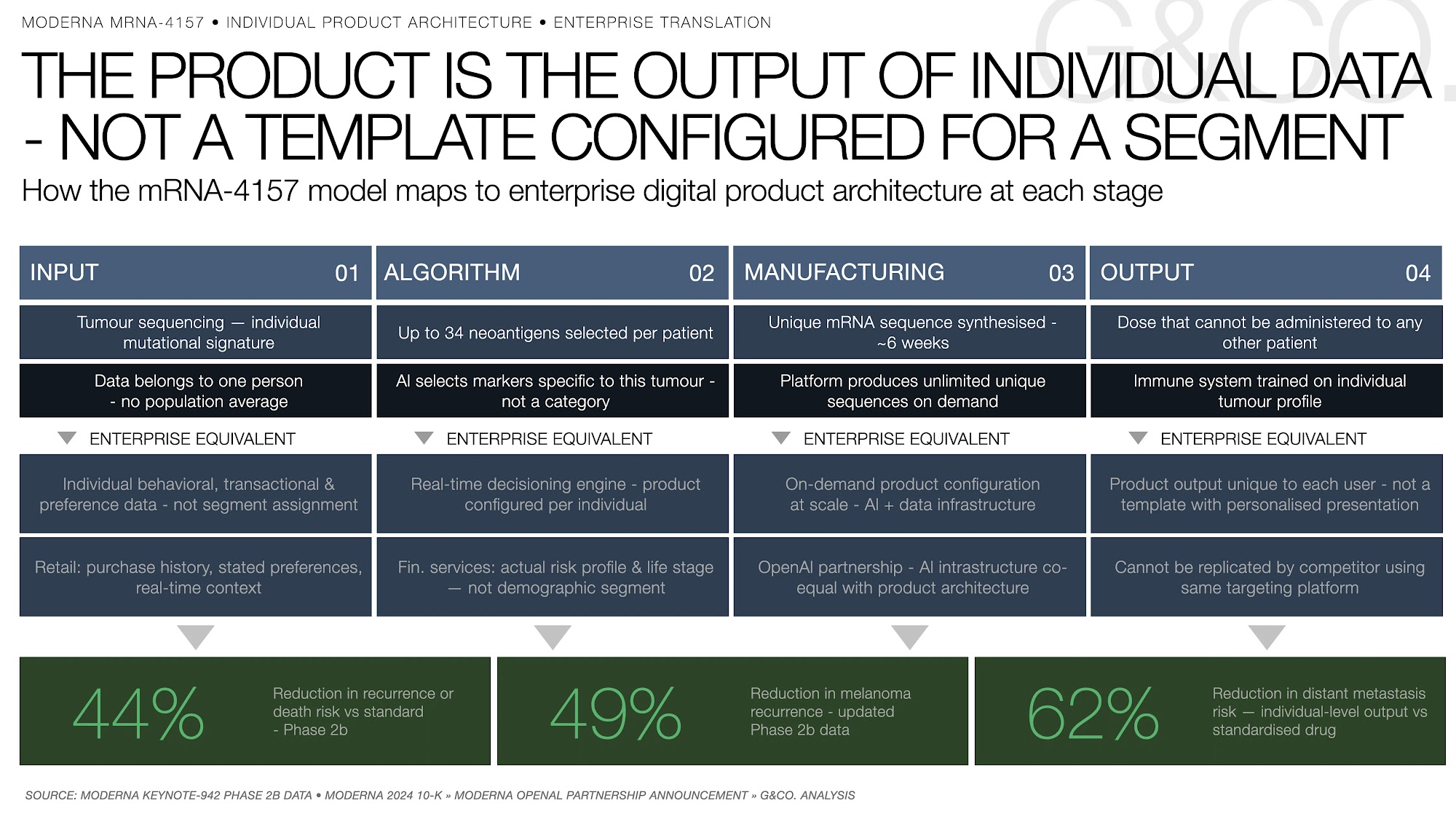
The architecture of mRNA-4157 is the decision this case turns on. Moderna did not design a drug and then decide how to deliver it more precisely to different populations. It designed a manufacturing system in which the drug is the output of an individual-level data process: each patient’s tumor is sequenced to identify its unique mutational signature, an algorithm selects up to 34 neoantigens (the markers that teach the immune system to recognize and attack that tumor), and a personalised mRNA sequence is constructed and manufactured in about six weeks. The result is a product that by design cannot be given to any other patient, because it was built from data belonging to one person only.
The significance is structural, not only clinical. Moderna has created a category of one: no competitor can offer the same product because the product is not a molecule, it is a process. The differentiation lives inside the manufacturing architecture, not the marketing, distribution, or brand, and it cannot be replicated through better targeting because there is no targeting involved, only individual output. The parallel to enterprise digital product strategy is specific. Most digital products are standardized outputs with personalised presentation: the same product delivered with different content, sequencing, or visual treatment by segment. The Moderna model asks what it would mean to build the product itself from individual data, a financial services product configured to the individual’s actual risk profile and life stage rather than a demographic segment, a retail experience that generates a different product configuration per customer rather than a different homepage, a healthcare application that produces a different clinical protocol per patient rather than a different content recommendation.
Making that commercially sustainable is the hard part, and it is a manufacturing problem more than a science one. Moderna’s 2024 10-K names it directly: its individualized neoantigen therapies are uniquely manufactured for each patient through a novel, complex process, and the company acknowledges it may encounter difficulties in production. The risk is real, and individual-level manufacturing at commercial scale is not yet fully solved: Phase 3 trials across melanoma, non-small cell lung cancer, and cutaneous squamous cell carcinoma are underway across 20 to 33 countries, with the pathway to commercial-scale individual manufacturing still being built. But the direction of the investment is the signal. Moderna is not solving personalisation by improving segmentation; it is building the infrastructure that makes individual output economically viable, the six-week timeline, the algorithmic neoantigen selection, and the mRNA synthesis platform that produces a unique sequence on demand. Those are not product features, they are the commercial architecture individual-level personalisation requires at scale.
The data layer is inseparable from that architecture, which is what the 2023 OpenAI partnership is really about. It is not primarily about chatbots or content generation; it is about the infrastructure individual-level manufacturing demands. The mRNA platform generates enormous individual-level biological data, tumor sequencing outputs, neoantigen decisions, manufacturing parameters, clinical response signals, and managing and acting on that data at the speed individual manufacturing requires is an AI infrastructure problem as much as a biological one. The enterprise parallel is exact: individual-level personalisation at scale generates individual-level data at a volume and velocity segment-level operations were never designed to process. The recommendation engine that produces a unique configuration for each of millions of users in real time needs the same class of AI and data infrastructure Moderna is building for individual dose manufacturing. The product architecture makes individual output possible; the data and AI infrastructure makes it commercially sustainable; neither is sufficient without the other.

Always-On Customer Intelligence
Turn your own customer data into foresight — validate, simulate, and sense every major decision before you commit.


Results and Evidence
The clinical evidence is the proof of the architectural premise. The Phase 2b KEYNOTE-942 trial, enrolling 157 patients with stage III/IV melanoma following complete resection, demonstrated a 44% reduction in the risk of disease recurrence or death compared to standard treatment, with updated data showing a 49% reduction in melanoma recurrence and a 62% reduction in distant metastasis risk. These are not outcomes a better-targeted standardized drug could produce, because the differentiation that generates them lives inside the product, not around it.
The platform logic is visible in the pipeline. The same manufacturing architecture that produces an individualized melanoma vaccine can be directed at non-small cell lung cancer, cutaneous squamous cell carcinoma, or any tumor type whose mutation profile can be sequenced and translated into a neoantigen sequence. This is the pharmaceutical industry’s pipeline-to-platform shift made concrete: a pipeline produces a standardized drug whose commercial value is bounded by that drug, while a platform produces a process whose value is bounded only by the number of individuals whose inputs it can process. The platform generates products; the brand builds the platform. For enterprise brands, the equivalent shift is from product to product architecture, from selling a standardized output with personalised presentation to selling a production system whose output is inherently individual and whose value compounds with every interaction.
Strategic Implications
Read at scale, the Moderna case offers a diagnostic that cuts across AI, customer experience, digital transformation, personalisation, commerce, data strategy, and product strategy: ask where the personalization lives. If it lives in the channel, in the message, timing, content selection, or visual treatment, it addresses the experience around the product. If it lives in the output, in what the customer actually receives, different from what any other customer receives, it addresses the product itself. Most enterprise brands, if honest, will find their personalization in the channel: the product is standardized and the presentation is personalized. That is the rational starting point and it produces real early returns, but it is not where structural advantage is built.
The advantage is built by brands that redesign the product around individual inputs, invest in the generation architecture that makes individual output sustainable, and treat the required data infrastructure as the primary investment rather than a supporting cost. The brands that have done this in adjacent domains, Spotify in music discovery, Netflix in individual-level content recommendation, Amazon in configuration by purchase history, built structural advantages that segment-level competitors cannot close through better targeting. The infrastructure is the moat. Brands that begin the shift now, from channel personalisation to product personalisation, will hold a two-to-three-year infrastructure advantage over those that recognize the ceiling only after their current approach’s marginal returns become impossible to ignore. Moderna began building its individual-level platform when the ceiling of standardized drug development first appeared, not when demand for personalized medicine became obvious. The same move from marketing to product-level personalization is visible in Spotify's recommendation engine, Pfizer's connected AI, and Samsung's data-driven appliances.
What Enterprise Leaders Can Learn
- Recognize the ceiling as structural.
Segment-level returns fall as competitors converge, and the ceiling cannot be raised by investing more in the same approach. - Build differentiation into the output.
The durable advantage is a product architecture whose output is genuinely individual, where the difference lives in what the customer receives, not how it is presented. - Treat the generation architecture as primary.
Individual output at scale needs a manufacturing or generation system segment-level operations were not built for, and that architecture is the enabling condition, not a supporting cost. - Fund product and data systems together.
The AI systems and data systems are a co-equal investment with the product design, not a supplementary tool. - Make the model decision, not just the tool decision.
The shift from product to platform is what separates structural advantage from a targeting layer with shrinking returns.
Conclusion
There is a detail that tends to get lost amid the Phase 2b and Phase 3 results. Moderna did not build mRNA-4157 because it found a market segment with unmet need and optimized a product for it. It built it from a different architectural premise: that the product should be an output of individual data rather than an input to individual targeting. The clinical results, the 44% reduction in recurrence risk and the 62% reduction in distant metastasis, are the commercial proof of that premise, compounded across 157 patients and multiple cancer types. Moderna did not find a better drug; it built a better product architecture.
That is the uncomfortable implication for leaders asking whether their personalisation investment is producing the returns it should. The question is not whether the targeting is accurate enough or the data rich enough or the platform sophisticated enough, those are questions about the channel. The prior question is whether the product itself is individual. If what the customer receives is the same product everyone else receives, presented through a more precisely targeted channel, then the ceiling on what personalisation can produce is structural, not technical, and it will not be raised by the next platform upgrade or data partnership. It will be raised only by the architectural decision Moderna made: to redesign the product, not the wrapper.
Through the Acumen platform, G&CO.Health gives enterprise healthcare and consumer brands the intelligence to move personalization from the channel into the product: where segment-level returns have hit their ceiling, what individual-level output would require, and where the product and data infrastructure investment pays off. G&CO.Health is a certified minority business enterprise through the National Minority Supplier Development Council (NMSDC). For enterprise organizations with diversity inclusion requirements in their procurement process, G&CO.Health meets the criteria for MBE-qualified partner status.
G&CO.Health works with enterprise brands in retail, luxury, financial services, and healthcare to design the product architecture and data infrastructure that determine whether personalisation is a marketing layer or a structural competitive advantage. If the Moderna model raises questions about your own digital product strategy and individual-level personalisation investment, submit an inquiry to G&CO.Health on our contact page or click on the blue “Click to Contact Us” button on the bottom right corner of your screen for your convenience. We look forward to hearing from you.
Frequently Asked Questions
What is the Moderna product strategy case study about, and why does it matter for enterprise brands?
It examines the architectural decision behind mRNA-4157, Moderna’s individualized cancer vaccine developed with Merck, as a model for brands evaluating the limits of segment-level personalization. It matters because it demonstrates, through Phase 2b clinical evidence, that individual-level product output produces outcomes that standardized products with personalized presentation cannot replicate. The 44% reduction in melanoma recurrence risk in KEYNOTE-942 is not the result of better targeting; it is the result of building a product uniquely configured for each individual from their own biological data. The enterprise translation: the most durable advantage in a personalization-saturated market is not a better recommendation engine, it is a product architecture whose output is inherently individual.
What can enterprise brands learn from Moderna’s personalization approach?
The distinction between channel personalization and individual-level product personalization, and the investments required to move from the former to the latter. Moderna’s platform teaches three lessons. First, the competitive ceiling of segment-level personalization is structural rather than technical and cannot be raised by more of the same investment. Second, individual-level output requires a manufacturing or generation architecture fundamentally different from segment-level operations, and that architecture is the primary enabling condition. Third, the data and AI infrastructure required is not a supporting cost but a co-equal investment with the product architecture, which is what Moderna’s OpenAI partnership reflects.
What is individual-level personalization product strategy, and how does it differ from segment-level personalization?
It is the approach of building products whose output is inherently unique to each individual, generated from individual data rather than configured from a standardized template for a segment. The difference is the layer at which differentiation is produced. Segment-level personalization differentiates in the channel: the same product delivered with different messaging, timing, content, or visual treatment by segment. Individual-level personalization differentiates in the output: what the customer receives differs from what any other customer receives, because it was generated from data belonging to that individual alone. The commercial significance is that individual-level output cannot be replicated by a competitor using the same targeting, because the differentiation lives inside the product rather than around it.
How does digital product strategy in pharma apply to other enterprise verticals?
Through the principle of individual-level output rather than the specific mechanism of mRNA manufacturing. In retail, the equivalent is a digital product whose configuration, not just its presentation, is generated from individual purchase history, behavioral data, and stated preferences. In financial services, a product whose structure reflects the individual’s actual risk profile and life stage rather than a demographic assignment. In luxury, a client experience assembled from individual client intelligence rather than tier-calibrated service scripts. In each case the requirement is the same: a production or generation system that takes individual inputs and produces individual outputs, supported by data infrastructure that makes the process sustainable at scale. The pharma case is useful because it demonstrates this at the most fundamental level, the product is the biology, and the biology is unique to each person.
What data infrastructure does individual-level personalization require?
Infrastructure of a fundamentally different class from segment-level operations. Segment-level personalization needs infrastructure that can assign customers to predefined groups and deliver group-appropriate content at scale. Individual-level personalization needs infrastructure that can process individual inputs in real time, generate individual outputs on demand, and improve those outputs through continuous individual-level feedback loops. For Moderna, that means tumor sequencing infrastructure, algorithmic neoantigen selection, mRNA synthesis platforms, and individual-patient clinical response monitoring. In enterprise digital terms, it means real-time individual behavioral data processing, on-demand configuration engines, and individual-level outcome tracking that feeds back into the model. The investment is substantially higher than segment-level infrastructure, and Moderna’s OpenAI partnership reflects that AI infrastructure is a co-equal component, not a supplementary tool.