Salesforce Agentforce and Customer Zero: How Running AI on Yourself Became the Enterprise Standard
This Salesforce case study examines how Salesforce ran its own AI product, Agentforce, on itself first, a program it calls Customer Zero, before selling it to customers. The bet was that success with agentic AI depends less on the AI model than on the architecture around it: governing agents by a goal instead of rigid rules, unifying data through Salesforce Data Cloud, and embedding agents in the tools employees already use. That approach helped Agentforce reach $800 million in annual recurring revenue (up 169%) and 29,000 deals, and it maps the enterprise AI architecture that moves AI from pilot to production.
Salesforce created Agentforce, its AI agent platform, and first tested it within its own business through an internal program called Customer Zero.
In September 2025, Salesforce published a look back at the first year of running its own AI product on itself, and opened not with a milestone but with a single interaction: an AI agent, not a human, fielded a complaint from a webinar prospect, addressed the concerns, pivoted to sales, and closed the deal. The argument underneath was counterintuitive for a company its size. Salesforce was not betting on the quality of its AI model. It was betting that the architecture around the model determined whether agentic AI reached enterprise scale, and that the only credible way to prove it was to run the product on itself first.
This Salesforce Agentforce story, the Customer Zero program, is therefore not about a better chatbot. It is about enterprise AI architecture: goals replacing rules, one data source replacing scattered ones, and agents built into the tools employees already use rather than sitting beside them. The difference between those two approaches is the distance between an AI pilot that demos well and an AI deployment that actually reaches full production. The lesson for enterprise leaders has nothing to do with CRM.
Key Points
- Salesforce ran Agentforce inside its own business before selling it to customers, a program it calls Customer Zero.
- Three things made the agents work: one clear goal instead of strict rules, data connected through Salesforce Data Cloud (650+ internal sources), and agents built into tools people already use, like Slack, where 86% of staff rely on them (99% company-wide).
- Salesforce's own sales agent went from answering "I don't know" a third of the time to under 10% after a year of fixes, and along the way its agents handled 1.5 million support requests, brought in $1.7 million from cold leads, and saved staff 500,000 hours.
- With customers, Agentforce now brings in $800 million a year in recurring revenue, up 169%, with more than 29,000 deals since its October 2024 launch and 2.4 billion tasks handled.


%20(1).png)

Let’s kickstart the conversation and design stuff people will love.

The Retail & Consumer Index


Why This Case Study Matters
The enterprise AI market is entering its third year since ChatGPT and its second since the first wave of AI procurement. Most programs launched in that window have not produced the returns their business cases assumed, and the gap between pilot and production has become the single most discussed problem in enterprise software. Moving enterprise AI from pilot to production is as much a strategy problem as a technical one, the kind of work the top enterprise digital strategy agencies are increasingly brought in to lead.
On its Q3 FY2026 earnings call, Salesforce referenced widely circulated research indicating that a substantial majority of enterprise generative AI projects fail to deliver ROI, and positioned Agentforce as a direct response to the architectural reasons they fail.
For CEOs, CIOs, chief digital officers, and heads of innovation, the relevance is immediate. Buyers who approved AI budgets in 2024 are being asked to justify them in 2026, and the justification increasingly depends on whether agents have moved from pilot into daily operational use. Salesforce is the clearest available demonstration of what that transition actually requires, documented through its own failures rather than a vendor’s polished customer story.
Strategic Context
The decision that made the Customer Zero argument possible was taken a year before the retrospective, when the industry was competing on model capability and every vendor positioned its foundation model as the differentiator. Salesforce, through the Customer Zero program led by Joe Inzerillo as President of Enterprise and AI Technology, chose the opposite path: assume the model is not the problem, and invest the company’s operational credibility in fixing everything around it. The underlying assumption was that a vendor selling an AI product it had not run at scale in its own business was, in the enterprise market of 2025, no longer selling a credible product.
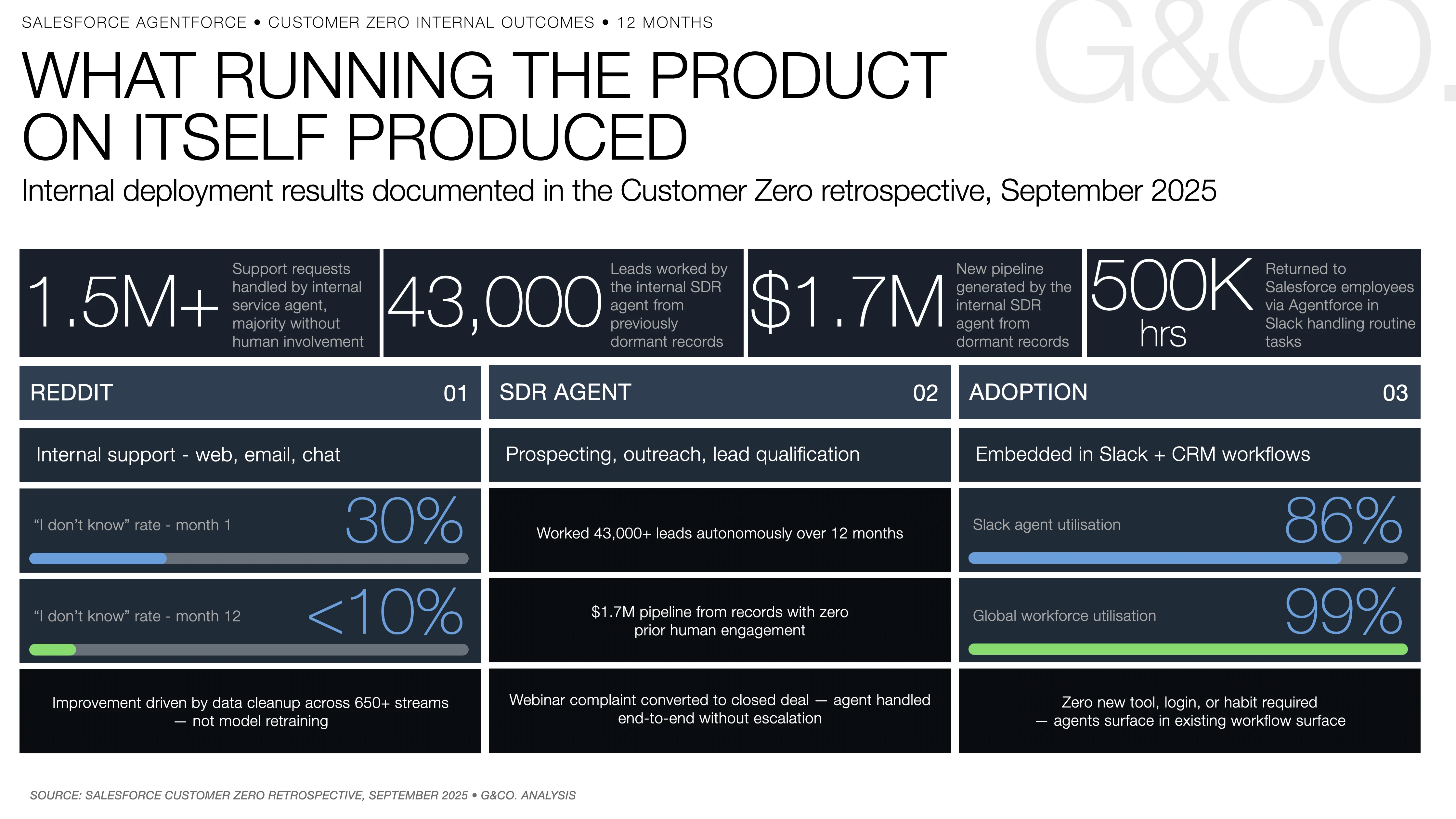
The most telling figure Salesforce disclosed is not a success metric but a failure rate. When it first deployed its internal sales development rep agent, designed to prospect, conduct outreach, and qualify leads autonomously, the agent responded “I don’t know” to thirty percent of requests for detail on a lead. A third of the time it was asked to do its core job, it failed. This is the kind of number that never appears in a vendor pilot, because a pilot is scoped to the questions the agent can answer, while a production deployment is scoped to whatever the business generates. At that scope, thirty percent is a program-ending failure mode, and Salesforce was running it on itself. Over twelve months of data cleanup and iterative training, it brought the rate below ten percent, and the lessons learned through those failures now define the Agentforce product.
Company Response
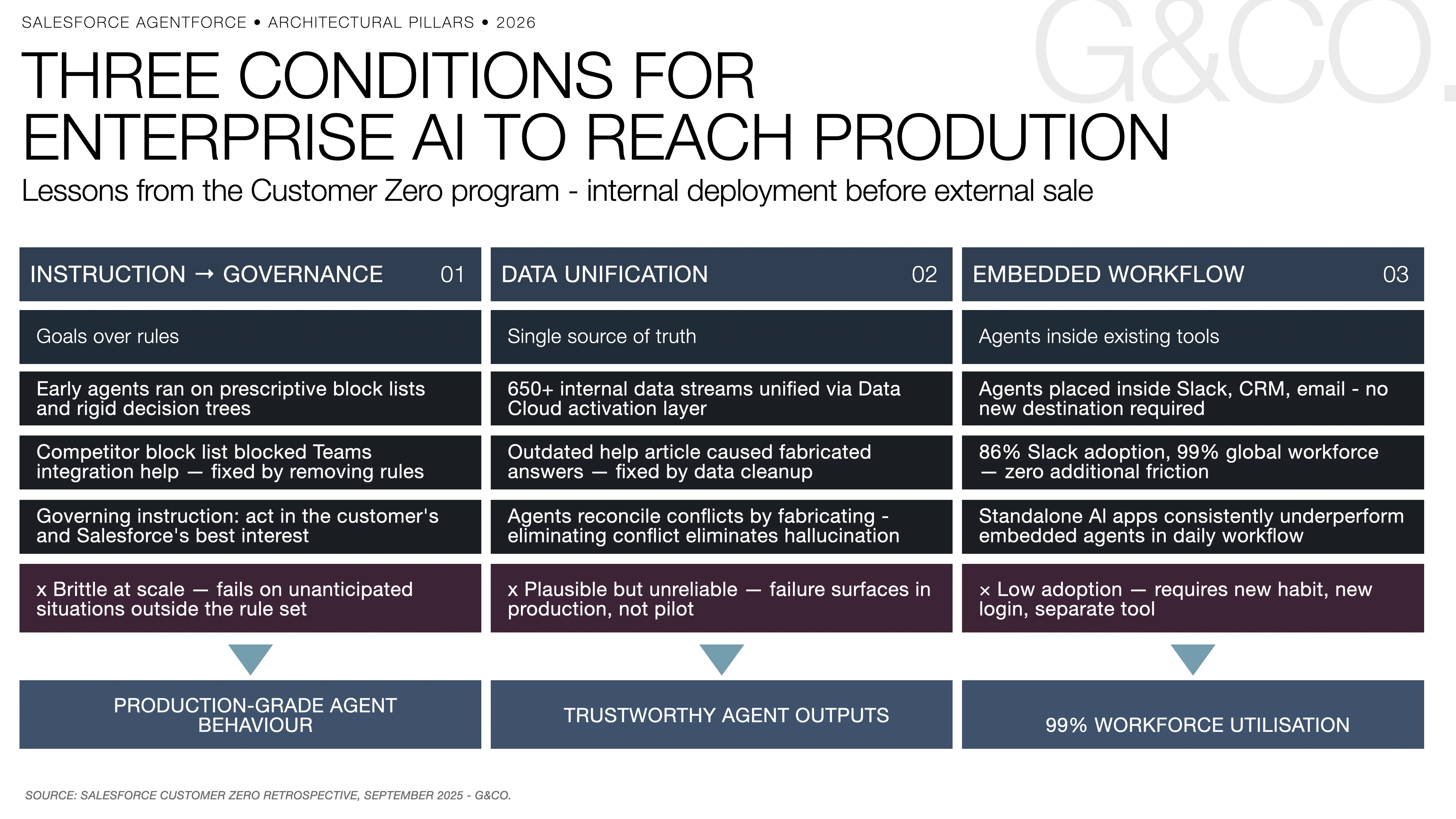
Three architectural lessons, each learned through Salesforce's own failures, structure the response. Together they answer how to scale agentic AI across a business without repeating the failures that strand most deployments between pilot and production.
Goals beat rules.
Early versions were built on strict instructions: do this, not that, follow this script. That produced fragile agents that broke whenever they met a situation the rules had not anticipated. The fix was to replace rigid instructions with one overarching goal, act in the customer's and Salesforce's best interest, captured internally as "let the LLM be an LLM": trust the model to reason within the goal rather than boxing it into a decision tree. The clearest example is the competitor block list. To avoid promoting rivals, Salesforce forbade its support agent from discussing competitors, so when customers asked the perfectly ordinary question of how to integrate Microsoft Teams with Salesforce, the agent refused, because Microsoft was on the list. The agent was not failing its task; it was succeeding at a rule that was wrong. Removing the list and governing by goal made the failure disappear, because the agent was now pursuing an objective rather than obeying an incomplete rule. Agents fail when instructed; they succeed when governed.
Clean, consistent data is the foundation.
This is the lesson Salesforce appears to have learned most expensively, because unlike an instruction that a prompt rewrite can change, data quality is an infrastructure problem that builds up over time. The support agent once pulled outdated information from an old page that was no longer linked but had never been removed, and finding it alongside a current article, produced an answer that tried to reconcile the two, incorrectly. Agents work by prediction: when they meet two conflicting sources that both look authoritative, they generate an answer rather than flag the contradiction. The response was to deploy Salesforce Data Cloud as a layer across more than 650 internal data streams, not to give agents more data, but to make sure the data they got did not contradict itself, unifying sources into one consistent set of facts. The implication for buyers is specific: agent deployments that proceed without unifying data first inherit every contradiction underneath, which does not cause loud failure but quiet fabrication, plausible one answer at a time and unreliable as a whole, and it surfaces in production, not in the pilot.
Put agents in the workflow, not beside it.
Salesforce discloses that eighty-six percent of its employees use agents in Slack and ninety-nine percent of its global workforce uses internal agents, usage rates for a daily workflow rather than sign-ups for a voluntary pilot. It did not train its workforce into those numbers; it placed agents inside the applications employees already used. The HR agent lives in Slack, the sales agent in the CRM, the IT agent in existing internal channels. The employee's habit does not change, no new tool, login, or routine, so the agent becomes part of the surface the employee already works in. The pattern that consistently underperforms puts agents in separate apps with their own address that employees must remember to open; the pattern that scales puts agents inside the tools employees cannot avoid using.
Always-On Customer Intelligence
Turn your own customer data into foresight — validate, simulate, and sense every major decision before you commit.


Results and Evidence
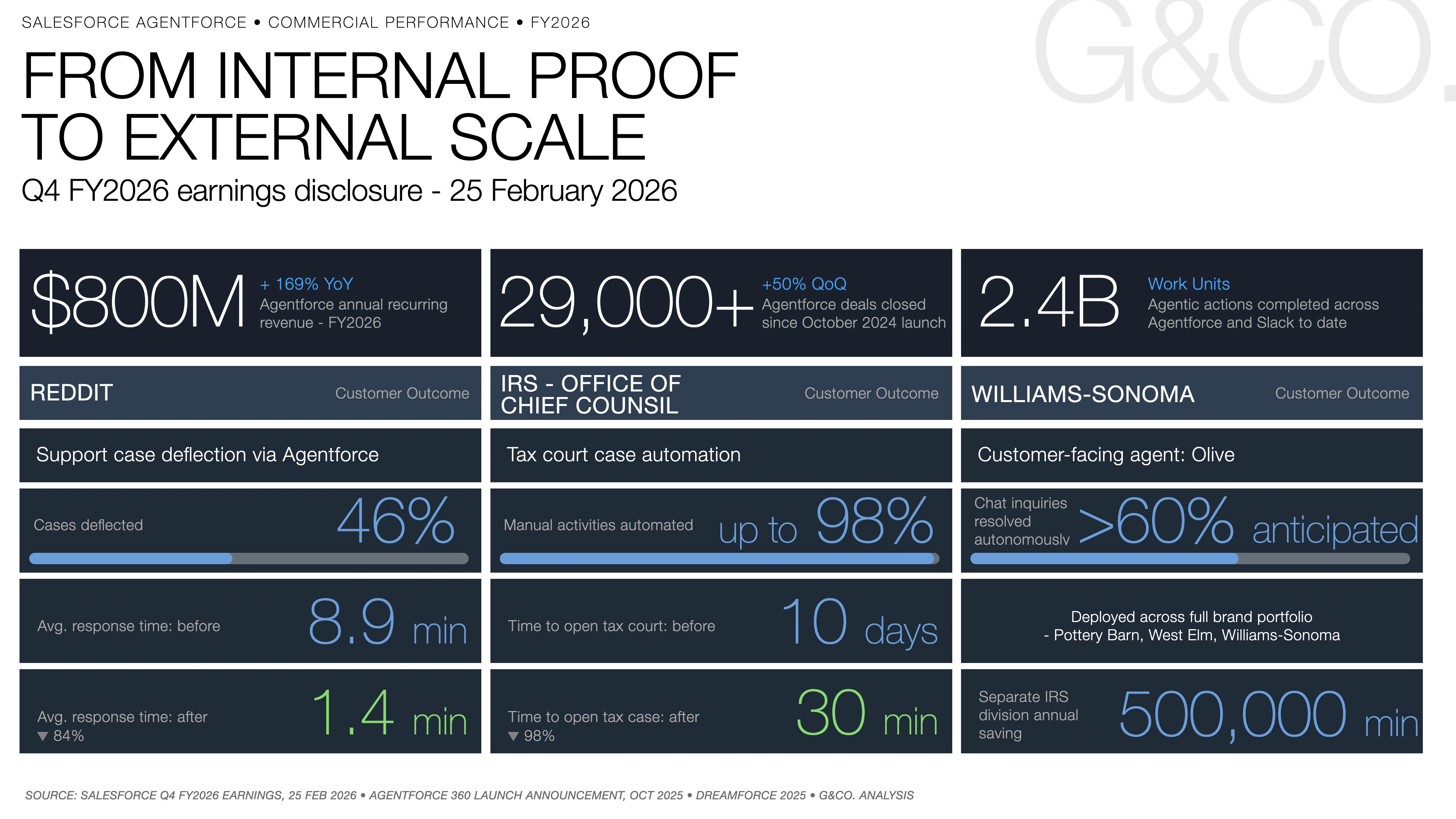
The commercial signal is substantial. In its Q4 FY2026 earnings release on 25 February 2026, Salesforce disclosed that Agentforce had reached $800 million in annual recurring revenue, up 169 percent year over year, with more than 29,000 deals closed since the October 2024 launch (up fifty percent quarter over quarter) and more than 2.4 billion agentic work units delivered across Agentforce and Slack. The ARR figure signals momentum, but the work-unit figure is the one that matters analytically. Salesforce introduced the agentic work unit, a discrete action taken by an agent such as a record updated or a decision made, specifically to move the conversation away from seats licensed and toward work actually completed, reflecting its argument that agentic AI is not a conventional software category because its unit of value is task execution, not seat access.
External outcomes support the pattern. Reddit deflected forty-six percent of support cases through Agentforce and cut average response time from 8.9 minutes to 1.4 minutes, an eighty-four percent reduction. Williams-Sonoma is deploying Agentforce across its brand portfolio through a customer-facing agent named Olive, expected to autonomously resolve more than sixty percent of chat inquiries. The IRS deployed Agentforce in the Office of the Chief Counsel, automating up to ninety-eight percent of previously manual activities and reducing the time to open a tax court case from ten days to thirty minutes, with a separate division saving an estimated 500,000 minutes annually after retiring legacy systems.
The most credible outcomes, though, are Salesforce’s own. In one year, the internal service agent handled more than 1.5 million support requests, the majority without human involvement. The internal SDR agent worked more than 43,000 leads and generated $1.7 million in new pipeline from previously dormant records. Agentforce in Slack returned 500,000 hours to employees through routine-task handling. These are not vendor case studies about a customer; they are the result of a vendor operating its own product at enterprise scale, and no third-party case study carries the same weight.
Strategic Implications
Read at scale, the Customer Zero standard is not a Salesforce innovation but the standard the market is beginning to apply to every vendor making enterprise AI claims, and it intersects the broader currents of AI, customer experience, digital transformation, and data strategy. The next twelve months will separate vendors who have operationalized agentic AI at enterprise scale from those who have not, and enterprises that have rebuilt their workflows around agents from those still deploying agents alongside workflows that never changed. The three conditions that determine whether a program reaches production, goals over instructions, data unification over data accumulation, embedded over standalone, are not proprietary to Salesforce; they are what any organization willing to run its own program at scale will discover.
The deeper implication for vendor selection and for internal strategy is the same: the organizations that bridge the gap between AI experimentation and AI at production scale are not the ones that buy a better model. They are the ones that rebuild their governance, their data infrastructure, and their workflow architecture around agents with the discipline Salesforce applied to itself, and that hold every vendor they evaluate to the same standard. The correction to a stalled program is infrastructure work, governance redesign, data unification, and workflow redesign, not model replacement. The same lesson runs through Adobe's move from tools to an AI platform, Nvidia's ecosystem lock-in, and Amazon's reasoning-based commerce.
What Enterprise Leaders Can Learn
- Run an internal deployment in parallel.
Pursuing enterprise AI adoption without operating it on yourself creates credibility gaps with the buyers you are trying to win, and gives up the lived evidence that closes deals. - Make governance the design problem.
Rigid rules reveal fragility at scale that pilots hide; the governance model, not the rule set, is what makes production-grade deployment possible. - Unify data before scaling agents.
Data problems compound because agents make things up to reconcile conflicts; fix the conflict at the data layer first. - Embed, don't bolt on.
Standalone agent apps consistently underperform agents built into the workflows employees already use. - Demand proof.
Evidence that a vendor runs its own product at scale now carries more weight with buyers than any demonstration of model capability.
Conclusion
There is a detail in the Customer Zero program that tends to get lost amid the ARR and work-unit counts. Salesforce did not build Agentforce to become a media case study about AI adoption. It built it because the alternative, selling an enterprise AI product without having deployed it on itself, had become commercially untenable in a market where buyers were beginning to ask the obvious question. The $800 million in ARR, the 29,000 deals, and the 2.4 billion work units are byproducts of that original decision, compounded across eighteen months of consistent operational commitment. Salesforce did not set out to define the standard for enterprise AI credibility; it simply refused, consistently, to make claims about a product it had not run.
That is the uncomfortable truth the case contains for most enterprise technology leaders. The three architectural conditions that determine whether an agentic AI program reaches production are not Salesforce innovations; they are the lessons any organization willing to run its own program at scale will discover. The organizations that will cross from experimentation to production are the ones that rebuild governance, data infrastructure, and workflow architecture around agents with that same discipline, and hold every vendor they evaluate to the same test.
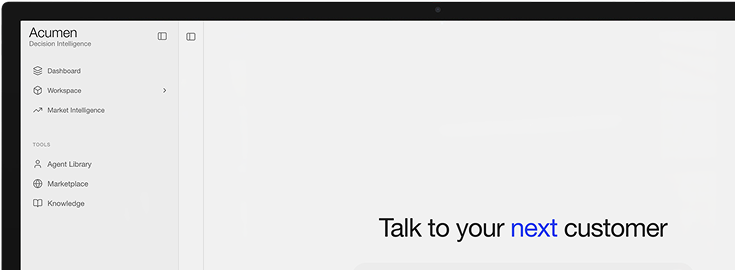
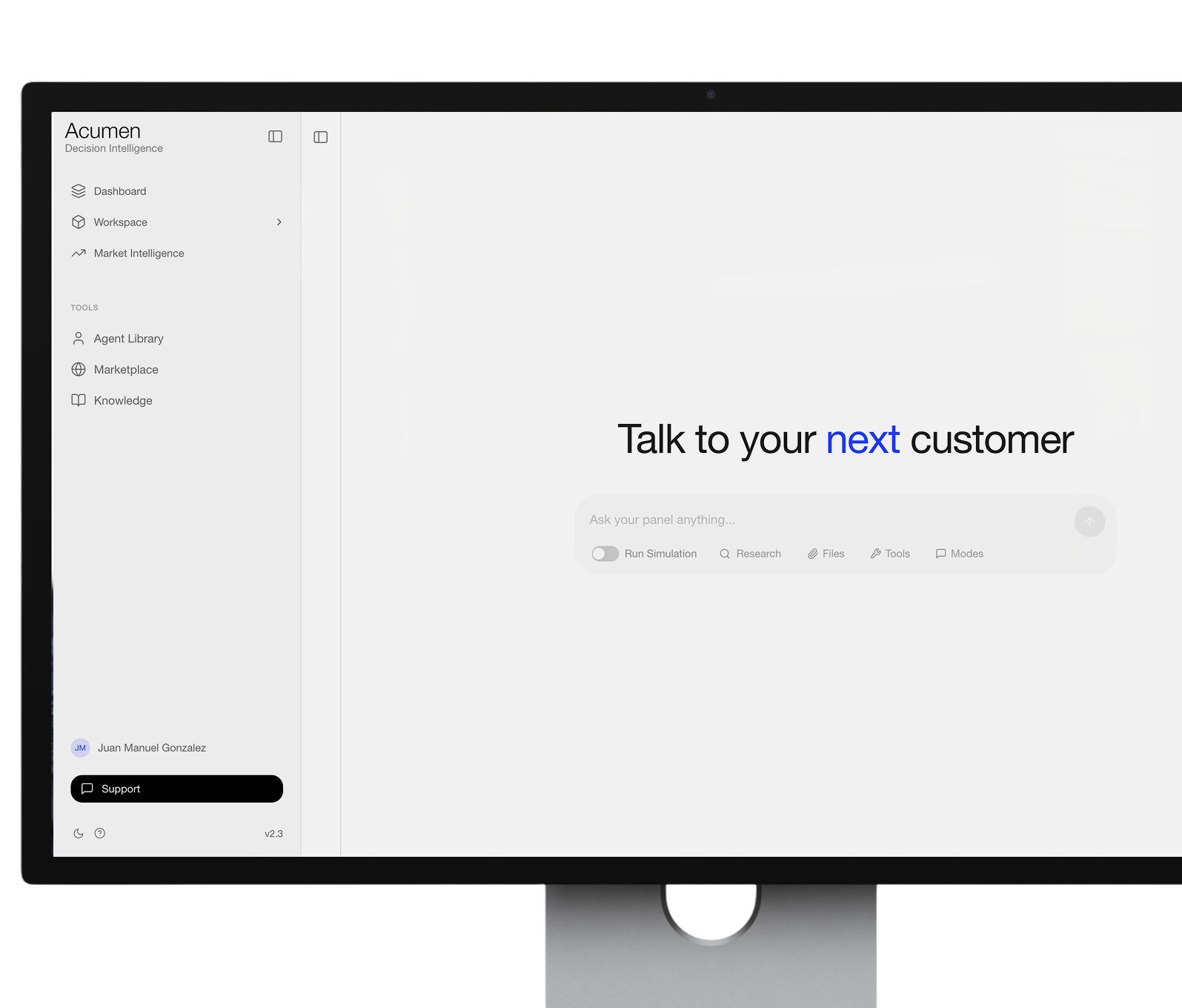
Through the Acumen platform, G&CO. gives enterprise brands the intelligence to move AI from pilot to production: where governance and data problems are stalling agents, which investments actually reach production scale, and how to hold vendors to a real standard of proof. G&CO. is a certified minority business enterprise through the National Minority Supplier Development Council (NMSDC). For enterprise organizations with diversity inclusion requirements in their procurement process, G&CO. meets the criteria for MBE-qualified partner status.
G&CO. works with enterprise brands in financial services, retail, and technology to design and build the integration architecture, data governance, and workflow models that determine whether enterprise AI stays in pilot or reaches production at scale. If the Salesforce Customer Zero programme raises questions about your own agentic AI strategy, submit an inquiry to G&CO. on our contact page or click on the blue “Click to Contact Us” button on the bottom right corner of your screen for your convenience. We look forward to hearing from you.
Frequently Asked Questions
What did Salesforce do to achieve $800 million in Agentforce annual recurring revenue?
Salesforce reached $800 million in Agentforce ARR by the end of FY2026, up 169 percent year over year, by deploying the product on its own operations before and during external rollout. That internal deployment, the Customer Zero program, surfaced three architectural decisions that now define the product: replacing prescriptive rules with goal-based governance, unifying internal data across more than 650 streams through Data Cloud, and embedding agents inside existing workflows rather than as standalone apps. The external trajectory, 29,000 deals closed since launch and 2.4 billion work units delivered, reflects the credibility that internal deployment created.
Why did Salesforce deploy Agentforce on itself before scaling it externally?
The Customer Zero program reflected a judgment that enterprise AI credibility in 2024 and 2025 could no longer be established through vendor demonstrations alone. By running Agentforce on its own sales, service, and internal operations first, Salesforce accepted the risk of discovering failure modes in its own deployment rather than in customers’. The program produced specific evidence, including reducing the internal SDR agent’s “I don’t know” rate from thirty percent to under ten percent through data cleanup and iteration, that became the basis for the product roadmap and for customer conversations grounded in lived experience.
How did Salesforce implement Agentforce across its own organization?
Salesforce embedded Agentforce into the tools its workforce already used rather than deploying agents as separate applications, producing adoption of eighty-six percent in Slack and ninety-nine percent across the global workforce. The data infrastructure was consolidated through Data Cloud, which unified more than 650 internal data streams into a single activation layer and resolved fragmented records into consistent profiles. The instruction model was rebuilt from prescriptive rules to goal-based governance, with agents trusted to reason within an overarching objective rather than executing a decision tree.
What were the results of Salesforce’s Customer Zero program?
In twelve months, the internal service agent handled more than 1.5 million support requests, the majority without human involvement. The internal SDR agent worked more than 43,000 leads and generated $1.7 million in new pipeline from previously dormant records. Agentforce in Slack returned 500,000 hours to employees. These internal outcomes formed the foundation for the commercial results in the Q4 FY2026 release: $800 million in ARR up 169 percent, 29,000 deals closed since launch, and 2.4 billion work units delivered.
What can enterprises learn from Salesforce’s Agentforce deployment?
The lesson is architectural, not technological. Enterprise AI programs stall in pilot for three identifiable reasons: agents instructed through prescriptive rules that cannot handle operational variability, agents encountering inconsistent data they reconcile by fabricating rather than escalating, and agents deployed as standalone apps rather than embedded in existing workflows. Each is correctable, but the correction is infrastructure work, governance redesign, data unification, and workflow redesign, not model replacement. For vendor selection, buyers increasingly apply a Customer Zero test: evidence that a vendor has operated its own product at scale carries more weight than any demonstration of model capability.