Apple’s Brand Strategy and the Anticipation Economy: When Promise Outruns Experience
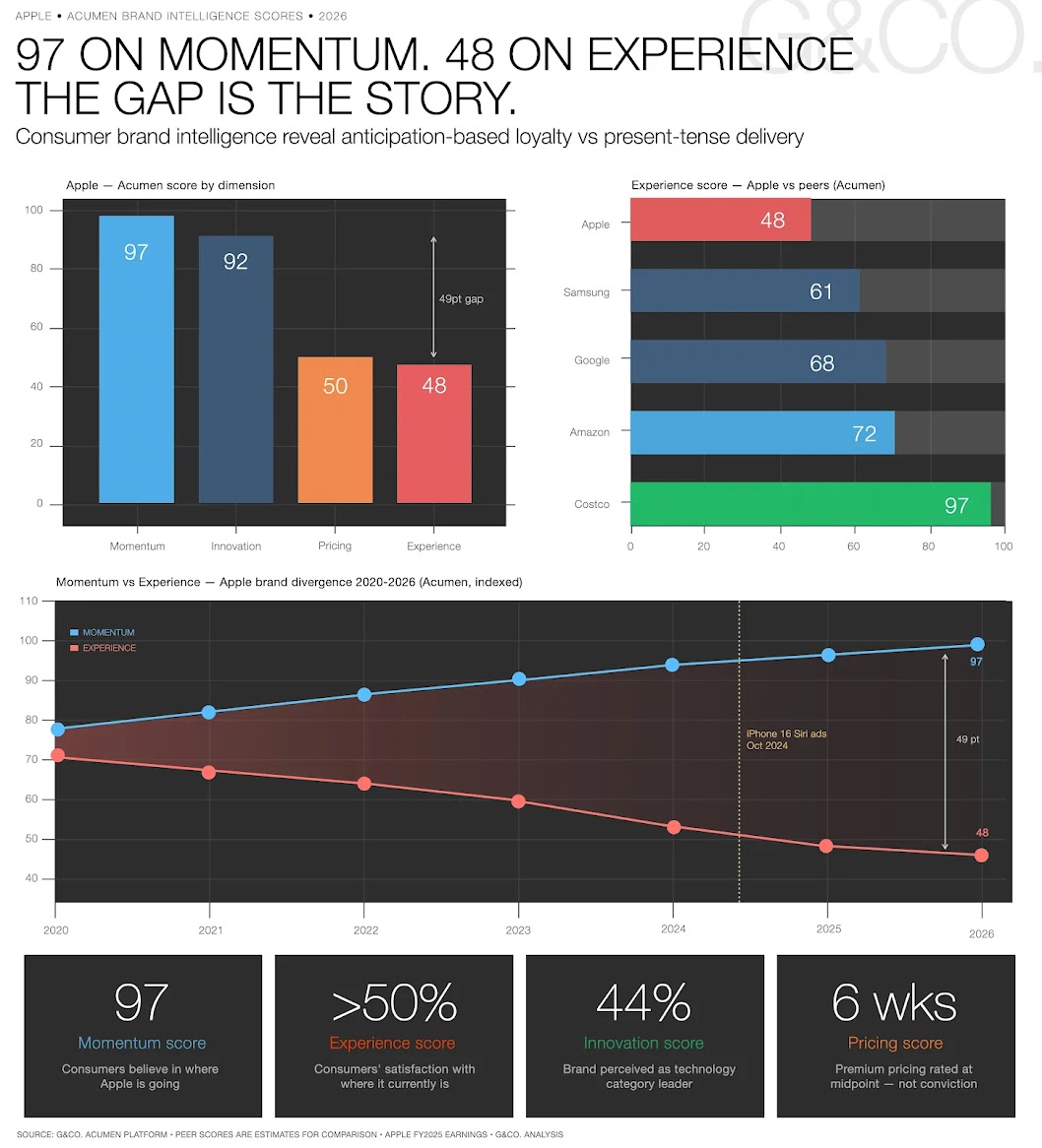
This Apple case study examines a puzzle at the center of Apple brand strategy: in 2024 Apple advertised Siri features it could not deliver, delayed them in March 2025, and faced lawsuits, yet its stock rose 12% and it posted the highest-revenue quarter in its history. The case shows how a brand promise built over decades can carry a company through a broken commitment, and where the limits are. In G&CO.'s Acumen tracking, Apple scores 97 on Momentum but only 48 on Experience, a gap that reveals a consumer loyalty built on anticipation rather than current satisfaction, and a warning as Apple's business shifts toward services judged every day.
Apple advertised AI Siri features it couldn't deliver, then delayed them for a year, testing how far a brand can run on what it promises versus what it actually ships.
In the autumn of 2024, Apple ran television ads for a version of Siri that did not yet exist, a Siri that moved between apps, filled out forms from what it already knew about you, and acted as an intelligent extension of daily life. The ads ran during the iPhone 16 launch, and some consumers upgraded specifically because of what they promised. In March 2025, Apple announced those features would not arrive for at least another year, a delay that drew class-action lawsuits and the departure of its AI strategy head.
Yet over the same twelve months, Apple's stock rose 12 percent and the company posted the highest-revenue quarter in its history. That tension, a brand whose consumer experience is visibly struggling alongside a business breaking its own records, is the heart of this Apple brand strategy case. It reveals something precise and transferable about how a brand promise affects consumer loyalty, and how long the gap between anticipation and delivery can widen before it starts to matter.
Key Points
- Apple ran ads for AI Siri features it then delayed for over a year, drawing lawsuits and the exit of its AI lead in 2025.
- Its brand absorbed the hit: over the same period Apple's stock rose 12% and it posted its highest-revenue quarter ever, $143.8 billion, so the broken promise barely dented it.
- The case measures the gap G&CO.'s Acumen platform makes visible: Apple scores 97 on Momentum but only 48 on Experience, a brand running on anticipation of what's next rather than satisfaction with what's here now.
- Subscriptions are judged every day against rivals, unlike a phone you upgrade once a year, so an anticipation-based brand is more exposed there.


%20(1).png)

Let’s kickstart the conversation and design stuff people will love.

The Retail & Consumer Index


Why This Case Study Matters
Apple in 2026 is the most visible instance of a dynamic playing out across every brand that made specific AI capability commitments in the 2024 and 2025 product cycles. The gap between what brands promised AI would do and what it currently does exists in enterprise software, retail personalization, healthcare digital products, and financial services interfaces, anywhere a brand attached a specific commercial promise to an AI feature that was not fully ready at the point of sale.
For CEOs, CMOs, heads of customer experience, and brand leaders, the relevance is that Apple makes the mechanics legible. Forrester’s 2025 CX Index found North American CX quality at an all-time low, with 25 percent of brands declining for the second consecutive year, and the decliners are largely brands that made visible commitments, in design, advertising, and launch communications, that their delivery did not match. Apple’s Experience score of 48 is the most prominent data point in a pattern brand leaders can recognize in their own data if they are looking at the right dimensions.
Strategic Context
Apple has built one of the most durable anticipation economies in consumer history. The annual iPhone launch is, structurally, an event designed to reset expectations and channel emotional investment toward the next product rather than a reckoning with the current one. It works because Apple’s execution has been consistent enough over two decades to justify the faith that the promise will eventually be delivered. When it has not been, AirPower, Maps at launch, Siri’s long underperformance relative to its own marketing, the failures were generally absorbed without lasting damage to brand intelligence scores or upgrade economics.
The Acumen platform data captures why the current moment is different. Apple scores 97 on Momentum and 92 on Innovation, both exceptional, but its Experience score sits at 48 and its Pricing score at 50, both below the midpoint. In a dataset where Costco scores 97 on Experience and Amazon regularly scores above 70, Apple’s 48 is a structural signal, not a rounding error. The behavioral drivers shaping Apple’s perception today are Investor Confidence and Product Roadmap Excitement, and the personas responding most strongly skew toward shareholders, analysts, and early adopters, not the everyday consumer who buys an iPhone because it is the best smartphone available and expects it to do what the box suggests. The Momentum score says consumers believe Apple is going somewhere; the Experience score says they are not entirely satisfied with where it currently is. For most brands those numbers would be contradictory. For Apple they are the definition of the anticipation economy: the promise of what is next sustaining enthusiasm for a present that does not fully deliver on the last promise.
Company Response
Apple's response is best understood through three pressures it is managing at once: the services transition, the Siri delay, and its AI infrastructure bet.
The services transition raises the cost of the gap.
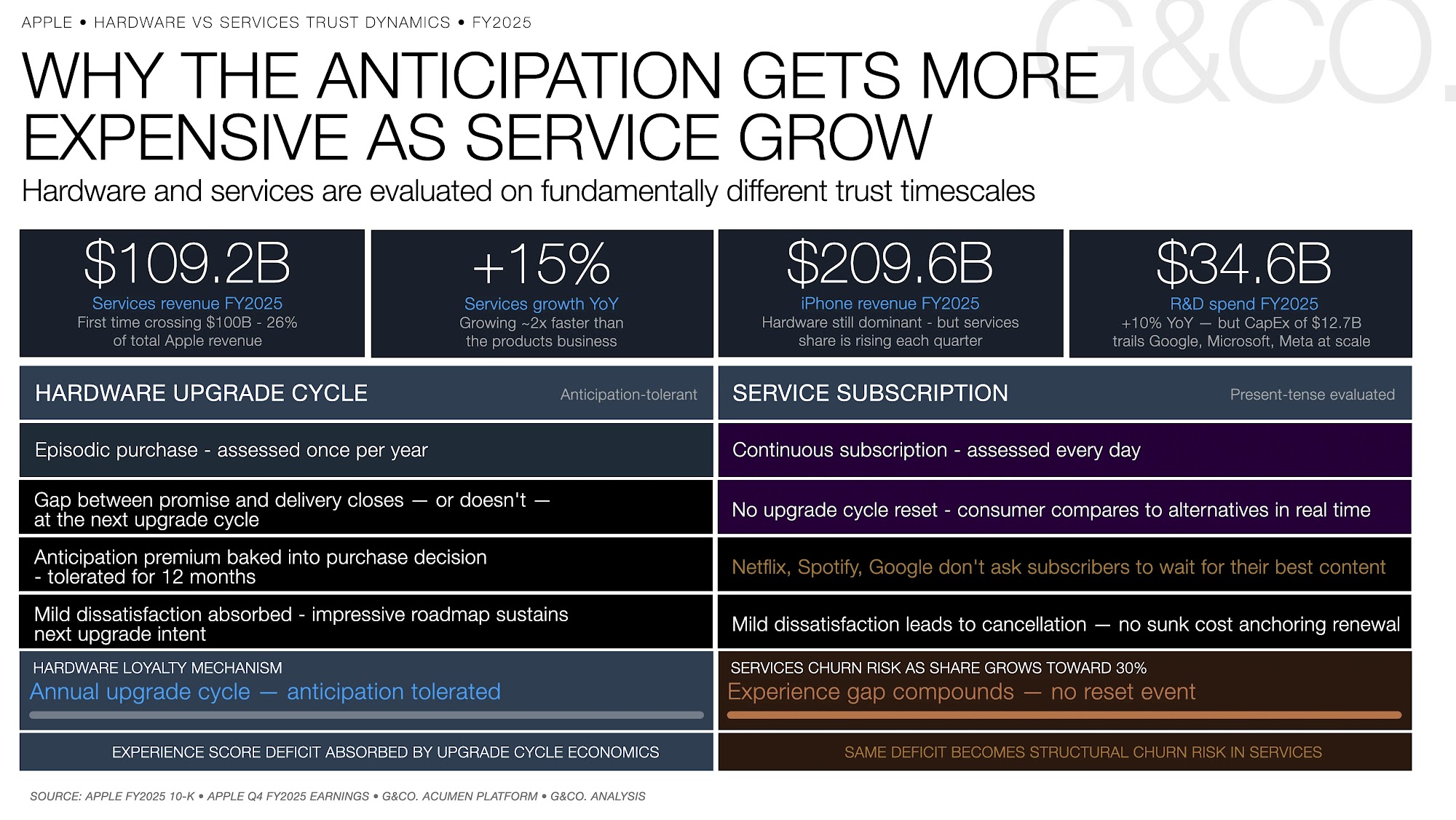
Services revenue reached $109.2 billion in FY2025, crossing $100 billion for the first time and representing 26 percent of total revenue, with Q4 services of $28.8 billion up 15 percent, nearly twice the products growth rate. This matters because services and hardware run on different trust dynamics. Hardware is episodic and forward-looking: you buy on the promise and assess delivery over twelve months before deciding to upgrade, so the anticipation premium is baked into the cycle. Services are continuous and present-tense: Apple Music, Apple TV, iCloud, and Arcade are judged against what they deliver today relative to alternatives. Netflix does not ask subscribers to wait for its best content, and Spotify does not promise a better algorithm next year. A consumer mildly dissatisfied with an iPhone but excited about the next one upgrades; a consumer mildly dissatisfied with Apple TV cancels. As services grow toward 30 percent of revenue, the anticipation model becomes less applicable and more risky, and it is the part of the consumer experience strategy most exposed to present-tense competition. Apple's own FY2025 filing names the pressure explicitly: downward margin pressure and consumer price sensitivity applied by companies whose entire model is present-tense delivery.
The Siri delay turned anticipation into a debt.
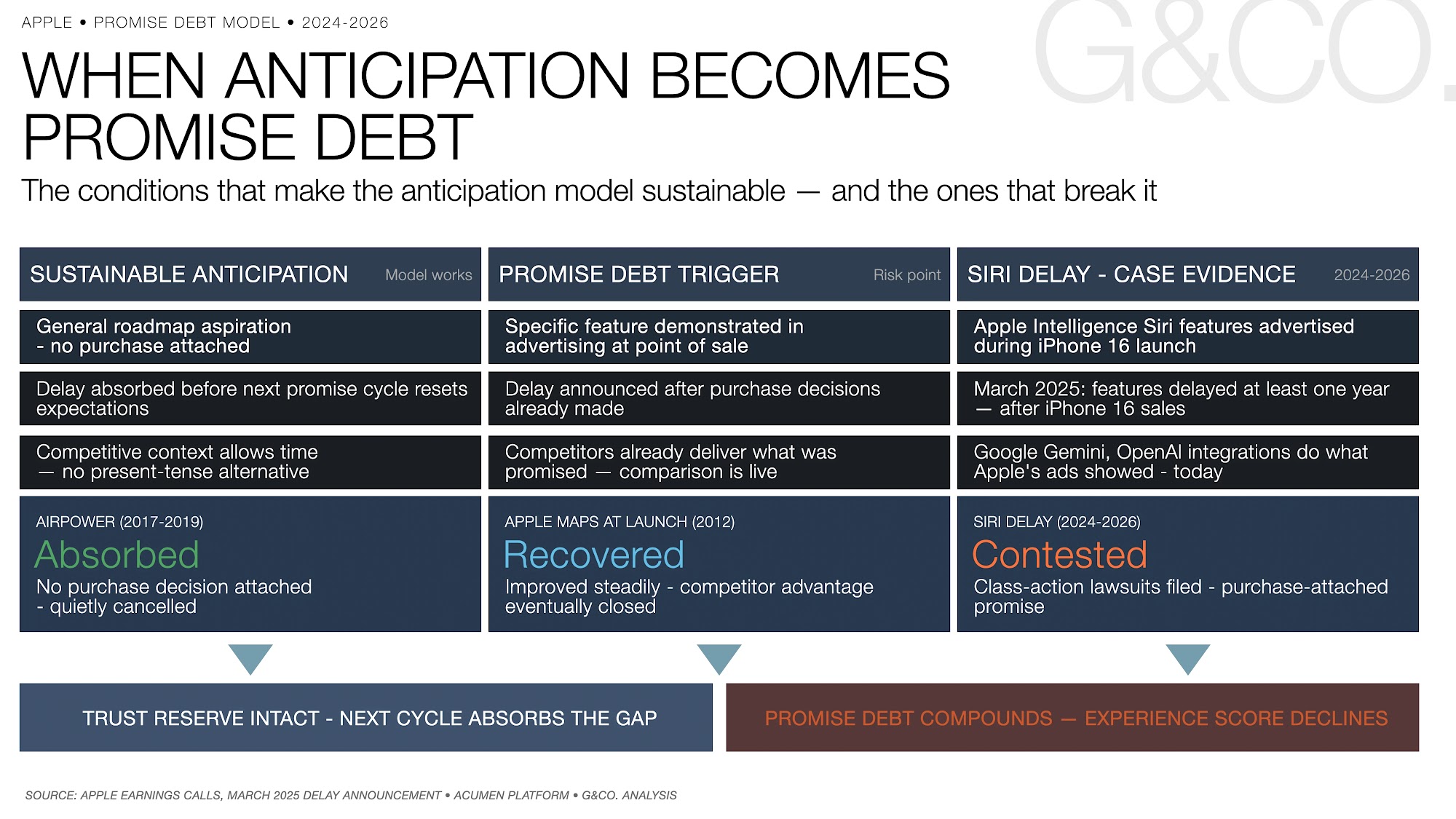
The instructive part is not the delay itself; Apple has navigated delays before, including AirPower, which was announced in 2017 and quietly cancelled in 2019 without lasting consequence. The difference is the commercial commitments that preceded this one. Apple ran advertising featuring the delayed features, positioned them as a reason to buy the iPhone 16 at the point of purchase, and then could not deliver on the advertised timeframe. The class-action lawsuits were not really about the delay but about the distance between the advertisement and the product that arrived. AirPower was absorbed because no purchase decision was attached to it; the Siri delay was different because iPhone 16 sales had already happened. The risk in a brand promise is set not by its ambition but by how specific and purchase-linked it is, and every major competitor, Google, Samsung, Microsoft through device partnerships, is now making AI claims judged against Apple's actual delivery, not its roadmap. Tim Cook's October 2025 message to investors, that Apple had made good progress and raised the bar on what to expect, was, as one analyst put it, the anticipation model stated openly: do not bother us about AI this year, and we will impress you next year. The open question is whether that works a second year running for the same feature.
The AI infrastructure bet is a deliberate, costly choice.
Apple spent $12.71 billion on capital expenditure in FY2025, up 35 percent year over year but still less than it spent in 2018, while Google, Microsoft, Meta, and Amazon collectively committed roughly $380 billion, much of it to the AI infrastructure that enables cloud-scale assistant reasoning. Apple's approach is deliberately different: it processes Apple Intelligence on the device or through its own Private Cloud Compute using its own chips rather than Nvidia-based servers. This is a principled, privacy-grounded position that may prove correct, but it has a near-term cost. On-device processing limits what Siri can do, not because the chip is insufficient but because the most capable current systems rely on cloud-scale computing that on-device designs cannot yet match. The irony is that Apple's most significant privacy commitment, that your data stays on your device, is one of the main reasons its most significant AI product is not ready. The Experience score of 48 may be the temporary cost of a long-term bet rather than a sign of decline, and the real question is how long the anticipation premium can sustain the gap while the bet pays off.
Always-On Customer Intelligence
Turn your own customer data into foresight — validate, simulate, and sense every major decision before you commit.


Results and Evidence
By conventional measures, Apple is performing at the highest level of its existence. FY2025 total revenue reached $416.2 billion, up 6.4 percent, with iPhone revenue of $209.6 billion, services of $109.2 billion, gross margin of $195.2 billion, and R&D of $34.6 billion, up 10 percent. Q1 FY2026 revenue of $143.8 billion was the highest single quarter in company history, and the stock rose 12 percent across the same window in which the Siri delay, lawsuits, and an executive departure unfolded. The iPhone 17 was described by analysts as a genuine commercial success.
The evidence that complicates the picture is that the Experience score has not moved. The anticipation model has sustained the brand through underwhelming cycles, AI delays, and premium pricing that consumers now rate at the midpoint rather than with conviction, and the Siri episode is its most visible test: a brand that advertised a product it had not built, delayed it publicly, faced legal action, and so far emerged with its anticipation premium intact. The early evidence says it can absorb the shock once. But in a business whose loyalty economics depend on consumers deciding every September that the next iPhone justifies the current price, and that increasingly depends on services judged in the present tense, a persistent gap between anticipation and experience is worth watching. A brand whose perception is shaped primarily by its investor narrative and next product cycle is one significant disappointment away from a trust recalibration that financial performance will not immediately reverse.
Strategic Implications
Apple’s situation connects directly to the broader currents reshaping enterprise strategy, AI, customer experience, digital transformation, personalization, and brand, because the anticipation gap is a leading indicator, not a lagging one. The three conditions the model needs to stay sustainable are now under pressure: that eventual delivery justifies the wait and beats what competitors offered during the delay; that promise debt does not compound into a narrative of its own, where the story of the delays becomes more visible than the story of the capabilities; and that the Experience gap does not begin to affect the services retention metrics the business now depends on in a way the hardware cycle could previously absorb. The Acumen data suggests the second condition is already under strain, since Apple’s perception is driven by investor confidence and roadmap excitement rather than product satisfaction or service quality.
The transferable lesson is the distinction between anticipation-based and experience-based loyalty, and the conditions under which each is sustainable. Anticipation-based loyalty is durable when promises are eventually delivered and the competitive context allows time for delivery. It becomes fragile when promises are specific and purchase-attached, when competitors offer present-tense alternatives that make the wait visible, and when the business shifts toward services evaluated continuously rather than episodically. Brand leaders who track perception at the dimension level can identify the gap between anticipation and experience while there is still time to act on it.
What Enterprise Leaders Can Learn
- Treat the Momentum-Experience gap as debt, not noise.
It builds up with each specific commercial commitment made against an undelivered feature. - Don't port the anticipation model to services.
Continuous subscriptions are judged in the present tense against rivals not competing on a roadmap. - Watch specificity, not ambition.
A broken promise becomes costly when the claim is purchase-linked rather than a general aspiration. - Account for trade-offs.
A commitment that builds trust on one dimension can erode experience on another, and both show up in brand data before the financials. - Measure at the dimension level.
Separating Momentum, Innovation, Experience, and Pricing by driver and persona reveals vulnerabilities that a single blended satisfaction score or one aggregate set of customer experience metrics would miss.
Conclusion
There is a specific irony at the center of Apple's brand story in 2026. The company that taught the technology industry how to build desire, how to make consumers feel the next product was not just better but necessary, that the promise was the product, is now being tested by the one category it cannot delay its way through. AI is not a hardware cycle. It does not reset once a year at a keynote. It is available to compare today, on any device with a browser, against whatever Siri currently does, and what Siri currently does is not what Apple's advertisements said it would. That does not make Apple a brand in crisis; a company posting $143.8 billion in a single quarter is not in crisis. But it makes Apple a case study every brand leader with a gap between promise and delivery should read carefully, not to predict Apple's future but to understand how a brand promise shapes consumer loyalty over time. The anticipation economy works until it does not, and the signal that it is beginning to fail is not a revenue decline. It is an Experience score of 48 beside a Momentum score of 97, a distance that has to be closed, eventually, by something other than the promise of what comes next. The brands that read that gap correctly, while it is still a brand intelligence signal rather than a financial one, are the ones with time to protect their brand trust before it erodes.
Through the Acumen platform, G&CO. gives enterprise brands the intelligence to see the gap between promise and experience before it reaches the financials: how perception splits across momentum, experience, pricing, and trust, and where a brand's commitments are outrunning its delivery. G&CO. is a certified minority business enterprise through the National Minority Supplier Development Council (NMSDC). For enterprise organizations with diversity inclusion requirements in their procurement process, G&CO. meets the criteria for MBE-qualified partner status.
G&CO. works with enterprise brands on the brand, customer-experience, and intelligence strategy that connects perception to commercial decisions before problems surface in the numbers. If this Apple case study raises questions about your own brand strategy, consumer experience strategy, or brand trust, submit an inquiry to G&CO. on our contact page or click the blue "Click to Contact Us" button in the bottom right corner of your screen. We look forward to hearing from you.
Frequently Asked Questions
What does Apple’s Experience score reveal about its consumer experience strategy?
Apple’s Experience score of 48 in Acumen tracking, against a Momentum score of 97 and an Innovation score of 92, reveals a brand whose perception is built more on anticipation of future delivery than on satisfaction with current ownership. The gap is not an anomaly; it reflects the structural consequence of a strategy that has consistently prioritized roadmap narrative and launch anticipation over the present-tense quality of daily ownership. The lesson for brand leaders is that anticipation and experience are distinct loyalty drivers, and a brand can maintain exceptional anticipation scores while accumulating a structural deficit in experience that compounds over time.
How has Apple built its brand on anticipation, and what are the commercial risks?
Through a consistent annual launch cycle that channels emotional investment toward the next release rather than a reckoning with the current one. It works because Apple’s execution has historically been consistent enough to justify faith that the promise will be delivered. The risk emerges when specific, purchase-attached promises, such as the Apple Intelligence Siri features advertised during the iPhone 16 launch, are not delivered on schedule. At that point anticipation becomes promise debt, and the gap becomes commercially consequential in ways general roadmap disappointments do not. Acumen brand intelligence captures this before it appears in financials, making it a leading indicator of trust risk rather than a lagging one.
How does brand promise affect consumer loyalty for a brand like Apple?
Through two mechanisms on different timescales. In the short term, a compelling promise sustains purchase intent and upgrade participation: consumers buy the current product because they believe in what the brand will deliver, and tolerate a present-tense gap because the next cycle should close it. In the medium term, accumulated unfulfilled promises create a trust deficit initially absorbed by goodwill but eventually affecting the Experience and Pricing scores that underpin services retention and hardware repurchase. Apple’s 97 Momentum score and 48 Experience score represent both sides in real time: extraordinary faith in the brand’s direction, and a structural deficit in current-ownership satisfaction the next cycle has to earn its way out of.
What can brand leaders learn from the Apple consumer experience strategy case study?
The distinction between anticipation-based and experience-based loyalty, and the conditions under which each is sustainable. Anticipation-based loyalty, built through decades of launch-cycle management, is durable when promises are eventually delivered and the competitive context allows time. It becomes fragile when promises are specific and purchase-attached rather than aspirational, when competitors offer present-tense alternatives that make the wait visible, and when the business shifts toward services evaluated continuously. Leaders who track brand intelligence at the dimension level, separating Momentum, Innovation, Experience, and Pricing rather than aggregating them into one satisfaction metric, can identify the gap before it appears in financial results.
What does Apple’s Siri delay tell us about the relationship between brand promise and brand trust?
It demonstrates the point at which anticipation-based management crosses into promise debt. Apple has absorbed delays before, including AirPower, but those were managed at the level of general roadmap aspiration rather than specific commercial commitment. The Siri delay was different because it followed advertising that attached specific feature demonstrations to purchase decisions, so when the features slipped, the debt was specific and legally contestable rather than abstractly disappointing. The lesson is that the risk profile of a promise is determined not by its ambition but by the commercial specificity with which it is made.