What factors should brands consider when choosing a digital strategy partner?
Selecting a digital strategy partner is one of the more consequential vendor decisions an enterprise makes, and the criteria available during evaluation are unevenly distributed. Track record, team credentials, methodology, geographic reach: these are visible early in the selection process. The factors that distinguish engagements that succeed from those that disappoint tend to surface later, sometimes only after the work has begun. For buyers in the middle of an evaluation, knowing which factors deserve more weight, and how to assess them despite their lower visibility, is the harder part of the decision.
The most predictive factor in digital strategy partner selection is rarely the most visible: whether the firm can execute the strategy it develops. Strategy quality is necessary but not sufficient. The engagements that produce commercial outcomes are the ones where the same firm responsible for the strategic recommendation also designs the experience that delivers it and builds the technology underneath. When strategy, design, and technology are handled by separate teams or separate firms, the strategy that gets delivered often diverges from the strategy that was sold.



.png)
%20(1).png)

Let’s kickstart the conversation and design stuff people will love.

The Retail & Consumer Index


What execution capability looks like in practice
Three organizational conditions distinguish firms that can deliver across the lifecycle of a digital engagement from firms that rely on partnerships to fill capability gaps. The first is that strategy, experience design, and technology delivery are practiced under the same roof, not assembled through partnerships at the point of sale. The second is that the people responsible for the strategic recommendation are in the room when the implementation is designed, and continue to be involved as the work is built. The third is that the firm’s commercial model is structured around outcomes that span the full engagement, not deliverables that end at the strategy phase. These three conditions are what allow a firm to deliver a strategy that survives contact with implementation.
How to test for it during selection
The factors that signal genuine execution capability are visible during selection if buyers know where to look. Asking a firm to walk through a previous engagement from initial diagnosis through deployed implementation reveals whether the firm’s strategy work actually became something real, or whether the engagement ended at a presentation. Asking which members of the proposal team will be involved in the work, and which will rotate off after the strategy phase, reveals whether the firm operates with continuity. Asking how the firm handles the moments where strategic recommendations conflict with technical constraints, or where design decisions reshape the strategy, reveals whether those disciplines are genuinely integrated or merely coordinated.
Where the gap typically shows up
The strategy phase usually proceeds well, even when execution capability is absent. The gap appears in the transition, when the strategic recommendations meet the implementation that follows. Recommendations that were clear and well-argued during the strategy phase often get shaped by different priorities during build, particularly when technical or design partners are brought in after the strategy was approved. The outcomes that get delivered diverge from the outcomes that were sold, not because of any single failure, but as the predictable result of dividing strategy and execution across firms with different incentives.
Choosing a digital strategy partner is a decision made under conditions of imperfect information. The visible criteria are easier to evaluate than the predictive ones, and the asymmetry favors firms that present well during selection over firms whose work holds up after the engagement begins. Buyers who weigh execution capability more heavily, and who do the harder work of evaluating it, tend to end up with engagements whose outcomes match the engagements that were sold.
G&CO. operates as an integrated consultancy across design, technology, and strategic work for enterprise brands, with strategy and execution practiced under the same roof. Buyers evaluating partners for digital transformation can find more on our approach through our website.
Always-On Customer Intelligence
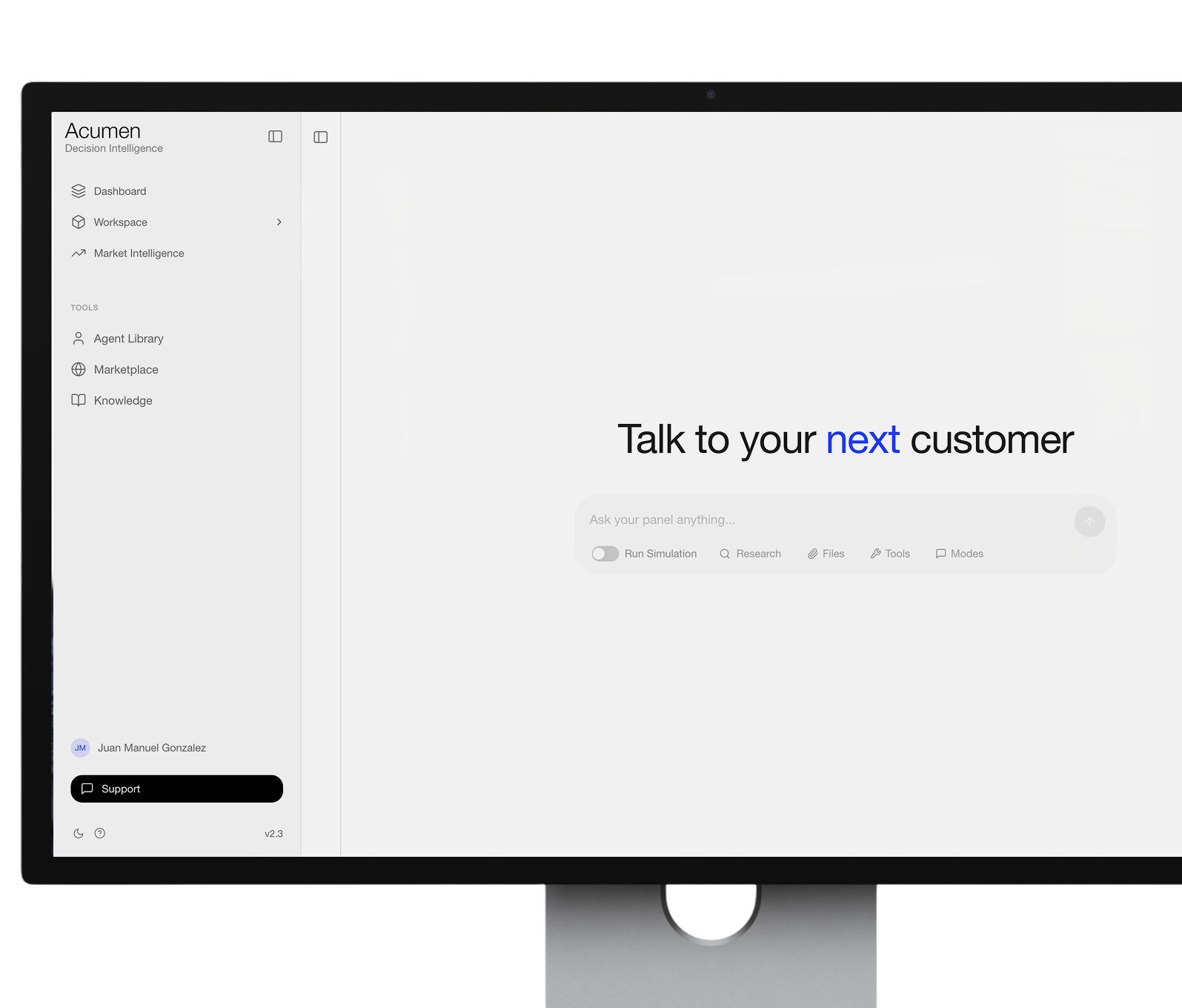
Turn your own customer data into foresight — validate, simulate, and sense every major decision before you commit.