Healthcare Market Entry & Expansion: 2026 Insights
Introduction
The five trends shaping healthcare market entry and expansion in 2026 are platform-based business development, digital-first market entry, partnerships with nontraditional players, data-driven personalization for new segments, and global expansion with local adaptation. The backdrop has shifted sharply: enhanced ACA subsidies expired at the end of 2025, average net premiums rose 58% from $113 to $178 per month according to KFF, and roughly 2 million Americans are expected to lose coverage in 2026. This article breaks down each trend and what leaders must weigh before they move.
Market Context: Disruption & Opportunity
Healthcare market entry is no longer a simple process of bringing a product to market. Rising costs, payer demands, global competition, and shifting regulations are forcing enterprise healthcare companies to rethink their strategies. Coverage disruption is the defining pressure of 2026, with monthly premiums roughly doubling for some 20 million Americans on the exchanges and Medicaid changes under recent federal legislation reducing enrollment further, driving uncompensated care for providers and reshaping the addressable market.
This matters because it directly impacts time-to-market, compliance costs, and revenue growth potential. Enterprise healthcare brands must now build not just a market entry strategy in healthcare, but an adaptable, insight-driven framework for healthcare market expansion. Companies that succeed are those investing in technology, experience design, and ecosystem partnerships.
• Increasing demand for integrated digital care experiences
• A shift from large-scale M&A toward flexible, capability-focused partnerships and ecosystem orchestration
• Coverage disruption from ACA subsidy expiration and federal Medicaid changes reshaping risk pools
• Barriers to entry in a healthcare market remain high for new players
• Growing focus on patient-centricity, value-based care, and the migration of care to ambulatory and home-based settings
Top 5 Trends to Watch in Healthcare Market Entry & Expansion
• Platform-Based Business Development Models
• Digital-First Market Entry Strategies
• Strategic Partnerships with Nontraditional Players
• Data-Driven Personalization for New Market Segments
• Global Expansion with Localized Adaptation

Trend Breakdown: Context & Competitive Insight
Platform-Based Business Development Models
Platform ecosystems have become the preferred way to enter healthcare markets without absorbing the cost and risk of full acquisition. Shared data, streamlined services, and scalable innovation reduce friction and expand access to patients, providers, and payers alike. The emerging advantage in 2026 is ecosystem orchestration built around owned assets, where growth comes from coordinating capabilities rather than simply buying them. That reflects a broader capital reality: with deal volume softening and buyers demanding proof, partnership and orchestration now carry advantages that outright ownership does not.
Digital-First Market Entry Strategies
The fastest route into a healthcare market now begins with virtual care, digital front doors, and telehealth, increasingly layered with AI-enabled triage and engagement, rather than physical infrastructure. These methods are faster and better aligned with consumer behavior. But the early digital-only disruptors taught a hard lesson: durable models pair digital access with selective physical or hybrid touchpoints. Investors have grown similarly demanding of AI claims, with PwC noting that pilot-stage claims no longer justify valuation uplift and that assets showing real AI-driven savings or access gains attract competitive interest while others face valuation pressure.
Strategic Partnerships with Nontraditional Players
Retail, tech, and logistics companies have moved into healthcare, and partnering with them helps overcome traditional barriers to entry. From pharmacy chains to Amazon, these collaborations open new channels, data insights, and operational reach. The market has matured well past the initial land grab: in 2026, partnership has become the dominant growth mode over outright acquisition, executed selectively as some entrants scale and others retrench. Private equity has also become the dominant buyer in physician practice M&A, at 54.6% of healthcare deal volume in Q1 2026, the first quarterly increase in its share in five years. For enterprise leaders, the right partners, with aligned incentives and sound governance, unlock growth in new or underserved markets.
Data-Driven Personalization for New Market Segments
Healthcare market entry is no longer about mass outreach. It is about precision. Enterprise brands use data and AI to understand underserved demographics and design targeted service lines, whether rural care delivery or multicultural engagement. Demographics reinforce the opportunity, as an aging population and rising utilization push US healthcare spending up roughly 5% to 6% annually through 2030. The result is increased patient satisfaction, loyalty, and lifetime value, provided the segment is genuinely reachable and reimbursable.
Global Expansion with Localized Adaptation
Cross-border healthcare expansion is rising, but it carries cultural, legal, and logistical complexity. Leading organizations embrace “glocal” strategies, combining global reach with local adaptation of services, compliance requirements, and care standards. It requires a nuanced healthcare strategy and market development plan but delivers stronger brand resonance and operational sustainability.


%20(1).png)

Let’s kickstart the conversation and design stuff people will love.

The Retail & Consumer Index



What Leading Brands Are Doing
Leading companies are already adapting to these trends by transforming how they engage, build, and innovate. CVS Health has integrated Signify Health and Oak Street Health into its Healthspire health-services business, scaling home care and value-based primary care across states while selectively pruning underperforming sites to protect margins, and exiting the ACA exchanges for 2026. Amazon has continued to build digital-first care through One Medical and Amazon Pharmacy, disrupting traditional models with services rooted in convenience, subscription pricing, and personalization. The pattern is selective scaling rather than expansion at any cost.
At G&CO.Health, G&CO.’s healthcare division, we work alongside clients to implement similar shifts, whether through digital strategy, customer journey redesign, or platform modernization. Our expertise enables brands to translate trend awareness into tangible market advantage.
Risks, Blind Spots & What to Avoid
Risk 1: Overlooking Regulatory Nuances
Why it matters: Ignoring regional compliance differences can delay launches and increase legal exposure, especially as coverage and Medicaid policy shift.
Blind spot: Businesses underestimate how state-by-state healthcare laws and federal policy changes reshape both operations and the size of the addressable market.
Risk 2: Treating Digital as an Add-On
Why it matters: Digital transformation is foundational, not optional, for healthcare business development.
Blind spot: Brands bolt on digital tools without integrating them into core strategy, and increasingly must prove returns rather than pilot indefinitely.
Risk 3: Misjudging Local Market Needs
Why it matters: Failing to understand patient expectations and cultural norms can undermine market expansion.
Blind spot: Internal teams rely on assumptions rather than localized research.
The Role of Healthcare Business Development Strategy Firms
Healthcare business development strategy firms guide enterprise brands through complex market entry and expansion. They help companies overcome barriers to entry by crafting tailored market entry strategies, aligning digital tools, and ensuring regulatory compliance.
By combining market analysis, competitive benchmarking, and strategic planning, the right partner can streamline business development for healthcare brands. Firms like G&CO.Health enable organizations to accelerate expansion, reduce risk, and identify high-value opportunities. Choosing the right partner also brings continuity, from strategic roadmap to execution to optimization. As markets evolve, continued guidance ensures brands stay ahead of disruption.
G&CO.Health delivers this value through our healthcare strategy and market development expertise, helping brands turn ambition into action.
Frequently Asked Questions
What are the top healthcare market entry trends in 2026?
The top trends are platform-based business development, digital-first market entry, strategic partnerships with nontraditional players, data-driven personalization for new segments, and global expansion with localized adaptation.
How is ACA subsidy expiration affecting healthcare market entry?
Enhanced ACA subsidies expired at the end of 2025. KFF reports average net monthly premiums rose 58% from $113 to $178, premiums are roughly doubling for some 20 million Americans, and around 2 million are expected to lose coverage in 2026, worsening risk pools and shrinking the insured addressable market.
Is healthcare M&A or partnership the better growth strategy in 2026?
Partnership and ecosystem orchestration have become the dominant growth mode. Deal volume has softened amid reimbursement and policy uncertainty, and buyers now demand proven margin profiles and scalable operations, making capability-focused partnerships lower-risk than large-scale acquisition for many entrants.
Why is care shifting to ambulatory settings?
Cost. EY notes ambulatory surgery center rates run 40% to 60% below hospital outpatient departments based on CMS rates, and ASCs are among the fastest-growing settings, forecast to grow roughly 5% to 7% annually through the late 2020s.
What are the biggest barriers to entry in healthcare markets?
Regulatory complexity that varies by state, capital intensity, entrenched payer and provider relationships, and the need to prove measurable outcomes rather than pilot-stage promise.
Conclusion & Strategic Outlook
These five trends are not passing fads. They reflect a deeper shift in how healthcare business development is structured and executed. Understanding what drives market entry, expansion, and digital transformation is essential to navigating complexity and sustaining growth. Enterprise brands that embrace innovation, data, and collaboration, and that can prove returns rather than promise them, will be better equipped to lead in a dynamic market.
At G&CO.Health, we bring the strategic clarity and executional power needed to translate trend awareness into business impact. Let’s explore what’s next, together.
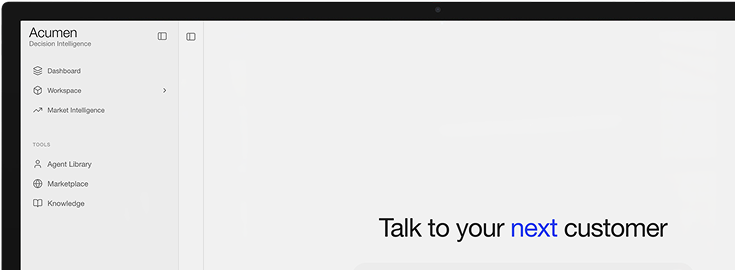
Always-On Customer Intelligence
Turn your own customer data into foresight — validate, simulate, and sense every major decision before you commit.