
Johnson & Johnson Case Study: Building a Patient-Centric Brand Architecture Across a Global Portfolio
This Johnson & Johnson case study looks at the brand architecture decision behind the 2021 to 2023 separation of its consumer health business into Kenvue. The move split one large healthcare company into two focused ones: Johnson & Johnson, now built only around medicine and medical devices, and Kenvue, the home of consumer brands like Tylenol, Neutrogena, Listerine, and BAND-AID. It is a study in branded house vs house of brands, in pharma brand management and pharma portfolio strategy, and in how splitting up can create more value than staying together. Johnson & Johnson raised $13.2 billion from the Kenvue IPO and, as a focused company, posted $88.8 billion in 2024 sales.
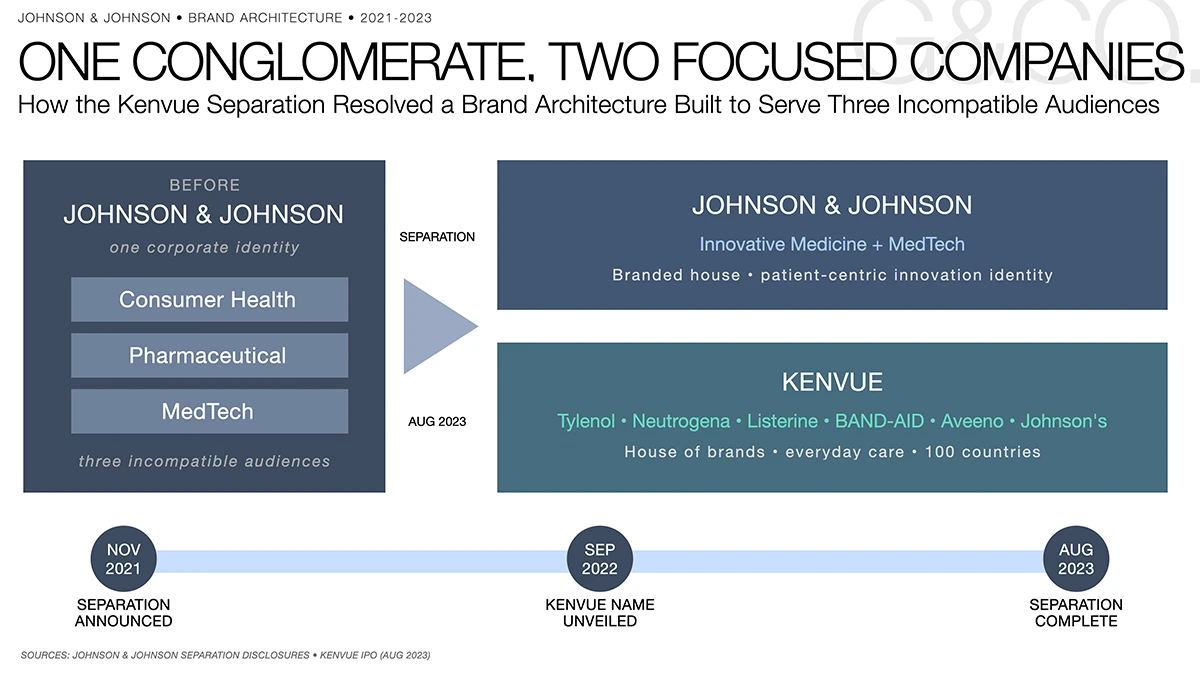
Johnson & Johnson spun off its consumer brands as a separate company called Kenvue, so each side could run under the brand structure that fits it, a focused corporate name for medicine, a house of independent names for consumer products.
For most of a century, one company name sat over everything Johnson & Johnson sold: baby shampoo, cancer medicines, and surgical robots alike. By 2021, that shared name had become a problem. A company cannot be the most trusted maker of everyday consumer products and the most credible innovator in serious disease at the same time. Those are different audiences, built on different kinds of trust, and they call for different brand approaches.
So Johnson & Johnson did something rare for a company its size: it split in two. The move that created Kenvue in 2023 was not just a financial deal. At its heart, it was a brand architecture decision, an acknowledgment that keeping everything under one name had started to cost more than it was worth. This Johnson & Johnson case study looks at how each company rebuilt its brand around that idea, why a branded house vs house of brands split solved the problem, and what it teaches any business whose portfolio has grown too wide for a single name.
Key Points
- J&J split into two companies to fix a brand-architecture mismatch. Pharma and medical devices work best under one trusted corporate name; consumer products (Tylenol, Neutrogena, Listerine) work best as independent brands, and one structure couldn't serve both.
- The consumer brands became Kenvue, the world's largest pure consumer-health company by revenue, free to run as a house of independent names rather than under the J&J master brand.
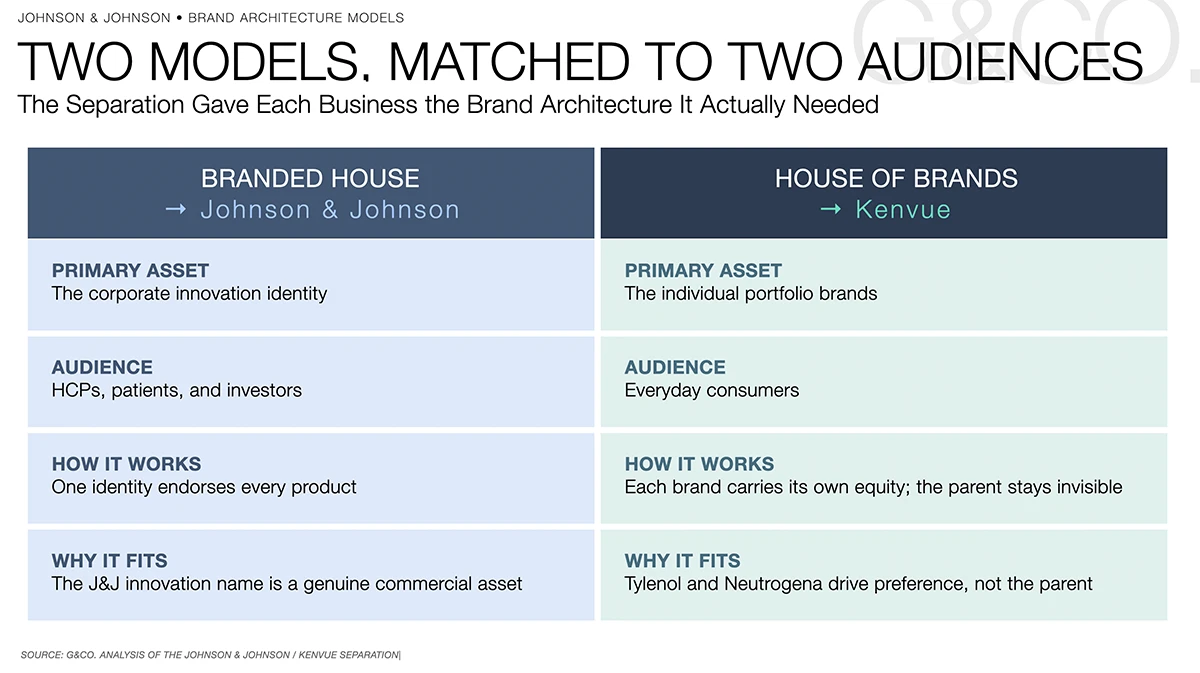
- J&J kept a "branded house" for pharma and devices. In medicine, the corporate name is a mark of trust and scientific credibility, so tying products to it is an asset, not a constraint.
- The logic is that brand structure is a business decision, not a marketing one. How a company names and groups its products shapes trust, focus, and how much each unit is worth.
Why This Matters
The stakes around pharmaceutical brand decisions have risen sharply since 2021. Across the biopharma sector, shareholder returns lagged the broader stock market from 2021 to 2025, and only a small group of top drug companies beat the market. The ones that did were mostly the companies that made clear choices about focus, brand clarity, and how they run their business. Johnson & Johnson's split was the most visible of those choices, and the logic behind it applies to healthcare and pharma companies of every size.
For any company managing a complex healthcare or pharmaceutical portfolio, the Johnson & Johnson case study is less a template to copy and more a set of questions to ask. Does the current corporate brand serve every part of the portfolio equally well, or is it a compromise that holds one part back? Are the audiences for different parts of the business so different that a single name creates confusion instead of clarity? And is the money spent keeping one consistent brand across everything actually paying off, or would a more focused approach do better?
There is also a market-by-market question in pharma brand management. Kenvue's brands are known and trusted to different degrees in different countries. Where the Johnson & Johnson name meant something to shoppers, the shift to Kenvue branding takes more careful handling than in markets where the individual brands already stood on their own. Managing that shift country by country, without losing the momentum of brands people have trusted for decades, is the hard operational work that follows the strategy. It is where good execution decides whether the split actually pays off.


%20(1).png)

Let’s kickstart the conversation and design stuff people will love.

The Retail & Consumer Index


Strategic Context
Before the split, Johnson & Johnson had one of the most complex brand setups in healthcare. The corporate name sat over three very different businesses: a consumer health business selling everyday products to shoppers in stores; a pharmaceutical business developing prescription medicines for doctors and patients; and a MedTech business supplying surgical systems and heart devices to hospitals. These three sold to different buyers, in different ways, and grew in different ways. Holding them under one brand created tensions that only grew over time.
This is a well-known and costly problem in large companies. When a parent brand has to mean too many things to too many people, it risks meaning nothing clear to anyone. Managing a portfolio well means deciding what role each brand plays, and combining or separating brands to cut complexity and cost. By 2021, Johnson & Johnson had reached the point where the cost of that complexity was greater than the benefit of sharing one name. The decision to split was the brand architecture move the business had been building toward for years.
Industry research points the same way. As portfolios get more complex, the old advantages of sheer size start to fade. The companies that simplify, focusing their money and their brand on the areas where they are genuinely strong, have tended to outperform those that try to keep a very broad portfolio under one name. Johnson & Johnson's split was the clearest recent example of exactly this move.
The company was direct about why. It said the split would "position each company to be more agile, focused and competitive, creating long-term growth and value for shareholders." Agility and focus are branding outcomes as much as operational ones. A company built around innovation in serious disease is a very different proposition from one that also has to answer for shampoo and adhesive bandages.
Company Response
Building Kenvue: a house of brands identity for the consumer portfolio.
The split asked Kenvue to do two things that pull in opposite directions: stand up as a credible new public company with its own identity, while protecting the value of consumer brands whose reputations were built over decades, partly under the Johnson & Johnson name.
The choices Kenvue made are useful for any company facing a portfolio split. It announced the Kenvue name on September 28, 2022, more than a year before the separation was final, giving the market, employees, and retail partners time to get used to the new identity before the deal closed. The name was built on purpose: "ken," meaning knowledge, and "vue," suggesting sight, to signal deep understanding of consumers and a clear view ahead.
Kenvue's purpose, "Realize the Extraordinary Power of Everyday Care," became the anchor for everything from positioning to hiring. CEO Thibaut Mongon explained it this way: "We believe that daily self-care rituals add up over time and have a profound cumulative impact on your wellbeing. This is the extraordinary power of everyday care. And our work is to put that power into the hands of consumers around the world." It was a warm, consumer-facing idea that Johnson & Johnson's more clinical corporate identity could never have carried. This is the branded house vs house of brands distinction in practice: Johnson & Johnson keeps a branded house, while Kenvue runs a house of brands. It gave the individual brands a shared home without flattening them. Tylenol, Neutrogena, Listerine, and BAND-AID are all forms of everyday care, and Kenvue's identity was built to hold them all without forcing them to look the same.
The look and feel followed the same logic. Johnson & Johnson's press release said "Kenvue's visual identity represents the company's timelessness, while allowing space for its iconic brands to also have a home." In plain terms, the corporate brand acts as a container that gives investors confidence and keeps the company coherent, while each product brand keeps its own identity and its own relationship with shoppers. This is the model consumer goods companies have used for decades, and Kenvue adopted it from day one. The insight was simple: Kenvue's products had more in common with a consumer goods company than with a drug company, and its brand should reflect that.
Johnson & Johnson's rebrand: a branded house for a focused innovator.
Johnson & Johnson's new identity came from a single realization: it was no longer a company that did a bit of everything in health. By its own description, it was now focused only on "transformational innovation in Pharmaceutical and MedTech." That focus called for a brand that could speak for both of those businesses with a sharper, more powerful purpose than the broad health message the old identity needed.
The company's positioning now centers on a statement it repeats across its investor and earnings communications: "At Johnson & Johnson, we believe health is everything. Our strength in healthcare innovation empowers us to build a world where complex diseases are prevented, treated, and cured, where treatments are smarter and less invasive, and solutions are personal. Through our expertise in Innovative Medicine and MedTech, we are uniquely positioned to innovate across the full spectrum of healthcare solutions today to deliver the breakthroughs of tomorrow, and profoundly impact health for humanity."
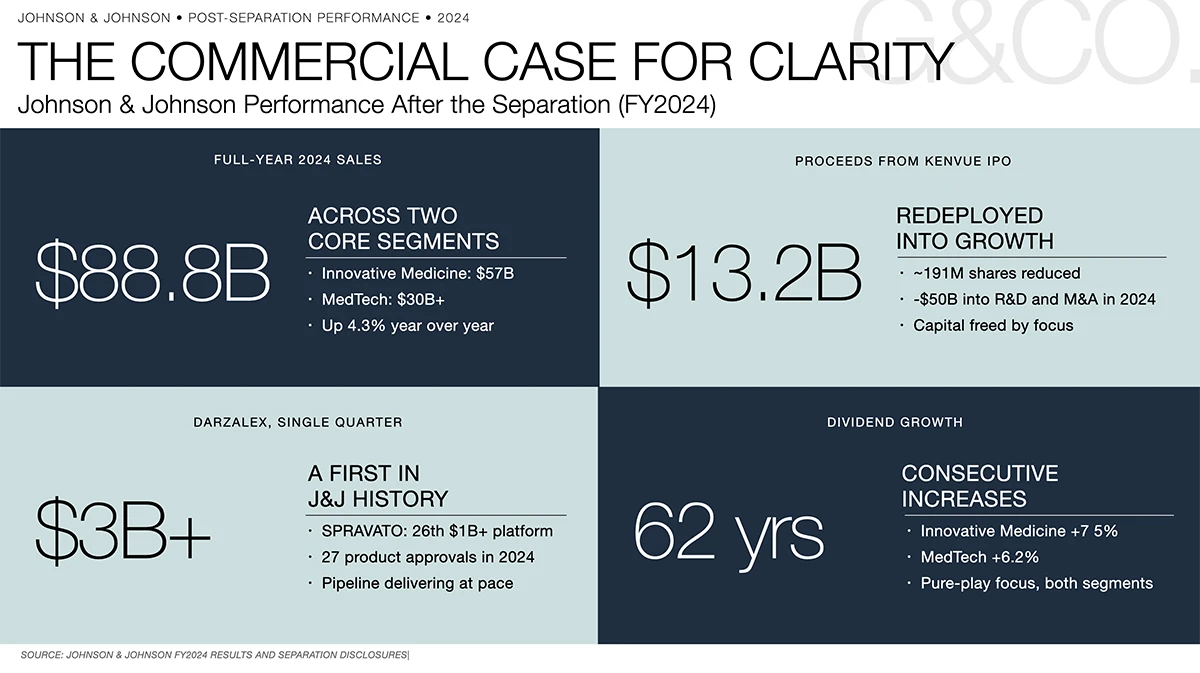
The results backed up the decision. In 2024, Johnson & Johnson reported full-year sales of $88.8 billion, with Innovative Medicine bringing in $57 billion and MedTech passing $30 billion for the second year running. DARZALEX became the first brand in company history to top $3 billion in sales in a single quarter, and SPRAVATO became the 26th product to generate at least $1 billion in a year. The company won 27 product approvals in major markets in 2024 and raised its dividend for the 62nd year in a row. The message in these numbers is clear: a company that sharpened its identity around medicine and medical devices is now posting its strongest results in recent memory.
The patient-first tone is not a coincidence. A promise to build "a world where complex diseases are prevented, treated, and cured, where treatments are smarter and less invasive, and solutions are personal" is one the old, split-focus company could not have made as convincingly. Removing consumer health did not weaken the Johnson & Johnson brand. It clarified it, making the story about patients and innovation both cleaner and more compelling.

Always-On Customer Intelligence
Turn your own customer data into foresight — validate, simulate, and sense every major decision before you commit.


Results and Evidence
The financial record since the split is the clearest evidence of whether the strategy worked. For Johnson & Johnson, both parts of the business are gaining momentum. Innovative Medicine sales, excluding the COVID-19 vaccine, grew 7.5% in 2024, led by DARZALEX in oncology, TREMFYA in immunology, and SPRAVATO in neuroscience. MedTech sales grew 6.2%, led by heart-related products and the Abiomed business. Full-year sales rose 4.3% to $88.8 billion, showing a company performing steadily across both of its core areas, without the internal fights over resources that a three-part structure tends to create.
For Kenvue, the early picture is more mixed. It entered the public markets with strong brands but also a new corporate structure to build, debt from the separation, and a consumer health market that was soft in several categories. Its 2023 results reflected those transition costs. But the point of Kenvue's brand strategy was never to win in year one. Good portfolio management tracks more than first-year revenue; it watches whether each brand is doing its job on measures like awareness, trial, and loyalty. Kenvue's Healthy Lives Mission, its focus on sustainable products, and its goal for 75% of new product development to have better environmental performance by 2030 all point to a pharma brand management strategy built for long-term value, not a quick financial win. The house of brands structure it set up at separation is the foundation for the next decade.
The market's response fills in the rest. Johnson & Johnson raised $13.2 billion in cash from the Kenvue IPO and quickly put it to work, investing about $50 billion in research, development, and acquisitions between January 2024 and the end of that year. That is a pace of investment the old, broader structure could not have supported, and the steady flow of new approvals shows the focus is producing real scientific and commercial output.
Strategic Implications
The lessons from this split reach well beyond healthcare. They speak to a question many companies face after years of growth by acquisition: at what point does keeping everything under one name cost more than it creates, and how do you make a separation decision carefully enough to match its size?
A sound pharma portfolio strategy weighs four options for a complex portfolio: reposition brands that have lost relevance, combine mature brands competing for the same customers, sell off a brand that takes more than it gives, or separate parts of the business into distinct companies when their audiences and growth models simply do not fit together. Johnson & Johnson chose the fourth option, at the scale of a roughly $90 billion company. The logic holds at any size: a brand setup that creates confusion, blurs positioning, or holds any part back is a liability. The real question is never whether a brand is strong enough to survive on its own. It is whether one combined structure creates more value than it costs, and whether the separated companies would each be stronger and more focused apart.
The pressure to make these calls is rising. With biopharma shareholder returns flat from 2021 to 2025 while the broader market pulled ahead, and only a handful of top drug companies beating the market, the push to rethink how these businesses are built keeps growing. Johnson & Johnson's split was, in effect, an early version of that rethink, a decision made before outside pressure forced it, letting both companies enter the next phase with sharper identities and more focused spending.
For any company weighing its own structure, the Johnson & Johnson case offers a practical frame. Brand architecture decisions at this scale are not mainly marketing decisions. They shape capital allocation, the investor story, how the company is organized, and how sharply it competes. The split worked not just because the new brands were well designed, though they were, but because the business logic underneath was sound: two focused companies, each with a clear identity and a defined audience, will beat one complex company trying to serve very different needs under a single name. The same brand-architecture thinking appears in Apple's brand strategy, Merck's franchise-defense playbook, and AstraZeneca's portfolio strategy.
What Enterprise Leaders Can Learn
A central question in any split is whether the brands left behind will miss the parent's name. For Kenvue, the question was whether Tylenol, Neutrogena, Listerine, and BAND-AID would suffer without the Johnson & Johnson endorsement. The evidence says no, and the reason is worth understanding.
These are "house of brands" products: each carries its own reputation, its own customer relationships, and its own promise, independent of any parent name. Someone buying Neutrogena for its dermatologist-recommended reputation is not making a Johnson & Johnson decision. Someone reaching for Tylenol is not thinking about Johnson & Johnson's drug pipeline. The parent name gave the company internal coherence and investor confidence, but it was not why people chose these products. So removing it did not take away something shoppers relied on. It removed a layer that, to shoppers, was mostly invisible.
That points to the key test for any parent brand in this kind of setup: is it doing real work with customers, or is it mainly there for investors and employees? If it is the latter, the cost of keeping it, in added complexity, communication spend, and limits on how each product brand can position itself, may outweigh the benefit. For Johnson & Johnson's consumer business, the parent name was mainly an internal and investor identity. Kenvue replaced it with a corporate brand that connects better with everyday shoppers and fits a pure consumer health company, because it is built around consumer care rather than the medical innovation mission that now defines Johnson & Johnson.
Kenvue's Healthy Lives Mission shows the new brand doing work the old endorsement never could. It ties the company's commercial activity directly to consumer health outcomes: sustainable products, health equity, and the 75%-by-2030 environmental goal. Those commitments matter to everyday care shoppers in a way Johnson & Johnson's innovation story did not. The split let Kenvue build an identity truly aligned with its audience, instead of one inherited from a parent built for a different audience entirely.
Conclusion
The Johnson & Johnson and Kenvue separation will be studied for years, not because it was the biggest healthcare split ever, but because the brand logic behind it was so clear. Johnson & Johnson knew what it wanted to be afterward: the world's leading medicine and medical-device innovator, with an identity built around serious disease and breakthrough science. Kenvue knew what it wanted to be: the world's most trusted consumer health company, built around the everyday power of care. Both identities are credible and focused in a way the old combined identity was not.
The results that followed, $88.8 billion in Johnson & Johnson's 2024 sales, 62 straight years of dividend growth, and a Kenvue brand built to grow an iconic consumer portfolio across 100 countries, reflect the payoff from a decision made three years earlier. The lesson is not that splitting up is always the answer to complexity. It is that a clear identity and a coherent brand structure are real assets with measurable value, and that companies willing to make the hard structural choices to get there will build advantages that rivals stuck under one crowded name cannot match.
Good portfolio work is never finished. Setting pharma portfolio strategy is an ongoing process of checking whether each brand is still doing its job. For Johnson & Johnson and Kenvue, that work is now underway across two separate companies, each with the focus, the identity, and the setup to manage its portfolio better than the combined structure allowed. The brand transformation is complete. The commercial payoff it enables is only beginning.
Through the Acumen platform, G&CO.Health gives enterprise pharmaceutical and healthcare brands the consumer and brand intelligence to make brand architecture decisions with evidence instead of guesswork: how each brand is seen against its competitors, where brand trust is strongest and weakest across audiences, and which positioning shifts would most improve results. G&CO. is a certified minority business enterprise through the National Minority Supplier Development Council (NMSDC). For enterprise organizations with diversity inclusion requirements in their procurement process, G&CO. meets the criteria for MBE-qualified partner status.
G&CO.Health works with enterprise pharmaceutical and healthcare brands to develop the brand strategy, pharma brand architecture, and patient-centric positioning that shape how global portfolios are seen, valued, and chosen. If this Johnson & Johnson case study raises questions about your own approach to pharmaceutical brand transformation, pharma brand management, or portfolio separation strategy, submit an inquiry to G&CO.Health on our contact page or click the blue "Click to Contact Us" button in the bottom right corner of your screen. We look forward to hearing from you.
Frequently Asked Questions
What is the Johnson & Johnson case study about, and why does the Kenvue separation matter for brand strategy?
This Johnson & Johnson case study looks at the brand decisions behind splitting off its Consumer Health business into Kenvue in 2023, and what that split shows about brand strategy for large, complex portfolios. It matters because it puts a number on the value of brand clarity: Johnson & Johnson raised $13.2 billion from the Kenvue IPO, reinvested about $50 billion in R&D and acquisitions in 2024 alone, and posted $88.8 billion in 2024 sales as a focused medicine and medical-device company. Separating consumer health from medicine under two distinct identities unlocked the focus and capital efficiency the combined structure had been holding back.
What is pharma brand architecture, and how does the Johnson & Johnson Kenvue split show it?
Pharma brand architecture is the way a healthcare company's corporate name relates to its individual product brands, and how each one is positioned for its audience. The Johnson & Johnson Kenvue split shows the branded house vs house of brands choice, the two most basic models. In a branded house, one corporate name backs every product. In a house of brands, each product carries its own reputation and the parent mostly serves investors and employees. Before the split, Johnson & Johnson was running a branded house for audiences that really needed a house of brands. The separation fixed that by giving each side the right model: a branded house for the medicine and MedTech business, where the Johnson & Johnson name is a real asset, and a house of brands for the consumer business, where Tylenol, Neutrogena, and Listerine are the real assets.
How did Kenvue build its brand identity as a standalone company?
Kenvue's identity rested on three connected choices. First, the name: "ken" for knowledge and "vue" for sight, to signal deep consumer understanding and a clear view ahead. Second, the purpose: "Realize the Extraordinary Power of Everyday Care," written to connect with everyday shoppers in a way Johnson & Johnson's innovation-focused identity could not, giving the brands a shared home without making them all look alike. Third, the look and feel: designed to show "timelessness while allowing space for its iconic brands to also have a home," so the corporate brand gives investors confidence and internal coherence without competing with the product brands it holds.
What does pharma brand management look like at Johnson & Johnson's scale?
At Johnson & Johnson's scale, pharma brand management means handling brand reputation, regulation, and identity across more than 100 countries, several different audiences, and two very different business models. For Johnson & Johnson today, it means making sure its patient-first message, a world where serious diseases are prevented, treated, and cured, comes through consistently in every market, every doctor interaction, and every investor update. For Kenvue, it means managing the shift from the Johnson & Johnson endorsement to the Kenvue name in markets where shoppers built their trust under the old parent, all while keeping those brands growing. Both jobs need the same foundation: a clear, well-run brand structure that spells out how the corporate name relates to each product brand in each market.
What brands did Johnson & Johnson own, and which ones went to Kenvue?
Many of the most recognized Johnson & Johnson brands were consumer health products that moved to Kenvue in the 2023 split, including Tylenol, Neutrogena, Aveeno, Listerine, BAND-AID, and Johnson's. These are now part of Kenvue's house of brands, sold in about 100 countries. Johnson & Johnson kept its pharmaceutical (Innovative Medicine) and MedTech businesses, so today the Johnson & Johnson brands are focused on prescription medicines and medical devices, while the everyday-care brands people recognize sit under Kenvue.
What can companies outside pharma learn from this?
Three lessons carry over to any company managing a broad, multi-part portfolio. First, brand architecture is a business decision with real consequences: a structure that creates confusion or holds any part back is a liability, no matter how strong the individual brands are. Second, the best time to make the call is before outside pressure forces it; Johnson & Johnson moved early, and both companies have benefited from making the change on their own terms. Third, a purpose that genuinely fits its audience is a growth asset: Kenvue's "Realize the Extraordinary Power of Everyday Care" is not just a tagline, it is the organizing idea that lines up product development, positioning, and hiring behind one clear mission, which is the mark of a well-run brand portfolio.