Walmart Case Study: Inside Walmart Connect, a Retail Media Network at Scale
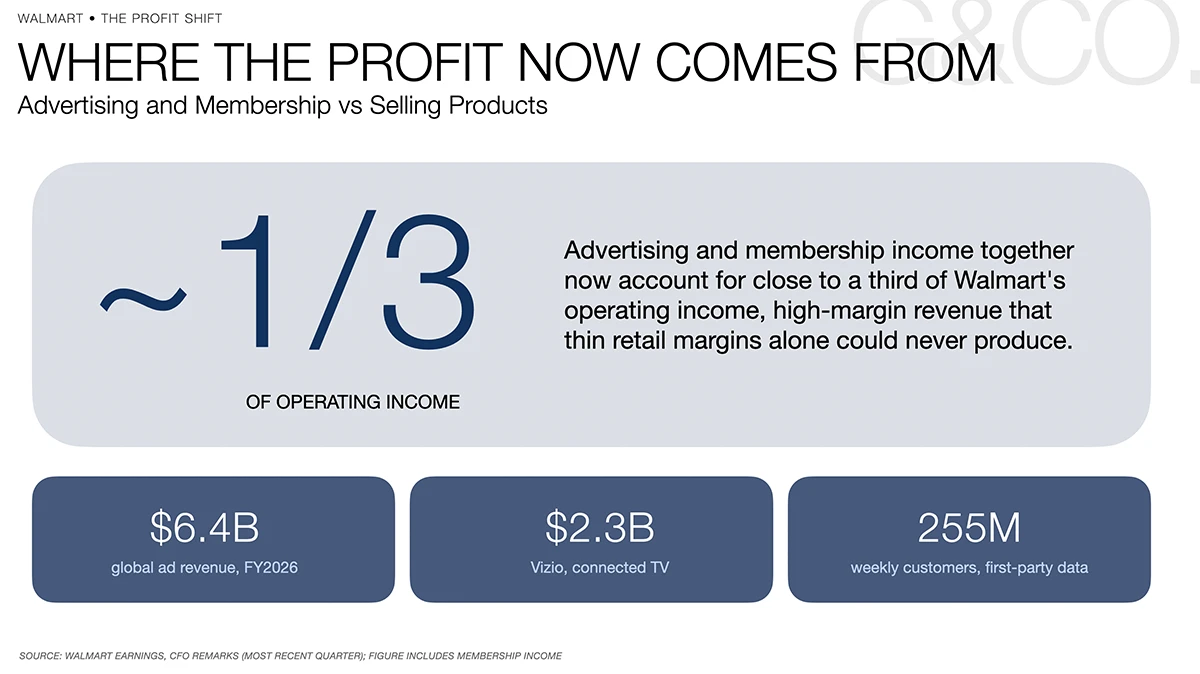
This Walmart case study looks at how Walmart turned the shopping data of roughly 255 million weekly customers into Walmart Connect, a retail media network that made $6.4 billion in global advertising revenue last year, up about 46% and growing roughly six times faster than its store sales. It is a study in retail media strategy and retail media monetization: how a low-profit retailer built a high-profit advertising business, advertising and membership together now make up close to a third of its profit, on top of its omnichannel retail strategy, then extended it onto the TV screen through the $2.3 billion Vizio acquisition.
Walmart used its store traffic and shopper data to build Walmart Connect, an advertising business whose high margins help pay for the low prices it's known for.
Retailing is a low-profit business. Walmart runs one of the largest store operations on earth while keeping only a few cents of profit on every dollar of sales. That is why the most telling number in its recent results has little to do with selling groceries: advertising and membership income together now make up close to a third of the company's profit. The money is no longer coming mainly from the products on the shelf. It is coming, more and more, from selling advertisers access to the shoppers who buy them.
That shift is the subject of this Walmart case study. Over five years, Walmart took the data its stores throw off every day, from roughly 255 million weekly customers across stores, its website, and its marketplace, and turned it into Walmart Connect, a retail media network that is now one of the fastest-growing advertising businesses in the country. The lesson for enterprise leaders is not really about retail. It is that customer attention and first-party data, which almost every large company already has, can be turned into a high-profit media business that changes the economics of the main operation.
Key Points
- Walmart built a high-margin advertising business, Walmart Connect, on top of its retail scale. It sells brands access to shoppers using first-party purchase data from its stores and website.
- The economics are the point: ads are far more profitable than selling groceries. Retail media income helps fund Walmart's low prices, so the ad business and the price promise reinforce each other.
- Its data edge is real purchase behavior at enormous scale. Roughly 90% of U.S. households shop Walmart, so its targeting is grounded in what people actually buy, not cookie guesswork.
- The ads reach shoppers across store, app, and site, connecting brands to customers at the moment of purchase in a way pure online media can't.
Why This Matters
For CMOs, chief digital officers, and heads of commercial strategy, Walmart matters because it shows the biggest business-model shift in modern retail: the rise of retail media monetization. Retail media networks are expected to make up about a quarter of all US advertising spend, roughly $130 billion, by 2028. That is not just more advertising. It is a real change in where retailers make their profit, and it rewards whoever owns the best first-party data and the clearest link between an ad and a sale.
The pressure is growing as third-party cookies disappear and every company races to build up its own first-party data. Walmart saw earlier than most that a retailer knows what a customer actually buys, not just what they look at, and that this purchase data is a commercial asset, not just an operating record. Many companies still treat their customer data as something to file away. Walmart built a multibillion-dollar business on it. That is why Walmart Connect is an early sign of where commercial value is moving, well beyond retail.


%20(1).png)

Let’s kickstart the conversation and design stuff people will love.

The Retail & Consumer Index


Why This Matters
For CMOs, chief digital officers, and heads of commercial strategy, Walmart matters because it shows the biggest business-model shift in modern retail: the rise of retail media monetization. Retail media networks are expected to make up about a quarter of all US advertising spend, roughly $130 billion, by 2028. That is not just more advertising. It is a real change in where retailers make their profit, and it rewards whoever owns the best first-party data and the clearest link between an ad and a sale.
The pressure is growing as third-party cookies disappear and every company races to build up its own first-party data. Walmart saw earlier than most that a retailer knows what a customer actually buys, not just what they look at, and that this purchase data is a commercial asset, not just an operating record. Many companies still treat their customer data as something to file away. Walmart built a multibillion-dollar business on it. That is why Walmart Connect is an early sign of where commercial value is moving, well beyond retail.
Strategic Context
For most of its history, Walmart competed on price and size. Its advantage was operational: buy efficiently, run lean, pass the savings to customers. That built the world's largest retailer, but it capped how much profit the company could make, because store margins are thin and price competition keeps them that way.
The opening came from the same asset that made Walmart so strong: its data. Every purchase across more than 10,500 stores and its digital channels is a record of what real people actually buy. In 2021, Walmart set out to make money from that asset. It created Walmart Data Ventures to turn first-party data into products for suppliers, and it built out Walmart Connect as the advertising layer on top. The insight was that Walmart's omnichannel retail strategy, bringing stores, website, and marketplace into one view of each customer, was not only a way to sell more products. It was the foundation for a retail media network that could sell something far more profitable than groceries: measurable access to shoppers who are ready to buy.
Company Response
Walmart's answer was to build a connected retail media and data business, not a small add-on ad unit. Three parts work together.
Walmart Connect: the retail media network.
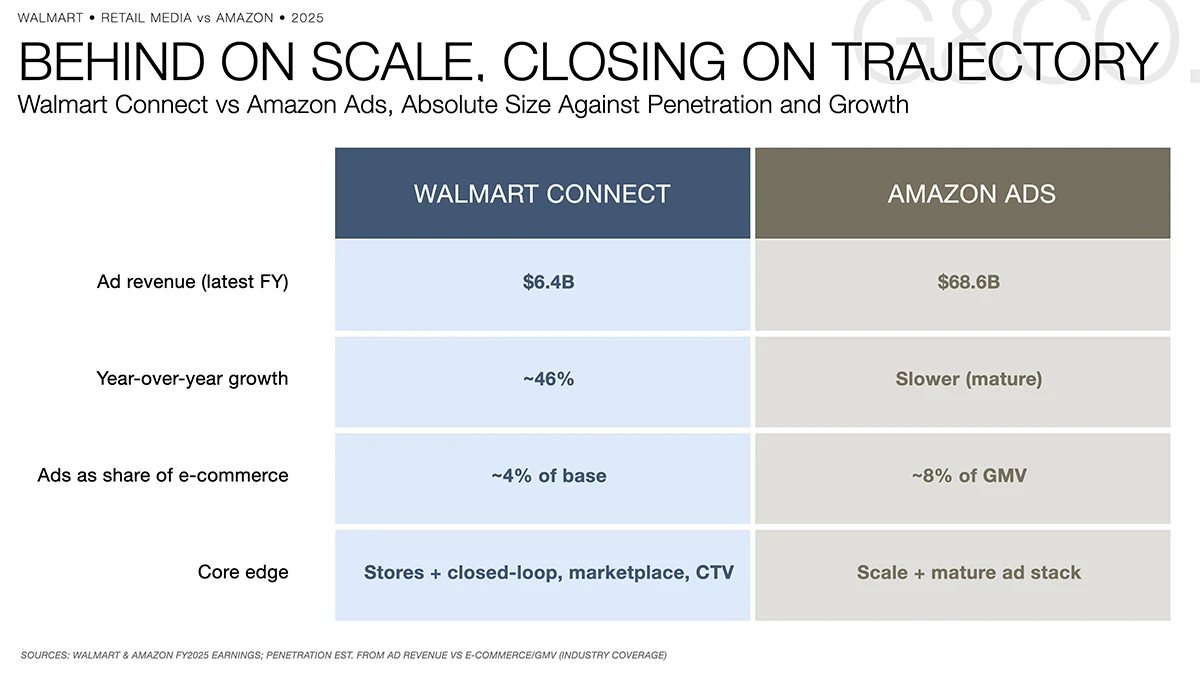
Walmart Connect is the advertising platform where brands and marketplace sellers buy sponsored search spots, display ads on and off Walmart's sites, and in-store advertising. What sets it apart is measurement: because Walmart sees the actual purchase, it can tie an ad directly to a sale, giving advertisers proof that most advertising cannot. A large share of recent growth has come from the marketplace, where more than 200,000 active sellers increasingly treat retail media advertising as a must-have to get noticed.
Walmart Data Ventures: the data engine.
Formed in 2021, Walmart Data Ventures packages the company's first-party data into insight products for suppliers through its Scintilla platform (formerly Walmart Luminate). This is the layer beneath the ads: the same data that helps a supplier improve a product also powers the targeting and measurement that make Walmart retail media valuable to advertisers.
Vizio: extending onto the TV screen.
In December 2024, Walmart closed its $2.3 billion purchase of Vizio, the smart-TV maker, to bring television into its retail media network. Vizio brings a smart-TV operating system and data about what people watch, letting Walmart connect a streaming ad to a real store or online purchase. Early results are strong: most surveyed customers said they discovered new products through TV ads, and campaigns have reached far more households than regular TV. The move lets Walmart go after big brand advertising budgets, not just the lower-cost ads retail media has usually won.
Always-On Customer Intelligence
Turn your own customer data into foresight — validate, simulate, and sense every major decision before you commit.


Results and Evidence
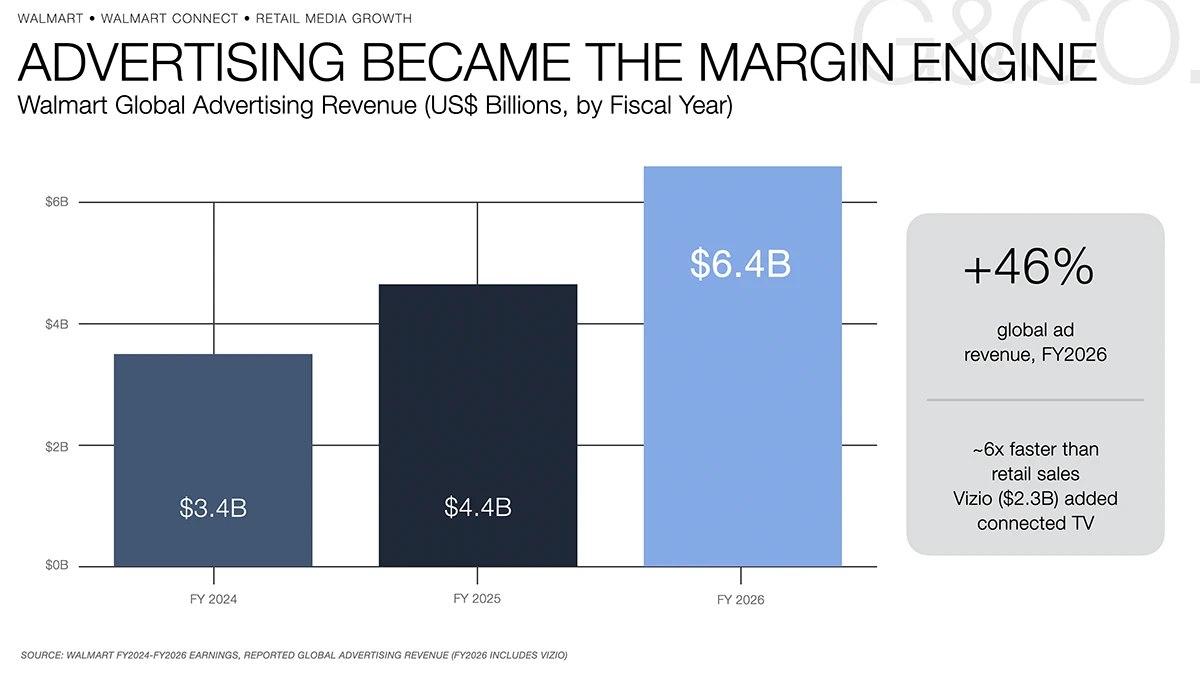
The results, drawn from Walmart's recent reporting, show a business growing fast from a small start. Walmart's global advertising business grew from about $3.4 billion two years ago to $4.4 billion, then to $6.4 billion last year, an increase of about 46%, with the US Walmart Connect business growing 41% in the fourth quarter alone. Advertising has grown faster than store sales every quarter since Walmart began reporting it, recently by roughly six times. And advertising and membership income together made up close to a third of Walmart's profit in the most recent quarter. The marketplace drives much of the growth: tens of thousands of new sellers join each year, and their ad spending has grown around 50% year over year. These figures come from Walmart's public reporting and should be confirmed against the latest earnings before publishing.
Strategic Implications
Walmart's model connects to bigger shifts in business: the decline of third-party data, the rise of retail and commerce media, and the coming together of content, shopping, and measurement into one system. The biggest implication is that first-party data plus a direct customer relationship is becoming one of the most valuable assets a company can hold, and that the winners will be the ones who turn it into a real media business instead of leaving it as a back-office report.
The lesson travels well. Any company with a large, engaged customer base and first-party data, a retailer, a bank, an airline, a telecom, a health or beauty brand, has the same ingredients Walmart used. What Walmart shows is how to turn those ingredients into a high-profit retail media network that changes the economics of the main business. A retail media strategy built on owned data and real purchase measurement is hard for rivals to copy, because it depends on things, purchase data and a direct customer relationship, that cannot simply be bought. As the model matures, the gap between companies that make money from their customer data and those that just store it will grow into a lasting advantage. The same first-party-data play runs through JPMorgan Chase's connected-commerce push, Mastercard's data-driven services, and United's Kinective Media network.
What Enterprise Leaders Can Learn
- Treat customer data as a commercial asset, not a report.
Walmart built a multibillion-dollar retail media network on data it was already collecting. Most companies hold similar data and use it only for dashboards. - Make money from the attention you already own.
The move is retail media monetization: turning your own channels and customer relationships into a media business, not just a sales channel. - Win on proof, not just reach.
Walmart's edge is tying an ad to a real purchase. In any category, the ability to prove results is what earns premium advertising dollars. - Use high-profit revenue to protect the core.
Ad profit helps fund Walmart's low store prices while still growing overall profit. A high-profit data or media layer can change the economics of a low-profit core business. - Extend the asset into new places on purpose.
The Vizio move shows the pattern: take a proven data advantage and push it into new places to advertise, here the TV screen, instead of letting the business level off.
Conclusion
Walmart has not just added an advertising product. It has changed what kind of business it is. By turning the data of hundreds of millions of weekly shoppers into Walmart Connect, a retail media network that now reaches from search ads to the living room through Vizio, it built a high-profit source of revenue that drives a real share of its profit and helps fund its low store prices. The bet is that the strongest advantage in commerce is no longer just price or size, but owning the data and the measurement that connect an ad to a sale. For enterprise leaders, the takeaway is not to copy the retail details but to copy the approach: stop treating customer data as a byproduct, and start building it into a media business that changes the economics of the core. In a market where owned data and proven results are the scarcest assets, the company that turns its customer relationships into a retail media network will hold an advantage that advertising budgets alone cannot buy.
Through the Acumen platform, G&CO. gives enterprise brands the consumer and commerce intelligence that shows where retail media and first-party data investment will pay off most: which owned channels are worth building into ad businesses, where real purchase measurement creates an edge, and how to turn customer data into a commercial asset. G&CO. is a certified minority business enterprise through the National Minority Supplier Development Council (NMSDC). For enterprise organizations with diversity inclusion requirements in their procurement process, G&CO. meets the criteria for MBE-qualified partner status.
G&CO. works with retail brands to design the data, commerce, and omnichannel systems that decide whether customer relationships become a lasting, profitable asset. If this Walmart case study raises questions about your own retail media strategy or first-party data, submit an inquiry to G&CO. on our contact page or click the blue "Click to Contact Us" button in the bottom right corner of your screen. We look forward to hearing from you.
Frequently Asked Questions
What is Walmart Connect?
Walmart Connect is Walmart's retail media network, the advertising business where brands and marketplace sellers buy sponsored search, display, in-store, and TV ads across Walmart's own channels. Its key advantage is measurement: because Walmart sees the actual purchase, it can tie an ad directly to a sale. Last year, Walmart's global advertising business, led by Walmart Connect in the US, made $6.4 billion in revenue, up about 46% from the year before.
What is a retail media network, and why is Walmart's growing so fast?
A retail media network is an advertising business a retailer builds on its own first-party data and channels, selling brands measurable access to its shoppers. Walmart's is growing quickly because it pairs huge scale, roughly 255 million weekly customers in stores and online, with real purchase measurement and a fast-growing marketplace where sellers increasingly see advertising as essential. Walmart's ad business has grown faster than its store sales every quarter since the company began reporting it.
How does Walmart's retail media monetization change its business model?
Retail media monetization lets Walmart earn high-profit advertising revenue on top of a low-profit store business. Because advertising and membership income together now make up close to a third of Walmart's profit, this revenue meaningfully improves the company's results and helps keep its prices low. In short, Walmart makes money from the attention and purchase data its stores already generate, turning an operating asset into a commercial one.
Why did Walmart buy Vizio?
Walmart bought Vizio for $2.3 billion to extend its retail media network onto the TV screen. Vizio brings a smart-TV operating system and data about what people watch, so Walmart can link a streaming ad to a real store or online purchase. The deal helps Walmart go after big brand advertising budgets, not just the lower-cost ads retail media has usually captured, by bringing content, shopping, and measurement together in one place.
What can enterprise brands learn from this Walmart case study?
The transferable lesson is that first-party data and a direct customer relationship can be built into a real media business, in any industry. Walmart's retail media strategy shows the pattern: treat customer data as a commercial asset rather than a report, compete on proof rather than reach alone, and use high-profit media revenue to strengthen a lower-profit core. Any company with a large, engaged customer base, a retailer, bank, airline, telecom, or health brand, holds similar ingredients.