
AstraZeneca’s Pharmaceutical CRM Strategy: How Post-Prescription Patient Engagement Became the Commercial Model
This AstraZeneca case study examines the company's pharmaceutical CRM strategy: treating the moment a prescription is written not as the finish line but as the start of a relationship that decides whether patients start, stay on, and benefit from treatment. Through a pharma patient engagement platform spanning AstraZeneca Direct (transparent pricing and home delivery), the Connect360 patient programme, the Access 360 HCP hub, and the Evinova digital-health business, AstraZeneca is building the infrastructure to support patients after prescription. It is a study in treatment adherence digital strategy and pharmaceutical loyalty strategy, with lessons for any category where a customer relationship compounds over time.
AstraZeneca is building the systems to support patients long after a prescription is written, treating whether people stay on their treatment as a business problem to solve, not just a medical one.
The pharmaceutical industry has spent two decades debating whether patient engagement is a commercial function or a clinical one. AstraZeneca has largely stopped debating it.
This AstraZeneca case study examines how the company built a pharmaceutical CRM and patient engagement platform that treats the moment of prescription not as the end of the commercial journey but as the beginning of a relationship that determines whether patients start treatment, stay on treatment, and reach the outcomes that justify the medicine. AstraZeneca's commercial strategy, set out in its 2024 Annual Report, centers on three areas: building strong brands, using its scale in key therapy areas, and transforming patient outcomes. The third is the most commercially important and the most demanding, because transforming outcomes requires the company to manage a relationship that extends well beyond the prescribing moment. The lessons for enterprise leaders reach well beyond pharmaceuticals, into any category where the value of a customer relationship compounds over time rather than ending at the point of sale.
Key Points
- AstraZeneca is shifting its focus from getting a prescription written to keeping patients on treatment. It treats patients dropping off their medicine as a commercial problem, not only a clinical one.
- The tools remove the practical reasons people quit: AstraZeneca Direct offers transparent cash prices (up to 70% below list) and home delivery, and the Connect360 program adds personalized, data-driven support.
- It runs on connected data across doctors and patients. A single HCP hub (Access 360), real-world data, and digital patient information replace the disconnected, prescribe-and-forget model most of pharma still uses.
- The capability became a product in its own right. Evinova, launched in 2023, sells the digital-health infrastructure AstraZeneca built for itself to the wider industry.


%20(1).png)

Let’s kickstart the conversation and design stuff people will love.

The Retail & Consumer Index


Why This Matters
For CEOs, CMOs, CIOs, and heads of customer experience, AstraZeneca matters because it makes a structural shift clear: the commercial advantage in pharma is moving from who most effectively influences the prescribing decision to who most effectively manages the patient relationship after it. The urgency is rising for a specific reason. Payers and health systems increasingly tie reimbursement to demonstrated real-world results rather than trial data alone, and AstraZeneca's 2024 Annual Report acknowledges the pressure to sell outcomes rather than pills. The company that holds the patient support infrastructure and adherence data to prove real-world outcomes has a much stronger market-access argument than one that cannot.
The relevance extends past pharmaceuticals. The problem AstraZeneca is solving, managing the relationship between first acquiring a customer and keeping them long term, in a regulated, high-stakes category where lifetime value depends on sustained engagement, is structurally identical to the challenge facing brands in financial services, healthcare, and any industry where the value of a customer relationship compounds over time.
Strategic Context
The commercial case for a treatment adherence digital strategy begins with a problem no amount of pre-prescription promotion can solve. Research on pharmaceutical commercial models consistently identifies non-adherence in chronic disease as one of the most significant and persistent challenges in the industry: patients who do not take their medicines as prescribed represent both a clinical failure and a commercial one, because the cost of acquiring the prescription is never recovered, the potential lifetime value of the relationship is never realized, and the real-world outcome data that would support the drug's market position is never generated.
The industry has historically directed investment at the moment before prescription, concentrating resources on medical representatives, speaker programs, and doctor-targeted content designed to influence the prescribing decision. Once the prescription was written, the commercial infrastructure largely disengaged, handing the patient to a healthcare system not designed to manage the behavioral, logistical, and informational challenges that determine whether they actually take the medicine. AstraZeneca's strategy identifies that gap as its main opportunity: its 2024 Annual Report describes intervening earlier in disease and improving outcomes by using digital tools, connected data, and clinical innovation. This is not pharmaceutical loyalty strategy as an abstract aspiration. It is the operational description of a commercial model that requires different infrastructure from the pre-prescription model it is replacing.
Company Response
AstraZeneca's response connects a set of interlocking investments, each addressing a different stage of the patient and HCP relationship.
Omnichannel HCP relationship management.
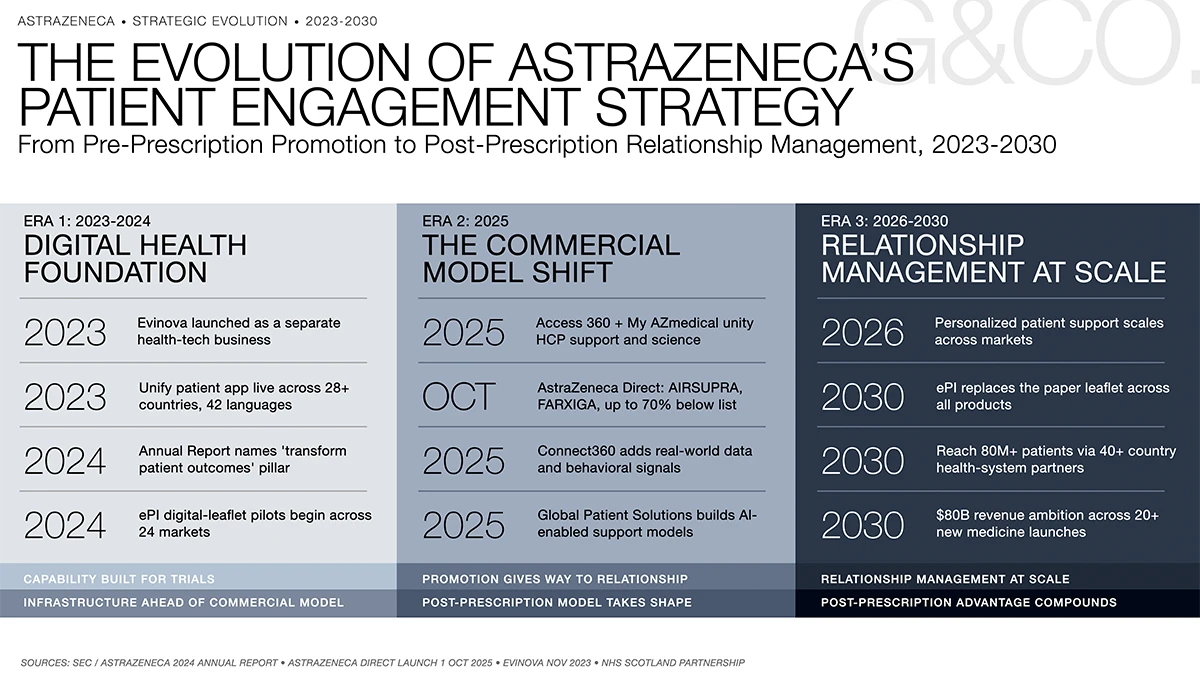
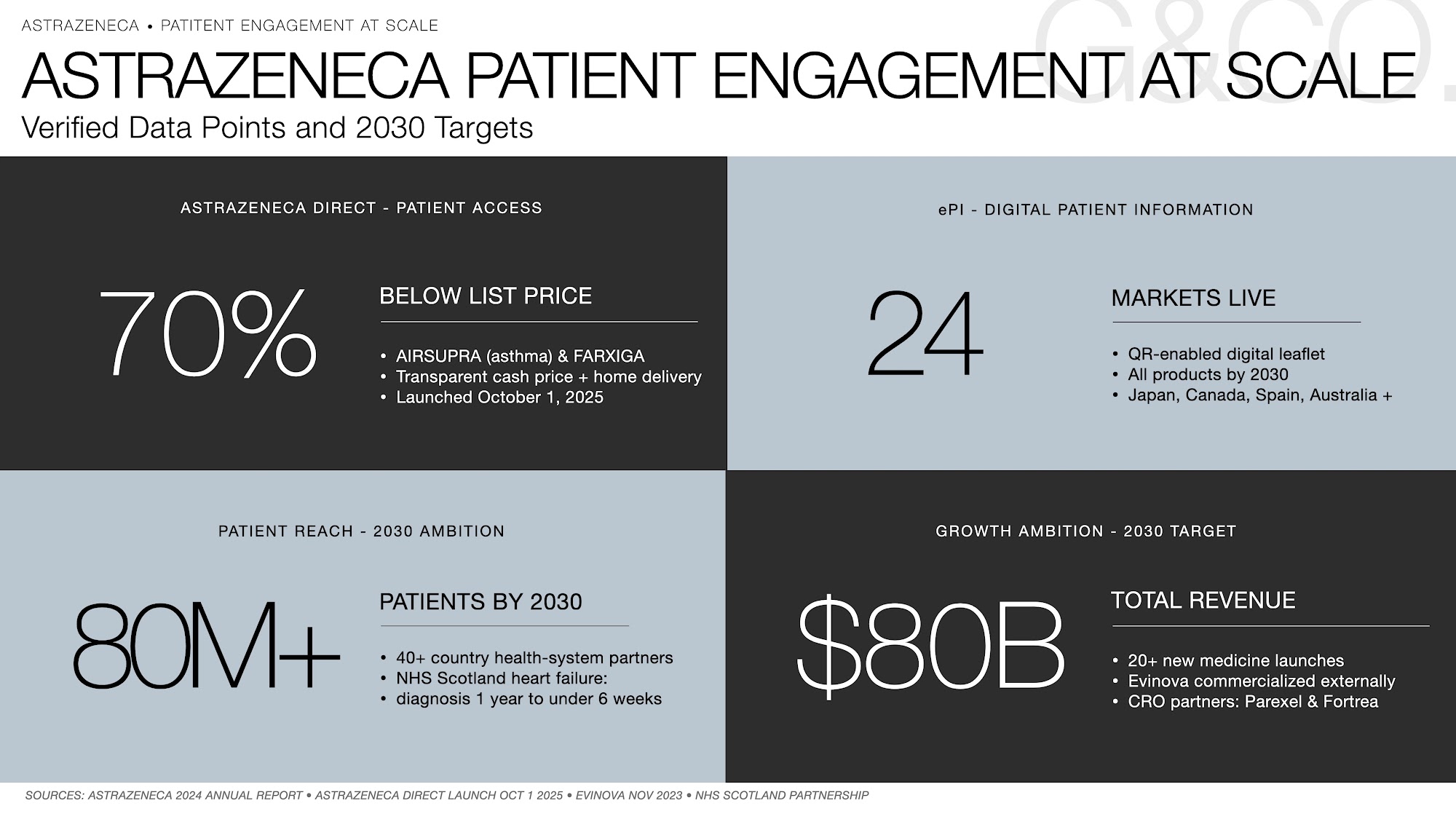
The foundation is a commercial infrastructure that connects engagement data across field representatives, digital channels, and medical affairs into a single view of each healthcare professional's relationship with the company, reflecting the 2024 Annual Report's description of using data, digital technology, and AI to work smarter. The logic rests on a well-established insight: healthcare professionals want a single source of coordinated content and support rather than fragmented interactions from disconnected teams. This is what modern HCP relationship management pharma teams are moving toward. The Access 360 program, AstraZeneca's US patient and HCP support hub, puts this into practice, giving professionals a single point of access to patient-support enrollment, affordability information, and scientific content through the My AZmedical platform, which updates in real time. AstraZeneca's partnerships, including a collaboration with NHS Scotland on AI-enabled heart-failure diagnostics that cut waiting times from a year to under six weeks, show the company positioning its infrastructure as a healthcare-system partner rather than a promotional tool, which opens access to patient populations and market-access conversations that purely promotional models cannot reach.
Patient support and the economics of post-prescription engagement.
The most commercially significant 2025 development was AstraZeneca Direct, a direct-to-patient platform launched on October 1 that gives eligible patients transparent cash pricing and home delivery, initially for AIRSUPRA (asthma) and FARXIGA (diabetes, heart failure, and chronic kidney disease) at prices up to 70 percent below list, positioned as a complement to existing services like Access 360. The logic is direct and measurable: both are chronic-condition medicines for which adherence is the main driver of clinical and commercial outcome. A patient who cannot afford or easily access their medicine is likely to stop taking it, so removing those barriers at the point of highest risk is the difference between a patient who stays on treatment for three years and one who abandons it after six months. The Connect360 programme, run by AstraZeneca's Global Patient Solutions team, addresses the behavioral side, combining real-world data, patient-reported outcomes, and long-term engagement patterns to deliver timely, clinically relevant support at scale. As a patient support programme digital from the ground up, it is not a helpline or a leaflet; it applies the same personalization logic the most advanced consumer brands apply to retention.
Digital patient information.
AstraZeneca is systematically replacing paper patient-information leaflets with QR-code-enabled digital information across its portfolio, targeting all products by 2030, with pilots live across 24 markets including Japan, Singapore, Australia, Canada, Spain, and Portugal. The commercial significance lies in what it converts. A paper leaflet is one-way and static at dispensing; a digital platform can be updated in real time as clinical information changes, and supplemented with video, adherence guidance, and links to support programs at the exact moment the patient is holding the medicine and deciding whether to begin. Because some markets still require paper, AstraZeneca is working through industry bodies to speed the transition, so the company that has already deployed the infrastructure before regulation requires it gains an operational and commercial advantage when the requirement arrives.
Always-On Customer Intelligence
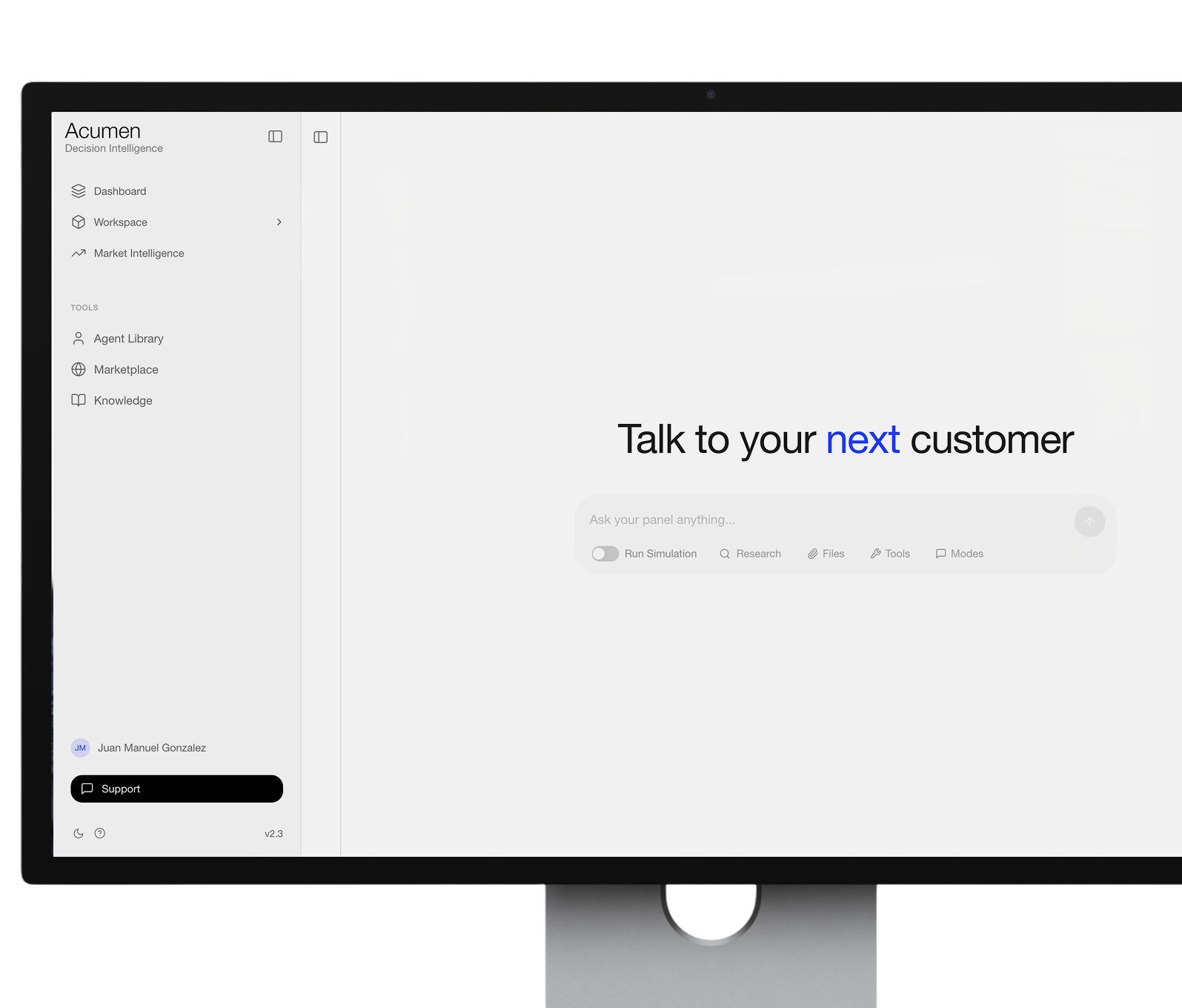
Turn your own customer data into foresight — validate, simulate, and sense every major decision before you commit.


Results and Evidence
The proof points show a coherent model rather than scattered pilots. AstraZeneca Direct prices key chronic-disease medicines up to 70 percent below list with home delivery, attacking the two most common adherence barriers directly. The NHS Scotland partnership cut heart-failure diagnostic waits from roughly a year to under six weeks. The Unify patient app, developed for clinical trials, has deployed across more than 28 countries in 42 languages, and the digital patient-information initiative is operational across 24 markets on the way to full-portfolio coverage by 2030. The 2024 Annual Report sets the scale of ambition the infrastructure is built to serve: reaching more than 80 million patients by 2030 through partnerships with health systems in over 40 countries, and a target of $80 billion in total revenue by 2030 through at least 20 new medicine launches. Evinova is the clearest evidence that the underlying capability has commercial value in its own right. Launched in November 2023 as a separate health-tech business, it makes the digital-health infrastructure AstraZeneca built for its own operations available to the wider life-sciences community across three service areas: unified trial solutions, AI-enabled study design, and portfolio management. Two major clinical-research organizations, Parexel and Fortrea, agreed to offer Evinova's solutions to their customers at launch, providing immediate distribution and an external signal that infrastructure built inside a major pharmaceutical company carries built-in credibility. Note that the more than 80 million patients and $80 billion revenue figures are 2030 targets, and the AstraZeneca Direct, Connect360, and Access 360 details are company-stated; confirm each against current disclosures before publication.
Strategic Implications
AstraZeneca's model connects to the broader shifts reshaping enterprise strategy: AI, customer experience, digital transformation, personalization, commerce, and data strategy. The traditional pharmaceutical CRM system was designed to manage sales-representative activity and doctor call records. The infrastructure AstraZeneca has built, from the Access 360 HCP portal to the Connect360 patient platform to AstraZeneca Direct, is designed to manage relationships across every channel and every stage of the journey. The difference is one of purpose, not scale: an activity-tracking system records what commercial teams did, while a relationship-management system informs what they should do next, based on a continuously updated understanding of each doctor's and patient's needs. Industry analysis identifies this move from product-centric to customer-centric, enabled by AI-powered CRM and real-world data, as the defining feature of the commercial model that will dominate by 2030.
For enterprise brands evaluating their own patient or customer engagement infrastructure, AstraZeneca is a clear benchmark. The organizations that lead in the next decade are those building the data infrastructure, support platforms, and omnichannel coordination that make post-prescription, or post-purchase, relationship management work at commercial scale. The shift from acquisition to retention, from transactional engagement to relationship management, and from single-channel execution to omnichannel coordination is underway across every category where customer lifetime value outweighs acquisition cost. Pharmaceuticals make the case more starkly because non-adherence is clinical as well as commercial, but the logic is identical: the brand that invests in managing the whole relationship, not just the acquisition moment, builds advantages that additional top-of-funnel spending cannot replicate. The same commercial-lifecycle logic runs through Pfizer's AI transformation, Eli Lilly's direct-to-patient model, and Sanofi's omnichannel platform.
What Enterprise Leaders Can Learn
- Judge relationship infrastructure on compounding value, not point-of-sale return. The commercial value of a customer or patient relationship is realized over time through sustained engagement, so infrastructure should be judged on lifetime value, not acquisition metrics.
- Removing friction pays measurable, often underestimated returns.
Whether it is transparent pricing and home delivery for a chronic medicine or a frictionless renewal for a subscription, removing barriers to continued engagement has a calculable return. - Build the data infrastructure to know where each customer is.
Organizations that can place each customer in their journey and deliver the right support at the right moment build advantages over those running fragmented engagement. - Mature internal capability can become a second business.
The Evinova model shows the most sophisticated engagement platforms can be sold independently of the core business that funded them. - Trust gaps cannot be closed quickly with technology.
The relationship advantage built through years of systematic investment is a data and trust gap, not a technology gap, so putting it off is more costly than it appears.
Conclusion
AstraZeneca has not solved the patient engagement problem. No pharmaceutical company has, and the structural challenges of adherence in chronic disease are not amenable to infrastructure investment alone. What AstraZeneca has done is build the most comprehensive pharmaceutical CRM strategy and patient engagement infrastructure in the industry, with a coherence of investment that reflects a clear conviction: the commercial model of the next decade will be determined not by who most effectively influences the prescribing decision, but by who most effectively supports the patient relationship after it.
From the Access 360 HCP portal and the Connect360 patient platform to AstraZeneca Direct, from Evinova's commercialization of internal digital health capability to the digital information initiative replacing the paper leaflet across 24 markets, every investment expresses the same thesis. AstraZeneca has bet its commercial future on the belief that the patient relationship, managed with the sophistication that leading consumer brands apply to retention, is the most durable source of pharmaceutical commercial advantage available. The enterprise lesson is the same one, stripped of its clinical specifics: durable advantage now accrues to whoever owns the relationship after the sale, not whoever wins the moment of it.
Through the Acumen platform, G&CO.Health provides enterprise pharmaceutical and healthcare brands with the consumer and brand intelligence that informs where patient engagement investment will generate the highest commercial return: which therapy areas face the highest adherence challenges, where patient trust in pharmaceutical brands is weakest, and what communication approaches are most effective for specific patient populations. G&CO.Health is a certified minority business enterprise through the National Minority Supplier Development Council (NMSDC). For enterprise organizations with diversity inclusion requirements in their procurement process, G&CO. meets the criteria for MBE-qualified partner status.
G&CO.Health works with enterprise pharmaceutical and healthcare brands to design the CRM infrastructure, patient support programs, and omnichannel HCP strategies that determine whether commercial investment translates into durable treatment adoption and measurable patient outcomes. If this AstraZeneca case study raises questions about your own organization's approach to pharmaceutical CRM strategy, treatment adherence, or HCP relationship management, submit an inquiry to G&CO.Health on our contact page or click on the blue "Click to Contact Us" button on the bottom right corner of your screen for your convenience. We look forward to hearing from you.
Frequently Asked Questions
What is this AstraZeneca case study about, and why does pharmaceutical CRM strategy matter commercially?
It examines how AstraZeneca built a post-prescription patient and HCP engagement infrastructure that treats the period between prescription and patient outcome as a commercially managed relationship. The rationale is structural: patients who do not stay on chronic-disease treatment represent lost lifetime value, lost real-world outcome data, and unrecovered commercial investment. AstraZeneca's investments in Access 360, AstraZeneca Direct, the Connect360 platform, and the Evinova digital-health business all reflect one idea: the pharmaceutical brand that manages the patient relationship after prescription builds commercial advantage that promotion-focused models cannot replicate.
How does AstraZeneca's treatment adherence digital strategy work in practice?
It operates at two levels: removing practical and financial barriers to access, and delivering personalized support for the behavioral and informational challenges that cause people to stop treatment. AstraZeneca Direct, launched in October 2025, removes financial and logistical barriers through transparent cash pricing and home delivery for chronic-disease medicines including AIRSUPRA and FARXIGA. The Connect360 programme, run by Global Patient Solutions, combines real-world data, patient-reported outcomes, and behavioral signals to deliver personalized, timely support at scale. Together they reflect the direction of pharmaceutical commercial change toward patient-centered care that uses real-world data across many touchpoints.
What is the AstraZeneca digital health strategy, and how does Evinova fit within it?
The AstraZeneca digital health strategy, set out in the 2024 Annual Report, is the use of data, digital technology, and AI to transform the business, accelerate the science, and reimagine healthcare through earlier diagnosis, precision treatments, and proactive monitoring. Evinova, launched in November 2023, is its commercial expression: a separate health-tech business that makes the digital-health infrastructure AstraZeneca developed for its own operations available to the wider life-sciences community. Its three service areas, unified trial solutions, AI-enabled study design, and portfolio management, reflect the depth of the internal capability, and its launch partnerships with Parexel and Fortrea signaled industry recognition of infrastructure built by an operator with real deployment experience.
How does AstraZeneca's pharma patient engagement platform differ from traditional HCP relationship management in pharma?
Traditional HCP relationship management was designed to manage sales-representative activity and track call records. AstraZeneca's platform, built around the Access 360 HCP portal, the My AZmedical content platform, and the Connect360 patient programme, is designed to manage relationships across every channel and every stage of the journey. The difference is one of purpose, not scale: coordinated, integrated engagement that treats healthcare professionals as long-term partners rather than promotional targets, and patients as individuals with specific needs at specific moments rather than one group to be messaged.
What can enterprise brands learn about pharmaceutical loyalty strategy from the AstraZeneca model?
Three transferable lessons for any regulated, high-stakes category. First, the value of a customer relationship is not realized at acquisition but compounds over time through sustained engagement, and infrastructure should be judged accordingly. Second, removing practical barriers to continued engagement, whether transparent pricing and home delivery or a frictionless renewal, generates measurable and often underestimated returns. Third, the organizations that build the data infrastructure to understand where each customer is in their journey, and to deliver the right support at the right moment, build advantages over those running fragmented engagement. The same dynamic of increasingly active, well-informed customers applies across financial services, healthcare, and any category where information access has shifted power toward the customer.