.webp)
Domino's Case Study: A Restaurant Digital Transformation
Domino's is one of the clearest examples of a legacy company rebuilding itself around technology. Once a struggling pizza chain, it reinvented itself into a technology-and-data company that happens to sell pizza. This Domino's case study looks at that restaurant digital transformation: more than 85% of its U.S. sales now come through digital channels, its Domino's Rewards program reached 37.3 million active members that feed a data engine for targeted marketing, and it runs AI across its stores for forecasting and scheduling. It is a study in data driven operations, ai in operations, and how domino's technology and domino's strategy turned a legacy brand into a market leader.
Domino's turned a struggling pizza chain into a technology company by building its own ordering apps, a loyalty program that doubles as a data engine, and AI that runs its stores.
In 2009, Domino's did something almost no company does: it went on television and admitted its pizza was not good. Sales were weak and the brand was in trouble. But that public turnaround was only the surface. The deeper decision was that Domino's would stop competing as a food company and start competing as a technology company, one that used software, data, and later AI to make ordering easier, delivery faster, and operations smarter than any rival's. Over the next fifteen years, that decision rebuilt the business.
This Domino's case study looks at that restaurant digital transformation: how a legacy pizza chain became a technology-and-data company, and what that shift produced. Today more than 85% of its U.S. sales run through digital channels, its loyalty program feeds a powerful data engine, and AI runs behind the scenes in its stores. The lesson is not about pizza. It is about how a traditional, physical business can reinvent itself around technology, and build advantages in data, customer relationships, and operations that competitors find very hard to match.
Key Points
- Domino's rebuilt a struggling pizza chain into a technology company that happens to sell pizza. After a public 2009-2010 turnaround, it chose to compete on software, data, and delivery technology rather than on food alone.
- Digital ordering is now the core of the business: more than 85% of Domino's U.S. sales run through its own apps and website, giving it a direct customer relationship and a flood of data.
- Domino's Rewards reached 37.3 million active members (up 20% since its 2023 relaunch), which Domino's uses to target promotions and grow orders rather than just discount.
- Domino's uses ai in operations for demand forecasting (in 15-minute increments), inventory, and scheduling, cutting food waste and helping franchisee profits.
- The transformation helped Domino's win market share for 11 straight years, backed by more than $150 million a year in technology investment.
Why This Matters
For CEOs, chief digital and technology officers, and leaders of any established, physical business, Domino's matters because it proves that a legacy company can reinvent itself around technology and win. Many traditional businesses treat digital as a channel to bolt on. Domino's treated it as the core of the company, and rebuilt everything, ordering, delivery, loyalty, and store operations, around software and data. The result is one of the great business turnarounds of the last two decades.
The timing makes it especially relevant. Every industry now faces pressure to modernize legacy operations, adopt AI, and build direct digital relationships with customers, often while competing against newer, tech-native rivals or against delivery platforms that sit between them and their customers. Domino's shows how a traditional company can meet that challenge: not by copying the newcomers, but by building its own technology, owning its customer data, and using both to run a better, smarter operation. Its restaurant digital transformation is a template for legacy reinvention in any sector.



.png)
%20(1).png)

Let’s kickstart the conversation and design stuff people will love.

The Retail & Consumer Index


Strategic Context
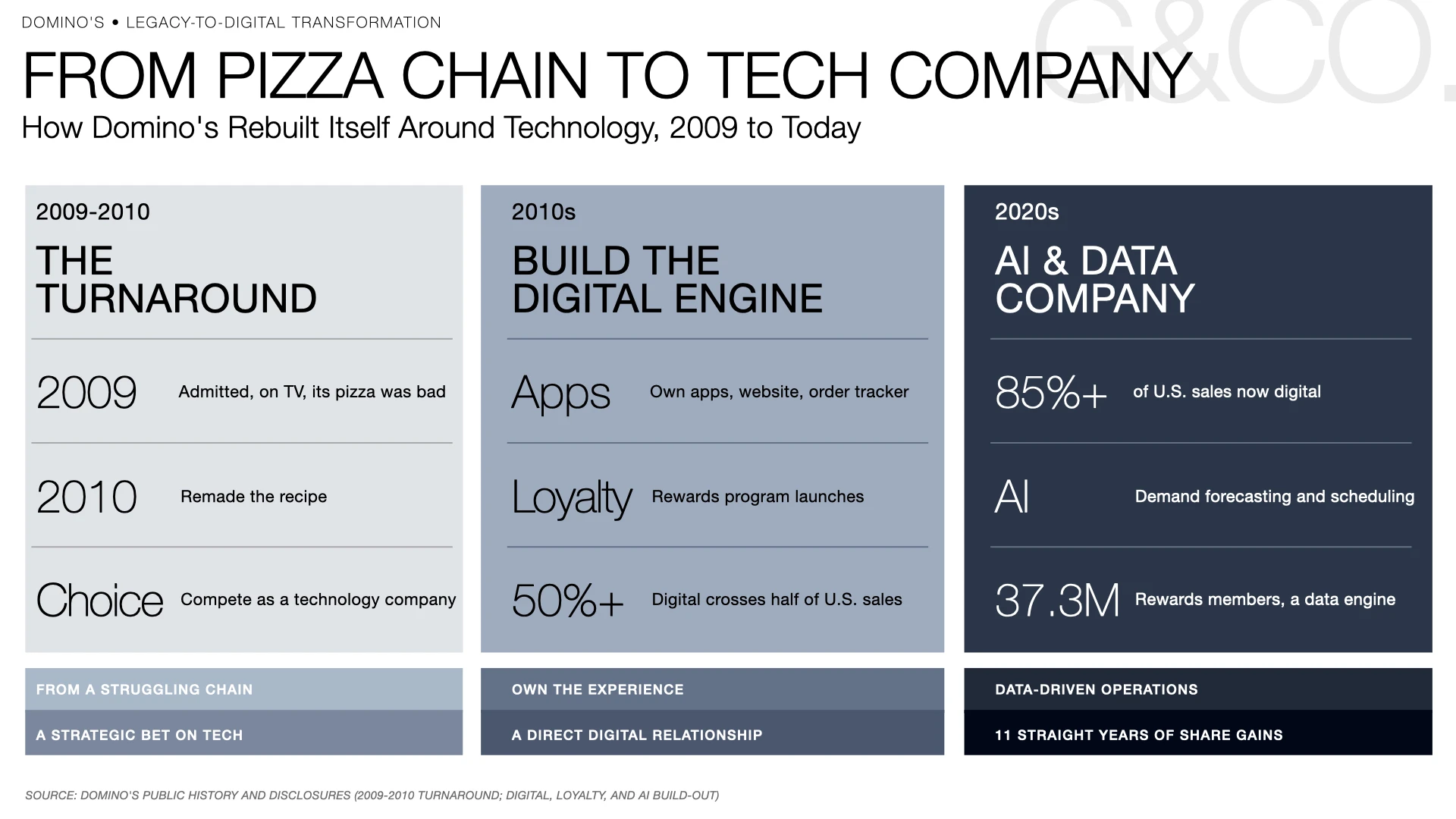
For most of its history, Domino's competed the way restaurants do: on food, price, and location. By the late 2000s, that was not working. The food had a weak reputation, and the business was under pressure. Domino's could have responded with a normal fix, better recipes and more advertising, and it did improve the recipe. But its more important choice was strategic: it decided the future of the business was technology, not just food.
The reasoning was simple. Pizza delivery is, at its heart, a logistics and ordering problem: take the order accurately, make it fast, and get it to the door hot. Those are problems software and data can solve better than anything else. So Domino's set out to build the best ordering and delivery technology in the industry, and to own it rather than rent it. That reframed the whole domino's strategy around a direct digital relationship with the customer: if people ordered through Domino's own apps and website, the company would own the experience and the data, and could keep improving both. Everything that followed, the loyalty program, the AI, the operational tools, grew from that one decision to compete as a technology company.
Company Response
Domino's built its transformation in layers over more than a decade, each one adding to the last.
Own the digital ordering experience.
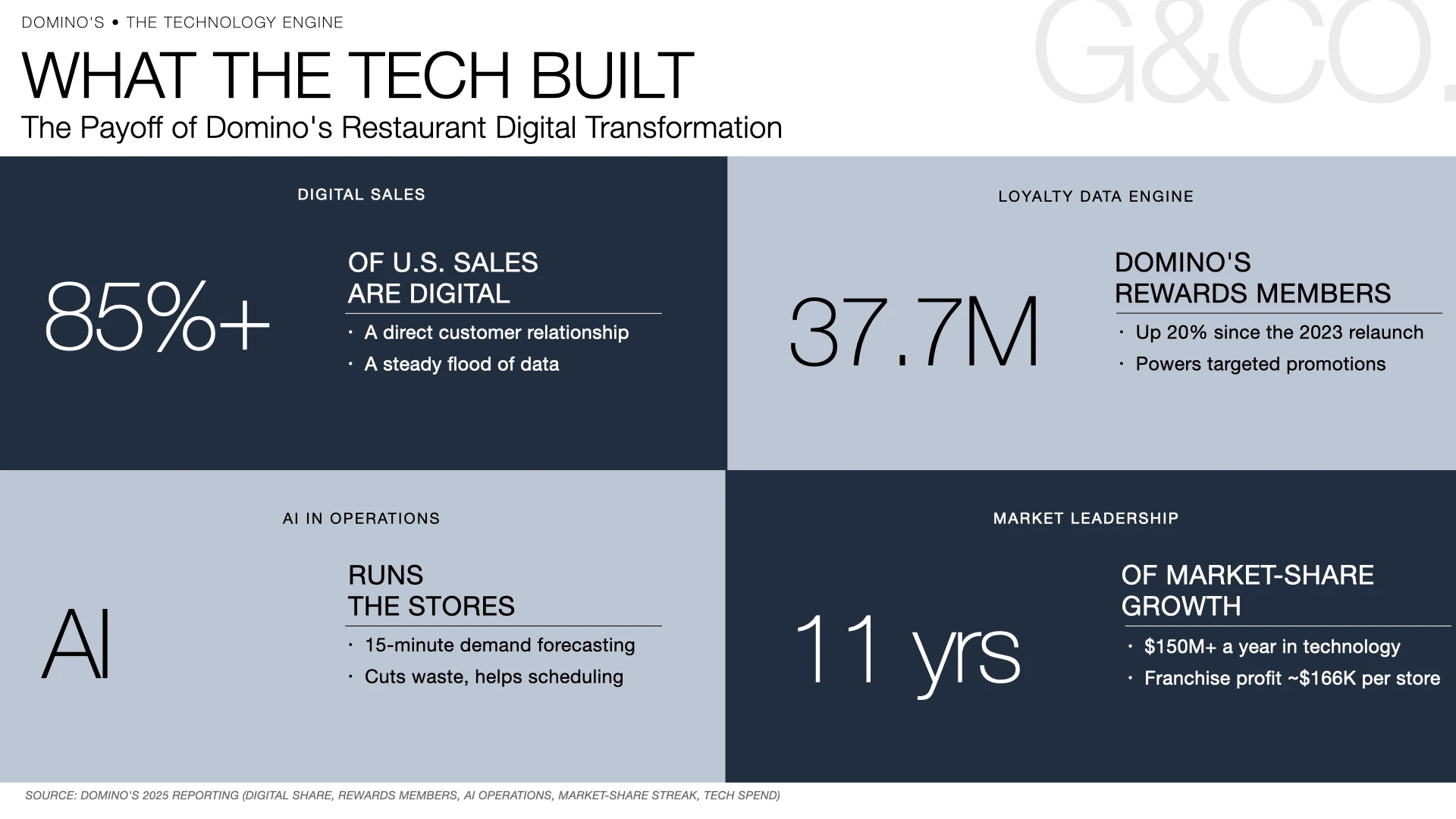
Domino's invested heavily in its own ordering apps and website, plus tools like its order tracker and voice ordering, to make ordering easy and to keep customers inside its own channels rather than third-party ones. That investment paid off: more than 85% of U.S. sales now come through digital, giving Domino's a direct relationship with tens of millions of customers and the data that comes with it. Owning this technology, rather than depending on outside platforms, is central to domino's technology strategy.
Turn loyalty into a data engine.
Domino's Rewards, relaunched in 2023 to lower the barrier to earn rewards, reached 37.3 million active members. But the program is not just about discounts; it is a source of customer data. Domino's uses that data to design targeted promotions that attract new and occasional customers and grow order frequency, rather than simply giving money back to people who would have ordered anyway. This is data driven operations applied to marketing: using what it knows about customers to grow the business efficiently.
Run the stores with AI.
Domino's has pushed technology deep into store operations. It uses ai in operations to forecast demand in 15-minute increments, which cuts food waste and sharpens inventory, and, through a cloud partnership, it is rolling out generative-AI tools that help store managers with scheduling and inventory. These tools lower costs and protect franchisee profits, which matters because healthy franchisees are what let the whole system keep investing and growing.
Manage delivery platforms on its own terms.
Rather than hand its business to third-party apps, Domino's added aggregator partnerships (such as Uber Eats and DoorDash) carefully, using them to reach new customers while protecting its own economics and its direct customer relationships. This disciplined approach keeps the benefits of extra reach without giving away the data and margin that make its model work.
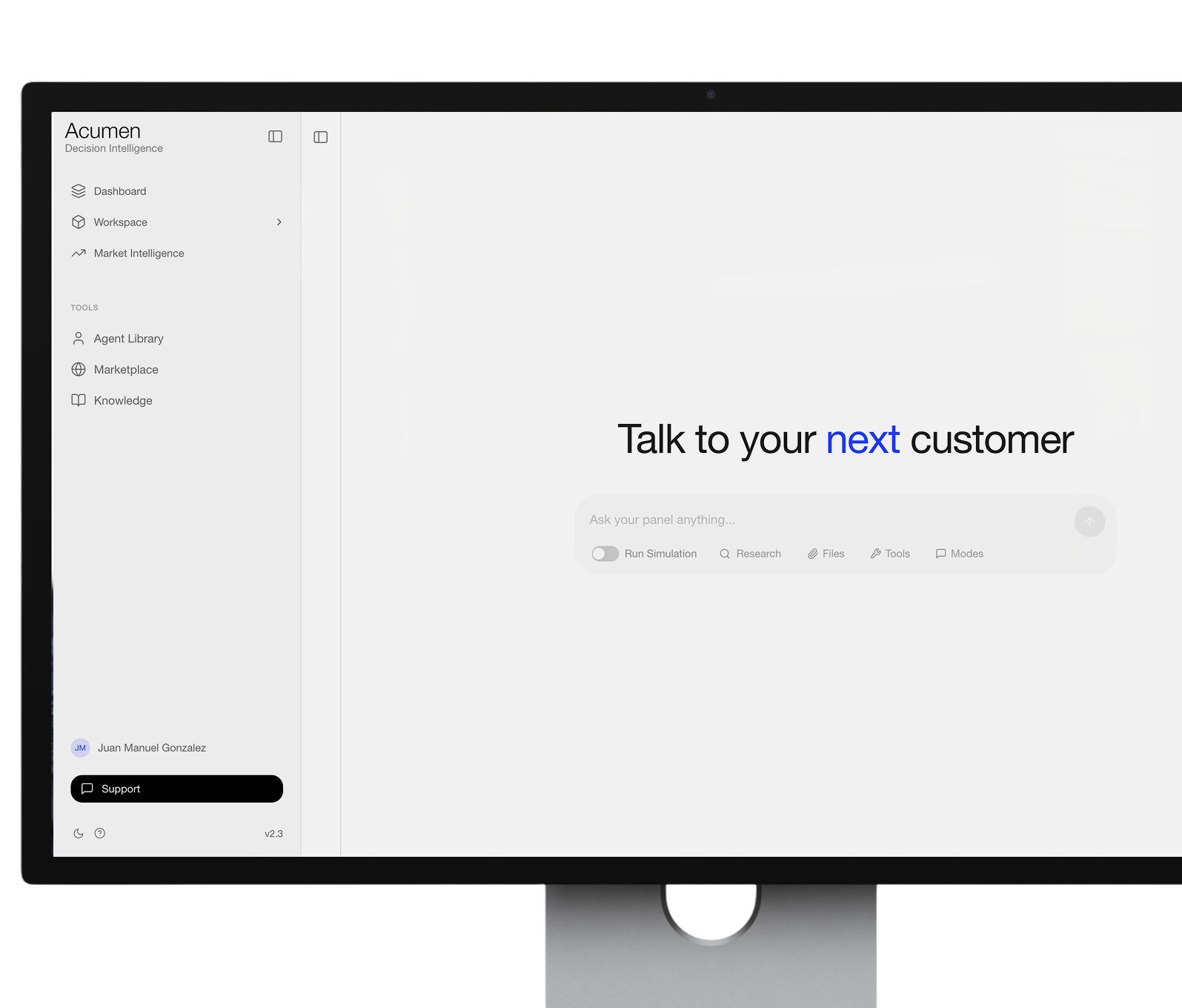
Always-On Customer Intelligence
Turn your own customer data into foresight — validate, simulate, and sense every major decision before you commit.


Results and Evidence
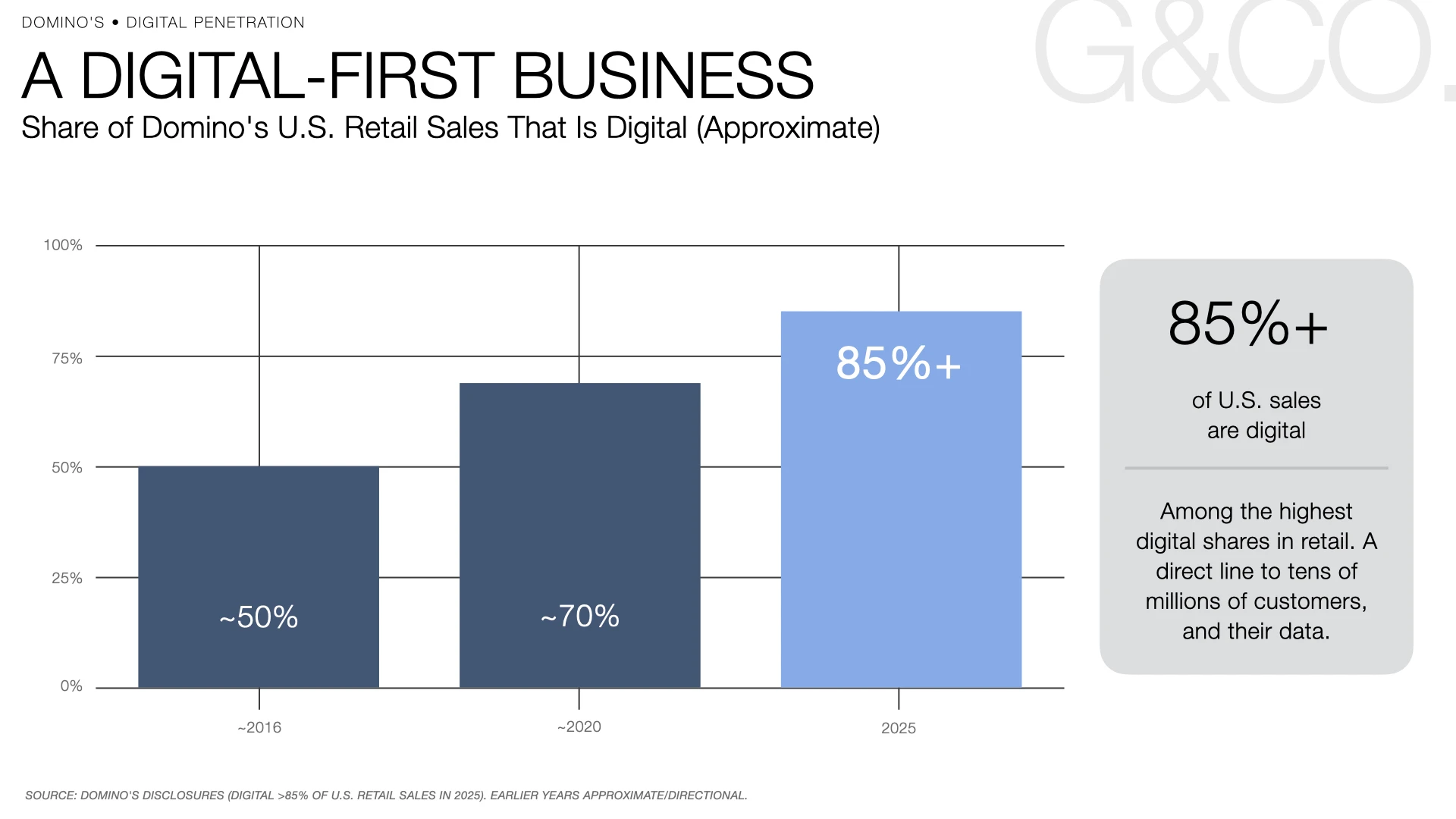
The evidence, drawn from Domino's recent reporting, shows a transformation that keeps delivering. More than 85% of Domino's U.S. retail sales now come through digital channels, and its Domino's Rewards program reached 37.3 million active members, up about 20% since its 2023 relaunch. The technology-driven model has helped Domino's expand its market share for 11 consecutive years, with U.S. same-store sales up 3.7% in the fourth quarter of 2025 and around 3% for the full year, and franchisee profitability per store rising to about $166,000. Its carryout business, increasingly digitized and supported by the loyalty program, reached $4.4 billion in 2025. Behind all of this sits sustained investment, more than $150 million a year in technology, that keeps the advantage compounding. These figures come from Domino's public reporting and are worth confirming against the latest results before publishing, since this names a real company and the numbers update quarterly.
Strategic Implications
Domino's points to a broader truth: in almost every industry, the winners are becoming the companies that treat themselves as technology and data businesses, whatever they sell. As customers move to digital ordering and expect fast, personalized, reliable service, the companies that own their technology, their customer relationships, and their data will out-operate those that depend on outside platforms or legacy systems. The advantage compounds: better technology produces more data, more data enables smarter operations and marketing, and that in turn funds more technology.
The lesson travels well beyond restaurants. Any legacy business with physical operations and a large customer base, in retail, hospitality, services, logistics, or manufacturing, faces the same choice Domino's faced: modernize around technology, or slowly lose ground to those who do. What Domino's demonstrates is a full playbook for a restaurant digital transformation that applies to any sector: own the digital customer experience, turn loyalty into a data engine, use AI to run operations more efficiently, and manage outside platforms without becoming dependent on them. The companies that commit to that kind of reinvention, and treat data and technology as the core of the business rather than a support function, will build the durable advantages that let a legacy brand keep winning. Domino's shows how much a traditional company can achieve when it decides to become a technology company. The same legacy-to-digital reinvention runs through Starbucks' operational AI, CVS Health's platform consolidation, and Tesla's software-defined car.
What Enterprise Leaders Can Learn
- Treat technology as the core, not a channel.
Domino's did not add digital on top of a food business; it rebuilt the business around technology. Real transformation means changing the center of the company, not decorating the edges. - Own your customer relationship and data.
By pushing customers to its own apps, Domino's owns the experience and the data, instead of renting them from delivery platforms. That ownership is the foundation of everything else it does. - Make loyalty a data engine, not just a discount.
Domino's Rewards works because it generates data that drives smarter, more efficient marketing, attracting new customers rather than just rewarding existing ones. A loyalty program should earn its keep in insight, not only in giveaways. - Use AI where it lowers cost and protects margins.
Domino's applies ai in operations to forecasting, inventory, and scheduling, unglamorous areas where AI clearly pays off. The best early AI wins are often operational, not flashy. - Reinvent from a clear strategic choice.
Domino's transformation worked because it started from one decision, to compete as a technology company, and stuck with it for years. Lasting reinvention needs a clear thesis and patience, not a series of pilots.
Conclusion
Domino's did not save itself by making better pizza, though it did that too. It saved itself by deciding to become a technology company, and then spending more than a decade building the software, data, and AI to back that decision up. The result is a business where more than 85% of U.S. sales are digital, a loyalty program that doubles as a data engine, AI running the stores, and 11 straight years of market-share gains. For enterprise leaders, the takeaway is not specific to food. It is that a legacy business can reinvent itself around technology and win, if it treats digital as the core of the company, owns its customer relationships and data, and commits to the change for the long term. In a world where every company is becoming a technology company, Domino's shows what that transformation looks like when it is done with conviction.
Through the Acumen platform, G&CO. gives enterprise brands the intelligence to guide a digital transformation with evidence instead of guesswork: where customers want a better digital experience, which technology and data investments will pay off, and how to turn a legacy operation into a data-driven advantage. G&CO. is a certified minority business enterprise through the National Minority Supplier Development Council (NMSDC). For enterprise organizations with diversity inclusion requirements in their procurement process, G&CO. meets the criteria for MBE-qualified partner status.
G&CO. works with enterprise brands on the technology, data, and customer-experience strategy that turns a legacy business into a modern, data-driven one. If this Domino's case study raises questions about your own restaurant digital transformation, data driven operations, or use of AI in operations, submit an inquiry to G&CO. on our contact page or click the blue "Click to Contact Us" button in the bottom right corner of your screen. We look forward to hearing from you.
Frequently Asked Questions
What is Domino's restaurant digital transformation?
Domino's restaurant digital transformation is its shift from a traditional pizza chain into a technology-and-data company that happens to sell pizza. Starting with a public turnaround in 2009-2010, Domino's chose to compete on technology, building its own ordering apps and website, a data-driven loyalty program, and AI-powered store operations. Today more than 85% of its U.S. sales come through digital channels, and the technology it built, not just its food, is a central reason it has gained market share for 11 straight years.
How does Domino's use AI in operations?
Domino's uses ai in operations mainly to make its stores run more efficiently. It forecasts demand in 15-minute increments, which reduces food waste and improves inventory management, and, through a cloud partnership, it is rolling out generative-AI tools that help store managers with tasks like scheduling and inventory. These uses of AI are focused on lowering costs and protecting franchisee profits, unglamorous but high-value areas where the technology clearly pays off.
What role does data play in Domino's technology and strategy?
Data is at the center of domino's technology and domino's strategy. Because more than 85% of sales are digital and its loyalty program has 37.3 million active members, Domino's collects a large amount of customer and operational data. It uses that data for data driven operations: designing targeted promotions that attract new and occasional customers, forecasting demand, managing inventory, and improving delivery. Owning this data, rather than handing it to third-party platforms, is what makes the whole model work and is hard for competitors to copy.
How does Domino's Rewards support its business?
Domino's Rewards, relaunched in 2023 with a lower barrier to earn rewards, reached 37.3 million active members. It supports the business in two ways. First, it encourages repeat orders and brings in occasional and carryout customers, helping grow sales. Second, and just as important, it generates customer data that Domino's uses to target promotions efficiently, attracting incremental customers rather than simply discounting to people who would have ordered anyway. In effect, the loyalty program is both a sales driver and a data engine.
What can enterprise brands learn from this Domino's case study?
The main lesson is that a legacy business can reinvent itself around technology and win. Domino's playbook is repeatable in almost any industry: treat technology as the core of the company rather than a channel, own your digital customer experience and data instead of renting them from outside platforms, turn loyalty into a data engine, use AI where it lowers cost and protects margins, and commit to the transformation over years rather than through scattered pilots. Any established business with physical operations and a large customer base can apply the same approach.