Merck Case Study: Managing the Keytruda Patent Cliff
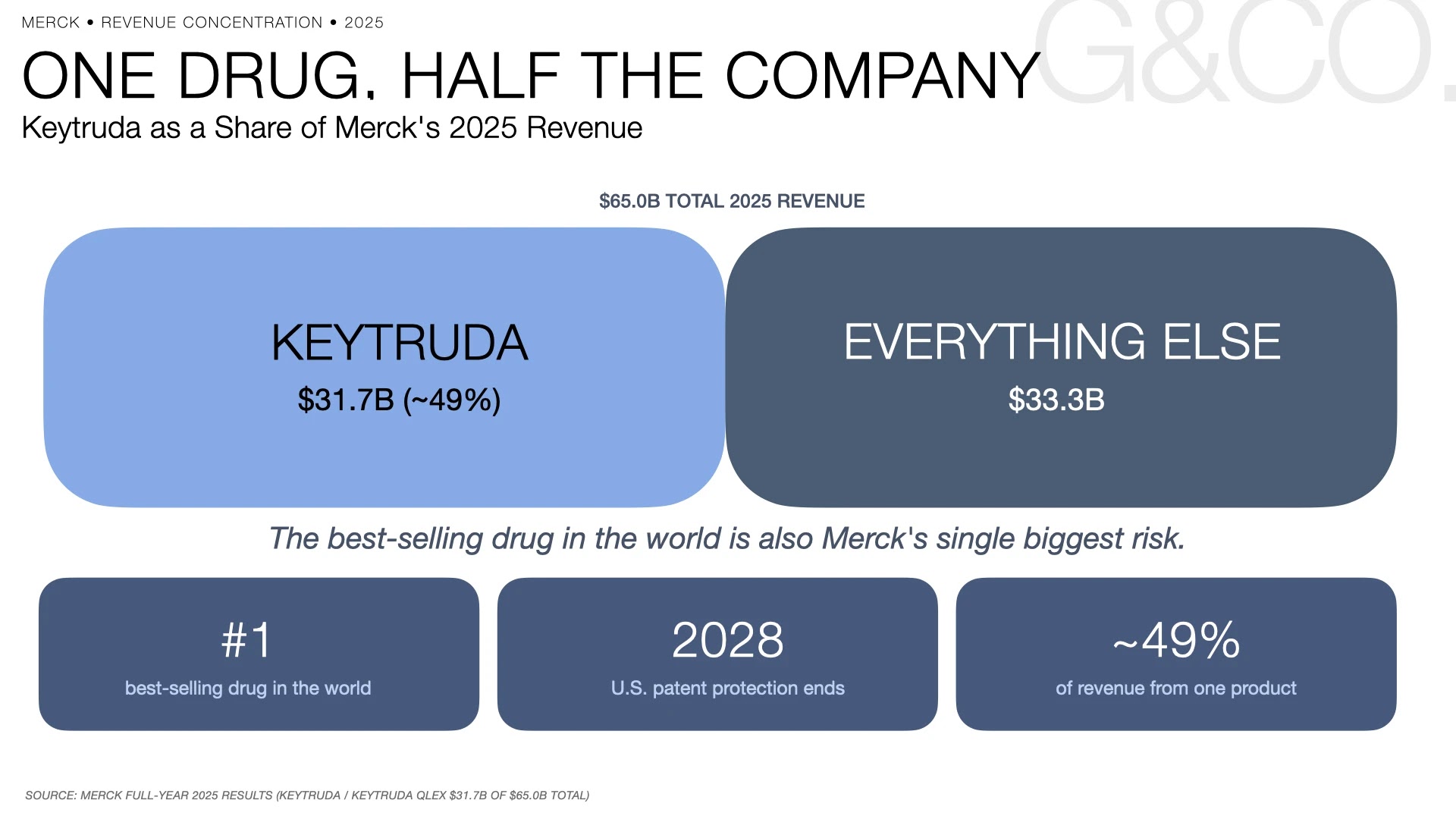
Merck earns nearly half its revenue from a single drug, Keytruda, which brought in $31.7 billion of the company's $65 billion in 2025 and is the best-selling medicine in the world. In 2028, Keytruda loses its U.S. patent protection, and cheaper copies will follow. This Merck case study looks at how the company is managing that pharma patent cliff: defending the franchise with a new under-the-skin version, using competitive intelligence to plan for biosimilar rivals, and building replacement revenue across a wider portfolio. It is a study in pharmaceutical product lifecycle management, pharma brand strategy, and the discipline of preparing early for a known revenue shock.
To get ahead of Keytruda losing patent protection in 2028, Merck is replacing nearly half its revenue with a longer-lasting version of the drug, new launches, and acquisitions.
Keytruda is the best-selling drug in the world. It is also Merck's biggest risk. In 2025, the cancer immunotherapy brought in $31.7 billion, about half of Merck's $65 billion in total revenue. That level of success creates a hard problem: when one product carries half the company, its patent expiration is not a footnote, it is a threat to the whole business. And Keytruda's expiration is not a surprise. Merck has known for years that U.S. patent protection ends in 2028, after which cheaper copycat versions, called biosimilars, will steadily eat into sales.
This Merck case study looks at how a company defends its most valuable asset when it knows, years in advance, that the asset is going to shrink. The pharma patent cliff is the clearest kind of business threat there is: a large, dated, unavoidable revenue loss. What Merck does about it, defending the Keytruda brand, modeling exactly how and when rivals will arrive, and building new revenue to fill the gap, is a lesson for any company that depends heavily on one product, in any industry. The lesson is not about drugs. It is about what disciplined preparation for a known shock actually looks like.
Key Points
- Merck's biggest problem is its biggest success, Keytruda: the cancer drug generates nearly half of Merck's revenue and loses U.S. patent protection in 2028, a cliff that threatens tens of billions in sales.
- Its main defense is a longer-lasting version of Keytruda itself: a subcutaneous form (approved as Qlex) is easier to administer and carries fresh patent protection, so Merck can move patients onto it before the original faces competition.
- New launches like WINREVAIR and CAPVAXIVE, plus acquisitions such as Verona and Cidara, aim to replace Keytruda's concentration with a broader base.
- Every patient moved to the new version, and every new drug that scales before 2028, softens how hard the cliff hits.


%20(1).png)

Let’s kickstart the conversation and design stuff people will love.

The Retail & Consumer Index


Why This Matters
For commercial leaders, strategists, and anyone whose business depends heavily on one product, Merck matters because it shows how to handle concentration risk: the danger of relying too much on a single source of revenue. Most companies with a dominant product prefer not to dwell on what happens when it fades. Merck cannot avoid the question, because the date is fixed and public, so it offers a clear view of how a disciplined company prepares.
The value here is that the threat is knowable. A pharma patent cliff is not a surprise disruption; it is a scheduled event with a date attached. That makes it the ideal test of a company's competitive intelligence and planning: How fast will rivals actually arrive? Which parts of the franchise can be protected, and for how long? How much new revenue is realistically needed, and by when? Merck's answer treats the cliff as a modeling and preparation problem, not a matter of hope. Any enterprise facing a known future loss, a product going out of style, a contract ending, a technology aging out, can learn from how Merck turned a fixed threat into a plan.
Strategic Context
In the drug business, a patent gives a company a period of exclusive sales before competitors can copy the product. When that protection ends, the "loss of exclusivity" opens the door to cheaper versions, and revenue from the original usually falls quickly. For an ordinary product, that is manageable. For a product that carries half a company, it is the defining strategic challenge of the decade. This is the pharma patent cliff, and Keytruda's is one of the largest the industry has ever seen.
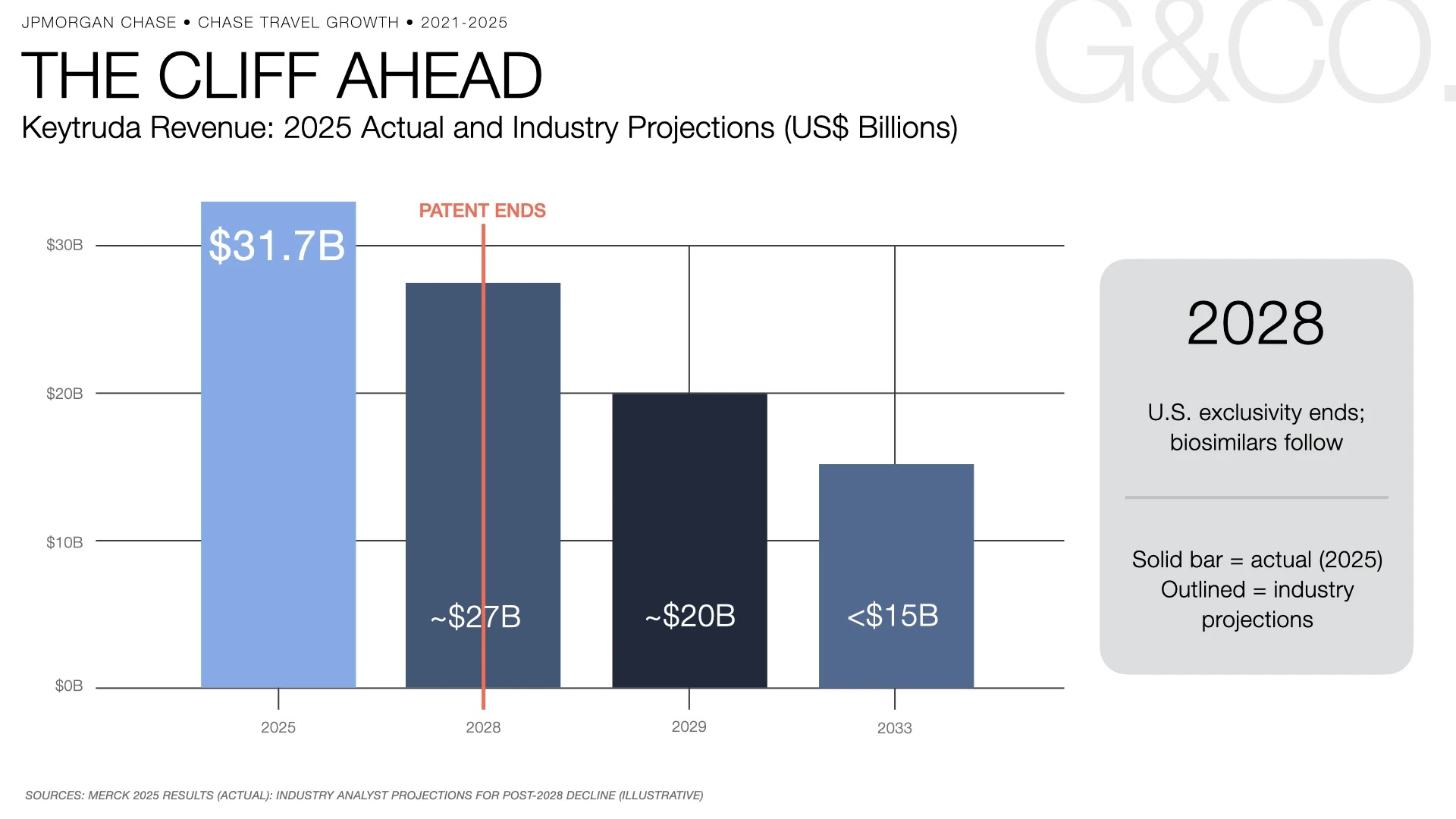
Keytruda's scale is the reason. It is approved to treat many different cancers, it keeps adding new uses, and it grew 7% in 2025 even as its expiration approached. It accounts for roughly half of Merck's total sales and an even larger share of the company's pharmaceutical business. That success is exactly what makes the 2028 cliff so serious: the more a single product grows, the more a company has riding on the day its protection ends. Industry estimates suggest Keytruda's revenue could fall from roughly $27 billion in 2028 toward $20 billion the following year, and below $15 billion within five years of losing protection. Replacing that kind of revenue is the problem Merck has organized itself around.
Always-On Customer Intelligence
Turn your own customer data into foresight — validate, simulate, and sense every major decision before you commit.


Company Response
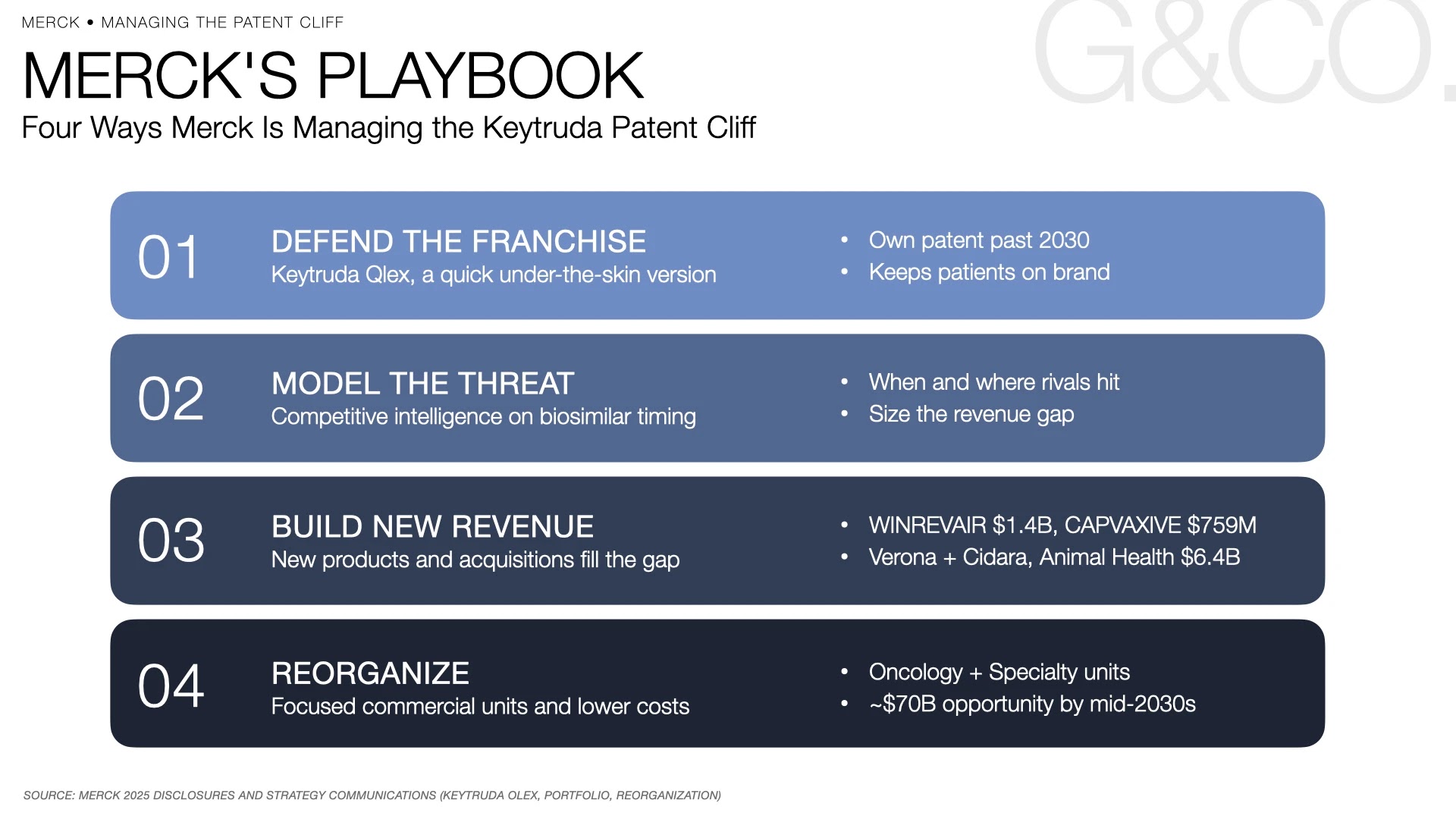
Merck's response has four parts. Together they form a playbook for managing a known revenue cliff, and each maps to a commercial discipline rather than to laboratory science alone.
Defend the franchise brand.
Merck's most direct move is to protect Keytruda itself. In 2025, it won approval for Keytruda Qlex, a version given as a quick under-the-skin injection instead of a longer intravenous infusion. Qlex is more convenient for patients and clinics, and, importantly, it carries its own separate patent protection that extends past 2030. That gives many patients a reason to stay on the branded product even after copycat versions of the original arrive, a textbook example of product lifecycle management: extending the commercial life of a franchise through a better, separately protected version. This is pharma brand strategy in action, defending the value of a brand, not just the underlying molecule.
Model the threat with competitive intelligence.
Because the cliff has a date, Merck can plan against it in detail. The core commercial question is not whether biosimilars arrive but how fast they take share, market by market, and how much of the franchise Qlex and new uses can protect. This is pharma competitive intelligence work: mapping when and where rivals will enter, modeling how quickly they gain ground, and pressure-testing the company's own defenses against those scenarios. The clearer that picture, the better Merck can size the revenue gap and time its investments to fill it.
Build replacement revenue.
Merck is widening its base of revenue beyond Keytruda. Newer products are scaling quickly: WINREVAIR, a heart and lung treatment, reached $1.4 billion in 2025, and the vaccine CAPVAXIVE added $759 million in its early going. Its Animal Health business grew to $6.4 billion. Merck has also acquired companies to add products, including Verona Pharma (about $10 billion, for a respiratory drug) and Cidara Therapeutics (about $9.2 billion). The goal is a portfolio where no single product carries the company the way Keytruda does today.
Reorganize commercially for the transition.
To manage a more diverse portfolio, Merck restructured into focused units, one for Oncology and one for Specialty, Pharma, and Infectious Diseases, so each area has dedicated leadership to launch and grow products. It is also cutting about $3 billion in costs by the end of 2027 to fund the transition. Merck has said its newer products represent a commercial opportunity of roughly $70 billion by the mid-2030s, well more than Keytruda alone.
Results and Evidence
The evidence, drawn from Merck's 2025 results, shows both the size of the risk and the early progress against it. In 2025, Merck reported $65.0 billion in total sales, with Keytruda (including the new Qlex version) at $31.7 billion, up 7% and still the world's best-selling drug. That single product represents about half of Merck's revenue, which is the concentration the company is working to reduce. The early replacement products are scaling: WINREVAIR reached $1.4 billion, growing fast, and CAPVAXIVE added $759 million, while Animal Health grew 8% to $6.4 billion. Not everything is up, the GARDASIL vaccine franchise fell sharply on weak demand in China, which is a reminder that diversification is uneven. Merck's stated goal is roughly $70 billion in revenue from its newer launches by the mid-2030s. These figures come from Merck's public reporting and are worth confirming against the latest results before publishing, since this names a real company and the numbers update quarterly.
Strategic Implications
Merck's situation connects to a challenge many large companies face: what to do when the very thing that made you successful becomes your biggest risk. A dominant product delivers profit and growth, but it also concentrates the company's future in one place. The discipline Merck models, treating a known threat as a planning problem, is the same discipline any market leader needs when its lead has an expiration date.
The lesson travels well beyond medicine. Any enterprise with a flagship product, a major client, or a core technology that will eventually face cheaper competition or obsolescence has a version of the patent cliff. What Merck demonstrates is a repeatable approach: use competitive intelligence to model exactly when and how the threat lands, defend the flagship's brand and experience to slow the decline, and build and organize around new revenue early. The companies that treat a known future loss as a plan, rather than a surprise to be survived, will manage the transition from a position of strength. The ones that wait until the decline is underway will manage it from weakness. In a market where a leader's advantage rarely lasts forever, preparing for the end of an advantage is itself a competitive advantage. The same portfolio-and-brand-defense thinking appears in Johnson & Johnson's Kenvue split, AstraZeneca's $80B growth strategy, and Disney's franchise-driven model.
What Enterprise Leaders Can Learn
- Know your concentration risk.
If one product, customer, or channel carries an outsized share of your revenue, that is your version of a patent cliff. Name it, size it, and plan for it before it becomes urgent. - Treat a known threat with intelligence, not hope.
A dated, predictable loss is a gift, it can be modeled. Competitive intelligence that maps when and how rivals will arrive turns a vague fear into a concrete plan. - Defend the brand, not just the product.
Merck protects Keytruda by offering a better, separately protected version that keeps customers loyal. When the core product is exposed, a stronger brand and a better experience can hold value the underlying product cannot. - Build the replacement before you need it.
Merck is scaling new revenue years ahead of the cliff. The time to build the next growth engine is while the current one is still strong, not after it fades. - Reorganize commercially for the transition.
New products need focused leadership and the right commercial infrastructure to succeed. Structure and data should be ready before the portfolio shifts, not after.
Conclusion
Merck's greatest strength and its greatest vulnerability are the same drug. Keytruda made Merck one of the most successful companies in its industry, and its 2028 patent cliff is the single biggest challenge Merck faces. What separates Merck's approach is that it is not waiting. It is defending the Keytruda franchise with a better, separately protected version, modeling in detail how and when competitors will arrive, and building new revenue and a new commercial structure years ahead of the drop. The bet is that a known loss, prepared for early and precisely, can be managed, while a known loss ignored becomes a crisis. For enterprise leaders, the takeaway is not specific to pharma. It is that the time to plan for the end of your biggest advantage is while that advantage is still at its peak, and that clear competitive intelligence and a defensible brand are what turn a looming cliff into a manageable transition.
Through the Acumen platform, G&CO.Health gives enterprise pharmaceutical and healthcare brands the competitive and commercial intelligence to plan for a patent cliff with evidence instead of guesswork: how and when biosimilar competition is likely to arrive, which parts of a franchise can be defended, and where new revenue can realistically come from. G&CO.Health is a certified minority business enterprise through the National Minority Supplier Development Council (NMSDC). For enterprise organizations with diversity inclusion requirements in their procurement process, G&CO.Health meets the criteria for MBE-qualified partner status.
G&CO.Health works with enterprise pharmaceutical and healthcare brands on the competitive intelligence, brand strategy, and commercial infrastructure that determine how well a company defends a franchise and builds what comes next. If this Merck case study raises questions about your own concentration risk, loss-of-exclusivity planning, or portfolio transition, submit an inquiry to G&CO.Health on our contact page or click the blue "Click to Contact Us" button in the bottom right corner of your screen. We look forward to hearing from you.
Frequently Asked Questions
What is the Keytruda patent cliff?
The Keytruda patent cliff is the expected drop in Keytruda's sales after it loses U.S. patent protection in 2028. Keytruda is Merck's best-selling drug, at $31.7 billion in 2025, and it accounts for about half of the company's total revenue. Once protection ends, cheaper copycat versions called biosimilars can enter the market, and the original's sales usually fall quickly. Industry estimates suggest Keytruda's revenue could decline from roughly $27 billion in 2028 to below $15 billion within about five years, which is why managing the cliff is Merck's defining challenge.
What is a pharma patent cliff?
A pharma patent cliff is the sharp revenue drop a drugmaker faces when a major product loses its patent protection and cheaper generic or biosimilar versions arrive. Because a single blockbuster drug can account for a large share of a company's sales, the loss of exclusivity on that product can create a significant, and predictable, revenue gap. The date is usually known years in advance, which makes a patent cliff a scheduled threat that companies can plan for rather than a sudden surprise.
How is Merck defending Keytruda against the patent cliff?
Merck is defending Keytruda in several ways. The most direct is Keytruda Qlex, a version given as a quick under-the-skin injection instead of an infusion, which is more convenient and, crucially, carries its own patent protection past 2030, giving patients a reason to stay on the brand. Merck also keeps adding new approved uses for Keytruda and uses detailed competitive intelligence to model how fast biosimilar rivals will take share so it can plan its defenses market by market. Alongside this, it is building new revenue from other products to reduce its reliance on Keytruda.
What is product lifecycle management in pharma?
In pharma, product lifecycle management means extending the commercial life and value of a drug franchise over time, especially as patent protection nears its end. Tactics include developing improved or more convenient versions of a product that carry fresh patent protection (such as Keytruda Qlex), expanding the approved uses of a drug, and combining it with other treatments. Done well, lifecycle management slows the revenue decline after loss of exclusivity and protects the value of the brand, not just the original molecule, giving the company more time to build replacement revenue.
What can enterprise brands outside pharma learn from this Merck case study?
The transferable lesson is how to prepare for a known, dated loss of a dominant revenue source. Any company with a flagship product, a major customer, or a core technology that will eventually face cheaper competition has a version of the patent cliff. Merck's approach is repeatable: name and size the concentration risk, use competitive intelligence to model exactly when and how the threat will land, defend the flagship's brand and customer experience to slow the decline, and build and organize around new revenue early, while the current source is still strong.