Mastercard Case Study: Data Monetization Beyond Payments
Mastercard no longer makes money only by processing card payments. It turned the data those payments generate into a fast-growing business of services, fraud protection, cybersecurity, and analytics, that it sells to banks and merchants. This Mastercard case study looks at how that data monetization works: value-added mastercard services reached about $13.3 billion in 2025, roughly 40% of total revenue, and grew nearly twice as fast as the core payment network. It is a study in revenue diversification and in how a platform business model turns data into higher-margin, stickier revenue that improves customer retention.
Mastercard turned the data from its payment network into a fast-growing business selling fraud protection, security, and analytics back to its own banks and merchants.
Most people think of Mastercard as the company that moves money when you tap a card. That business is enormous, and it still earns most of the company's revenue. But it is not where Mastercard is growing fastest. The fastest-growing part of Mastercard is not payments at all, it is the services built on top of the data that payments generate.
This Mastercard case study looks at how the company turned data monetization into a second engine. Every transaction on its network produces data, and Mastercard uses that data to build services, fraud detection, cybersecurity, identity checks, and analytics, that it sells back to banks, merchants, and governments. Those value-added services now bring in about 40% of revenue and grow far faster than the core payment business. The lesson is not about payments. It is about how a company sitting on valuable data can turn it into higher-margin, stickier revenue, and build a platform business model that competitors find very hard to copy.
Key Points
- Mastercard turned its payment data into a services business: Every transaction produces data, and Mastercard sells services built on it, fraud detection, cybersecurity, and analytics, back to banks and merchants, a textbook case of data monetization.
- Those services are now a huge, fast-growing share of the company. Value-added mastercard services reached about $13.3 billion in 2025, roughly 40% of revenue, and grew nearly twice as fast as the core payment network.
- More transactions create more data, which powers better services, which make the network stickier, which attracts more transactions.
- The services make customers hard to lose. A bank that uses Mastercard for payments plus fraud, identity, and analytics is deeply embedded, so data driven services strengthen customer retention.
Why This Matters
For CEOs, chief data officers, and strategy leaders, Mastercard matters because it is one of the clearest examples of data monetization done at scale. Almost every large company sits on valuable data. Very few have turned that data into a large, fast-growing, high-margin business the way Mastercard has. It shows what is possible when a company stops treating data as a byproduct of operations and starts treating it as a product.
The timing makes it especially relevant. As digital commerce grows, so do fraud and security risks, and demand for data-driven tools to manage them keeps rising. At the same time, companies everywhere are looking for revenue diversification, new sources of growth beyond their core business, especially when that core is mature or faces pricing and regulatory pressure. Mastercard's core payments business is huge but slower-growing and faces regulatory scrutiny, so building a services business on top of its data is exactly the kind of diversification many enterprises need. Its playbook, turn your data into services your customers will pay for, applies well beyond payments.



.png)
%20(1).png)

Let’s kickstart the conversation and design stuff people will love.

The Retail & Consumer Index


Strategic Context
Mastercard's core business is a network: it connects banks, merchants, and cardholders, and earns fees when transactions flow across it. It is a very good business, with more than $10 trillion in yearly transaction volume, but it has limits. Growth is tied to overall spending and the shift from cash to digital payments, and the fees are under constant pressure from regulators and large merchants. Relying on transaction fees alone would leave Mastercard exposed.
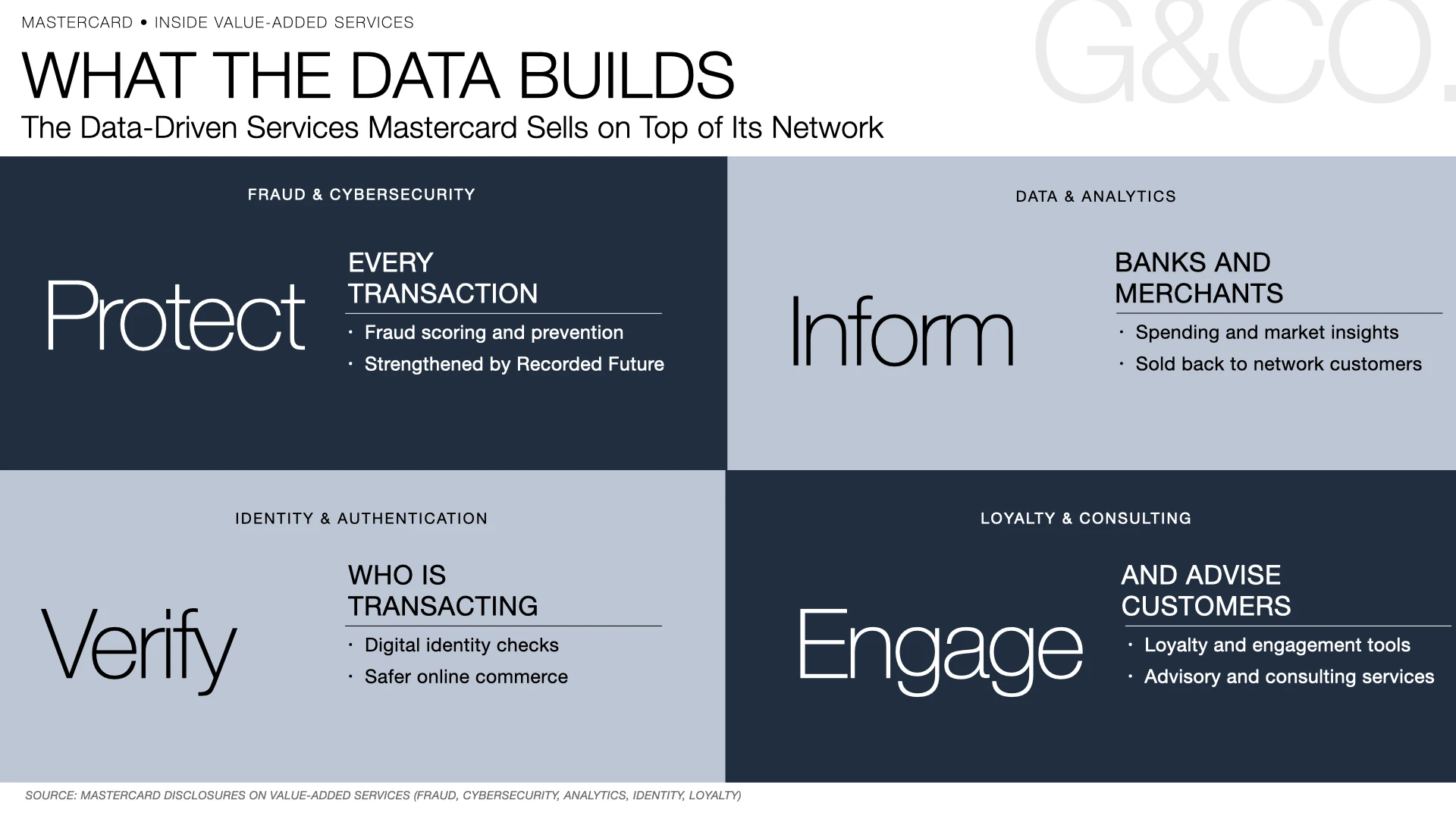
The strategic insight was that the network produces something besides fees: data. Every transaction is a signal about spending, fraud, and behavior. Mastercard realized it could turn that data into services that its own customers, the banks and merchants on its network, urgently need, above all, tools to fight fraud and to understand their customers. That reframed the company from a payments network into a platform business model: the network is the foundation, and a growing layer of data driven services sits on top of it. The services do not replace the payments business; they build on it, and they make it stronger.
Company Response
Mastercard's response was to build a large, distinct services business on top of its network, and to keep feeding it with data and acquisitions.
Turn data into services customers need.
Mastercard packages the intelligence from its network into value-added services in several areas: fraud detection and prevention, cybersecurity, digital identity and authentication, data analytics, loyalty, and consulting. These are not side projects. They solve urgent problems for the banks and merchants on Mastercard's network, especially fraud and security, which grow more pressing as commerce moves online. Because these mastercard services are built on data the company already has, they can be very profitable.
Build the "virtuous circle."
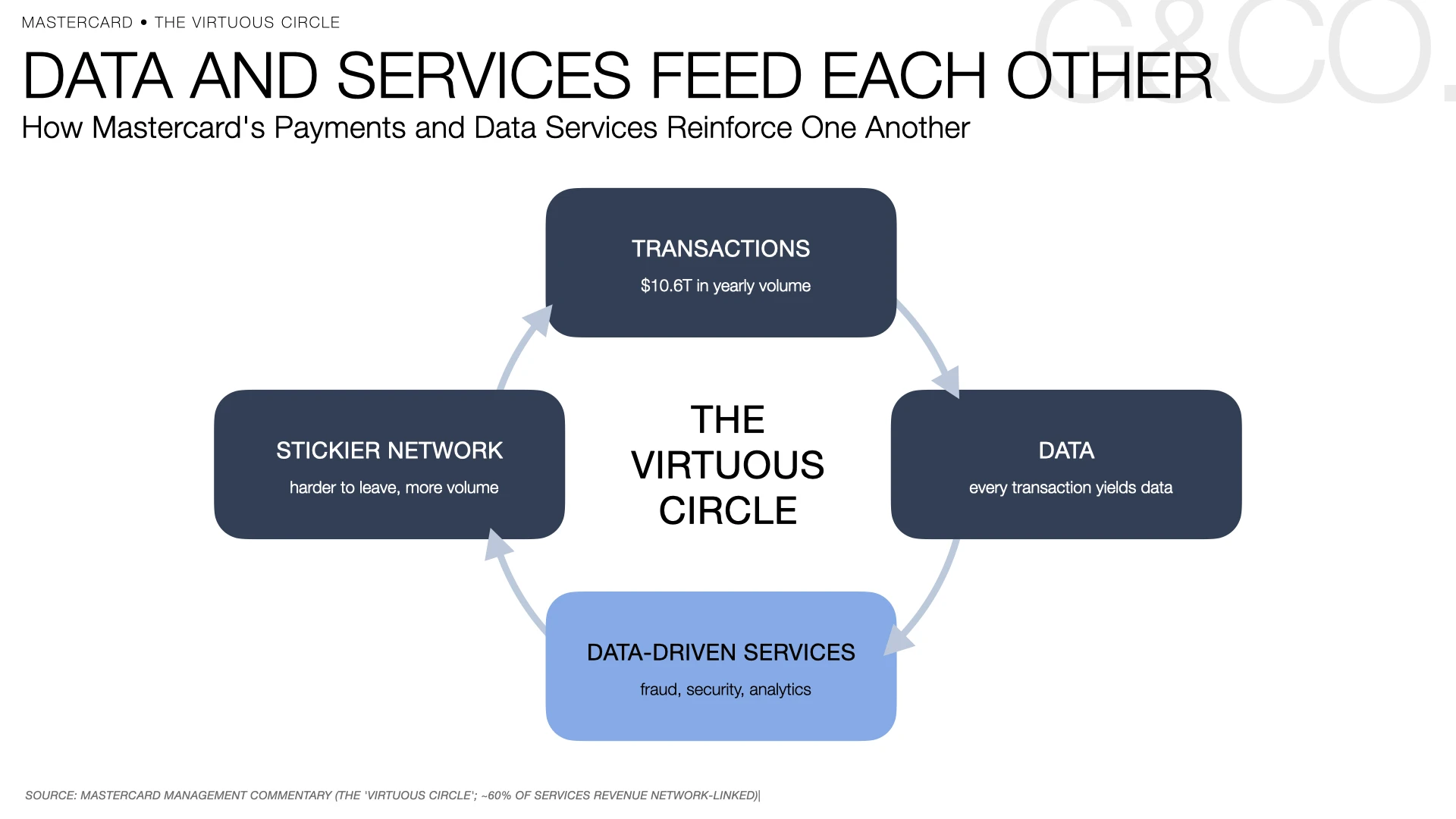
Mastercard's leadership describes the model as a virtuous circle. Every payment produces data. That data powers better services, such as sharper fraud scoring or richer analytics. Those services make Mastercard's network more valuable and stickier for customers, which attracts more transactions, which in turn produce more data. Each part strengthens the others. Roughly 60% of the services revenue is directly linked to the payment network, which is what makes the loop so powerful: the two businesses feed each other rather than competing.
Acquire to go deeper.
To strengthen the services layer, Mastercard has acquired specialist companies, including the cybersecurity and threat-intelligence firm Recorded Future. These acquisitions add capabilities Mastercard can sell across its huge customer base, accelerating data monetization and deepening the moat around the network.
Make customers harder to leave.
The strategic effect of all this is stronger customer retention. A bank that uses Mastercard only to process card payments could, in theory, switch networks. A bank that also relies on Mastercard for fraud protection, identity verification, analytics, and consulting is deeply embedded and far harder to dislodge. Every service a customer adopts raises the cost of leaving, turning data driven services into a powerful defense of the core business.

Always-On Customer Intelligence
Turn your own customer data into foresight — validate, simulate, and sense every major decision before you commit.


Results and Evidence
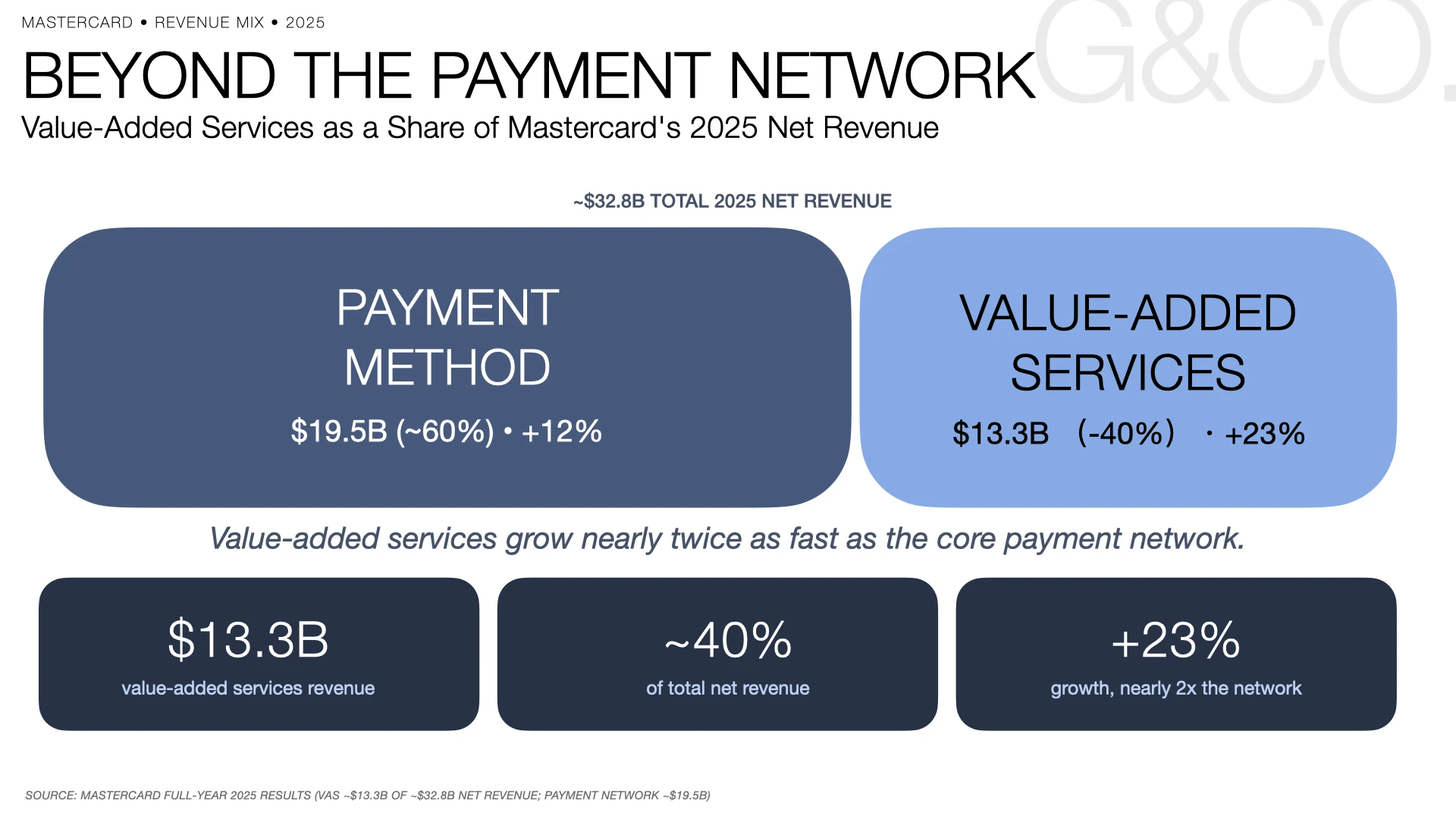
The evidence, drawn from Mastercard's 2025 reporting, shows data monetization becoming a major engine. Value-added services and solutions generated about $13.3 billion in 2025, up roughly 23% from the year before, and now make up about 40% of Mastercard's total net revenue, up from around 38% the prior year. That segment is growing nearly twice as fast as the core payment network, which grew about 12% to roughly $19.5 billion. Underneath it all, the network processed more than $10 trillion in volume, with cross-border transactions (a high-value category) growing about 15%. The pattern is consistent: the services layer keeps taking a larger share of the company and driving a growing share of its growth. These figures come from Mastercard's public reporting and are worth confirming against the latest results before publishing, since this names a real company and the numbers update quarterly.
Strategic Implications
Mastercard's story points to a broad shift: data is becoming a primary source of revenue and competitive advantage, not just a support for operations. As every industry digitizes, the companies that turn their data into services, and build the loop where data improves the product and the product generates more data, will pull ahead of those that leave their data unused. The advantage is durable because it compounds: more data makes better services, better services attract more usage, and more usage creates more data.
The lesson travels far beyond payments. Any company with a large flow of transactions or customer interactions, a retailer, a bank, a telecom, a logistics or software company, sits on data it could turn into services. What Mastercard demonstrates is the full model: build data driven services your customers need, use them to make your core offering stickier, and let the two reinforce each other in a virtuous circle. This is also a revenue diversification strategy that strengthens rather than dilutes the core, because the new business depends on the old one and protects it. The enterprises that treat data monetization as a platform to be built, rather than a report to be filed, will create both new growth and a moat that is very hard for competitors to cross. The same data-as-a-business logic drives Walmart Connect, Chase's connected commerce, and United's Kinective Media.
What Enterprise Leaders Can Learn
- Treat your data as a product, not a byproduct.
Mastercard's data was always there; the move was to build services on it and sell them. Most companies hold valuable data and use it only internally. - Sell services your own customers already need.
Mastercard succeeded because it sold fraud and analytics tools to the banks and merchants already on its network, customers with an urgent problem and an existing relationship. The best data services solve a real pain for people you already serve. - Build a loop, not a side business.
The virtuous circle works because payments and services feed each other. The strongest data monetization strengthens the core business rather than distracting from it. - Use services to defend the core.
Every service a customer adopts makes them harder to lose. Data driven services are not just new revenue; they are one of the best tools for customer retention and building a moat. - Diversify before you have to.
Mastercard built its services business while payments were still strong. Revenue diversification is easiest and most effective when it is done from a position of strength, not under pressure.
Conclusion
Mastercard is still one of the world's great payment networks, but that is no longer the whole story. By turning the data its network generates into a fast-growing business of fraud, security, and analytics services, it has built a second engine that now drives about 40% of its revenue and most of its growth, while making its core network stickier and harder to leave. The bet is that in a digital economy, the company that monetizes its data and builds the loop between data and services will out-compete the one that only moves transactions. For enterprise leaders, the takeaway is not specific to payments. It is that your data, treated as a product and built into services your customers need, can become both your fastest-growing business and your strongest defense. In a market where data is the scarcest advantage, the companies that build that platform will own growth that compounds and a moat that lasts.
Through the Acumen platform, G&CO. gives enterprise brands the intelligence to turn data into a business: which data assets customers would pay for, which services would strengthen the core relationship, and where data-driven offerings would create the most durable advantage. G&CO. is a certified minority business enterprise through the National Minority Supplier Development Council (NMSDC). For enterprise organizations with diversity inclusion requirements in their procurement process, G&CO. meets the criteria for MBE-qualified partner status.
G&CO. works with enterprise brands on the data, analytics, and platform strategy that turn information into new revenue and stronger customer relationships. If this Mastercard case study raises questions about your own data monetization, revenue diversification, or platform business model, submit an inquiry to G&CO. on our contact page or click the blue "Click to Contact Us" button in the bottom right corner of your screen. We look forward to hearing from you.
Frequently Asked Questions
What is data monetization, and how does Mastercard do it?
Data monetization means turning the data a company generates into revenue, either by selling data-driven services or by using data to create products customers will pay for. Mastercard does it by taking the data from the transactions on its network and building services on top of it, fraud detection, cybersecurity, identity verification, and analytics, which it sells to the banks and merchants that use its network. These value-added services reached about $13.3 billion in 2025, roughly 40% of the company's revenue, making Mastercard one of the clearest large-scale examples of data monetization.
What are Mastercard's value-added services?
Mastercard's value-added services are the products it sells beyond simply processing payments. They include fraud detection and prevention, cybersecurity (strengthened by acquisitions such as Recorded Future), digital identity and authentication, data analytics, loyalty programs, and consulting. These mastercard services are built largely on the data and intelligence from its payment network, and they are the fastest-growing part of the company, expanding nearly twice as fast as the core payments business.
How does Mastercard's "virtuous circle" work?
Mastercard describes its model as a virtuous circle. Every transaction on its network produces data. That data powers better services, such as more accurate fraud scoring or richer analytics. Those services make Mastercard's network more valuable and stickier for customers, which attracts more transactions, which generate still more data. Each element strengthens the others. Because roughly 60% of services revenue is tied to the payment network, the payments and services businesses reinforce each other instead of competing, which is what makes the loop so effective.
How do data-driven services improve customer retention?
Data driven services deepen the relationship between Mastercard and its customers, which improves customer retention. A bank that uses Mastercard only to process payments could consider switching networks. But a bank that also relies on Mastercard for fraud protection, identity verification, analytics, and consulting is far more embedded, and switching would mean replacing many connected services at once. Every additional service raises the cost of leaving, which turns the services layer into both a revenue source and a strong defense of the core business.
What can enterprise brands learn from this Mastercard case study?
The main lesson is that data can be a product, not just a byproduct. Any company with a large flow of transactions or customer interactions can potentially build data driven services and sell them, ideally to customers it already serves who have an urgent need. Mastercard's approach is repeatable: build services on your data, use them to make your core offering stickier, and let data and services reinforce each other in a loop. Done well, this delivers revenue diversification that strengthens the core business and a competitive moat that is very hard to copy.