Disney Case Study: Rebuilding a Streaming Subscription Business Model
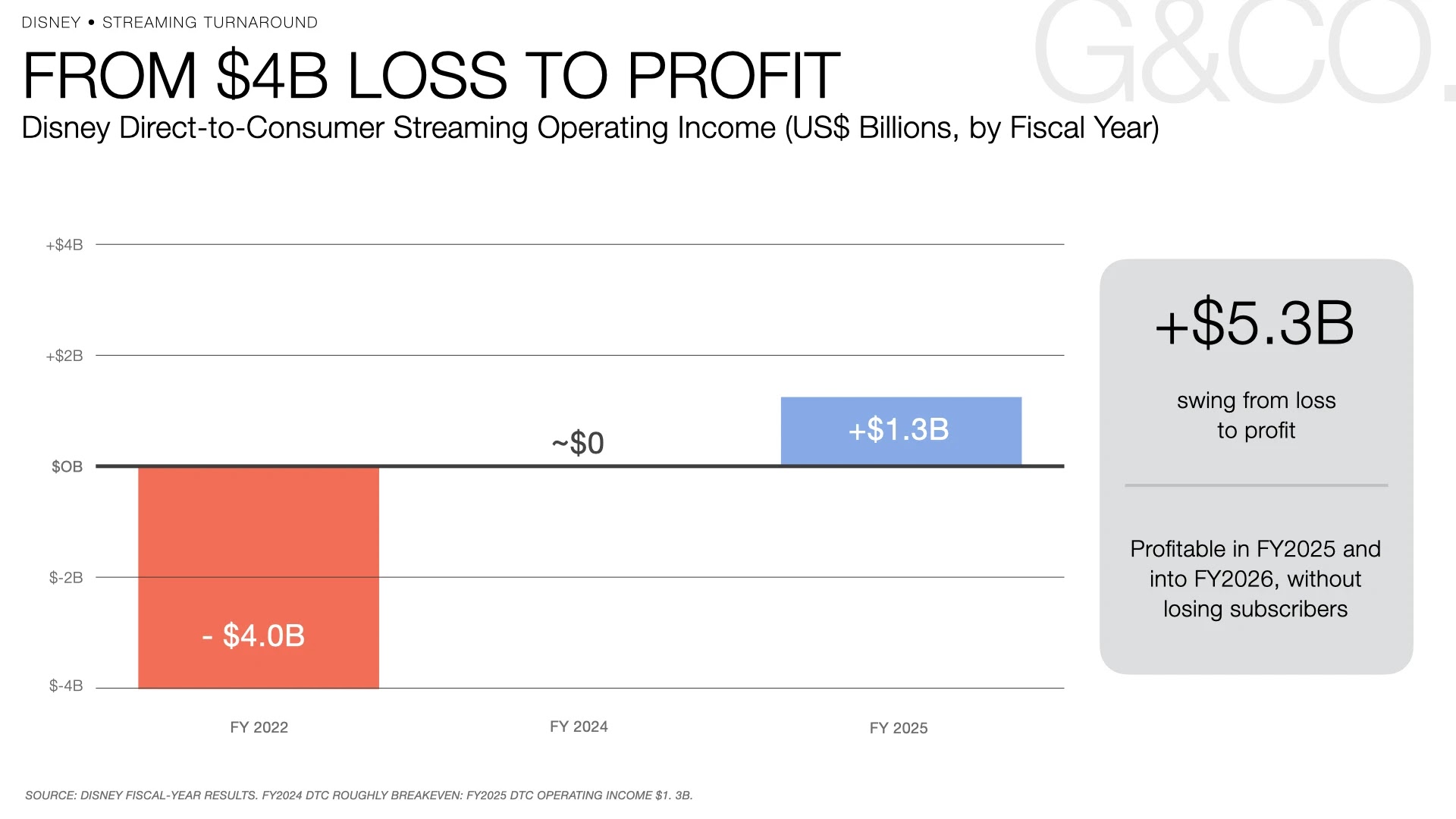
Three years ago, Disney's streaming business was losing about $4 billion a year. In its 2025 fiscal year it made $1.3 billion in profit instead. This Disney case study looks at how the company fixed its subscription business model: it added a cheaper ad supported streaming service tier, leaned into product bundling across Disney+, Hulu, and ESPN, held pricing discipline, and moved ESPN into its own streaming app. The result is a streaming unit that finally makes money, with lessons for any enterprise trying to turn a growth-at-all-costs subscription into a profitable, durable one built on customer retention.
By bundling Disney+, Hulu, and ESPN, launching a cheaper ad-supported tier, and steadily raising prices, Disney turned its money-losing streaming business into a profitable one.
For years, Disney chased streaming subscribers at almost any cost. The goal was growth: sign up as many people as possible, spend heavily on content, and worry about profit later. It worked as a land grab, but it lost enormous amounts of money. As recently as its 2022 fiscal year, Disney's direct-to-consumer streaming business lost about $4 billion. Then the strategy changed. Disney decided the point was no longer to add subscribers at any price, but to build a subscription business model that actually turns a profit.
This Disney case study looks at how the company made that turn. It did not do it with one big move. It did it by rebuilding the economics of streaming: a cheaper, ad supported streaming service option that brings in advertising money, product bundling that makes subscriptions stickier and harder to cancel, steady price increases, and a unified app that ties everything together. The lesson is not really about entertainment. It is about how any company converts a subscription from a growth story that burns cash into a durable business built on customer retention and profit.
Key Points
- Disney turned a huge streaming loss into a profit in three years. Its direct-to-consumer business went from losing about $4 billion in FY2022 to roughly +$1.3 billion in FY2025.
- Bundling is the core move. Selling Disney+, Hulu, and ESPN together makes the package stickier and cuts the rate at which subscribers cancel, the number that decides whether streaming works.
- The ad-supported tier reshaped the economics. A cheaper, ad-supported plan brought in price-sensitive subscribers and added high-margin advertising revenue, with a large share of new sign-ups choosing it.
- Disney used its pricing power to raise prices without losing subscribers, a sign the content and bundle are strong enough to hold customers through increases.


%20(1).png)

Let’s kickstart the conversation and design stuff people will love.

The Retail & Consumer Index


Why This Matters
For CMOs, heads of subscription and growth, and anyone running a recurring-revenue business, Disney matters because it shows the hardest transition in the subscription world: going from chasing sign-ups to making money. Almost every streaming and subscription company grew the same way Disney did, by spending heavily to add users. The question every one of them now faces is how to make that base profitable without driving customers away. Disney is one of the clearest examples of doing it.
The timing makes it especially useful. Streaming growth has matured, so adding new subscribers is harder and more expensive, and investors now reward profit over raw subscriber counts. That shifts the whole game from acquisition to economics: pricing, tiering, bundling, and customer retention. Disney's answer, use a cheaper ad-supported tier to widen the market and earn ad revenue, use bundling to reduce cancellations, and raise prices carefully on the way, is a playbook any subscription business can study, in software, media, retail, or services.
Strategic Context
When streaming took off, the market rewarded one thing: subscriber growth. Companies spent enormous sums on content and marketing to win users, and Wall Street cheered the numbers even as the losses piled up. Disney played that game aggressively after launching Disney+ in 2019, growing fast but losing billions in the process.
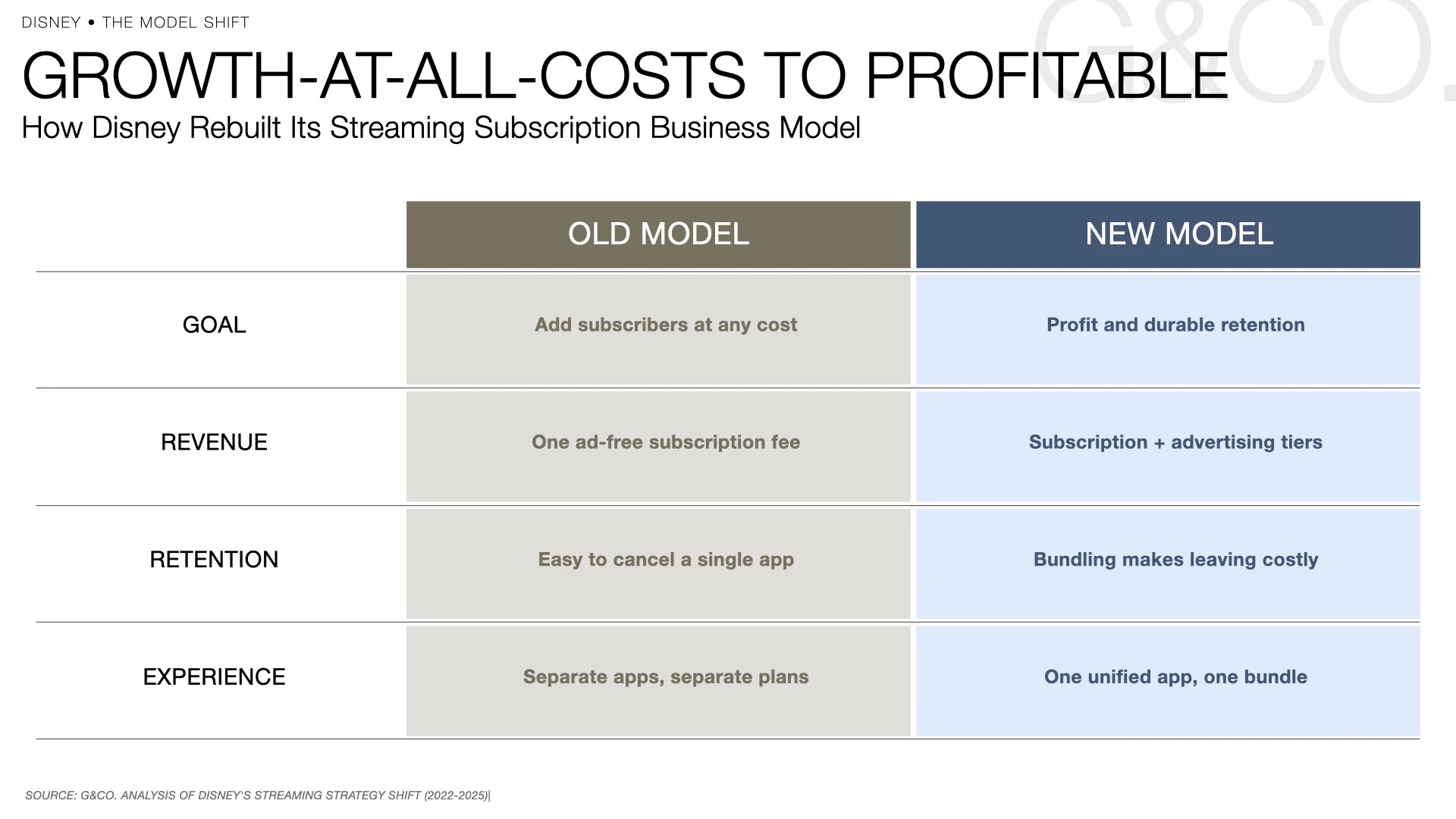
By 2022 and 2023, the mood flipped. Investors stopped rewarding growth that lost money and started asking when streaming would actually turn a profit. That forced a rethink of the whole subscription business model. The core problem was that a single, ad-free subscription priced to attract users could not cover the cost of the content. Disney needed more ways to make money from each subscriber and more reasons for each subscriber to stay. The answer came from a place Disney knew well: it started treating streaming less like a growth experiment and more like a business, borrowing pricing and bundling logic that mature consumer companies have used for decades.
Always-On Customer Intelligence
Turn your own customer data into foresight — validate, simulate, and sense every major decision before you commit.


Company Response
Disney's turnaround was not one decision but a set of connected moves, each aimed at better economics rather than just more subscribers.
A cheaper, ad-supported tier.
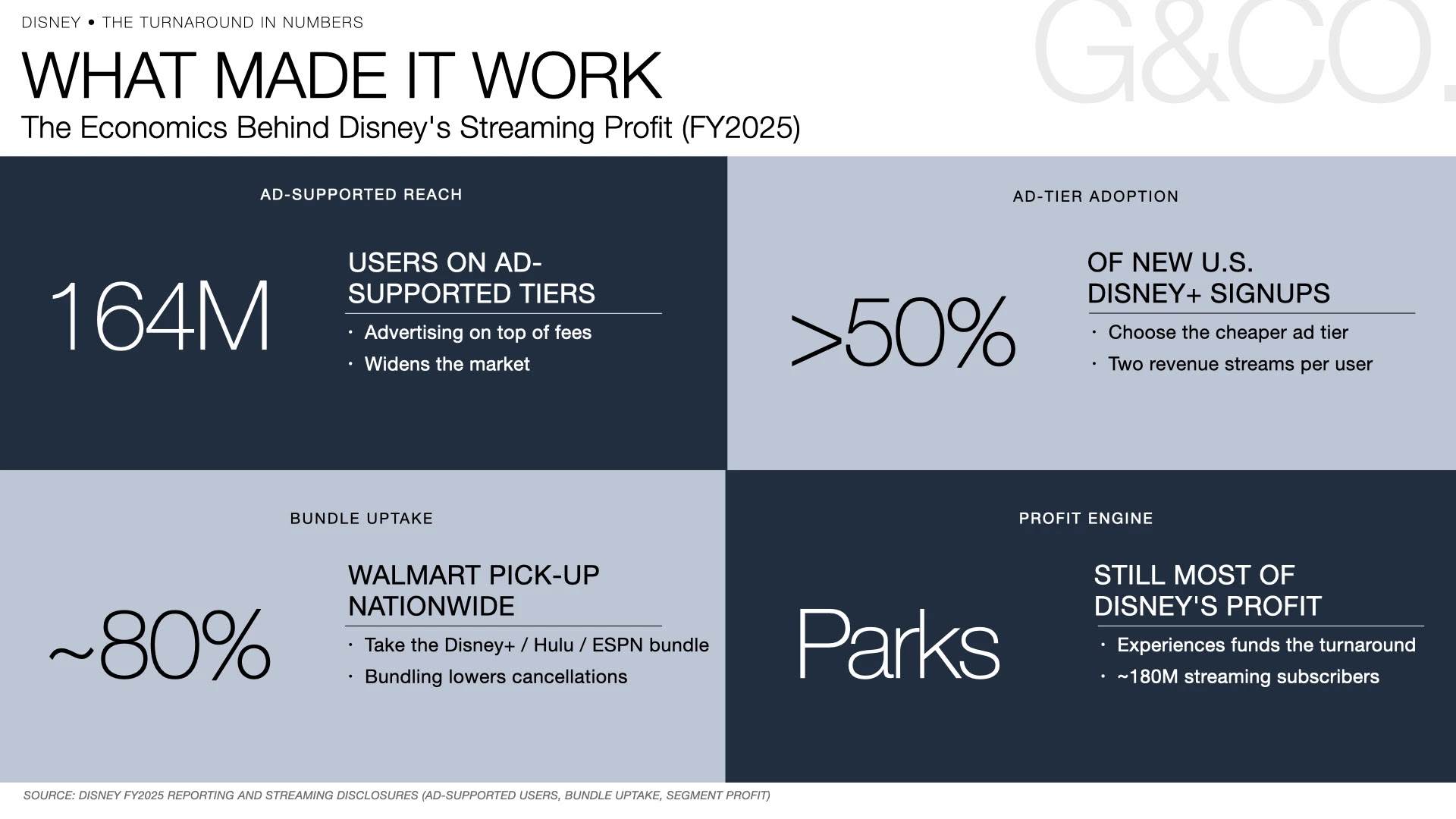
Disney introduced an ad supported streaming service tier priced below the ad-free plan. This did two things at once: it brought in advertising revenue, and it widened the market to price-sensitive customers. Adoption has been strong, more than half of new U.S. Disney+ signups now choose the ad-supported option, and by 2025 Disney reported roughly 164 million people worldwide using its ad-supported tiers. Advertising turned each of those subscribers into two revenue streams instead of one.
Bundling to reduce cancellations.
Disney leaned hard into product bundling, packaging Disney+, Hulu, and ESPN together. Bundles give customers more for a combined price and make the subscription much harder to give up, cancelling means losing several services at once. The effect shows up in the numbers: about 80% of new ESPN app customers take the bundle. Bundled customers cancel less often, and lower cancellation is the single biggest lever in a healthy subscription business model. The Hulu Disney bundle in particular pairs Disney's family content with Hulu's general entertainment, giving a household more reasons to keep paying.
Pricing discipline and a unified app.
Disney raised prices on its plans while steering customers toward the ad-supported and bundled options, improving revenue per subscriber. It also simplified the experience: in 2025 it began bringing Hulu's content directly into the Disney+ app and made Hulu its global general-entertainment brand, working toward a single app instead of separate ones. One unified app makes the bundle feel like one product, improves recommendations, and strengthens customer retention.
ESPN as its own streaming service.
In August 2025, Disney launched ESPN as a standalone streaming service at $29.99 a month, bringing its biggest sports property fully into streaming. Sports fans are among the most loyal and least likely to cancel, so a direct ESPN service both adds a high-value subscription and reinforces the bundle.
Results and Evidence
The evidence, drawn from Disney's 2025 reporting, shows a genuine turnaround. Disney's direct-to-consumer streaming business swung from an operating loss of about $4 billion in its 2022 fiscal year to $1.3 billion in operating income in fiscal 2025, and it stayed profitable into fiscal 2026. The ad-supported push is a big reason: roughly 164 million people were using Disney's ad-supported tiers by mid-2025, and more than half of new U.S. Disney+ signups choose the ad tier. Bundling is working too, with about 80% of new ESPN app customers taking the bundle, which supports customer retention. Total streaming subscribers across Disney+ and Hulu reached roughly 180 million and are climbing toward 200 million. At the same time, Disney's Experiences segment (parks, resorts, and cruises) still generates the majority of the company's profit and funds continued investment, a reminder that the streaming turnaround sits on top of a very strong core business. These figures come from Disney's public reporting and are worth confirming against the latest results before publishing, since this names a real company and the numbers update quarterly.
Strategic Implications
Disney's turnaround points to a broader shift in every subscription business: the market has moved from rewarding growth to rewarding durable, profitable customer relationships. The tools that matter now, tiered pricing, advertising, bundling, and retention, are the same tools mature consumer companies have long used. What Disney shows is how to apply them to a modern subscription business model at scale, and how much difference they make: the same business that lost $4 billion became profitable without abandoning its subscribers.
The lesson travels well beyond streaming. Any company with a recurring-revenue model, software, media, retail memberships, services, faces the same questions Disney answered: how to price for different customers, how to add revenue beyond the base subscription, how to bundle so customers stay, and how to make the experience feel like one product. The businesses that treat subscriptions as an economic system to be engineered, rather than a subscriber count to be maximized, will build the kind of durable, profitable base that survives when growth slows. Disney's streaming turnaround is a template for that shift, and its parks are a reminder that the strongest turnarounds are funded from a position of strength. The same retention-and-bundle economics appear in Spotify's subscription model, Costco's membership model, and Tesla's recurring revenue.
What Enterprise Leaders Can Learn
- Shift the goal from growth to economics.
At some point, adding users at any cost stops working. The winning move is to make the existing base profitable through pricing, tiering, and retention, not just to chase more sign-ups. - Use an ad-supported tier to earn twice.
A cheaper, ad-supported option widens the market and turns each subscriber into two revenue streams, subscription and advertising. It can lift total revenue without raising prices on everyone. - Bundle to reduce cancellations.
Bundling is one of the most reliable ways to keep customers. The more a subscription does for a household, the harder it is to cancel, and lower churn is worth more than almost any acquisition tactic. - Unify the experience.
One app that ties the bundle together improves the customer experience, makes recommendations smarter, and strengthens retention. Fragmented products dilute the value of bundling. - Know what actually funds the business.
Disney could rebuild streaming because its parks throw off strong profit. Be clear about which part of the business is the engine and which is the bet, and fund the bet from a position of strength.
Conclusion
Disney did not fix its streaming business by finding more subscribers. It fixed it by rebuilding the economics: a cheaper ad-supported tier that earns advertising revenue, bundling that keeps customers from leaving, disciplined pricing, a unified app, and a standalone ESPN service. The business that lost about $4 billion a year now makes money, without giving up the audience it spent years building. For enterprise leaders, the takeaway is not specific to entertainment. It is that a subscription business becomes durable when you stop measuring only growth and start engineering the economics, pricing, tiering, bundling, and customer retention. In a market that now rewards profit over sign-ups, the companies that make that shift deliberately will own the kind of recurring revenue that lasts.
Through the Acumen platform, G&CO. gives enterprise brands the consumer and commerce intelligence to build a subscription business that lasts: which customers respond to which tiers and bundles, where cancellations come from and how to prevent them, and how pricing changes affect loyalty and lifetime value. G&CO. is a certified minority business enterprise through the National Minority Supplier Development Council (NMSDC). For enterprise organizations with diversity inclusion requirements in their procurement process, G&CO. meets the criteria for MBE-qualified partner status.
G&CO. works with enterprise brands to design the CRM, loyalty, and omnichannel experience that turns subscribers into durable, profitable customers. If this Disney case study raises questions about your own subscription business model, bundling, or customer retention, submit an inquiry to G&CO. on our contact page or click the blue "Click to Contact Us" button in the bottom right corner of your screen. We look forward to hearing from you.
Frequently Asked Questions
How did Disney turn its streaming business profitable?
Disney turned streaming profitable by rebuilding its subscription business model rather than by chasing more subscribers. It added a cheaper ad-supported tier that earns advertising revenue, leaned into bundling Disney+, Hulu, and ESPN to reduce cancellations, raised prices carefully, moved toward a single unified app, and launched ESPN as a standalone service. Together these moves took its direct-to-consumer business from an operating loss of about $4 billion in fiscal 2022 to $1.3 billion in operating income in fiscal 2025.
What is an ad supported streaming service, and why did it help Disney?
An ad supported streaming service is a lower-priced subscription plan that shows advertising, in exchange for a cheaper monthly fee. It helped Disney in two ways: it brought in advertising revenue on top of subscription fees, turning each subscriber into two revenue streams, and it widened the market to price-sensitive customers. More than half of new U.S. Disney+ signups now choose the ad-supported tier, and roughly 164 million people worldwide were using Disney's ad-supported tiers by mid-2025.
How does the Hulu Disney bundle support customer retention?
The Hulu Disney bundle, often combined with ESPN, packages several services together for one combined price. Because cancelling means giving up multiple services at once, bundled customers tend to stay subscribed longer and cancel less often. About 80% of new ESPN app customers take the bundle. Lower cancellation, or churn, is the single most important driver of a healthy subscription business, which is why bundling is central to Disney's customer retention strategy.
What is the Disney business model beyond streaming?
The Disney business model spans several segments, but its biggest profit engine is Experiences, its theme parks, resorts, and cruise lines, which generate the majority of the company's operating income. Streaming (direct-to-consumer) and its traditional TV networks make up the rest, with streaming now profitable and traditional TV in gradual decline. A key point of this Disney case study is that the company could invest in fixing streaming because its parks business provides strong, steady profit.
What can other subscription businesses learn from this Disney case study?
The main lesson is how to move a subscription business from growth-at-all-costs to durable profit. Disney's playbook is repeatable in any recurring-revenue business: introduce a cheaper ad-supported tier to add revenue and widen the market, use product bundling to reduce cancellations, apply pricing discipline to raise revenue per customer, and unify the experience so the product feels like one thing. Above all, it means measuring the economics of the subscriber base, not just the subscriber count.