Eli Lilly Case Study: LillyDirect and the Rise of DTC Pharma
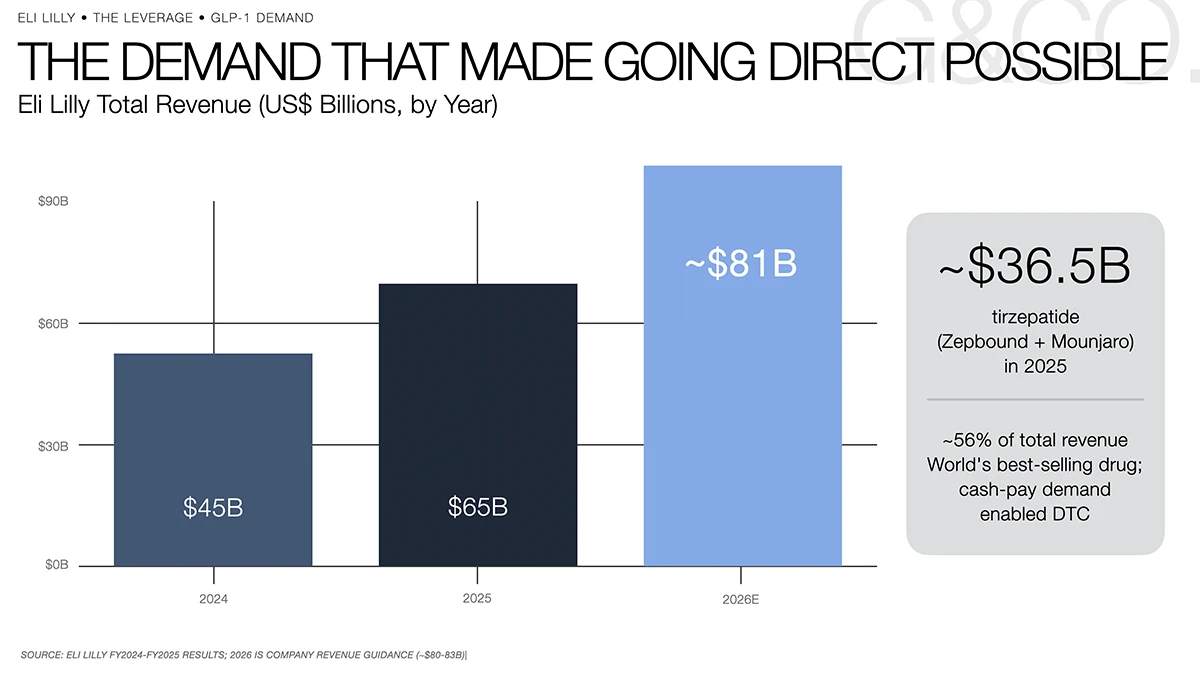
This Eli Lilly case study looks at LillyDirect, the direct-to-consumer platform Lilly launched in January 2024 to connect patients with telehealth doctors and ship its own medicines to their door, skipping much of the usual pharmaceutical distribution chain. Backed by huge demand for its GLP-1 drugs, Zepbound and Mounjaro brought in roughly $36.5 billion in 2025, about 56% of Lilly's $65.2 billion in revenue, LillyDirect uses clear self-pay pricing to go around pharmacy benefit managers and insurers and reach patients directly. It is a study in DTC pharma: how a drugmaker with a standout product went around the middle of its own industry to own the patient relationship.
Eli Lilly built LillyDirect, becoming one of the first pharmaceutical companies to bypass the middlemen and sell medication directly to consumers through their own platform.
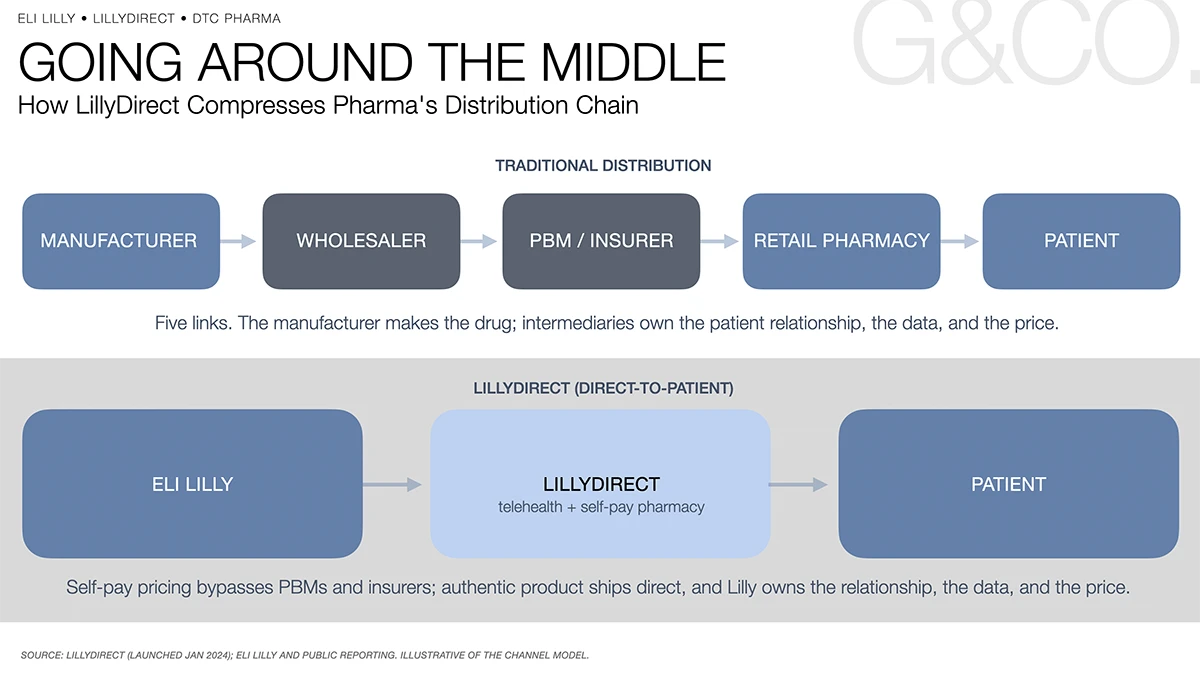
For a century, drugmakers sold through a fixed chain. A drug moved from the maker to a wholesaler, through the pharmacy benefit managers and insurers who decided what was covered and at what price, to the pharmacy that handed it over, and only then to the patient. The drugmaker made the product; the companies in between owned the relationship with the person who took it. Eli Lilly decided that setup was no longer a given.
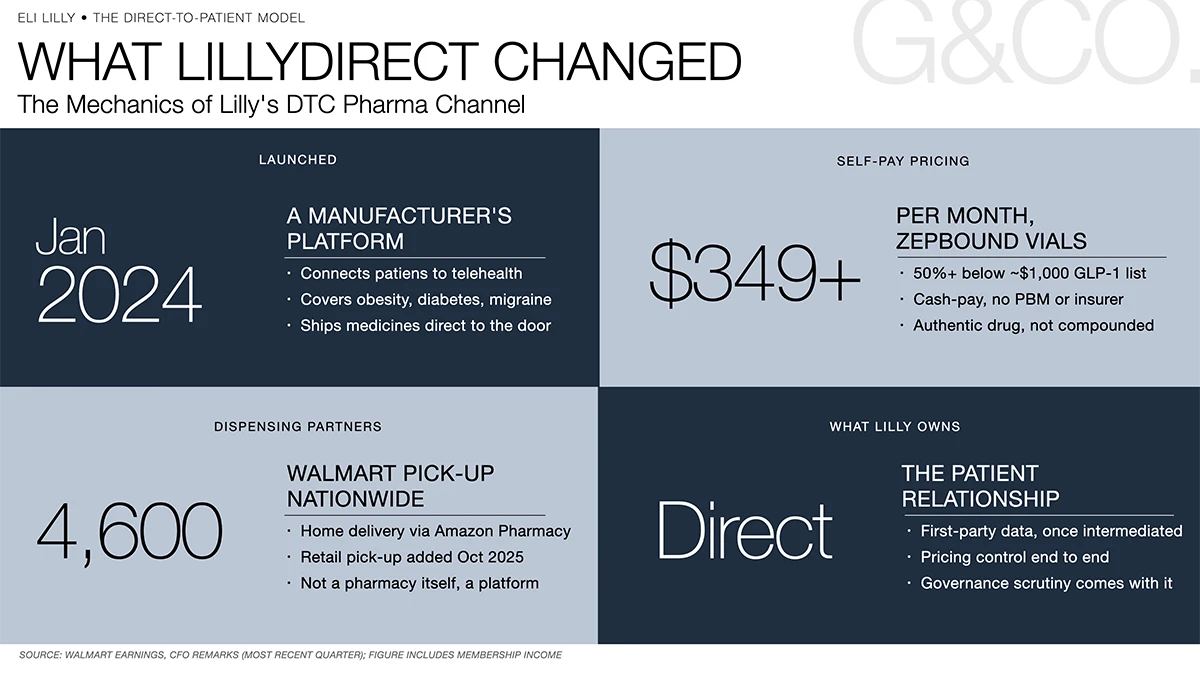
In January 2024, Lilly launched LillyDirect, a direct-to-consumer platform that connects patients with independent telehealth doctors and delivers its medicines to their door, shortening a chain that had stood for decades. This Eli Lilly case study looks at how a drugmaker built a DTC pharma channel around the middle of its own industry, why the timing depended on a surge in demand, and what the model teaches any company that has only ever reached its end customer through middlemen. The lesson is not specific to medicine. It is that when demand is strong enough and the product stands out enough, the company that owns the direct relationship with the customer, along with the data and pricing that come with it, holds an advantage the middle of the chain cannot take back.
Key Points
- Eli Lilly built LillyDirect to sell directly to patients, a drugmaker going around the pharmacies and benefit managers that normally stand between it and the people taking its medicines.
- The move is about owning the customer relationship and the data, not just the sale. Going direct gives Lilly a line to patients, and the information about how they actually use its drugs, that it never had before.
- It started with the drugs where direct access matters most, its high-demand weight-loss and diabetes medicines, where affordability and convenience most affect whether patients stay on treatment.
- It's a structural bet, not a marketing channel. Cutting out middlemen challenges the decades-old system of how prescription drugs reach patients in the U.S.


%20(1).png)

Let’s kickstart the conversation and design stuff people will love.

The Retail & Consumer Index


Why This Matters
For commercial leaders, strategists, and anyone whose business reaches customers through middlemen, Lilly matters because it shows that going around those middlemen is now possible even in one of the industries most crowded with them. Medicines sit behind wholesalers, pharmacy benefit managers, insurers, and pharmacies, layers that grew up precisely because drugmakers historically could not reach patients directly. LillyDirect shows those layers can be bypassed when a drugmaker is strong enough to go around them.
The urgency comes from the demand behind it. GLP-1 drugs for diabetes and obesity have become one of the fastest-growing drug markets ever, and much of that demand is cash-pay: patients who are not covered for these drugs or whose plans do not pay for them. That created a rare opening, a huge group of people willing to pay directly for a product, which is exactly when a direct-to-consumer channel makes sense. Lilly saw that a telehealth platform connecting patients to doctors, paired with home delivery, could serve that demand while capturing a relationship the old chain never gave the drugmaker. For any company, the signal is clear: strong, specific demand is what makes going direct work.
Strategic Context
The traditional way of selling medicine was built for a world of insurance. Drugmakers focused on getting their drug covered by insurers and pharmacy benefit managers (PBMs), who negotiated discounts and decided which products patients could actually afford. In that world, the drugmaker's real customer was the insurer, not the patient, and the patient relationship belonged to the pharmacy and the health plan.
Two things cracked that model open. First, the GLP-1 boom created demand at a scale the system struggled to handle, with shortages, coverage gaps, and a wave of copycat and counterfeit versions filling the space. Second, because so many obesity patients were paying out of pocket anyway, the insurer's role as gatekeeper disappeared for that group. Lilly saw that it could serve those patients directly, with the real drug and clear pricing, and in doing so build a direct-to-consumer pharma channel the old middlemen had no part in. LillyDirect was how it did this: not a replacement for the whole system, but a second path to the patients the old model was failing.
Always-On Customer Intelligence
Turn your own customer data into foresight — validate, simulate, and sense every major decision before you commit.


Company Response
Lilly's answer was to build a platform, not just a mail-order option. LillyDirect brings together three things that used to sit in separate hands.
A telehealth platform for getting care.
LillyDirect connects patients with independent telehealth doctors and offers tools, including a Healthgrades-powered search, to find local in-person care. The doctor still makes the prescribing decision, but the platform removes the hassle of finding a clinician and then a pharmacy separately. This telehealth layer is what makes the model direct-to-consumer rather than just direct-to-pharmacy: it handles how a patient gets a prescription, not only how they fill it.
Delivery and dispensing.
LillyDirect is not itself a pharmacy. It sends prescriptions to pharmacy partners and offers home delivery, working with pharmacies including Amazon Pharmacy and others. In October 2025, Lilly and Walmart announced the first retail pick-up option for LillyDirect's self-pay Zepbound vials, available at Walmart's nearly 4,600 pharmacies, bringing the direct channel into physical stores for the first time.
Clear self-pay pricing.
The heart of the model is cash-pay pricing that skips insurance and PBMs. Lilly has offered Zepbound single-dose vials through LillyDirect starting at $349 a month for the lowest dose, at least 50% below the roughly $1,000-a-month list price of these branded drugs, available to anyone with a valid prescription for an approved use, no matter their insurance. Selling the real drug directly also gives patients an alternative to the copycat and counterfeit versions that spread during shortages.
Results and Evidence
The foundation for the strategy shows up in Lilly's financials, which reveal the demand that made a direct channel possible. In 2025, Lilly reported $65.2 billion in revenue, up 45% from the year before, driven overwhelmingly by its tirzepatide drugs: Mounjaro brought in roughly $23 billion (up about 99%) and Zepbound roughly $13.5 billion (up about 175%), for combined sales near $36.5 billion, about 56% of total revenue. Tirzepatide became the world's best-selling drug in 2025, and Lilly expects revenue of roughly $80 to $83 billion for 2026. LillyDirect has grown steadily since its January 2024 launch, adding pharmacy partners, lowering and widening its self-pay pricing, and adding Walmart pick-up in late 2025. These figures come from Lilly's public reporting and reputable coverage; because pricing and partnerships change often here, confirm the latest details before publishing.
Strategic Implications
Lilly's model connects to a bigger shift across industries: the shrinking distance between the companies that make products and the people who use them. Direct-to-consumer selling has already reshaped retail, media, and consumer goods. LillyDirect shows the same idea reaching even into medicine, one of the industries most crowded with middlemen. The takeaway is that layers built to solve a reach problem become vulnerable once the maker can reach the customer directly, and once the customer prefers it that way.
The lesson carries over, but only under certain conditions. The ingredients Lilly used, a standout product, strong demand, a group willing to buy directly, and the ability to actually deliver, are what any company needs to go around its own middlemen. Lilly also shows the catch: direct models in regulated or trust-sensitive fields carry real risk around oversight. A 2025 U.S. Senate inquiry into drugmaker-linked telehealth raised questions about whether these platforms push patients toward pricier branded drugs and how thorough the medical visits really are. That scrutiny is not a side note; it is the central tension of DTC pharma. It signals that the winners will be the companies that pair the convenience of a direct model with clear medical and pricing honesty. As more drugmakers build direct channels, the lasting advantage will belong to those who own the customer relationship without appearing to put their own interest ahead of the customer's. The same direct-relationship bet runs through AstraZeneca's post-prescription strategy, Tesla's ongoing customer model, and Nubank's direct-to-customer banking.
What Enterprise Leaders Can Learn
- Strong, specific demand is what unlocks a direct channel.
Lilly could go direct because a large, motivated group was willing to pay for its product outside the insurance system. Direct-to-consumer works where demand is strong and specific, not everywhere at once. - Own the relationship the middlemen hold.
The real prize is not just a new sales channel. It is the customer relationship, the first-party data, and the control over pricing that the middle of the chain used to capture. - Handle the whole journey, not one step.
LillyDirect works because it pairs telehealth access (how the patient qualifies) with home delivery (how they get the drug). A direct model has to solve the full journey, not just one part of it. - Use clear pricing as the way in.
Cash-pay, transparent pricing is what let Lilly skip the insurers. Clear, direct pricing is often what makes going around the middlemen believable to customers. - Plan for the hard questions.
A company steering customers toward its own products invites scrutiny. Going direct means owning the trust and conflict-of-interest questions that come with it, before regulators and customers raise them.
Conclusion
Eli Lilly did not just open a new sales channel. It challenged how medicine reaches patients in the first place. By launching LillyDirect, a telehealth-enabled channel paired with home delivery and clear self-pay pricing, Lilly used the strength of the best-selling drug franchise in the world to go around the wholesalers, benefit managers, and other middlemen that had always stood between a drugmaker and the patient. The bet is that owning the direct relationship with the customer, along with the data and pricing that come with it, is a stronger long-term advantage than fighting for coverage inside a system someone else controls. For enterprise leaders, the takeaway is not to copy the medicine-specific details but to read the pattern: when demand is strong and a product stands out, the middlemen between you and your customer are no longer guaranteed their place, and the company that builds the direct relationship first, and handles it responsibly, will hold an advantage the middle of the chain cannot easily win back.
Through the Acumen platform, G&CO.Health gives enterprise pharmaceutical and healthcare brands the consumer and commerce intelligence to guide direct-to-consumer and channel decisions with evidence instead of guesswork: where direct demand is strong enough to support a direct model, how patients and customers see a brand's direct offering, and which positioning and pricing shifts would most improve results. G&CO.Health is a certified minority business enterprise through the National Minority Supplier Development Council (NMSDC). For enterprise organizations with diversity inclusion requirements in their procurement process, G&CO.Health meets the criteria for MBE-qualified partner status.
G&CO.Health works with enterprise pharmaceutical and healthcare brands to design the brand, commerce, and channel strategy that decides whether a direct-to-consumer model strengthens the customer relationship and the business result. If this Eli Lilly case study raises questions about your own approach to DTC pharma, direct-to-patient channels, or distribution strategy, submit an inquiry to G&CO.Health on our contact page or click the blue "Click to Contact Us" button in the bottom right corner of your screen. We look forward to hearing from you.
Frequently Asked Questions
What is LillyDirect?
LillyDirect is Eli Lilly's direct-to-consumer healthcare platform, launched in January 2024. It connects patients who have a prescription with independent telehealth doctors and with tools to find local care, and it arranges for Lilly medicines to be dispensed and delivered, working with pharmacy partners including Amazon Pharmacy and, for retail pick-up, Walmart. It covers conditions including obesity, diabetes, and migraine, and offers clear self-pay pricing for medicines such as Zepbound. LillyDirect is not itself a pharmacy; it is the platform that brings the steps of getting and filling a prescription together in one place.
What is DTC pharma, and why is LillyDirect a leading example?
DTC pharma, or direct-to-consumer pharma, is when a drugmaker reaches patients directly rather than only through the usual chain of wholesalers, pharmacy benefit managers, insurers, and pharmacies. LillyDirect is a leading example because it combines a telehealth platform for getting care with home delivery and cash-pay pricing. That shortens a decades-old chain and lets the drugmaker own the patient relationship, the data, and the pricing. It is one of the clearest cases of a large drugmaker building a direct channel around its own industry's middlemen.
How does LillyDirect's self-pay pricing work?
LillyDirect offers clear self-pay, or cash-pay, pricing that does not run through insurance or pharmacy benefit managers. For Zepbound single-dose vials, for example, Lilly has offered pricing starting at $349 a month for the lowest dose, at least 50% below the roughly $1,000-a-month list price of these branded drugs, available to anyone with a valid prescription for an approved use, regardless of insurance. Because pricing here changes often, patients and analysts should confirm current figures directly. This case study mentions pricing to explain the business model, not as medical or purchasing advice.
How does LillyDirect change pharmaceutical distribution?
Normally, a medicine passes from the drugmaker to a wholesaler, through pharmacy benefit managers and insurers, to a pharmacy, and finally to the patient. LillyDirect shortens that path: a patient connects with a telehealth doctor through the platform, and the real Lilly medicine is delivered directly, with self-pay pricing that skips the insurers for those who use it. It does not replace the whole system, but it creates a second, direct-to-patient path for the patients the old model serves poorly, which is what makes it a real shift in pharmaceutical distribution.
What can enterprise brands outside pharma learn from this Eli Lilly case study?
The transferable lesson is that going around the middlemen becomes possible when demand is strong and specific and the product stands out enough that customers will buy directly. Lilly's model shows the pattern: pair the way a customer qualifies for and gets a product (here, telehealth access) with direct delivery, use clear pricing as the way past the middlemen, and treat the customer relationship and data as the real prize. It also comes with a warning: going direct in a trust-sensitive field means owning the oversight and conflict-of-interest questions that come with steering customers toward your own products.