Spotify Case Study: Personalization Strategy as a Growth Engine
Spotify built its business on personalization: using AI to learn what each of its 700 million-plus listeners likes and give them a music and audio experience that feels made for them. This Spotify case study looks at how that personalization strategy, from Discover Weekly to the AI DJ, drives the user engagement and retention that turned years of losses into the company's first full-year profit in 2024. It is a study in ai recommendations and ai in customer experience at massive scale, and in how a well-built spotify business model turns a great experience into durable, profitable growth.
Personalization is how Spotify keeps customers: it uses AI tools like Discover Weekly and its AI DJ to learn each listeners’ preference and tailor what they're offered.
Most streaming services offer the same enormous library. Spotify has more than 100 million tracks, but so do its rivals. What sets Spotify apart is not the size of its catalog, it is how well the service knows each listener. Spotify uses AI to learn what a person likes, when they like it, and what they might enjoy next, and then builds each user a music and audio experience that feels personal. That personalization is the product.
This Spotify case study looks at how the company turned personalization into a growth engine. The story is not really about music. It is about how AI-driven personalization builds user engagement, how engagement builds loyalty and keeps people from cancelling, and how that loyalty finally turned a business that lost money for years into a profitable one, with its first full-year profit in 2024. For any company that wants to use personalization and AI to deepen customer relationships, Spotify is one of the clearest examples of how a great, tailored experience becomes a durable business.
Key Points
- Spotify competes on personalization, not catalog size. Every rival has the same 100 million-plus songs; Spotify's edge is how well it uses AI to tailor the experience to each listener.
- AI recommendations turn listening data into a personal experience: Discover Weekly, the AI DJ, and tailored playlists use each person's habits to surface the right music and podcasts.
- That personalization drives user engagement and keeps people subscribed. The more the service feels made for you, the more you listen and the less likely you are to cancel, the foundation of a subscription business.
- After years of losses, personalization-driven engagement helped Spotify post its first full-year profit in 2024 (about €1.1 billion), with more than 700 million users and 281 million subscribers.
Why This Matters
For CMOs, heads of customer experience, product leaders, and anyone investing in AI, Spotify matters because it shows what personalization done well actually delivers: not just a nicer experience, but measurable engagement, loyalty, and profit. Almost every company now talks about personalization and AI. Spotify is one of the few that has turned it into the core of the product and the reason customers stay.
The timing makes it especially relevant. AI has made it possible to personalize experiences at a scale and quality that was impossible a few years ago, and customers increasingly expect it. The question for most enterprises is no longer whether to use AI in customer experience, but how to do it in a way that genuinely helps the customer and pays off for the business. Spotify's answer, use AI to understand each person and tailor the experience, then let that experience drive engagement and retention, is a model any brand with a large customer base and rich data can learn from.



.png)
%20(1).png)

Let’s kickstart the conversation and design stuff people will love.

The Retail & Consumer Index


Strategic Context
Spotify entered a brutal business. Music streaming has high, largely fixed content costs: the company pays rights holders a large share of its revenue, which historically left thin margins and years of losses. Every major streaming service offers a similar catalog, so competing on library size alone is a losing game, and competing on price only makes the margins worse.
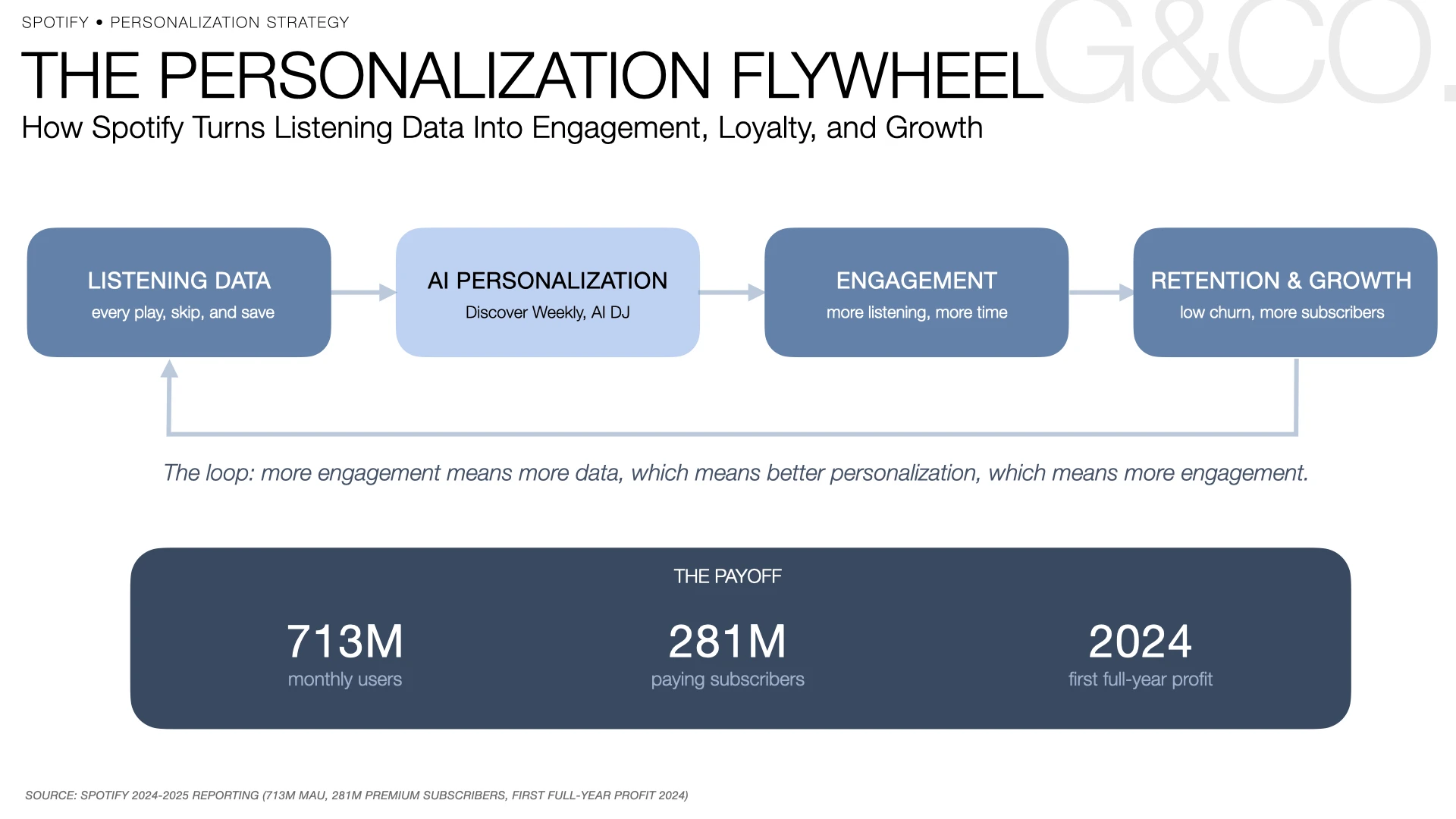
Spotify's answer was to compete on experience instead of catalog. If every service has the same songs, the winner is the one that helps you find the music and audio you love with the least effort. That reframed the whole spotify business model around personalization: the more the service understands each listener, the more valuable it becomes to them, the longer they stay, and the more the company can eventually earn from each one. Personalization was not a feature added on top of the product. It became the product's main reason to exist, and the foundation for turning a hard business into a profitable one.
Company Response
Spotify's response was to build personalization into the core of the experience and to keep pushing it with AI. Several connected pieces work together.
A recommendation engine at the center.
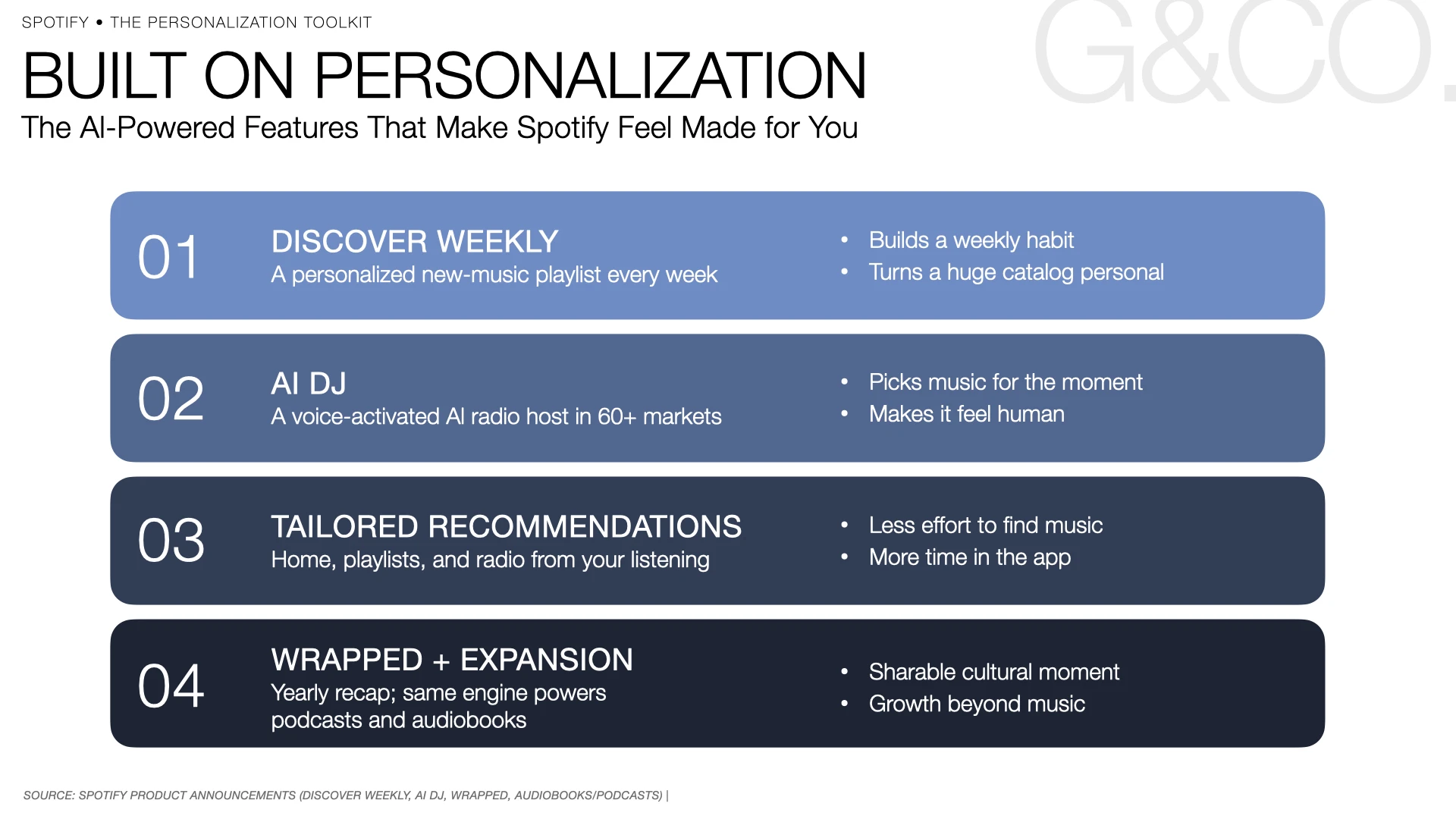
Spotify's best-known feature, Discover Weekly, gives every user a personalized playlist of new music each week based on their listening. Alongside it, personalized playlists, home-screen recommendations, and radio all use the same idea: turn a person's listening history into suggestions tailored to them. These ai recommendations are what make a catalog of 100 million tracks feel manageable and personal rather than overwhelming.
AI that makes it feel human.
Spotify has pushed personalization further with generative AI. Its AI DJ, now available in 60-plus markets and voice-activated, acts like a personal radio host, choosing music for the moment and talking the listener through it. Spotify has also introduced AI-narrated audiobooks and, in 2025, made its personalization available inside ChatGPT, so people can get tailored music and podcast suggestions there too. These are concrete examples of AI in customer experience: not AI for its own sake, but AI that makes the experience feel more personal and effortless.
Personalization that drives engagement and loyalty.
The payoff of all this is user engagement. The more the service tailors itself, the more people listen, and the more they listen, the more data Spotify has to personalize further, a self-reinforcing loop. Spotify Wrapped, the yearly personalized summary of each user's listening that people love to share, turns that engagement into a cultural moment and free marketing. High engagement is what keeps churn low, and low churn is what let Spotify raise prices (in the U.S., from $11.99 to $12.99 a month) without losing many customers, a clear sign of how sticky the personalized experience has become.
The same engine powers expansion.
Personalization is not limited to music. The recommendation engine now helps users discover podcasts (with millions of titles) and audiobooks (hundreds of thousands of titles), pulling people into higher-margin content and turning Spotify from a music app into a broader audio platform. The engine that learned your music taste helps grow the whole business.
Always-On Customer Intelligence
Turn your own customer data into foresight — validate, simulate, and sense every major decision before you commit.


Results and Evidence
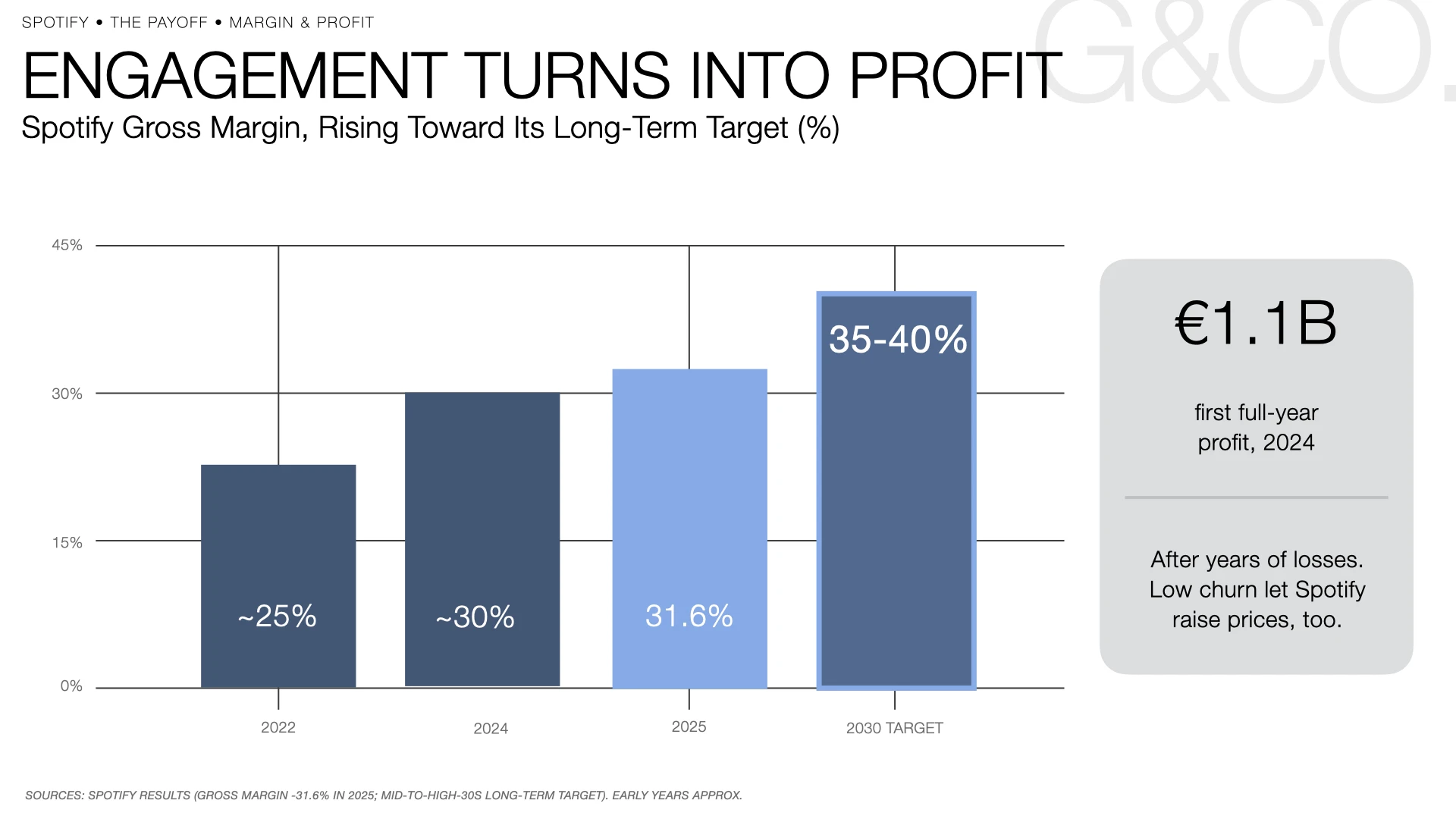
The evidence, drawn from Spotify's 2025 reporting, shows personalization translating into scale and, finally, profit. Spotify surpassed 700 million monthly active users in 2025, reaching about 713 million (up 11% year over year), with 281 million paying Premium subscribers (up 12%). After years of losses, the company posted its first full-year profit in 2024, roughly €1.1 billion in net income, and kept improving in 2025, with quarterly revenue around €4.3 billion, operating income of €582 million, and gross margin rising to about 31.6%, on the way toward a longer-term target in the mid-to-high 30s. The pricing power is telling: Spotify raised prices with very little customer loss, which only happens when the experience is sticky enough that people do not want to leave. These figures come from Spotify's public reporting and are worth confirming against the latest results before publishing, since this names a real company and the numbers update quarterly.
Strategic Implications
Spotify's story points to a broader shift: personalization is moving from a nice-to-have feature to the core of how customer experiences are built and how companies compete. As AI makes tailored experiences cheaper and better, the brands that use it to genuinely understand and serve each customer will pull ahead of those offering the same experience to everyone. The competitive advantage is no longer only what you sell, but how well the experience fits each person.
The lesson travels well beyond audio. Any company with a large customer base and meaningful data, in retail, media, financial services, travel, or software, has the raw materials for a personalization strategy like Spotify's. What Spotify demonstrates is the full loop: use AI to turn customer data into a tailored experience, let that experience drive engagement and retention, and let engagement fund both profit and expansion into new areas. The businesses that treat personalization as the center of the product, rather than a marketing add-on, will build the kind of loyalty that is hard to copy and expensive to compete with. Spotify shows how much value that loop can create when it is built well and powered by AI. The same personalization advantage shows up in Disney's streaming turnaround, Sephora's connected retail, and Moderna's individualized medicine.
What Enterprise Leaders Can Learn
- Compete on experience, not just on what you offer.
When competitors offer similar products, the winner is often the one that makes the experience feel tailored and effortless. Personalization can be the difference even when the underlying product is the same. - Turn your data into a better experience.
Spotify's advantage is a loop: usage generates data, data powers ai recommendations, better recommendations drive more usage. Any company with rich customer data can build a version of that loop. - Use AI to help the customer, not to look modern.
Spotify's AI DJ and recommendations work because they make the experience genuinely better. The test for AI in customer experience is whether it helps the customer, not whether it sounds impressive. - Let engagement drive loyalty and pricing power.
Deep user engagement is what keeps churn low, and low churn is what lets you raise prices and grow profit. Engagement is not a vanity metric; it is the foundation of a durable business. - Reuse the engine to expand.
The same personalization engine that powers your core product can open new lines of business, as Spotify's did with podcasts and audiobooks. Build it once, then extend it.
Conclusion
Spotify did not win by having more songs. It won by knowing its listeners better than anyone else and using AI to give each of them an experience that feels personal. That personalization strategy drives the user engagement that keeps people subscribed, and that loyalty is what turned years of losses into the company's first profit and a platform now expanding well beyond music. For enterprise leaders, the takeaway is not specific to streaming. It is that AI-driven personalization, done in a way that truly serves the customer, is one of the most powerful ways to build engagement, loyalty, and durable, profitable growth. In a market where customers increasingly expect experiences made for them, the companies that build that engine, and keep improving it with AI, will own the relationships that last.
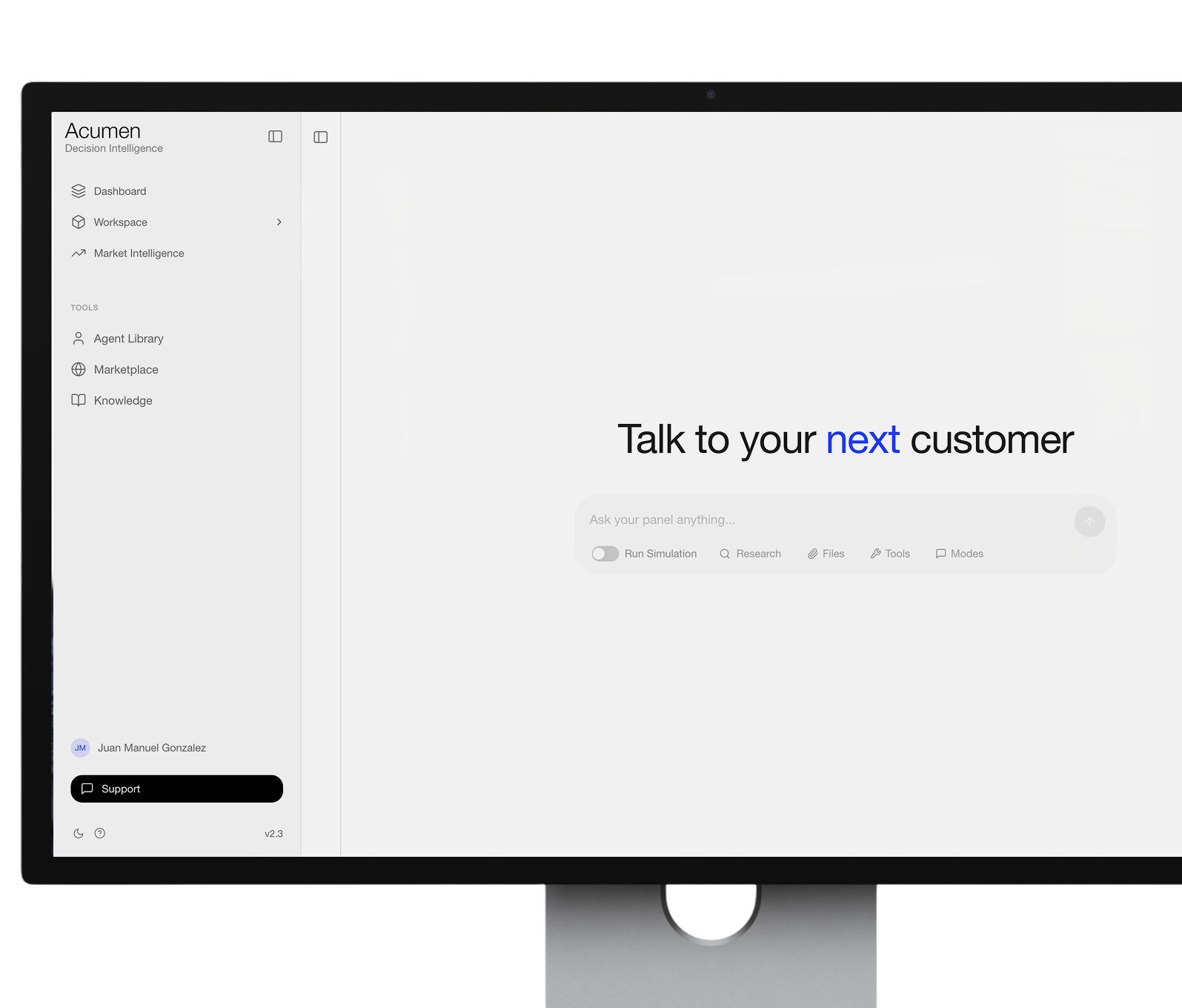
Through the Acumen platform, G&CO. gives enterprise brands the consumer intelligence to make personalization pay off: what different customers actually want, which tailored experiences drive engagement and retention, and where AI-driven recommendations create the most value. G&CO. is a certified minority business enterprise through the National Minority Supplier Development Council (NMSDC). For enterprise organizations with diversity inclusion requirements in their procurement process, G&CO. meets the criteria for MBE-qualified partner status.
G&CO. works with enterprise brands to design the personalization, AI, and customer-experience systems that turn data into engagement, loyalty, and growth. If this Spotify case study raises questions about your own personalization strategy, ai recommendations, or use of AI in customer experience, submit an inquiry to G&CO. on our contact page or click the blue "Click to Contact Us" button in the bottom right corner of your screen. We look forward to hearing from you.
Frequently Asked Questions
What is Spotify's personalization strategy?
Spotify's personalization strategy is to use AI and each user's listening data to tailor the entire experience, so the service feels made for that person. It shows up in features like Discover Weekly (a weekly personalized playlist), the AI DJ (a voice-activated, AI-powered personal radio host), personalized home-screen recommendations, and Spotify Wrapped (a yearly personalized listening summary). The goal is to help each listener find music and audio they love with minimal effort, which drives engagement, keeps people subscribed, and makes the whole spotify business model work.
How does Spotify use AI recommendations?
Spotify turns every play, skip, save, and search into data about what a user likes, then uses ai recommendations to suggest the right music, podcasts, and audiobooks for that person. This powers Discover Weekly, personalized playlists, and radio, and increasingly uses generative AI, as in the AI DJ, which selects music for the moment and talks the listener through it. The recommendations make a catalog of more than 100 million tracks feel personal and manageable rather than overwhelming.
How does personalization drive Spotify's user engagement and profitability?
The more Spotify tailors the experience, the more people listen, and the more they listen, the more data Spotify has to personalize further, a self-reinforcing loop that lifts user engagement. High engagement keeps churn low, and low churn is the foundation of a healthy subscription business. That loyalty is a big reason Spotify could raise prices with little customer loss and post its first full-year profit in 2024 (about €1.1 billion), with over 700 million users and 281 million paying subscribers.
What is an example of AI in customer experience at Spotify?
A clear example of AI in customer experience is Spotify's AI DJ: a voice-activated feature, available in 60-plus markets, that acts like a personal radio host, picking music for the moment and narrating it in a natural voice. Other examples include AI-narrated audiobooks and Spotify's integration into ChatGPT, which lets people get personalized music and podcast recommendations there. In each case, the AI is used to make the experience feel more personal and effortless, not just to add a feature.
What can enterprise brands learn from this Spotify case study?
The main lesson is that AI-driven personalization can be the core of the product and a genuine growth engine, not just a marketing add-on. Spotify's approach is repeatable in any data-rich business: use AI to turn customer data into a tailored experience, let that experience drive engagement and retention, use the loyalty it creates to support pricing and profit, and reuse the same personalization engine to expand into new areas. Any company with a large customer base, retail, media, finance, travel, or software, has the raw materials to build a similar loop.