Nvidia Case Study: The CUDA Software Moat Behind the Chips
This Nvidia case study examines the advantage most people miss: Nvidia leads the market for AI infrastructures not because its chips are the fastest, but because of CUDA, the software layer developers have written AI on for nearly two decades, which makes switching to a rival chip enormously costly. On top of that moat, Nvidia sells not just GPUs but a full stack AI platform, chips, networking, systems, and software together, so customers buy a complete system rather than a component. The Nvidia strategy turned a hardware company into the default platform for AI, and the AI boom turned that into more than $130 billion in annual revenue and a multi-trillion-dollar valuation.
Nvidia is building CUDA, the software developers use to program its chips, thus making it the platform the entire AI industry runs on.
Everyone knows Nvidia makes the chips that power artificial intelligence. What fewer people understand is that the chips are not the hard part to copy. Competitors can and do build fast AI chips. What they cannot easily build is the twenty years of software that the entire AI industry has been written on top of, and that software, called CUDA, is Nvidia's real advantage.
This case study looks at how Nvidia turned a hardware business into the default platform for AI by building a software moat around its chips, and then extending that into a full stack of AI infrastructure that customers buy as one system. For enterprise leaders, the lesson has nothing to do with semiconductors. It is about why a software and ecosystem advantage lasts, while a hardware lead alone rarely does.
Key Points
- Nvidia's real moat is software, not chips. CUDA, its programming platform, has been the default way to build AI software for nearly 20 years, so the whole ecosystem is locked into it.
- Switching to a rival chip means rewriting everything. Because AI software, libraries, and tools are built for CUDA, a cheaper competing chip still cannot easily win, the cost to a customer is the rewrite, not the hardware.
- Nvidia sells the whole stack, not just GPUs. It combines chips, networking, systems, and software into full stack AI infrastructure, so customers buy a complete AI platform rather than a component to integrate themselves.
- The AI boom turned the moat into staggering numbers. Data-center demand drove Nvidia past $130 billion in annual revenue, up about 114%, and a multi-trillion-dollar valuation.
Why This Matters
For CEOs, CIOs, chief digital officers, and anyone whose company sells hardware or any product that could be commoditized, Nvidia is the clearest lesson in why some leads last and others evaporate. A faster chip can be matched within a generation. A software platform that millions of developers have spent two decades building on cannot. Nvidia understood that difference early and built the whole Nvidia strategy around it.
The timing makes it urgent. As every company races to build or buy AI capability, the question of who controls the underlying AI infrastructures, the chips, software, and systems that AI actually runs on, has become one of the most important in business. Nvidia sits at the center of that, and its position is defended not mainly by its hardware lead but by the ecosystem locked into its software. For any leader trying to understand where durable advantage comes from in a fast-moving technology market, Nvidia is the case to study.


%20(1).png)

Let’s kickstart the conversation and design stuff people will love.

The Retail & Consumer Index


Strategic Context
For most of computing history, chips were sold as components: a customer bought the fastest processor available and wrote their own software to run on it, and when a faster chip came along, they could switch. That made chipmakers vulnerable, because their advantage lasted only until a competitor shipped something faster. Performance leads in hardware are real but temporary.
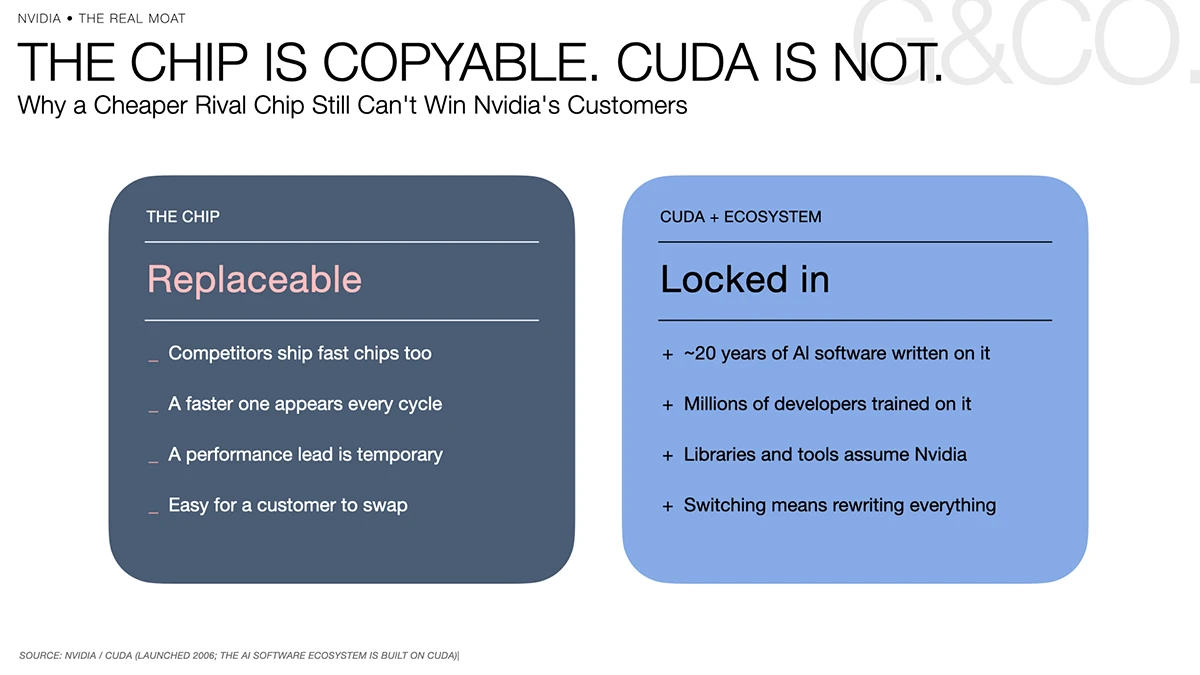
Nvidia's insight, going back to 2006, was that it could make its chips far stickier by giving developers a software platform to program them, called CUDA, and making that platform excellent, free, and ubiquitous. For years, long before the AI boom, Nvidia invested in CUDA and in teaching a generation of researchers and developers to use it, even when the immediate payoff was unclear. That patience is the strategic core of the Nvidia strategy. By the time AI exploded, essentially all of the world's AI software had been written on CUDA, which meant it ran best, and often only, on Nvidia. The company had turned a replaceable component into the foundation everyone else built on.
Company Response
Nvidia's response, sustained over nearly two decades, has three connected parts.
Build the software moat first.
CUDA is the platform developers use to write software that runs on Nvidia chips, and around it Nvidia built a deep set of libraries and tools for AI, from the building blocks of neural networks to systems for running trained models efficiently. Because the entire AI field learned on and built with these tools, Nvidia's advantage is not that its chip is fastest in a given month; it is that the world's AI software assumes Nvidia. A competitor offering a cheaper or faster chip still faces the wall every customer runs into: moving means rewriting years of software built for CUDA. The moat is the switching cost, and Nvidia spent twenty years digging it.
Sell the whole stack, not a chip.
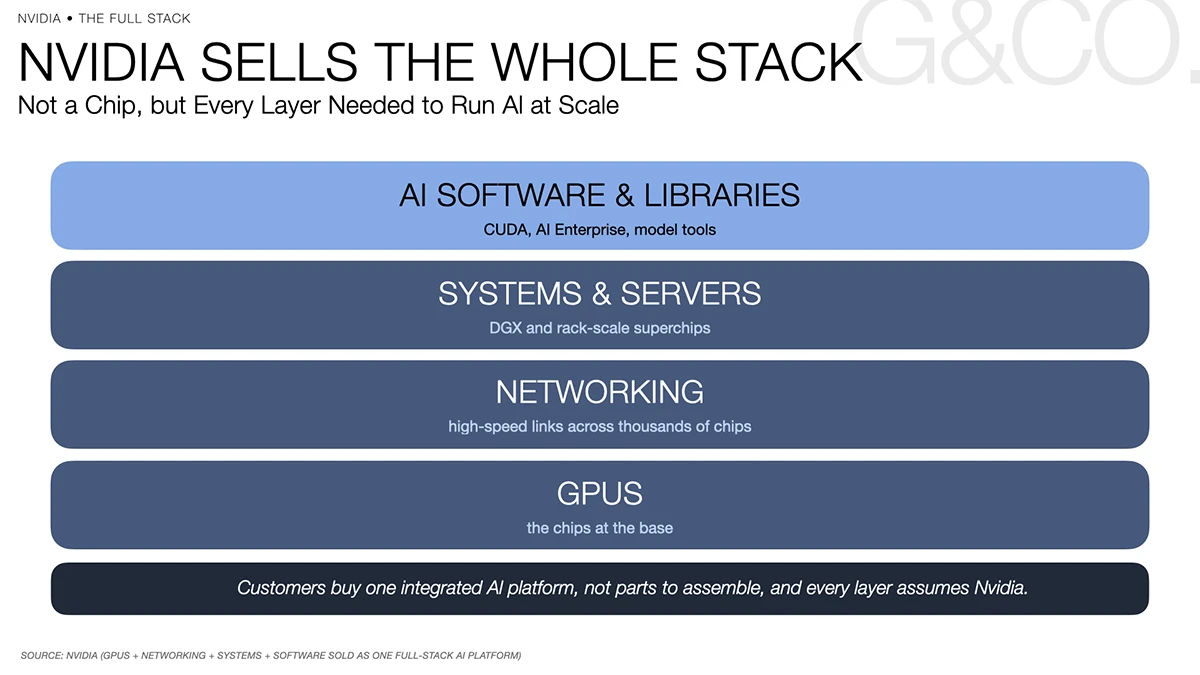
Nvidia extended from GPUs into the full set of pieces needed to run AI at scale, high-speed networking to connect thousands of chips, complete systems and servers, and a growing layer of enterprise software, so that a customer can buy AI infrastructure as one integrated system rather than assembling it from many vendors. This is the shift from selling a component to selling a full stack AI platform, and it is central to the Nvidia business model: the more of the stack Nvidia provides, the more value it captures and the deeper the lock-in goes, because now the networking and systems assume Nvidia too.
Move fast enough that the moat keeps widening.
Nvidia releases new generations of chips and systems on an aggressive schedule, each a large jump in capability, so that even as competitors and big customers design their own chips, Nvidia stays ahead on the frontier where the most demanding AI work happens. Speed on its own would be copyable; speed on top of the CUDA ecosystem is not, because each new generation arrives with all the software already written for it. The pace and the moat reinforce each other.
The approach carries real tension. Nvidia's dominance has made it a target: its largest customers (the big cloud companies) are designing their own AI chips to reduce dependence, competitors are building CUDA alternatives, and regulators are scrutinizing its position. And the current revenue depends heavily on a small number of huge buyers during an AI investment surge that may not continue at the same pace. But the software moat is exactly what buys Nvidia time against all of these: even customers building their own chips still run most of their AI on Nvidia, because the software is there.

Always-On Customer Intelligence
Turn your own customer data into foresight — validate, simulate, and sense every major decision before you commit.


Results and Evidence
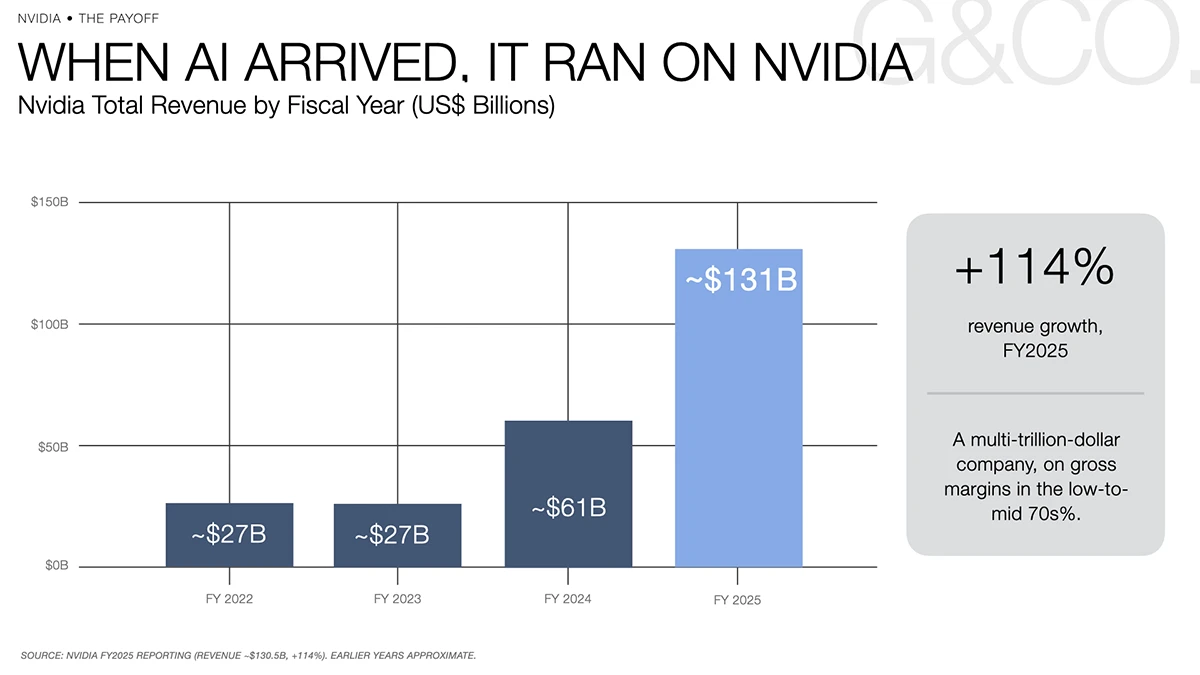
The evidence is among the most dramatic in business history, and it traces directly to the moat. As AI demand exploded, Nvidia's data-center business, selling the chips, systems, and networking that AI runs on, drove total revenue past $130 billion in its FY2025, up roughly 114% year over year, and carried the company to a multi-trillion-dollar valuation, among the most valuable in the world. The important point for this case is why the demand concentrated on Nvidia rather than spreading across chipmakers: because the software the world's AI is built on assumes Nvidia, the buying did too. Competitors shipped capable chips during this period and still could not meaningfully dent Nvidia's share, which is the clearest possible proof that the advantage is the ecosystem, not merely the silicon. Gross margins in the range of the low-to-mid 70s percent underline the point, those are software-like margins on what is nominally a hardware company, which is what a moat looks like on a financial statement. These figures come from Nvidia's public reporting and are worth confirming against the latest results before publishing, since this names a real company and the numbers move fast.
Strategic Implications
Read at scale, Nvidia is a case about the difference between a performance lead and a platform moat, and it connects to the broader shifts in AI, enterprise architecture, and platform economics. The pattern is repeatable well beyond chips: a company that turns its product into the thing others build on, the way Nvidia sits under the world's AI infrastructures, converts a temporary lead into a durable one. The chip is the product; CUDA is the platform; and the platform is what competitors cannot copy by shipping better hardware. Any company with a product that could be commoditized should be asking what its version of CUDA is, the layer that, once others build on it, makes switching away expensive.
The deeper implication is about where to invest before the payoff is obvious. Nvidia spent years making CUDA excellent and free when the return was unclear, and that patience is precisely why it owned the ground when AI arrived. The companies that build the platform layer early, and give it away to seed an ecosystem, are the ones positioned to capture enormous value when demand finally concentrates on the standard they set. For enterprise leaders, the takeaway is to look past the current product race and ask which layer, if you owned it and others built on it, would still be yours after the hardware advantage is gone. The same platform logic drives Salesforce's Agentforce strategy, Shopify's commerce operating system, and Figma's design platform.
What Enterprise Leaders Can Learn
- A platform outlasts a performance lead.
Hardware or feature advantages are temporary; an ecosystem built on your software or standard is what endures. Find the layer that becomes the moat. - Switching cost is the real barrier.
Nvidia wins not because rivals lack chips, but because moving off CUDA means rewriting everything. Design for the cost of leaving, not just the appeal of joining. - Sell the system, not the component.
Extending from a chip to a full stack captures more value and deepens lock-in; owning more of the stack makes each piece stickier. - Invest in the platform before the payoff is clear.
Nvidia funded CUDA for years without an obvious return. Ecosystem advantages are built early and cheaply, or not at all. - Give the platform away to seed the ecosystem.
Making CUDA free and ubiquitous is what created the developer base that became the moat. The giveaway was the strategy.
Conclusion
Nvidia's story is not really about chips. It is about the difference between being ahead and being unavoidable. Plenty of companies have built a faster processor; the advantage always faded when someone built a faster one still. Nvidia did something different: it spent nearly two decades getting the entire AI world to build on its software, so that when artificial intelligence became the most important technology of the decade, it ran on Nvidia by default, and moving off meant starting over. Then it wrapped that software moat in a full stack of chips, systems, and networking that customers buy as one platform. For enterprise leaders, the transferable lesson is to stop asking only whether your product is the best and start asking whether it is the thing others build on. A performance lead is rented and can be lost to the next release. A platform that the market is built on is owned, and that is the advantage worth spending years to create.
Through the Acumen platform, G&CO. gives enterprise brands the intelligence to find and build durable advantage: which layer of your product could become a platform others build on, where switching costs actually protect you, and where to invest before the payoff is obvious. G&CO. is a certified minority business enterprise through the National Minority Supplier Development Council (NMSDC). For enterprise organizations with diversity inclusion requirements in their procurement process, G&CO. meets the criteria for MBE-qualified partner status.
G&CO. works with enterprise brands on the platform, architecture, and AI strategy that turns a temporary product lead into a durable ecosystem advantage. If this Nvidia case study raises questions about your own AI platform, full stack AI strategy, or where your real moat lies, submit an inquiry to G&CO. on our contact page or click the blue "Click to Contact Us" button in the bottom right corner of your screen. We look forward to hearing from you.
Frequently Asked Questions
What is Nvidia's real competitive advantage?
Nvidia's real advantage is CUDA, the software platform developers have used to program its chips for nearly 20 years, not the chips themselves. Because essentially all of the world's AI software is written on CUDA and its libraries, AI runs best, and often only, on Nvidia hardware. Competitors can build fast chips, but a customer moving to one would have to rewrite years of software, so the switching cost, not the silicon, is the moat. This is why Nvidia leads the market for AI infrastructures so decisively.
What is CUDA, and why does it matter so much?
CUDA is Nvidia's platform for writing software that runs on its GPUs, launched in 2006 and expanded over the years into a deep set of AI libraries and tools. It matters because the entire AI field learned on and built with it, which means the world's AI software assumes Nvidia. That makes Nvidia's position far stronger than a hardware lead: even a cheaper or faster competing chip cannot easily win, because the cost to the customer is rewriting everything built for CUDA. CUDA is the clearest example of a software moat around a hardware product.
What does "full stack AI" mean in Nvidia's strategy?
It means Nvidia sells not just GPUs but all the pieces needed to run AI at scale: chips, high-speed networking to connect thousands of them, complete systems and servers, and a growing layer of software. Customers can buy AI infrastructure as one integrated system rather than assembling it from many vendors. This full stack AI approach is central to the Nvidia business model because it captures more value and deepens the lock-in, the networking and systems come to assume Nvidia too, not just the software.
How big is Nvidia, and where does the revenue come from?
Driven by the AI boom, Nvidia's revenue passed $130 billion in its FY2025, up about 114% year over year, and it became one of the most valuable companies in the world, worth several trillion dollars. The large majority comes from its data-center business, the chips, systems, and networking that power AI in the cloud and in enterprises. Gross margins in the low-to-mid 70s percent are unusually high for a hardware company, which reflects the pricing power the CUDA moat provides. These figures move fast and should be confirmed against the latest results.
What can enterprise leaders learn from the Nvidia case study?
The core lesson is that a platform moat outlasts a performance lead. A faster product can always be matched; an ecosystem of customers and developers built on your software or standard cannot be, because leaving means rewriting or rebuilding. Nvidia's playbook is instructive for any company with a product that could be commoditized: identify the layer that could become the thing others build on, invest in it early and give it away to seed an ecosystem, sell the whole system rather than a component, and design for the cost of leaving. The company others build on owns a far more durable position than the company that is merely ahead.