Siemens Case Study: How a Hardware Giant Became an Industrial Software Company
This Siemens case study examines how a 175-year-old maker of physical equipment reinvented itself as an industrial software company. Its flagship is the digital twin, a virtual replica of a product or factory that lets manufacturers design, simulate, and optimize in software before and while building in the real world. By bridging the factory floor (operational technology) and enterprise IT, and packaging it all into a platform with added industrial AI, Siemens turned smart manufacturing and factory digitalization into its growth engine. The Siemens digital transformation shows that even a legacy hardware giant can rebuild itself around software, data, and automation.
Siemens turned itself from a maker of industrial hardware into a software company, building digital twins, virtual replicas of products and factories, that let manufacturers design, test, and run operations in software first.
For most of its history, Siemens sold physical things: motors, controllers, trains, medical scanners, the machinery that runs modern industry. That is a good business, but a slow-growing and commoditizing one, and it does not capture the value that increasingly sits in software and data. So Siemens did something few industrial giants manage: it rebuilt itself around software without abandoning the hardware that made it.
This case study looks at how Siemens became one of the world's leading industrial software companies, with the digital twin at its center, and how it connected the factory floor to enterprise software to run manufacturing as one digital system. For enterprise leaders, the lesson reaches well beyond industry. It is about how an established hardware business reinvents itself around software and data, and turns a maturing product line into a growth platform.
Key Points
- Siemens reinvented itself from a hardware maker into an industrial software company. A 175-year-old maker of physical equipment now competes on software, data, and the digital twin, without walking away from the hardware.
- The flagship is the digital twin: a virtual replica of a product or a factory. Manufacturers design, simulate, and optimize in software before and while building in the real world, cutting cost, time, and error.
- It bridges the factory floor and enterprise IT. Siemens connects industrial automation hardware with software so the physical and digital sides of a factory run as one system, the core of smart manufacturing.
- It packaged the software into a platform and is adding industrial AI. Siemens Xcelerator bundles the software and marketplace, and acquisitions like Altair and AI partnerships layer simulation and artificial intelligence on top.
- The transformation is now a profit engine. Siemens Digital Industries, its combined software-and-automation business, drives much of the group's profit on roughly EUR 76 billion in annual revenue.
Why This Matters
For CEOs, CIOs, and any leader running an established hardware or product business, Siemens is one of the clearest examples of a legacy industrial company successfully reinventing itself around software. Many hardware businesses know the value is shifting to software and data but cannot make the leap, trapped by their existing products, cultures, and margins. Siemens made it, and did so while remaining one of the largest industrial companies in the world, which makes it a rare, real-world model rather than a startup story.
The timing matters. Manufacturing is being reshaped by digitalization and AI, and the companies that thrive will be the ones that connect the physical world of the factory to the digital world of software and data. That connection, between operational technology on the factory floor and information technology in the enterprise, is exactly what Siemens has built its transformation around. For any leader whose business bridges the physical and the digital, Siemens shows what the reinvention looks like at scale.


%20(1).png)

Let’s kickstart the conversation and design stuff people will love.

The Retail & Consumer Index


Strategic Context
Industrial companies have always sold capability in the form of hardware: a better machine, a faster controller, a more reliable motor. But hardware advantages erode, competitors catch up, products commoditize, and margins compress. Meanwhile, more and more of the value in industry moved to the software that designs the products, simulates them, runs the factories, and analyzes the data they produce. A company that only sold the machines was leaving the fastest-growing, highest-margin part of the value chain to others.
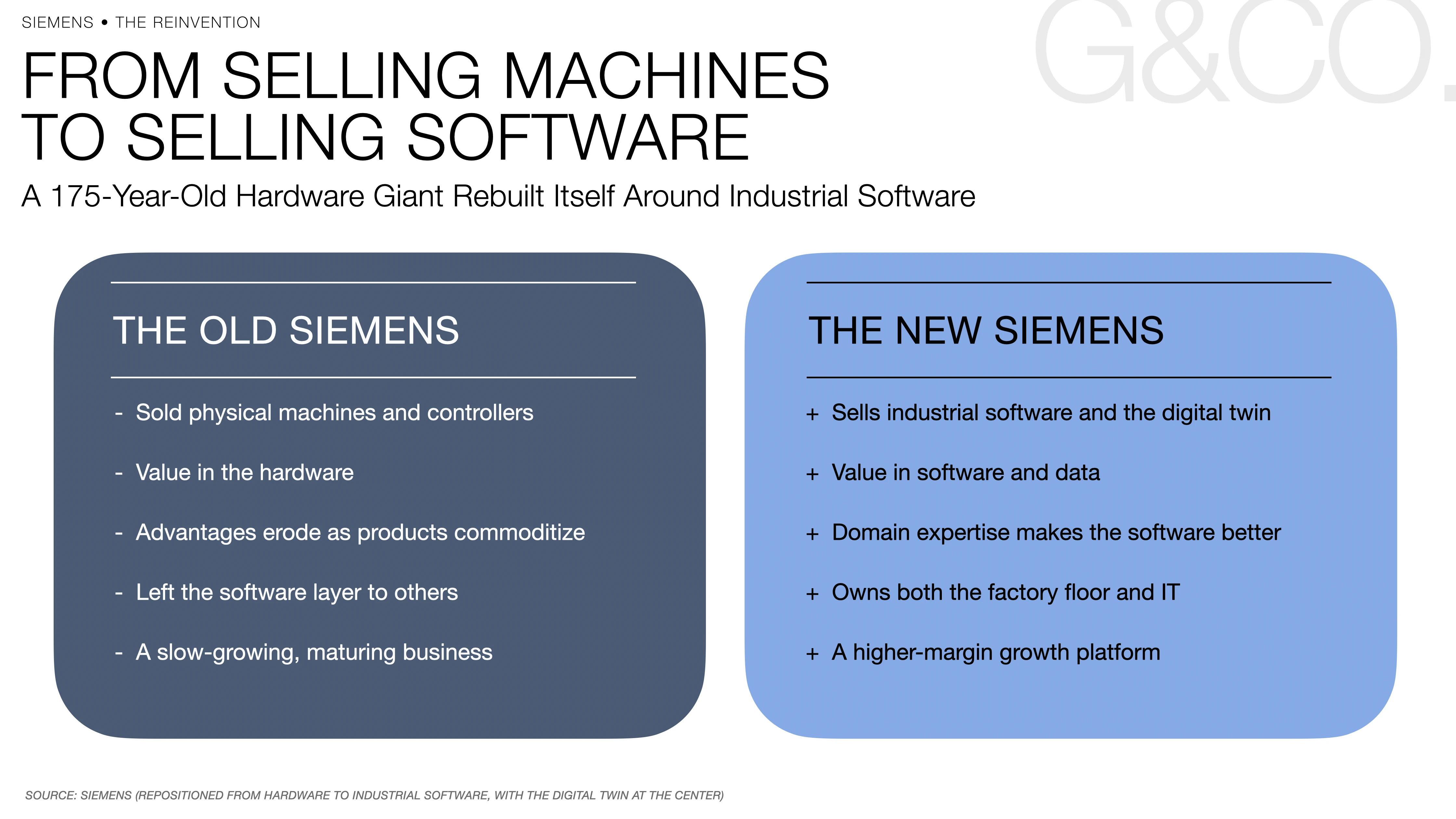
Siemens's strategic insight was that its deep knowledge of the physical, industrial world was actually its biggest advantage in software, if it built the software itself. Over years, largely through a series of major acquisitions of design, simulation, and manufacturing-software companies, Siemens assembled one of the most complete software portfolios in the world, and tied it to its automation hardware. The strategic choice at the heart of this case is that Siemens did not treat software as an add-on to sell alongside machines; it repositioned the company so that software and the digital twin became the core of what it offers, with the hardware as one part of a larger digital system.
Company Response
Build the digital twin.
The centerpiece of Siemens's transformation is the digital twin, a detailed virtual replica of a physical product, production line, or entire factory. Using Siemens software, a manufacturer can design a product, simulate how it will perform, test how it will be built, and optimize the factory that will make it, all in software, before committing anything to the physical world, and then keep the twin in sync with the real thing to monitor and improve it in operation. This is software doing what hardware never could: it turns design and manufacturing into a data-driven process where problems are found and fixed virtually, cutting cost, time, and error. The digital twin is the product that repositioned Siemens from a hardware company to a software one.
Connect operational technology to IT.
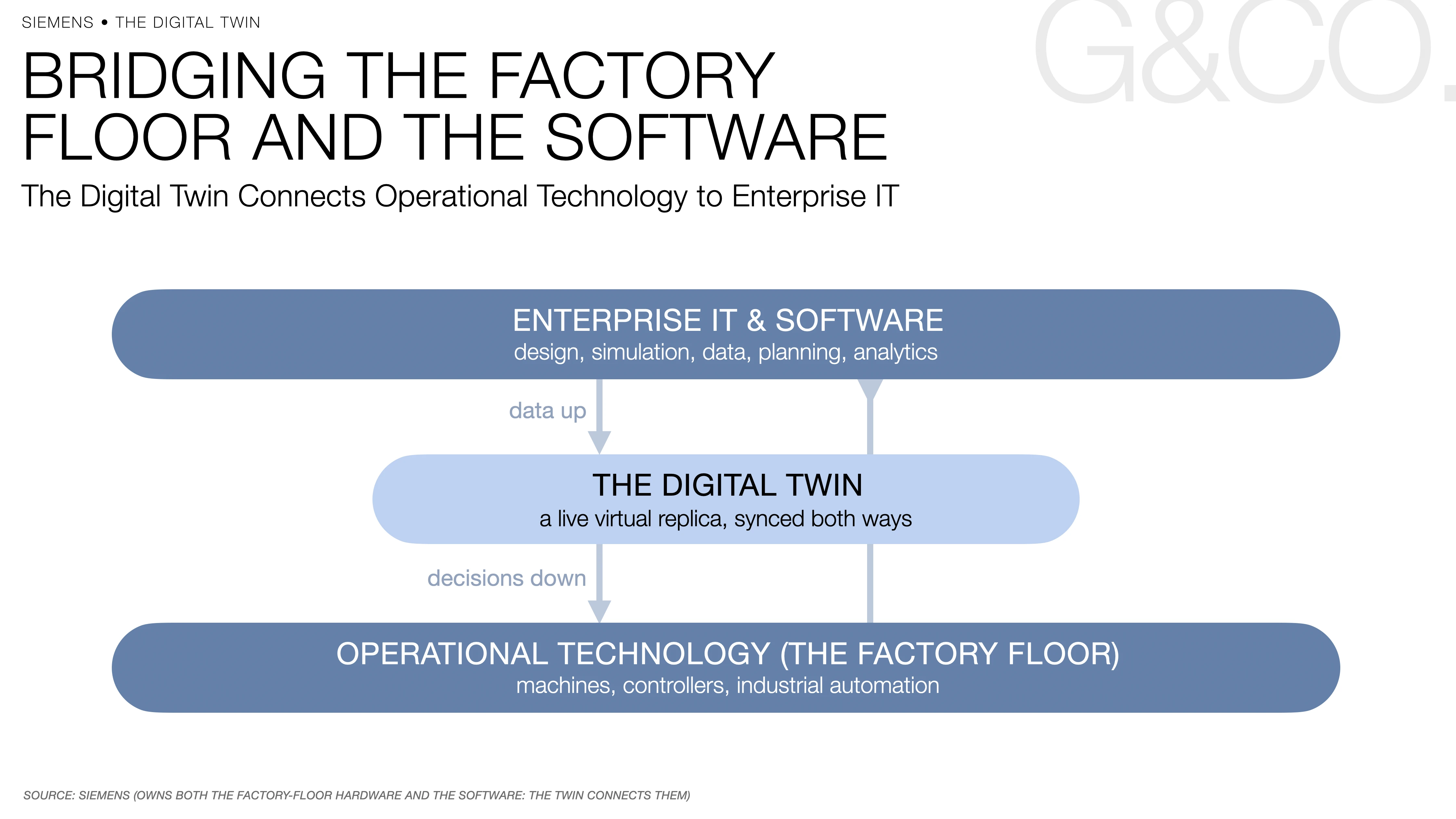
Siemens's rare advantage is that it sits on both sides of the divide that defines modern manufacturing: the operational technology on the factory floor (the machines, controllers, and industrial automation it has always made) and the information technology of enterprise software and data. Siemens connects the two, so data flows from the physical machines up into the software and decisions flow back down, and the factory runs as one integrated system rather than two disconnected worlds. This bridging of the physical and digital is the essence of smart manufacturing and factory digitalization, and it is something a pure-software company cannot easily do, because it does not own the factory floor, and a pure-hardware company will not do, because it does not own the software.
Package it as a platform and add AI.
To make the software easier to adopt and to build a durable business, Siemens brought its tools together into a platform, Siemens Xcelerator, an open ecosystem of software, connected hardware, and a marketplace of partners. On top of that, it is layering industrial AI, through major acquisitions such as the simulation-and-AI company Altair and partnerships to build AI assistants for engineers and factory workers, so that the digital twin becomes not just a model but an intelligent one. The platform widens adoption; the AI deepens the value and the lock-in.
The approach carries real tension. Reinventing a 175-year-old hardware culture around software is slow and hard, and requires different talent and ways of working. The software portfolio was assembled through expensive acquisitions that had to be integrated. And Siemens competes now with both industrial rivals and pure-software companies at once. But its position on both sides of the OT-IT divide is exactly what neither a pure-hardware nor a pure-software competitor can easily replicate.
Always-On Customer Intelligence
Turn your own customer data into foresight — validate, simulate, and sense every major decision before you commit.


Results and Evidence
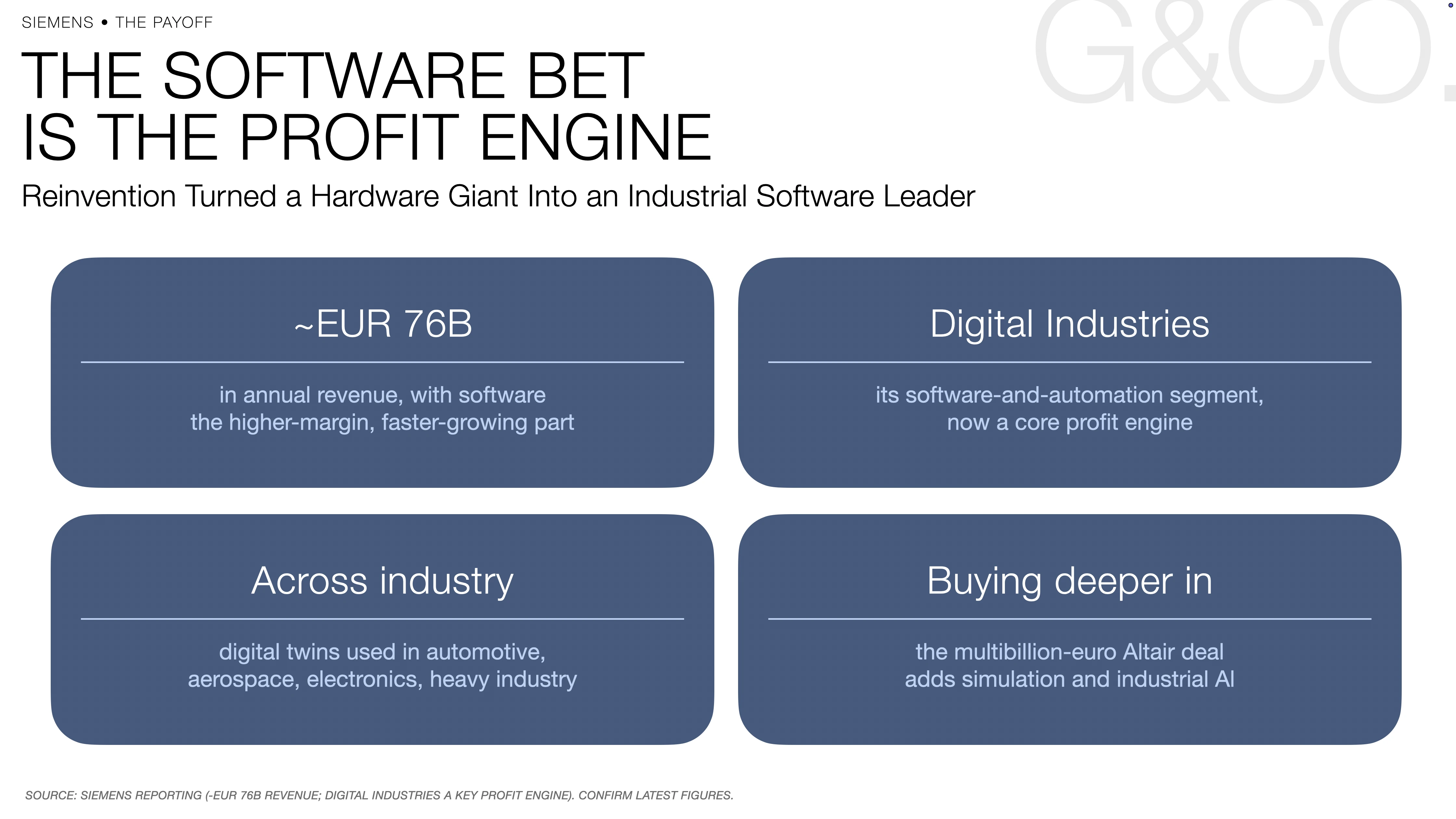
The evidence is in the shift of the business and where its profit now comes from. Siemens generates roughly EUR 76 billion in annual revenue, and its Digital Industries segment, the combined software and automation business, has become one of the group's most important profit engines, with software the higher-margin, faster-growing part. The clearest proof of the strategy is that Siemens is now regularly described and valued not as a traditional industrial conglomerate but as one of the world's largest industrial software companies, a repositioning that would have been unthinkable a generation ago. Its digital twin technology is used across automotive, aerospace, electronics, and heavy industry, and its platform and AI investments (including the multibillion-euro Altair acquisition) show it continuing to push deeper into software and industrial AI rather than retreating to hardware. These figures come from Siemens's public reporting and are worth confirming against the latest results before publishing, since this names a real company and the numbers update each year.
Strategic Implications
Read at scale, Siemens is a case about a hardware business reinventing itself around software and data, and it connects to the broader shifts in industrial digitalization, AI, and the convergence of the physical and digital worlds. The pattern is repeatable well beyond industry: an established company whose product is commoditizing can move up the value chain by building the software that designs, runs, and analyzes that product, and by connecting the physical thing it sells to a digital system around it. Siemens did not abandon its hardware; it made the hardware one node in a larger software-and-data platform, which is where the growth and margin now live.
The deeper implication is the advantage of owning both the physical and the digital. Because Siemens sits on both sides of the operational-technology and IT divide, it can offer something neither a pure-software nor a pure-hardware competitor can: a single system that connects the factory floor to the enterprise. For enterprise leaders, the takeaway is to ask where the value in your industry is migrating from hardware to software and data, and whether your knowledge of the physical product is actually your best foundation for building the software layer, rather than a legacy to defend. The companies that win the digital transformation of physical industries are often the incumbents that understood the physical world best, if they are willing to rebuild around software. The same reinvent-around-software logic runs through Adobe's move from tools to an AI platform, Domino's legacy-to-digital reinvention, and Tesla's software-defined product.
What Enterprise Leaders Can Learn
- Move up the value chain from hardware to software.
As products commoditize, the growth and margin move to the software that designs, runs, and analyzes them. Build that software rather than cede it. - Your physical expertise is a software advantage.
Siemens's deep knowledge of industry made its software better than a pure-software rival could build. Treat domain knowledge as a foundation, not a legacy. - Own both sides of the physical-digital divide.
Connecting operational technology to IT is something pure-software and pure-hardware competitors cannot easily do; that bridge is a durable moat. - Package tools into a platform.
Bringing software together into an open platform (like Siemens Xcelerator) widens adoption and builds an ecosystem that is hard to leave. - Reinvention is slow, and that protects you.
Rebuilding a hardware culture around software takes years and heavy investment, which is exactly why competitors cannot copy it quickly.
Conclusion
Siemens's story is not really about factories. It is about how an established hardware business reinvents itself for a world where value has moved to software and data. Rather than defend a commoditizing product line, Siemens built the software that designs and runs industry, put the digital twin at the center of what it sells, and connected the factory floor it has always owned to the enterprise software around it, becoming one of the world's largest software companies without ceasing to be an industrial one. For enterprise leaders, the transferable lesson is that the deep knowledge of a physical product is not a liability in a software world; it can be the strongest possible foundation for the software layer, if the company is willing to rebuild around it. The incumbents that win the digital transformation of their industries are the ones that turn their understanding of the physical into an advantage in the digital.
Through the Acumen platform, G&CO. gives enterprise brands the intelligence to lead a digital transformation from a position of strength: where value is migrating from hardware to software, how domain knowledge can become a software advantage, and where connecting the physical and digital sides of the business would create a durable moat. G&CO. is a certified minority business enterprise through the National Minority Supplier Development Council (NMSDC). For enterprise organizations with diversity inclusion requirements in their procurement process, G&CO. meets the criteria for MBE-qualified partner status.
G&CO. works with enterprise brands on the software, platform, and AI strategy that turns a maturing hardware or product business into a growth platform. If this Siemens case study raises questions about your own industrial software, smart manufacturing, or Siemens digital transformation-style reinvention, submit an inquiry to G&CO. on our contact page or click the blue "Click to Contact Us" button in the bottom right corner of your screen. We look forward to hearing from you.
Frequently Asked Questions
How did Siemens become an industrial software company?
Siemens repositioned itself over years from a maker of physical equipment into one of the world's leading industrial software companies, largely by acquiring and integrating a portfolio of design, simulation, and manufacturing-software firms and tying that software to its automation hardware. Instead of selling software as an add-on to machines, Siemens made software and the digital twin the core of what it offers, with hardware as one part of a larger digital system. The result is that Siemens is now valued and described as an industrial software leader, not just an industrial conglomerate.
What is a digital twin, and why is it central to Siemens's strategy?
A digital twin is a detailed virtual replica of a physical product, production line, or entire factory. With Siemens software, a manufacturer can design, simulate, test, and optimize a product and the factory that makes it entirely in software before building anything physical, then keep the twin synced with the real thing to monitor and improve it in operation. It is central because it turns design and manufacturing into a data-driven process where problems are found and fixed virtually, cutting cost, time, and error, and it is the product that repositioned Siemens from a hardware company to a software one.
What does it mean that Siemens bridges the factory floor and IT?
The factory floor (OT) is the machinery, controllers, and industrial automation on the factory floor; information technology (IT) is the enterprise software and data systems. Traditionally these are two disconnected worlds. Siemens sits on both sides, it has always made the factory-floor hardware, and it now provides the software, so it can connect them: data flows up from machines into software, and decisions flow back down, letting the factory run as one integrated system. That bridging of the physical and digital is the essence of smart manufacturing, and it is something pure-software or pure-hardware competitors cannot easily do.
What is Siemens Xcelerator?
Siemens Xcelerator is Siemens's open digital business platform, an ecosystem that brings together its software, connected hardware, and a marketplace of partners and applications. Its purpose is to make Siemens's digital tools easier to adopt and integrate, and to build a durable, expanding ecosystem around them rather than selling point products. Combined with Siemens's growing investments in industrial AI (including the Altair acquisition and AI assistants for engineers and factory workers), Xcelerator is how Siemens turns its software portfolio into a platform business with real staying power.
What can enterprise leaders learn from the Siemens case study?
The central lesson is that an established hardware or product company can reinvent itself around software, and that its deep knowledge of the physical product is a foundation for that software, not a legacy to defend. Siemens's repeatable playbook: move up the value chain to the software that designs and runs your product, use your domain expertise to build software a pure-software rival cannot match, own both the physical and digital sides so you can connect them, and package it all into a platform. Leaders should ask where value in their industry is migrating from hardware to software, and whether they are positioned to build that layer rather than cede it.