
Airbnb Case Study: Why Trust Is the Real Product of the Marketplace
This Airbnb case study examines the counterintuitive truth behind its marketplace platform: the real product is not homes, it is trust. For strangers to stay in each other's homes, they have to feel safe, so Airbnb's core work is manufacturing brand trust through reviews, verified profiles, secure payments, and guarantees. That trust, plus a brand strong enough that most travelers come directly, drives community-driven growth rather than paid ads, and it underpins a business handling tens of billions of dollars in bookings a year. The Airbnb strategy shows that in a marketplace, the product is often the trust that makes the transaction feel safe.
Airbnb's real product isn't homes, it's trust: the reviews, verified profiles, and guarantees that make strangers comfortable staying in each other's homes.
On paper, Airbnb is a website that lists places to stay. But the thing it actually had to build was far harder than a website: a reason for a stranger to hand over their house keys to another stranger, and for that traveler to feel safe sleeping in someone else's home. No amount of listings solves that. What solves it is trust, and manufacturing trust at scale is the real business Airbnb is in.
This case study looks at how Airbnb built the systems that make trust possible between strangers, how its brand became strong enough that most travelers come to it directly rather than through ads, and what that means for any company running a marketplace. For enterprise leaders, the lesson reaches well beyond travel. It is that in a marketplace, the real product is often the trust and brand that make the transaction feel safe, not the thing being transacted.
Key Points
- Airbnb's real product is trust, not homes. For strangers to stay in each other's homes, they have to trust each other, so Airbnb's core job is manufacturing that trust at scale.
- It built the systems that make trust possible. Two-way reviews, verified profiles, payments held until check-in, and AirCover protection remove the risk that would otherwise stop people from ever booking.
- The brand and community drive growth, not ads. Airbnb became a verb, and most of its traffic comes directly, so it relies on community-driven growth and spends far less on performance marketing than rivals.
- The scale is enormous, and profitable. Airbnb handles tens of billions of dollars in bookings a year (about $82 billion in gross bookings in 2024) across millions of listings, with strong profits and cash flow.


%20(1).png)

Let’s kickstart the conversation and design stuff people will love.

The Retail & Consumer Index


Why This Matters
For CEOs, CMOs, heads of customer experience, and anyone building or running a marketplace or platform, Airbnb is the clearest lesson in what a marketplace actually sells. Many companies think they are in the business of connecting supply and demand, listings and bookings, drivers and riders, buyers and sellers, when the harder and more valuable thing they must provide is the trust that makes strangers willing to transact at all. Airbnb built its whole company around that insight.
The timing matters. As more of the economy moves to platforms where strangers deal directly with each other, trust and safety have become the deciding factor in which marketplaces thrive and which collapse under fraud, and the core of the customer experience travel brands now compete on. At the same time, rising advertising costs are pushing every company to find cheaper ways to grow, and Airbnb's brand-and-community model is a leading example of growth that does not depend on buying attention. For any leader weighing how to build a durable platform, and how to grow without endlessly rising ad spend, Airbnb is instructive.
Strategic Context
Every marketplace faces the same starting problem: why would two strangers trust each other enough to do business? For Airbnb the version of that question was unusually stark, it was asking people to sleep in a stranger's home, or to let strangers sleep in theirs. The default answer, for most people, is no. Fear of fraud, damage, danger, or simply a miserable experience is enough to stop the transaction before it begins. Traditional hotels solved this with brands and standards built over a century; Airbnb had to solve it for millions of individual, unbranded hosts almost from scratch.
That is the strategic core of this case. Airbnb understood early that its real competitor was not hotels but distrust, and that the product it most needed to build was not a better listings page but a system that made strangers feel safe with each other. Everything else, the growth, the brand, the expansion, follows from getting that right. A marketplace platform is only as valuable as the trust that lets its transactions happen, and Airbnb chose to invest in that trust as its foundation rather than treat it as a feature.
Company Response
Manufacture trust with systems, not promises.
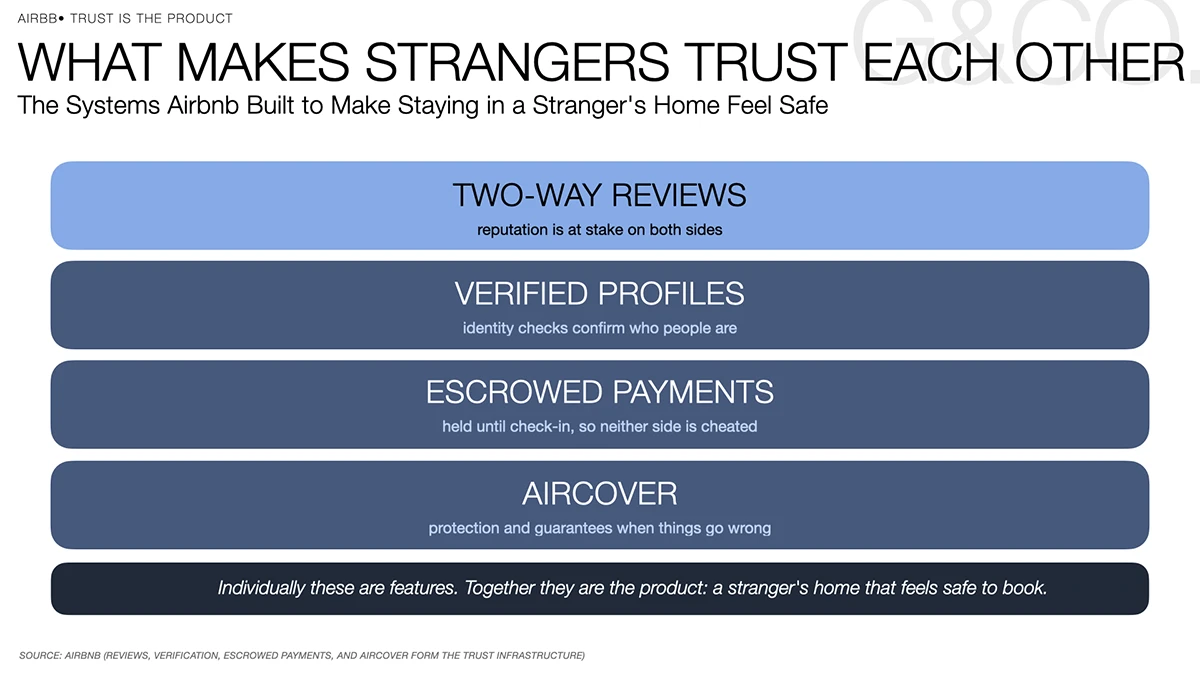
Airbnb built a stack of mechanisms that together make a stranger feel safe: two-way reviews (guests and hosts rate each other, so reputation is at stake on both sides), verified profiles and identity checks, payments held by Airbnb and released to the host only after check-in (so neither side can be easily cheated), and AirCover, its protection and guarantee program for damage and serious problems. Individually these are features; together they are the product. They convert a frightening proposition, stay with a stranger, into a safe-feeling one, and that manufactured brand trust is the foundation of the customer experience travel that Airbnb offers. This trust infrastructure, not the listings, is Airbnb's real moat, because a competitor can copy a listings page in a weekend but cannot copy years of accumulated reviews and reputation.
Grow through brand and community, not paid ads.
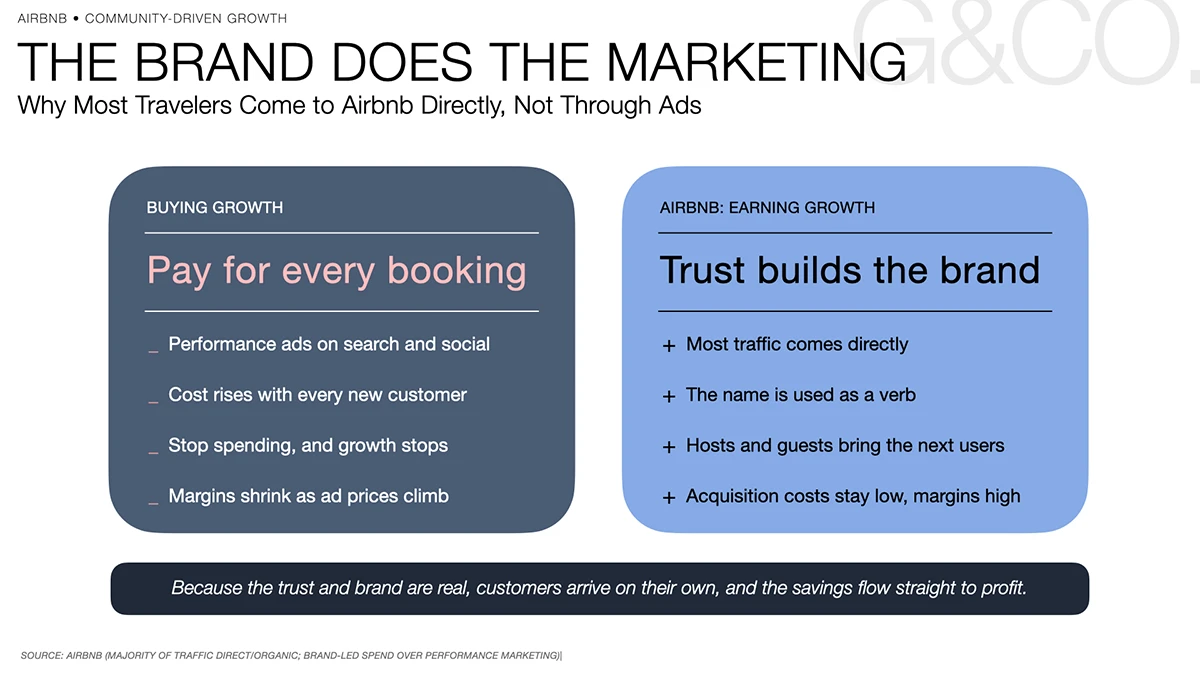
Because the experience is trusted and distinctive, Airbnb became a household name, its name is used as a verb, and most of its traffic comes to it directly rather than through search or performance ads. Airbnb leaned into this deliberately, shifting spend away from performance marketing toward brand and PR, and relying on its hosts and guests, its community, to bring in the next users. This community-driven growth means Airbnb acquires customers far more cheaply than a rival buying every booking through ads, and the savings flow straight to profit. The brand is not decoration; it is the low-cost growth engine, and it exists because the trust underneath it is real.
Extend the trusted relationship into new areas.
With trust and brand established, Airbnb has begun expanding what the marketplace platform offers, relaunching Experiences and adding Services (from private chefs to spa treatments) so travelers can book more of a trip in one trusted place, and investing in AI to guide trip planning and customer support. The logic is that once people trust Airbnb enough to sleep in a stranger's home, that trust transfers, they will trust it to book the rest of the trip too. The expansion is a bet on stretching the trusted relationship, not just adding inventory.
The approach carries real tension. Trust is fragile and expensive to maintain: a small number of high-profile safety incidents or fraud stories can damage the brand disproportionately, so Airbnb must keep investing heavily in safety and support even though it is a cost center. Regulation is a constant pressure, as cities restrict short-term rentals. And the expansion into services and AI takes Airbnb into new areas where its trust advantage has to be re-earned, not assumed. But the trust foundation is exactly what gives it the right to try.

Always-On Customer Intelligence
Turn your own customer data into foresight — validate, simulate, and sense every major decision before you commit.


Results and Evidence
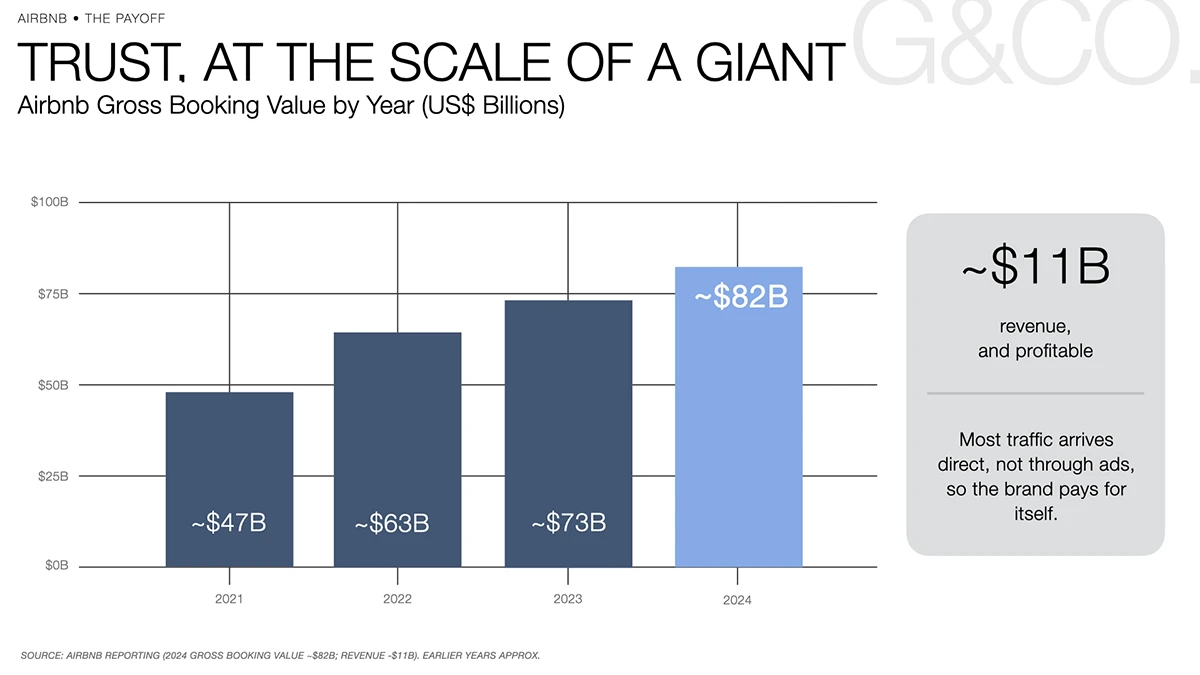
The evidence is in the scale, the profitability, and where the growth comes from. Airbnb handles roughly $82 billion in gross bookings a year (2024) across millions of active listings, on revenue of about $11 billion, and, unlike many marketplaces that grew fast and lost money, it is solidly profitable with strong free cash flow. The most telling number is not in the financials but in how customers arrive: the large majority of Airbnb's traffic is direct or organic rather than paid, which is the measurable proof that the brand and community, built on trust, are doing the work a marketing budget does for competitors. That is why Airbnb can spend proportionally less on performance marketing and still grow, the savings are a direct result of the trust and brand it invested in. The durability shows in resilience too: the business recovered strongly after travel collapsed in 2020, because the trusted relationship with hosts and guests survived the disruption. These figures come from Airbnb's public reporting and are worth confirming against the latest results before publishing, since this names a real company and the numbers update each quarter.
Strategic Implications
Read at scale, Airbnb is a case about trust as the real product of a marketplace, and it connects to the broader shifts in brand strategy, customer experience, platform economics, and community-driven growth. The pattern is repeatable across every platform business: the company is not really selling the listing, the ride, or the item; it is selling the confidence that the transaction will go well. The marketplaces that win are the ones that invest most in manufacturing that confidence, through reviews, verification, guarantees, and support, and the accumulated trust and reputation become a moat competitors cannot copy quickly, because it is built from years of real transactions.
The deeper implication is how trust compounds into cheap growth. Because Airbnb's trust and brand are real, customers come to it directly, which lowers acquisition cost, which improves margins, which funds more investment in trust and experience, which strengthens the brand further. That loop is why a brand-and-community model can out-compete a rival that has to buy each customer through ads. For enterprise leaders, the takeaway is to ask what their marketplace or platform is really selling, and whether they are investing enough in the trust that makes the transaction feel safe, because that trust, not the inventory, is what builds a brand strong enough to grow on its own. The platforms that treat trust as the product, not a feature, are the ones that become verbs. The same trust-and-brand logic drives Apple's anticipation-led brand, Costco's membership trust, and Nubank's community-driven growth.
What Enterprise Leaders Can Learn
- Know what your marketplace actually sells.
It is rarely the listing or the transaction itself; it is the trust that the transaction will go well. Invest there first. - Build trust with systems, not slogans.
Reviews, verification, escrowed payments, and guarantees manufacture trust reliably; promises do not. Together they become the real product. - Trust becomes a brand, and a brand becomes cheap growth.
When trust is real, customers come directly, which lowers acquisition cost and funds more investment in trust, a compounding loop rivals buying ads cannot match. - Reputation is the moat, not the software.
A competitor can copy your platform quickly but cannot copy years of accumulated reviews and reputation; that is what protects you. - Extend trust deliberately into new areas.
A trusted relationship can stretch into adjacent offerings, but the trust advantage has to be re-earned in each, not assumed.
Conclusion
Airbnb's story is not really about spare rooms or vacation homes. It is about the difference between building a marketplace and building the trust that makes a marketplace possible. Airbnb understood that its real competitor was distrust, and that the product it most needed to manufacture was the confidence for a stranger to stay in another stranger's home. It built that trust with systems, reviews, verified profiles, escrowed payments, and guarantees, and out of that trust grew a brand strong enough that most travelers come to it directly, a growth engine that costs far less than buying customers through ads. For enterprise leaders, the transferable lesson is to stop thinking of a marketplace as a place that connects supply and demand and start thinking of it as a machine for manufacturing trust. The listings are replaceable; the trust and the brand built on it are not. The platforms that treat trust as the product are the ones that endure, and the ones that become part of how people talk.
Through the Acumen platform, G&CO. gives enterprise brands the intelligence to build trust into a growth engine: where trust breaks down in your customer experience, what would make people confident enough to transact, and how a stronger brand could lower what you spend to acquire each customer. G&CO. is a certified minority business enterprise through the National Minority Supplier Development Council (NMSDC). For enterprise organizations with diversity inclusion requirements in their procurement process, G&CO. meets the criteria for MBE-qualified partner status.
G&CO. works with enterprise brands on the brand, experience, and platform strategy that turns trust into a marketplace's real product and a low-cost engine for growth. If this Airbnb case study raises questions about your own marketplace platform, brand trust, or community-driven growth, submit an inquiry to G&CO. on our contact page or click the blue "Click to Contact Us" button in the bottom right corner of your screen. We look forward to hearing from you.
Frequently Asked Questions
What is Airbnb's real product, and why is it trust?
Airbnb's real product is trust, not homes. Its business depends on convincing strangers to stay in each other's homes, which most people would never do without a reason to feel safe. So Airbnb's core work is manufacturing that trust, through two-way reviews, verified profiles, payments held until check-in, and its AirCover protection program. The listings are just inventory; the trust systems are what make anyone willing to book. That is the insight behind the whole Airbnb strategy: in a marketplace, the product is the confidence that the transaction will go well.
How does Airbnb build trust between strangers?
Through systems, not promises. Two-way reviews put reputation at stake for both guests and hosts; verified profiles and identity checks confirm who people are; payments are held by Airbnb and released to the host only after check-in, so neither side can easily be cheated; and AirCover provides protection and guarantees when something goes seriously wrong. Individually these are features, but together they convert a frightening proposition, staying with a stranger, into one that feels safe. That accumulated brand trust, built from years of real transactions and reviews, is Airbnb's real moat.
What is brand-and-community growth, and how does Airbnb use it?
Brand-and-community growth means growing through your users and brand rather than through paid advertising. Because Airbnb's experience is trusted and distinctive, it became a household name (its name is used as a verb), and most of its traffic comes to it directly rather than through search ads. Airbnb leaned into this, shifting spend from performance marketing toward brand and PR and relying on its hosts and guests to bring in the next users. This lets Airbnb acquire customers far more cheaply than rivals who buy every booking through ads, and the savings flow to profit.
How big and how profitable is Airbnb's marketplace platform?
Airbnb handles roughly $82 billion in gross bookings a year (2024) across millions of active listings, on revenue of about $11 billion, and it is solidly profitable with strong free cash flow, unusual for a marketplace that scaled as fast as it did. The most revealing figure is that the large majority of its traffic is direct or organic rather than paid, which is the measurable proof that its trust and brand are doing the work a marketing budget does for competitors. That is what lets Airbnb spend proportionally less on performance marketing and still grow.
What can enterprise leaders learn from the Airbnb case study?
The core lesson is to understand what your marketplace or platform actually sells: rarely the listing or transaction itself, and almost always the trust that the transaction will go well. Airbnb's playbook is repeatable, build trust with systems (reviews, verification, escrowed payments, guarantees) rather than slogans; let real trust become a brand that lowers your customer acquisition cost; treat reputation, not the software, as the moat; and extend the trusted relationship carefully into new areas. Leaders should ask whether they are investing enough in the trust that makes people comfortable transacting, because that trust, not the inventory, is what builds a brand that grows on its own.