LEGO Case Study: The Brand Strategy Behind a Historic Turnaround
This LEGO case study examines the brand strategy behind one of the great corporate turnarounds: a company that nearly went bankrupt in the early 2000s and rebuilt itself into the world's largest and most valuable toy company. The recovery was not a marketing campaign but a system, refocusing on the core brick, licensing blockbuster franchises like Star Wars and Marvel, and turning fans into co-creators through programs like LEGO Ideas. The result is a multi-generational brand with rare brand loyalty and a LEGO business strategy that any enterprise can learn from: brand revitalization comes from focus and fandom, not from chasing every category.
After nearly going bankrupt, LEGO rebuilt itself by refocusing on its core brick, licensing blockbuster franchises, and turning fans into co-creators.
By 2003, LEGO was close to collapse. In its rush to grow, it had wandered far from the brick, into theme parks, clothing, video games, and television, and had lost both focus and money, reportedly losing well over a million dollars a day. The company that had defined childhood play for generations was, by its own account, running out of road.
This case study looks at how LEGO turned that near-death into the strongest position in its industry, not through a single clever campaign, but by rebuilding its brand as a system: a disciplined focus on the core product, powerful licensed franchises, and a community of fans it invited to help design the product itself. For enterprise leaders, the lesson reaches well beyond toys. It is about what a brand actually is, a system of focus, partnerships, and community, and how a struggling one is genuinely revived.
Key Points
- LEGO nearly went bankrupt in the early 2000s from over-diversification. It had strayed from the brick into theme parks, clothing, and media, losing focus, control, and money.
- The turnaround started by returning to the core brick. New leadership cut complexity, fewer unique pieces, refocused on profitable lines, and fixed operations, brand revitalization through focus rather than expansion.
- Licensed IP became a growth engine. Partnerships with Star Wars, Harry Potter, and Marvel brought powerful franchises into the brick, widening the audience without diluting the brand.
- Fans became co-creators and a market of their own. LEGO Ideas lets fans design and vote on sets that get produced, with royalties to the creator, and LEGO built a large adult-fan business (Icons, Botanicals, Art) on that loyalty. This customer co-creation turned devotion into product.
- The result is the world's most valuable toy company. LEGO now earns around DKK 74 billion (roughly $11 billion) a year, growing faster than the toy market, on a multi-generational brand.
Why This Matters
For CEOs, CMOs, and brand leaders, LEGO is one of the clearest proofs that a brand is not a logo or an ad budget, it is a system, and that even a beloved brand can nearly die if that system loses focus. LEGO's recovery is a working example of how to revive a brand from a position of real weakness, which makes it far more instructive than the usual story of a brand that was strong all along.
The timing matters too. As media fragments and customer acquisition costs rise, the brands that endure are the ones with genuine loyalty and an engaged community, assets that cannot be bought quickly. LEGO built exactly that: multi-generational loyalty, a passionate adult-fan base, and a co-creation model that turns customers into contributors. For any leader trying to build durable brand loyalty rather than rent attention, LEGO shows what the finished system looks like, and how it was rebuilt from near-zero.


%20(1).png)

Let’s kickstart the conversation and design stuff people will love.

The Retail & Consumer Index


Strategic Context
LEGO's near-collapse was not caused by a bad product; the brick was as good as ever. It was caused by a loss of focus. Through the 1990s and early 2000s, LEGO tried to grow by expanding into everything adjacent to its core, its own theme parks, a clothing line, video games, television content, and an ever-growing catalog of unique, specialized pieces. Each move seemed reasonable on its own, but together they scattered the company's attention and capital, drove up complexity and cost, and pulled it away from the thing it did better than anyone: the brick system itself.
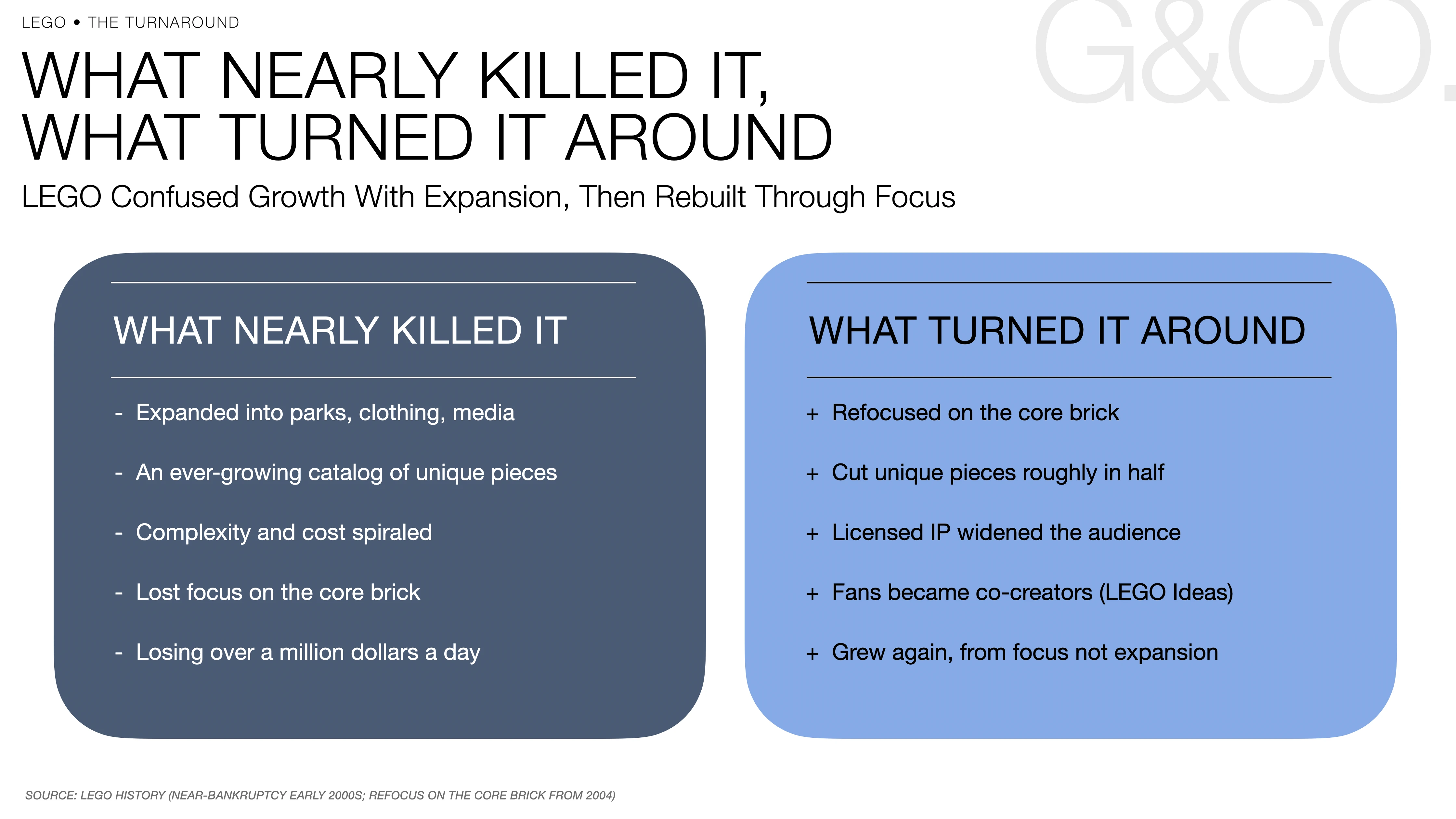
The strategic core of this case is that LEGO's problem was strategic, not creative. The company had confused growth with expansion, and had treated the brand as a license to enter any category rather than as a system to be focused and protected. The turnaround, led by new management from 2004, began with a hard admission: the company had to shrink and refocus before it could grow again. That reframing, from "where else can the brand go?" to "what is the brand actually for?", is the decision everything else in the recovery is built on.
Company Response
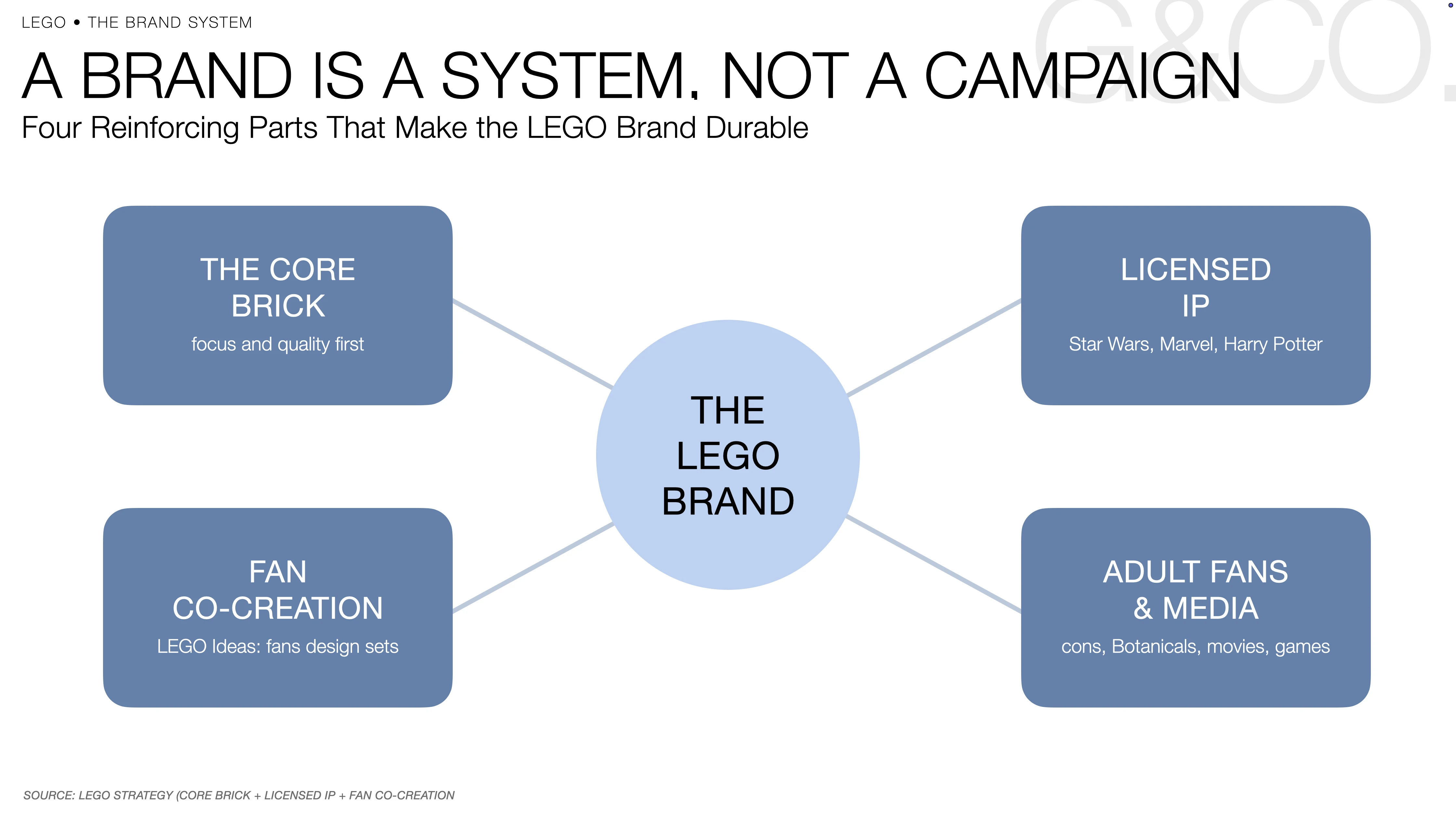
Refocus on the core.
The first move was discipline. LEGO cut the number of unique pieces roughly in half, exited or sold off distractions, and refocused on the profitable core of the brick system. It fixed a broken supply chain and brought costs under control. This was brand revitalization by subtraction: rather than add new categories to chase growth, LEGO removed what diluted it and rebuilt around what made it distinctive. The lesson embedded here is that focus, not expansion, is what restored both the finances and the brand.
Bring in powerful partners through licensed IP.
With the core stabilized, LEGO widened its audience through licensing. Its first big licensed line, LEGO Star Wars, had already shown the potential, and LEGO leaned into partnerships with Star Wars, Harry Potter, Marvel, and later many others. These franchises brought their own passionate fans into the brick and gave LEGO a steady stream of culturally relevant sets, without changing what LEGO fundamentally is. Done carelessly, licensing can dilute a brand; LEGO's discipline was that every licensed set still had to be a great LEGO building experience first. The IP widened the funnel; the brick kept the brand intact.
Turn fans into co-creators and a market.
LEGO's most distinctive move was to treat its most passionate customers as partners. Through LEGO Ideas, fans submit their own set designs, the community votes, and sets that clear the bar get produced, with the original creator earning a share of sales. This customer co-creation gives LEGO a pipeline of proven, fan-validated products and makes the community feel genuine ownership of the brand. In parallel, LEGO deliberately embraced adult fans (AFOLs), building a large business of sophisticated sets, Icons, Botanicals, Art, aimed at grown-ups, and turning what was once seen as a children's toy into a multi-generational hobby. The community is not an audience LEGO markets to; it is part of how the product gets made.
The approach carries real tension. Licensing means depending on partners and paying royalties, which limits margin and control. A large fan community raises expectations and can react strongly when LEGO missteps. And the constant pressure to grow risks pulling LEGO back toward the over-expansion that nearly killed it. But the system, focus plus IP plus community, is what keeps those risks in check, because each part reinforces the discipline of the others.
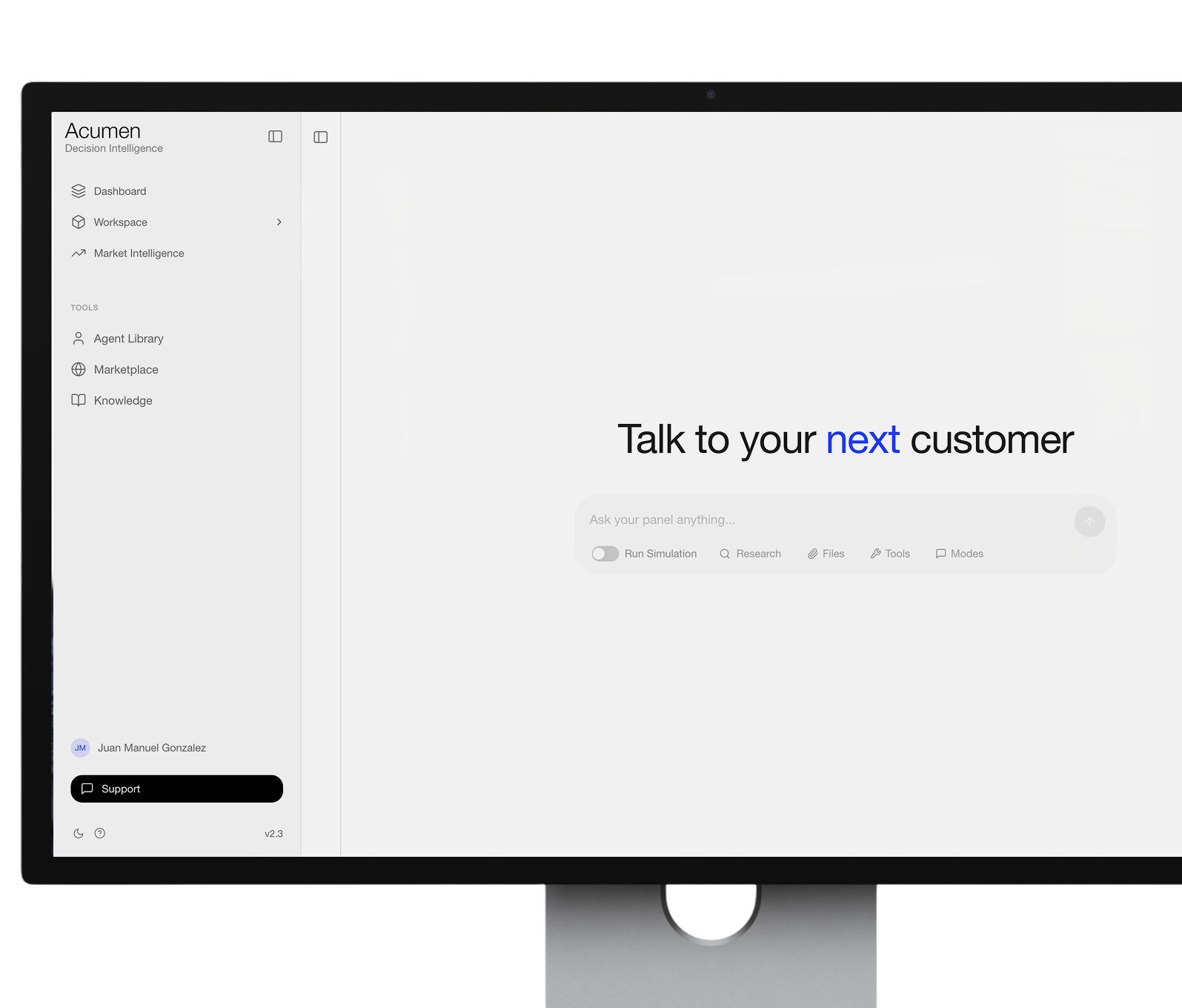
Always-On Customer Intelligence
Turn your own customer data into foresight — validate, simulate, and sense every major decision before you commit.


Results and Evidence
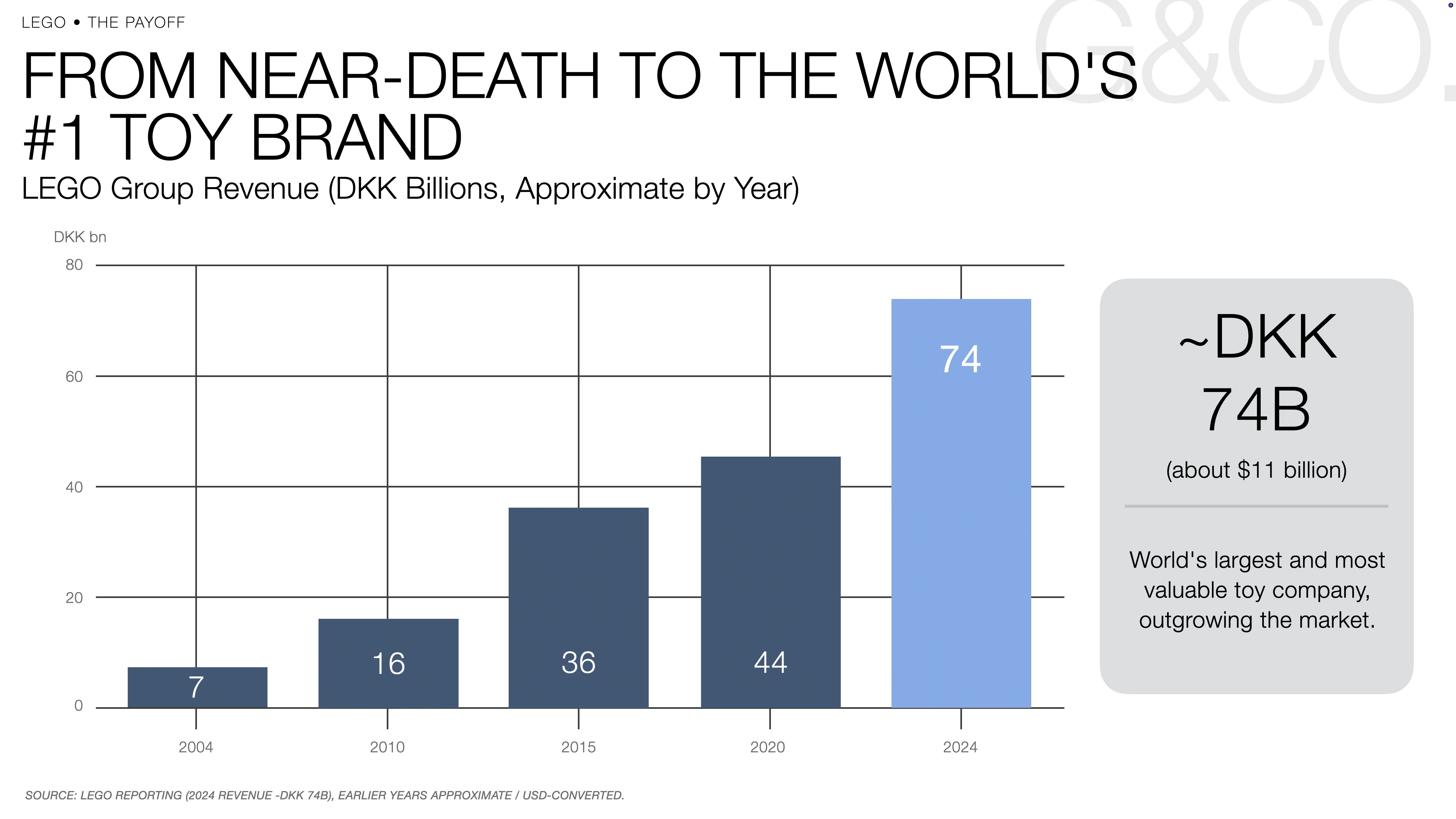
The evidence is a complete reversal of fortune. From near-bankruptcy in the early 2000s, LEGO became the world's largest and most valuable toy company, with revenue of around DKK 74 billion (roughly $11 billion) in 2024, up double digits in a year when the broader toy market was roughly flat, meaning LEGO is taking share, not just riding the category. It has stayed consistently and strongly profitable, and as a privately held company owned by its founding family, it has been able to invest for the long term rather than manage to quarterly targets. The deeper proof, though, is in the brand itself: LEGO consistently ranks among the world's most reputable and valuable brands, commands genuine multi-generational loyalty, and sustains a passionate adult-fan community that co-creates its products, assets that its financial results reflect but do not fully capture. These figures are drawn from LEGO's public reporting and are worth confirming against the latest annual results before publishing, since this names a real company and the numbers update each year.
Strategic Implications
Read at scale, LEGO is a case about a brand as a system rather than a message, and it connects to the broader questions of brand strategy, customer loyalty, community, and growth. The pattern is repeatable well beyond toys: a brand in trouble is rarely saved by a new campaign; it is saved by refocusing on what made it distinctive, extending it through partnerships that widen the audience without diluting the core, and building a community engaged enough to help create and sustain it. LEGO did not out-market its problems; it rebuilt the system underneath the brand.
The deeper implication is how these parts compound into durability. Focus restored the finances and the identity; licensed IP widened the audience; and customer co-creation turned loyalty into both a product pipeline and a moat that competitors cannot easily copy, because they cannot copy the community. For enterprise leaders, the takeaway is to stop thinking of a brand as something you advertise and start thinking of it as a system you focus, extend, and co-own with your most passionate customers. The brands that endure are not the ones that spend the most on attention; they are the ones whose customers are invested enough to carry the brand themselves. The same brand-as-a-system logic runs through Apple's anticipation-led brand, Airbnb's community-driven trust, and Costco's loyalty-as-the-business model.
What Enterprise Leaders Can Learn
- A brand is a system, not a campaign.
LEGO's recovery came from focus, partnerships, and community working together, not from a single message. Fix the system, not the advertising. - Revitalize by subtraction first.
LEGO grew again only after it cut complexity and exited distractions. A struggling brand usually needs focus before expansion. - Extend through partners without diluting the core.
Licensed IP widened LEGO's audience because every set still had to be a great LEGO experience first. Partnerships should widen the funnel, not blur the brand. - Turn your best customers into co-creators.
Customer co-creation (like LEGO Ideas) gives you validated products and a community that feels ownership, an advantage rivals cannot copy. - Loyalty is the asset money cannot buy quickly.
LEGO's multi-generational, co-creating community is its real moat; it was built over years and cannot be shortcut with ad spend.
Conclusion
LEGO's story is not really about toys. It is about what a brand actually is, and what it takes to revive one that has lost its way. Faced with near-bankruptcy, LEGO did not reach for a bigger marketing budget; it rebuilt the system underneath the brand, refocusing on the core brick, widening its audience through carefully chosen partnerships, and inviting its most passionate fans to help design the product itself. That system, focus plus IP plus community, is what carried it from losing more than a million dollars a day to becoming the most valuable toy company in the world, with a brand loyalty few companies in any industry can match. For enterprise leaders, the transferable lesson is to treat your brand as a system to be focused and co-owned, not a message to be broadcast. The brands that last are the ones whose customers are invested enough to build them alongside you.
Through the Acumen platform, G&CO. gives enterprise brands the intelligence to build brand as a system: where a brand has lost focus, which partnerships would widen the audience without diluting it, and how to turn loyal customers into co-creators. G&CO. is a certified minority business enterprise through the National Minority Supplier Development Council (NMSDC). For enterprise organizations with diversity inclusion requirements in their procurement process, G&CO. meets the criteria for MBE-qualified partner status.
G&CO. works with enterprise brands on the brand, community, and growth strategy that turns a brand from a message into a durable, co-owned system. If this LEGO case study raises questions about your own brand strategy, brand revitalization, or fan co-creation, submit an inquiry to G&CO. on our contact page or click the blue "Click to Contact Us" button in the bottom right corner of your screen. We look forward to hearing from you.
Frequently Asked Questions
What was LEGO's brand strategy in its turnaround?
LEGO's brand playbook was to rebuild the brand as a system rather than run a marketing campaign. It refocused on the core brick (cutting complexity and exiting distractions), widened its audience through licensed franchises like Star Wars and Marvel, and turned its most passionate fans into co-creators through LEGO Ideas. Each part reinforced the others: focus restored the finances and identity, IP widened the audience, and community built durable loyalty. That system, not any single ad, is what took LEGO from near-bankruptcy to the world's most valuable toy company.
How did LEGO achieve its brand revitalization?
Through focus before expansion. When new leadership took over in 2004, LEGO cut the number of unique pieces roughly in half, sold off or exited distractions like some of its theme-park operations, fixed a broken supply chain, and refocused on the profitable core of the brick system. Only once the core was stable and profitable did LEGO grow again, through licensing and community. The brand revitalization came from subtraction first, removing what diluted the brand, rather than from adding new categories to chase growth.
What is fan co-creation, and how does LEGO use it?
Fan co-creation means involving customers directly in designing the product. LEGO's clearest example is LEGO Ideas, where fans submit their own set designs, the community votes, and designs that clear a threshold get produced as official sets, with the original creator earning a share of sales. This gives LEGO a pipeline of proven, fan-validated products and makes the community feel genuine ownership of the brand. Combined with LEGO's embrace of adult fans, it turns loyalty into both a product source and a competitive moat rivals cannot easily copy.
How did licensing fit into LEGO's business strategy?
Licensing widened LEGO's audience without changing what LEGO is. Starting with LEGO Star Wars and expanding to Harry Potter, Marvel, and many others, licensed franchises brought their own passionate fans into the brick and gave LEGO a steady stream of culturally relevant sets. The discipline that made it work, and the key part of the LEGO business strategy, is that every licensed set still had to be a great LEGO building experience first, so the partnerships widened the funnel without diluting the core brand. Done carelessly, licensing can cheapen a brand; LEGO's focus kept it additive.
What can enterprise leaders learn from the LEGO case study?
The central lesson is that a brand is a system, not a campaign, and that even a beloved brand can fail if that system loses focus. LEGO's repeatable playbook: revitalize by subtraction first (cut complexity, exit distractions, refocus on the core), extend through partnerships that widen the audience without diluting the brand, and turn your most passionate customers into co-creators who build genuine loyalty and a product pipeline. Leaders should treat their brand as something to focus and co-own with customers, not just advertise, because the loyalty that results is the one asset competitors cannot buy quickly.