Lemonade Case Study: Rebuilding Insurance Around AI
This Lemonade case study examines how a young insurtech rebuilt insurance around AI instead of digitizing an old process. Lemonade sells policies through a chatbot in minutes, pays some claims in seconds through another, and runs underwriting on machine learning, turning one of the slowest, least-trusted industries into a fast, modern digital insurance experience. Just as important, its flat-fee model removes the usual incentive to deny claims, which builds trust and reduces fraud. The result is a transformed insurance customer experience and a business growing quickly toward profitability. The Lemonade insurance story shows what it means to redesign an industry around AI and aligned incentives, not just a better app.
Lemonade rebuilt insurance around AI, selling policies through a chatbot in minutes and paying some claims in seconds, on a flat-fee model that removes the usual incentive to deny you.
Insurance is one of the industries people trust least and enjoy least. Buying a policy is slow and confusing, filing a claim is worse, and behind it all sits an uncomfortable fact: a traditional insurer keeps whatever it does not pay out, so it profits by finding reasons to say no. Lemonade was built to attack both problems at once, the terrible experience and the broken incentive.
This case study looks at how Lemonade rebuilt insurance around artificial intelligence rather than bolting technology onto an old process, and paired that with a business model designed to align its interests with its customers'. For enterprise leaders, the lesson reaches well beyond insurance. It is about what becomes possible when you redesign a legacy industry around AI and aligned incentives, instead of digitizing the way it always worked.
Key Points
- Lemonade rebuilt insurance around AI from the ground up. Rather than digitize an old process, it built the company on AI bots that handle quotes, onboarding, and claims, a true insurtech, not a legacy insurer with an app.
- The experience is the product: minutes to buy, seconds to pay. An AI chatbot sells a policy in minutes, and a claims bot can approve and pay simple claims in seconds, a radically better insurance customer experience than the industry norm.
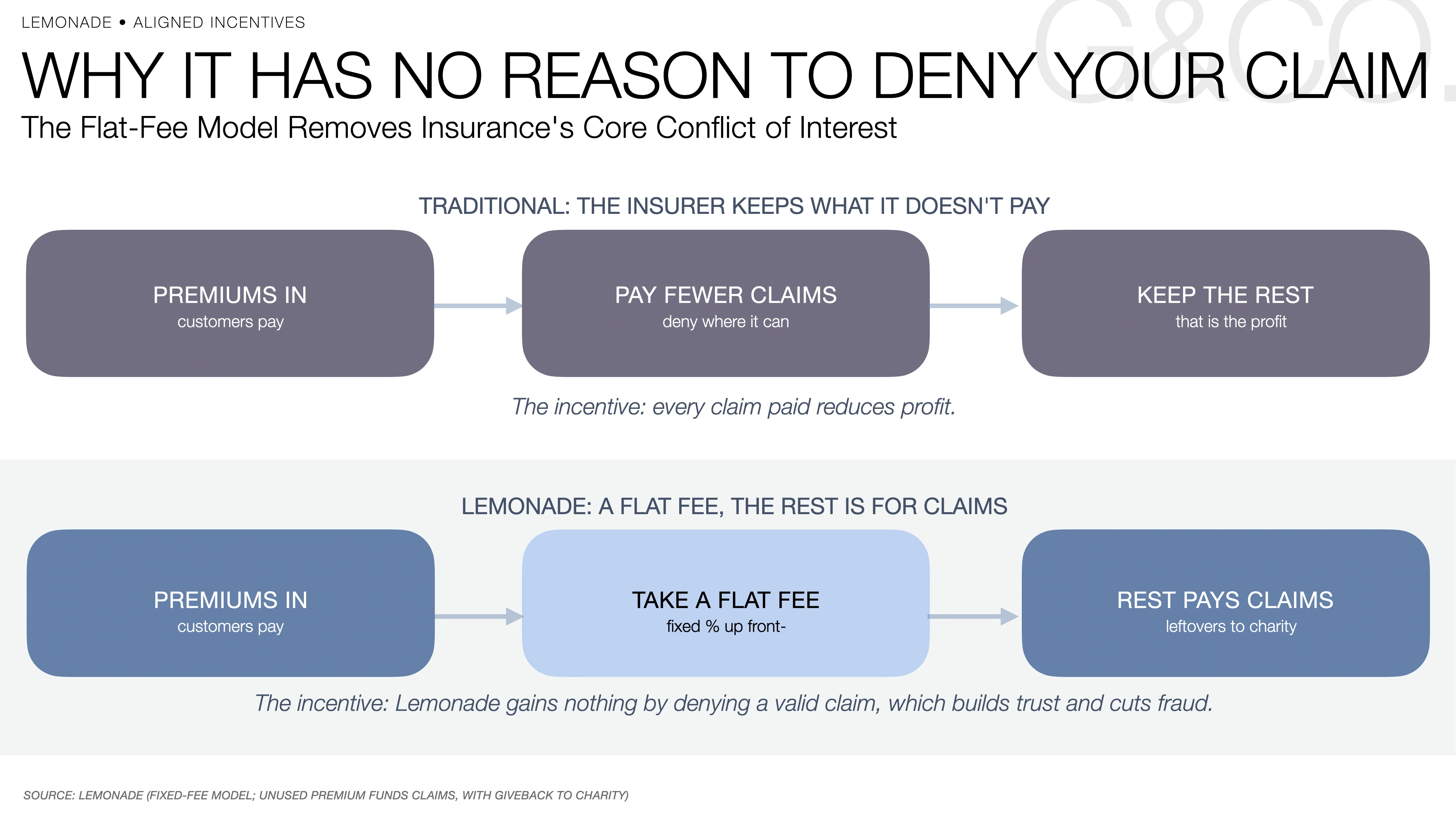
- A flat-fee model removes the conflict of interest. Lemonade takes a fixed cut of premiums and gives leftover money to charities through its Giveback program, so it does not profit by denying claims, which builds trust and reduces fraud.
- AI runs underwriting and pricing, not just the chat. Machine learning on rich data lets Lemonade price risk and flag fraud, and its loss ratios have improved as the data compounds.
- The bet is growth now, profitability as it scales. Lemonade has grown to around 2 million customers and roughly $900 million in in-force premium, with losses narrowing as its AI and data improve.
Why This Matters
For CEOs, chief digital officers, and anyone running or disrupting a legacy, low-trust industry, Lemonade is a clear test of a strategic idea: that the biggest opportunity is not to digitize the old process but to rebuild it around AI and better incentives. Lemonade did not make insurance slightly more convenient; it reimagined what buying and using insurance feels like, and rethought how the insurer makes money.
The timing matters. AI has made it possible to automate the core work of many industries, underwriting, claims, service, at a cost and speed incumbents cannot match with legacy systems. At the same time, customers increasingly reward companies they trust and punish those they do not. Lemonade sits at the intersection: an AI-first cost structure and an incentive model built for trust. For any leader asking whether their industry could be rebuilt rather than merely upgraded, and whether a fairer model could be a competitive weapon, Lemonade is instructive.


%20(1).png)

Let’s kickstart the conversation and design stuff people will love.

The Retail & Consumer Index


Strategic Context
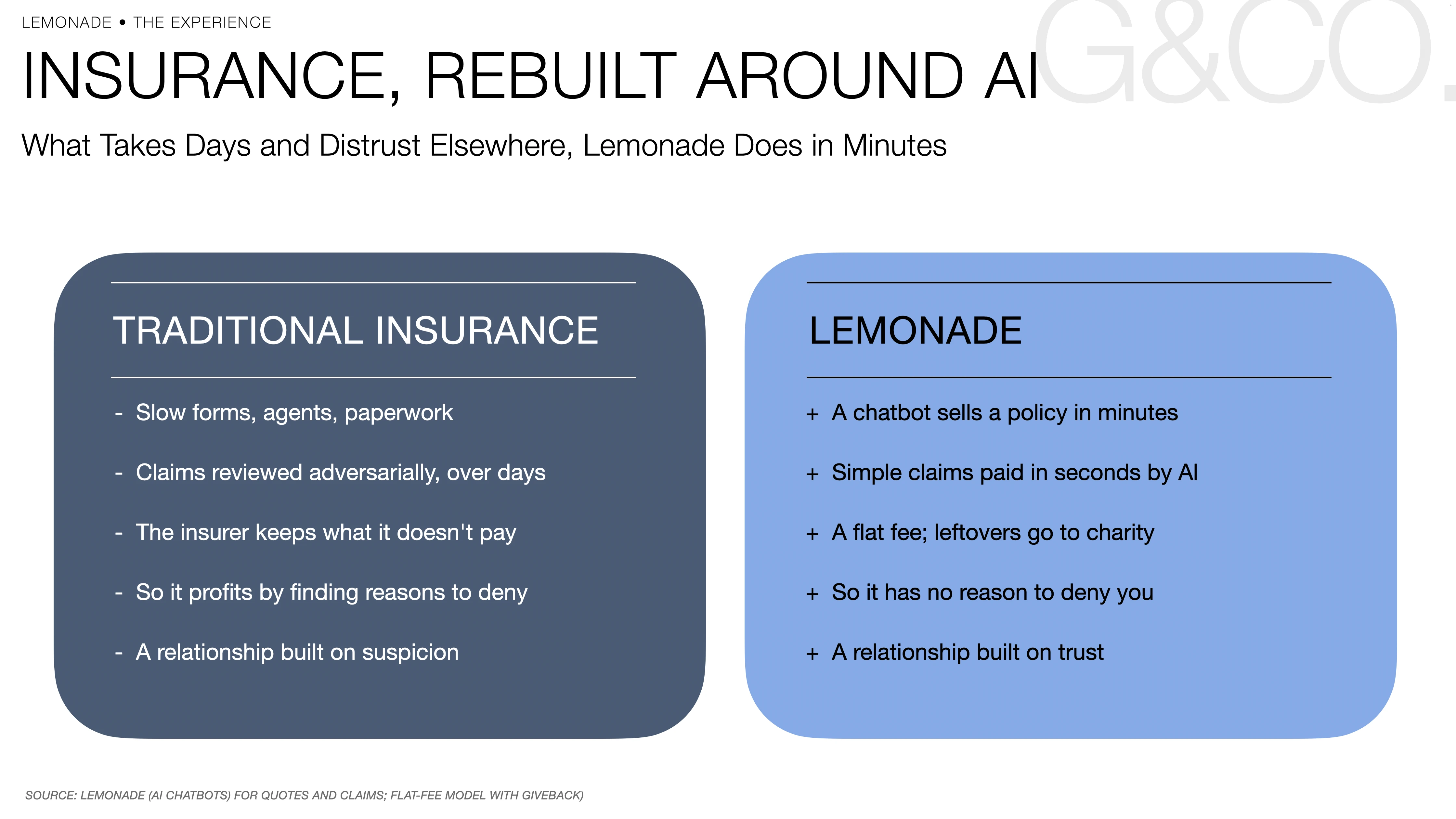
Insurance runs on a structural conflict most customers sense but cannot name. A traditional insurer collects premiums, pays out claims, and keeps the difference, which means every claim it pays reduces its profit. That single fact shapes the whole experience: slow claims, adversarial reviews, fine print, and a customer relationship built on suspicion in both directions. Layered on top is decades of legacy technology and paperwork that make buying and claiming slow and painful. The industry is large, essential, and almost universally disliked.
Lemonade's founding insight was that both problems, the bad experience and the bad incentive, could be solved together, and that AI made it possible. Building from scratch, with no legacy systems to protect, Lemonade could automate the core of insurance and redesign the business model at the same time. The strategic choice at the heart of this case is that Lemonade did not set out to be a nicer insurance company; it set out to rebuild insurance around two ideas the incumbents could not easily adopt, AI doing the work and a flat fee removing the conflict, because their old systems and profit models were built the other way.
Company Response
Run the core on AI.
Lemonade built its company around AI rather than adding it later. A chatbot named Maya handles quotes and onboarding, gathering what it needs and issuing a policy in minutes. A second bot, Jim, handles claims, and for straightforward cases can review, approve, and pay in seconds, famously as fast as a few seconds end to end. Behind the scenes, machine learning does the underwriting and pricing, assessing risk from far more data points than a traditional process, and flags likely fraud. This is what makes Lemonade a genuine insurtech rather than a digital insurance front end on an old engine: the AI is the operation, not a feature.
Align incentives with a flat fee.
Lemonade changed how the insurer makes money. Instead of keeping the money it does not pay in claims, it takes a fixed percentage of premiums as its fee and uses the rest to pay claims, giving leftover funds to charities chosen by customers through its Giveback program. Because Lemonade does not pocket unpaid claims, it has no financial reason to deny a valid one, which removes the industry's core conflict of interest. That design does real work: it builds trust, and because customers are effectively taking from a charitable pool rather than a faceless corporation, it discourages the padded and fraudulent claims that inflate costs across the industry.
Make the experience the product.
The combination of AI speed and aligned incentives produces a customer experience insurance buyers are not used to: friendly, fast, transparent, and free of the sense that someone is trying to trick them. Lemonade leaned into this as its brand, a simple app, plain language, instant answers, and used the quality of the experience itself as its main engine of growth and word of mouth. In an industry where the product is nearly identical from company to company, Lemonade competes on the experience and the trust around it.
The approach carries real tension. Automating claims and underwriting invites scrutiny over fairness and bias, and Lemonade has to prove its AI is accurate and even-handed. Growing fast in insurance means paying out claims before the book of business matures, so profitability lags growth, and Lemonade has run losses while it scales. And incumbents are watching and investing in their own automation. But the AI-first cost structure and the trust model are exactly what a legacy insurer cannot quickly copy without dismantling its own systems and economics.
Always-On Customer Intelligence
Turn your own customer data into foresight — validate, simulate, and sense every major decision before you commit.


Results and Evidence
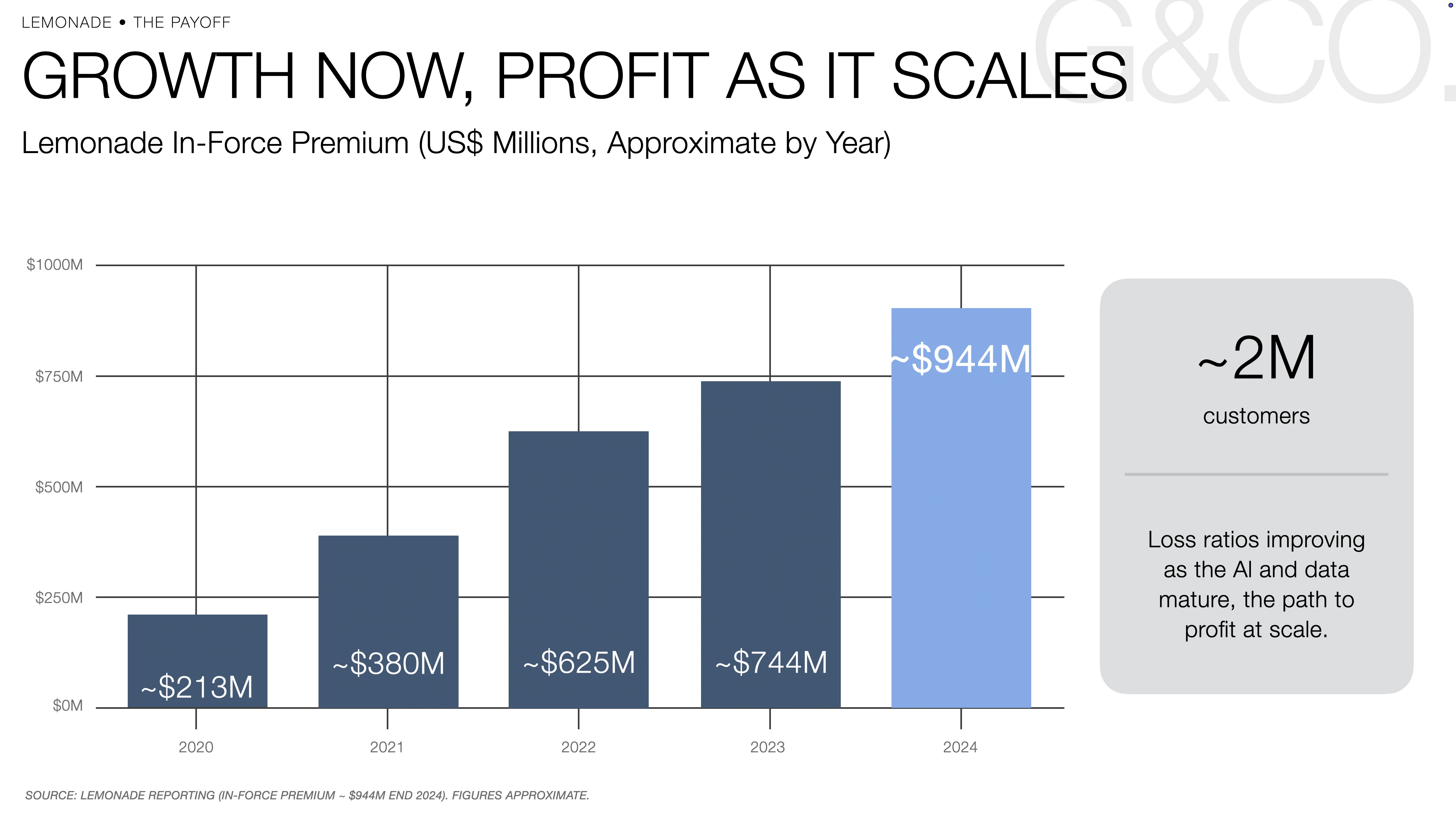
The evidence is in the growth, the experience, and the improving economics. Lemonade insurance has grown to around 2 million customers and roughly $900 million in in-force premium, expanding from renters insurance into homeowners, pet, car, and life, with premium growing at a healthy double-digit rate. The clearest proof of the model is operational: simple claims paid in seconds by AI, and a large share of customer interactions handled without human agents, which is what lets a young company serve millions at a cost structure legacy insurers cannot match. Just as important, its loss ratio, the share of premiums paid out in claims, has improved as its data and models mature, which is the metric that determines whether the AI-and-incentives model actually works, and it has been moving in the right direction. Lemonade is not yet consistently profitable, which is the honest state of the story: it is a growth-stage company betting that its AI cost advantage and improving loss ratios will carry it to profit at scale. These figures come from Lemonade's public reporting and are worth confirming against the latest results before publishing, since this names a real company and the numbers update each quarter.
Strategic Implications
Read at scale, Lemonade is a case about rebuilding a legacy industry around AI and incentives rather than digitizing it, and it connects to the broader shifts in insurtech, AI-driven operations, customer experience, and trust. The pattern is repeatable well beyond insurance: in many old, disliked industries, the largest opportunity is not a nicer interface on the existing process but a company built from scratch around automation and a fairer model, which a new entrant can do and incumbents cannot, because incumbents must protect their legacy systems and profit structures. Lemonade did not compete with insurers on their terms; it changed the terms.
The deeper implication is that experience and trust can be the strategy, not the veneer. Because Lemonade's model genuinely aligns its interests with its customers', the resulting trust and experience become its growth engine and its defense, and the AI underneath makes that experience cheap enough to offer at scale. For enterprise leaders, the takeaway is to look at any slow, low-trust, legacy industry and ask what it would mean to rebuild it around AI and aligned incentives from the ground up, rather than to automate the existing steps. The disruptors that win in these industries are rarely the ones with a better app; they are the ones that redesigned the economics and the experience together. The same rebuild-the-industry logic runs through Nubank's digital-native challenge, Airbnb's trust-as-the-product model, and Salesforce's AI-run operations.
What Enterprise Leaders Can Learn
- Rebuild around AI, don't bolt it on.
Lemonade's advantage is that AI is the operation, not a feature added to a legacy process. The cost and speed edge comes from building AI-first. - Fix the incentive, not just the interface.
Lemonade's flat fee removed the industry's core conflict of interest. A fairer model can be a durable competitive weapon incumbents cannot easily copy. - Make the experience the growth engine.
In a commodity category, a genuinely better, more trusted experience becomes the marketing, cutting the cost of growth. - Trust can reduce cost, not just win customers.
Aligning interests with customers (the Giveback design) discourages fraud, which improves the economics, trust pays for itself. - Legacy incumbents can't easily follow.
The reason a new entrant can rebuild an industry is that incumbents must defend their old systems and profit models; that constraint is the opening.
Conclusion
Lemonade's story is not really about insurance policies. It is about the difference between digitizing an old industry and rebuilding it. Faced with a business almost everyone finds slow and untrustworthy, Lemonade did not simply put insurance in a nicer app; it ran the core of the business on AI, so buying takes minutes and simple claims are paid in seconds, and it changed how the insurer makes money, so it no longer profits by saying no. Those two moves, automation and aligned incentives, reinforce each other: the AI makes a great experience affordable at scale, and the fair model makes that experience trustworthy. For enterprise leaders, the transferable lesson is to look at any legacy, low-trust industry and ask not how to digitize it but how to rebuild it around AI and better incentives, because the companies that redesign the economics and the experience together are the ones that change the terms of competition.
Through the Acumen platform, G&CO. gives enterprise brands the intelligence to rethink a legacy industry rather than digitize it: where AI could run the core of the operation, where a fairer model would build trust and cut cost, and where a rebuilt experience could become the growth engine. G&CO. is a certified minority business enterprise through the National Minority Supplier Development Council (NMSDC). For enterprise organizations with diversity inclusion requirements in their procurement process, G&CO. meets the criteria for MBE-qualified partner status.
G&CO. works with enterprise brands on the AI, experience, and business-model strategy that turns a slow, low-trust category into a fast, trusted one. If this Lemonade case study raises questions about your own insurtech, digital insurance, or insurance customer experience strategy, submit an inquiry to G&CO. on our contact page or click the blue "Click to Contact Us" button in the bottom right corner of your screen. We look forward to hearing from you.
Frequently Asked Questions
What makes Lemonade a true AI-first insurer rather than a digital insurer?
The difference is that Lemonade built its company around AI rather than adding technology to a legacy process. An AI chatbot (Maya) handles quotes and onboarding in minutes, a second bot (Jim) can approve and pay simple claims in seconds, and machine learning does the underwriting, pricing, and fraud detection. The AI is the core operation, not a feature. That is what separates a genuine AI-first insurer from a traditional insurer with a nicer app, and it is what gives Lemonade a cost and speed advantage incumbents on legacy systems cannot match.
How does Lemonade improve the insurance customer experience?
By making it fast, transparent, and free of the usual adversarial feel. Buying a policy takes minutes through a friendly chatbot, simple claims can be paid in seconds, and the language and app are deliberately plain and clear. Crucially, Lemonade's flat-fee model means it has no incentive to deny valid claims, so customers do not feel they are being tricked. The result is a customer experience insurance buyers rarely get from traditional providers, and Lemonade uses the quality of that experience as its main engine of growth.
How does Lemonade's flat-fee model work, and why does it matter?
Instead of keeping the money it does not pay out in claims (as traditional insurers do), Lemonade takes a fixed percentage of premiums as its fee and uses the rest to pay claims, donating leftover funds to charities customers choose through its Giveback program. Because Lemonade does not pocket unpaid claims, it has no financial reason to deny a valid one, which removes insurance's core conflict of interest. This builds trust, and because customers are effectively drawing from a charitable pool, it also discourages the fraudulent and padded claims that raise costs across the industry.
Is Lemonade profitable?
Not yet consistently, and that is the honest state of the story. Lemonade is a growth-stage company: it has grown to around 2 million customers and roughly $900 million in in-force premium, but growing fast in insurance means paying claims before the book of business matures, so profitability lags growth. The key metric to watch is its loss ratio (the share of premiums paid out in claims), which has been improving as its data and AI models mature. The bet is that its AI cost advantage and improving loss ratios carry it to profit at scale. These figures should be confirmed against Lemonade's latest results.
What can enterprise leaders learn from the Lemonade case study?
The central lesson is that the biggest opportunity in a legacy, low-trust industry is often to rebuild it around AI and better incentives, not to digitize the existing process. Lemonade's repeatable playbook: run the core operation on AI (for cost and speed a legacy player cannot match), fix the incentive that makes customers distrust you (its flat fee removed the conflict of interest), and make the resulting experience the growth engine. Leaders should ask what it would mean to redesign the economics and the experience of their industry together, because incumbents, bound to their old systems and profit models, usually cannot follow.