Sanofi’s Omnichannel Marketing in Pharma: How AI and Golden Profiles Drove 30% Higher Conversion
This Sanofi case study examines how the pharmaceutical company rebuilt its data foundation to fix a hidden cost: the days its customer insight spent stuck in separate systems before anyone could act on it. Through its Digital Accelerator and AI platforms (Turing and plai), Sanofi cut the time to act on data from days to hours, lifted marketing conversion by about 30%, and extended AI into its supply chain. It is a case study in omnichannel marketing in pharma and pharma digital transformation, built on strong enterprise data architecture rather than on more content.
Sanofi used an AI platform it calls Turing to turn its slow, scattered customer data into one connected system it can act on in real time.
Sanofi set out to remove a hidden cost that slows every large pharmaceutical company: the days or weeks that customer insight spends trapped in separate departments before anyone can act on it. That delay is not really a technology gap; it is a data problem, and it quietly taxes every decision a commercial team tries to make.
Its approach to omnichannel marketing in pharma is instructive because of what it chose to fix first. Rather than buying more channels or making more content, Sanofi rebuilt the data foundation underneath them and let smart, automated decisions run on top, turning slow, manual marketing work into fast, automated engagement. For enterprise leaders, Sanofi is a blueprint for turning slow human work into fast, scalable AI, and for treating the data foundation, not the volume of content, as the real driver of commercial results.
Key Points
- Customer insight sat in separate systems for days before anyone could act on it, so Sanofi rebuilt the data foundation first.
- Two AI platforms, Turing for commercial teams and plai enterprise-wide, pull that data together, cutting the time to act on data by about 95%, from days to hours, and recommend the best next step for each doctor.
- Better targeting lifted sales conversion by about 30%, and business EPS grew 15% while sales grew 9.9%, a sign costs and growth had separated.
- AI-driven research found 10 new drug targets in a year, and factory "digital twins" predict about 80% of low-inventory situations before they happen.


%20(1).png)

Let’s kickstart the conversation and design stuff people will love.

The Retail & Consumer Index


Why This Case Study Matters
With higher interest rates and regulatory pressure, the grow-at-any-cost model is over. Companies now have to improve margins through efficiency rather than headcount, and Sanofi is one of the clearest demonstrations that AI can drive that at global scale, not just in isolated pilots.
For CEOs, CMOs, chief digital officers, and transformation leaders, the relevance reaches well beyond pharma. Sanofi shows how a large, regulated company removes delay from its data, turns slow manual work into scalable systems, and turns raw data into a valuable intelligence asset that informs the whole business. The ability to make this shift now is what will separate the leaders of the next decade from the laggards.
Strategic Context
Pharmaceutical commercialization has long carried a “latency tax,” where patient and provider insight stayed trapped in departmental silos for days or weeks. For an enterprise of Sanofi’s scale, generating more than €43.6 billion in annual revenue, the inability to synchronize digital touchpoints with field-force activity was a structural barrier to growth. Generic email blasts and disconnected CRM entries became untenable as the market shifted toward a unified, AI-powered health platform.
Sanofi’s “Play to Win” strategy identified this friction as a critical vulnerability in an increasingly competitive immunology and vaccines landscape. Leadership concluded that optimizing omnichannel marketing in pharma was no longer a functional upgrade but a survival mandate, and faced a clear choice: continue incrementally digitizing legacy processes, or execute a wholesale architectural migration toward a predictive, event-driven engagement model. It chose the latter.
Company Response
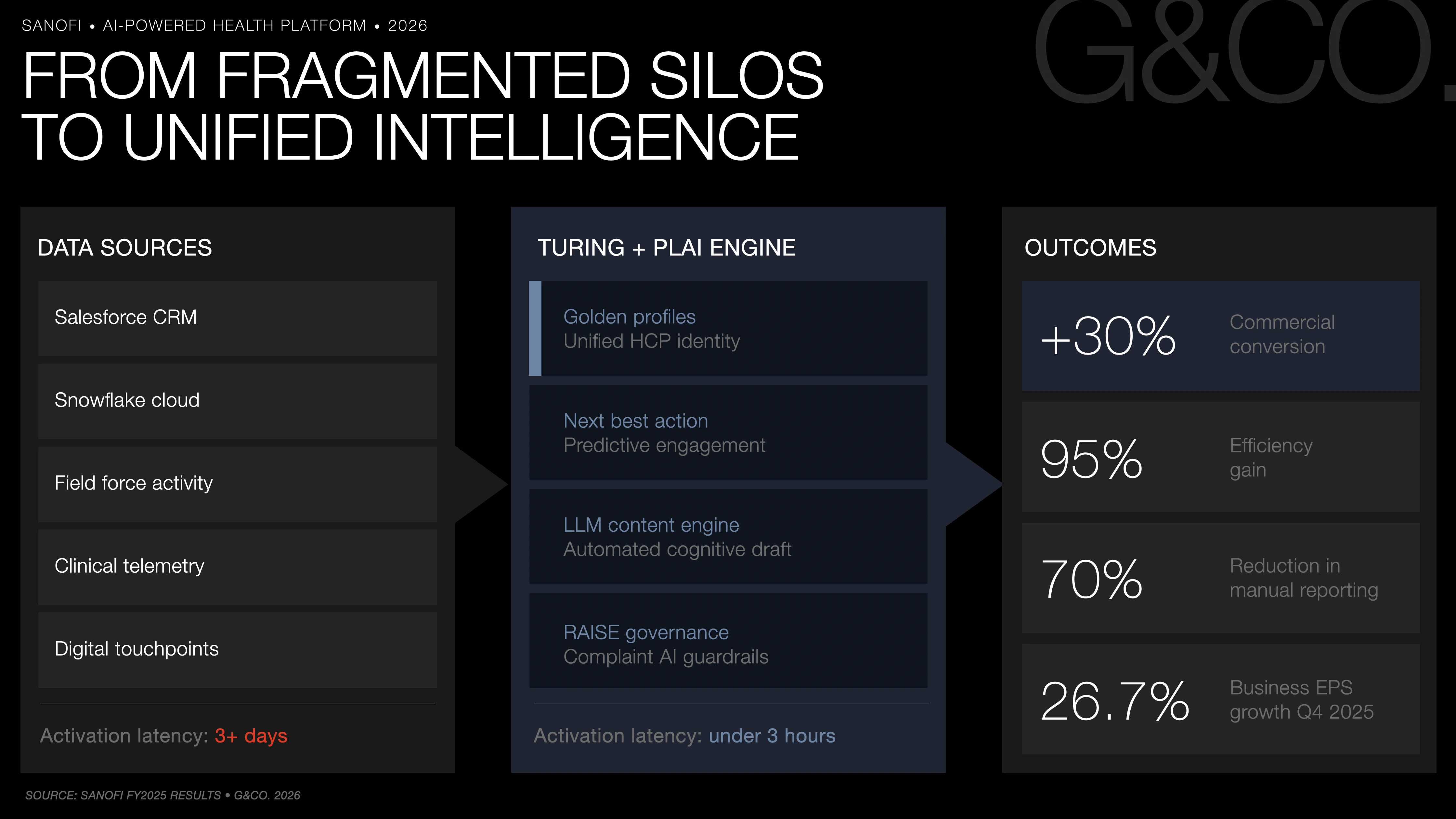
Executive leadership made an explicit decision to deprioritize generic content volume in favor of decision velocity and precision, codified through a “Digital Accelerator” pod structure that operated like an internal agile startup to bypass legacy corporate lethargy. By focusing on Product Experience Management, Sanofi invested in data sovereignty, building proprietary golden profiles that integrate online and offline telemetry into a single source of truth.
That pivot required a ruthless reallocation toward enterprise and solution architecture. Rather than purchasing disparate SaaS tools, Sanofi prioritized AI integration that could harmonize data across its Snowflake cloud and Salesforce environments, moving from a reactive marketing posture to a proactive “Next Best Action” engine so that every HCP interaction was informed by the most recent clinical and behavioral data.
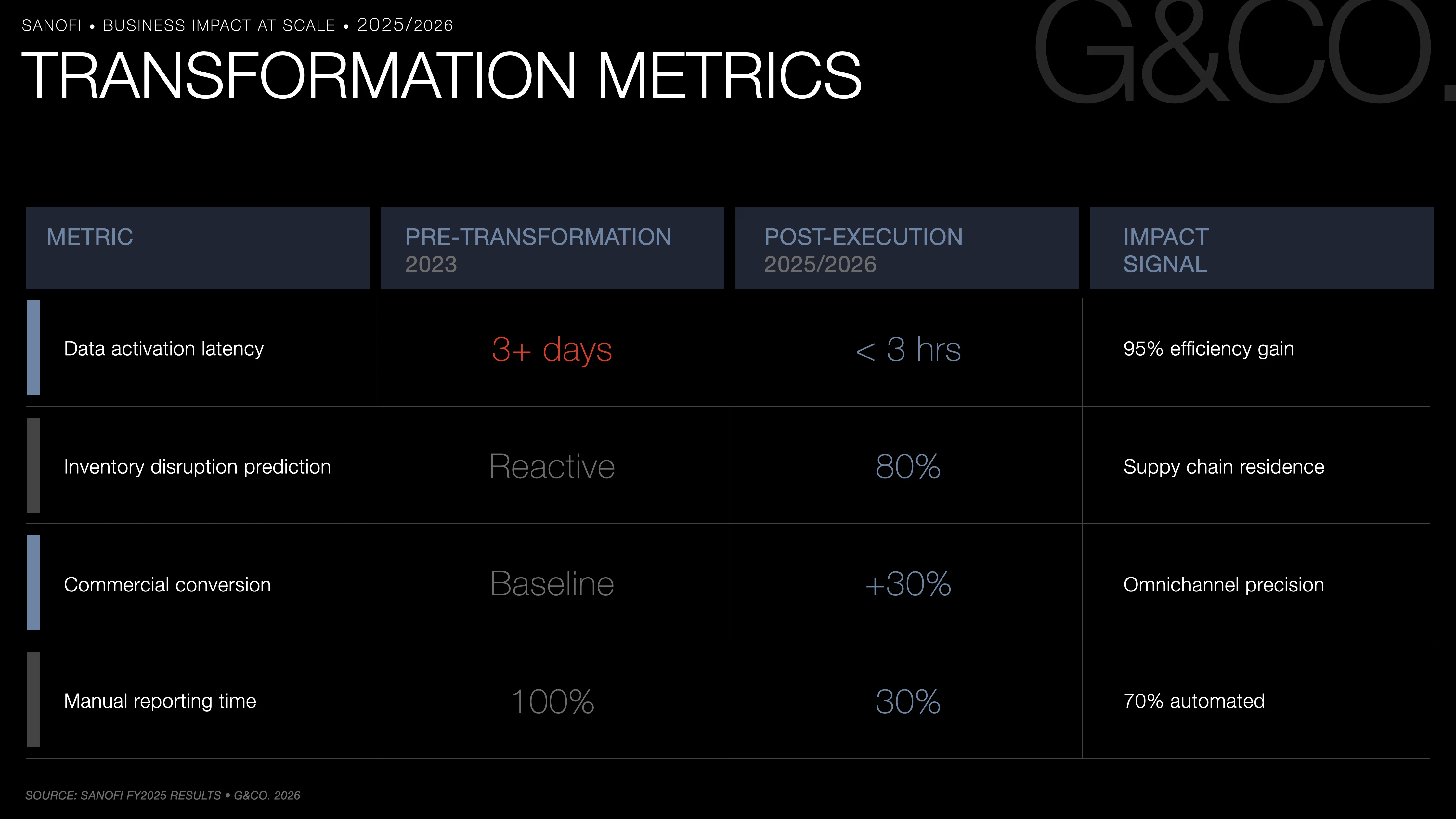
Execution was anchored by the Turing (commercial) and plai (enterprise) platforms, which function as the organization’s digital nervous system, aggregating internal data to give thousands of decision-makers “what-if” scenarios. In the field this shows up as a roughly 95% efficiency gain: data that once took three days to activate now activates in under three hours. The underlying plumbing uses digital experience platforms to automate delivery of personalized medical education, while LLM strategy and implementation automates the “cognitive draft” of highly regulated marketing materials, letting teams scale without a linear increase in headcount. The same modularity extends to the supply chain through digital facility management, where AI-enabled digital twins predict 80% of inventory disruptions so commercial demand is consistently met by production agility.
Two tensions accompany this. The first is governance: Sanofi’s RAISE framework enforces proportionate controls so AI-generated recommendations stay traceable, explainable, and compliant with healthcare regulation, acting as a deliberate friction point against uncoordinated agentic deployments. The second is cultural: moving legacy sales teams from “gut-feel” decisions to data-driven orchestration is slower than the technical integration, and the “Fight Club” initiative was designed to break internal silos by forcing collaboration between data scientists and brand managers. Technical integration has outpaced cultural adoption in some regions, which keeps change management central to the 2026 roadmap.
Always-On Customer Intelligence
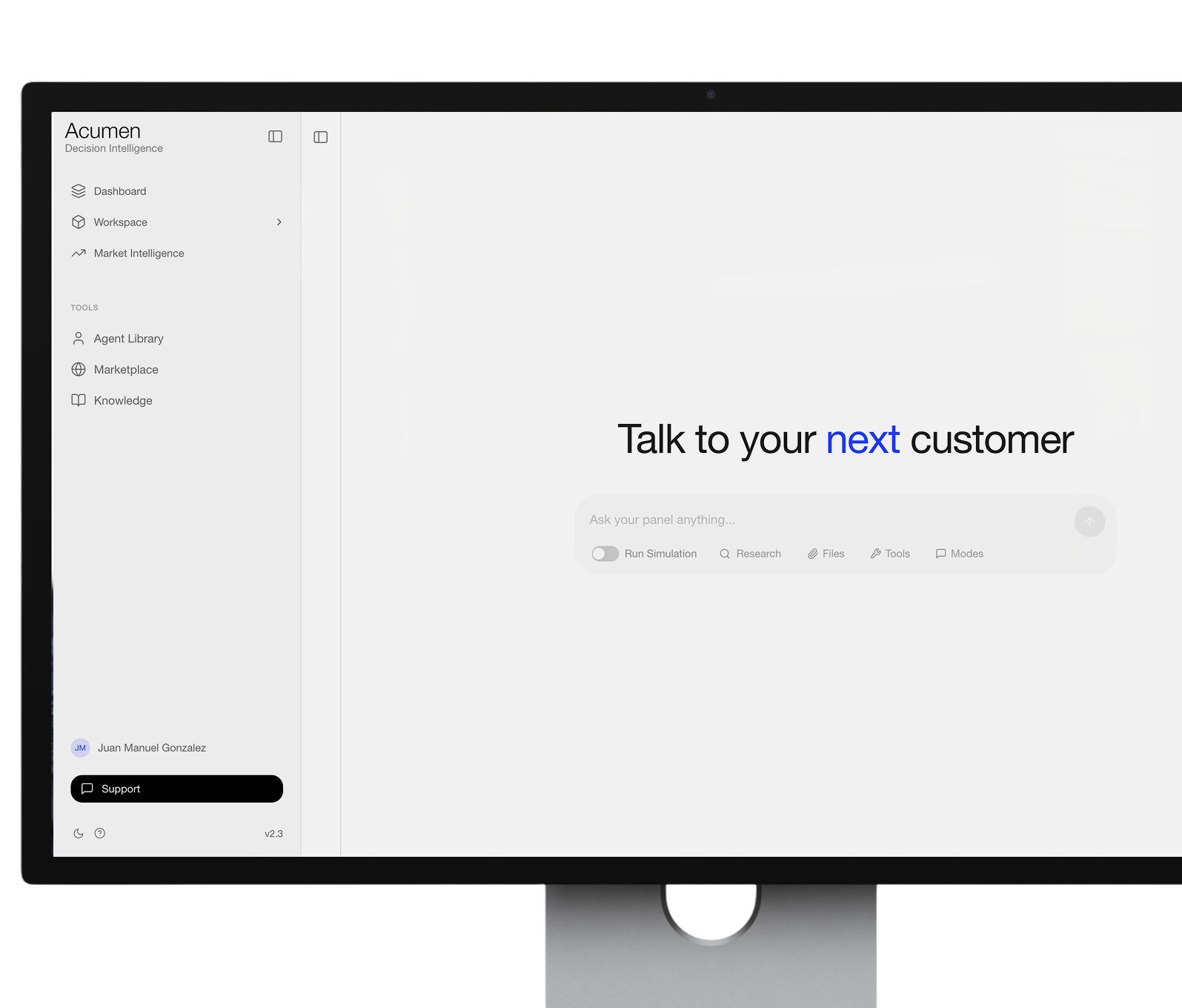
Turn your own customer data into foresight — validate, simulate, and sense every major decision before you commit.


Results and Evidence
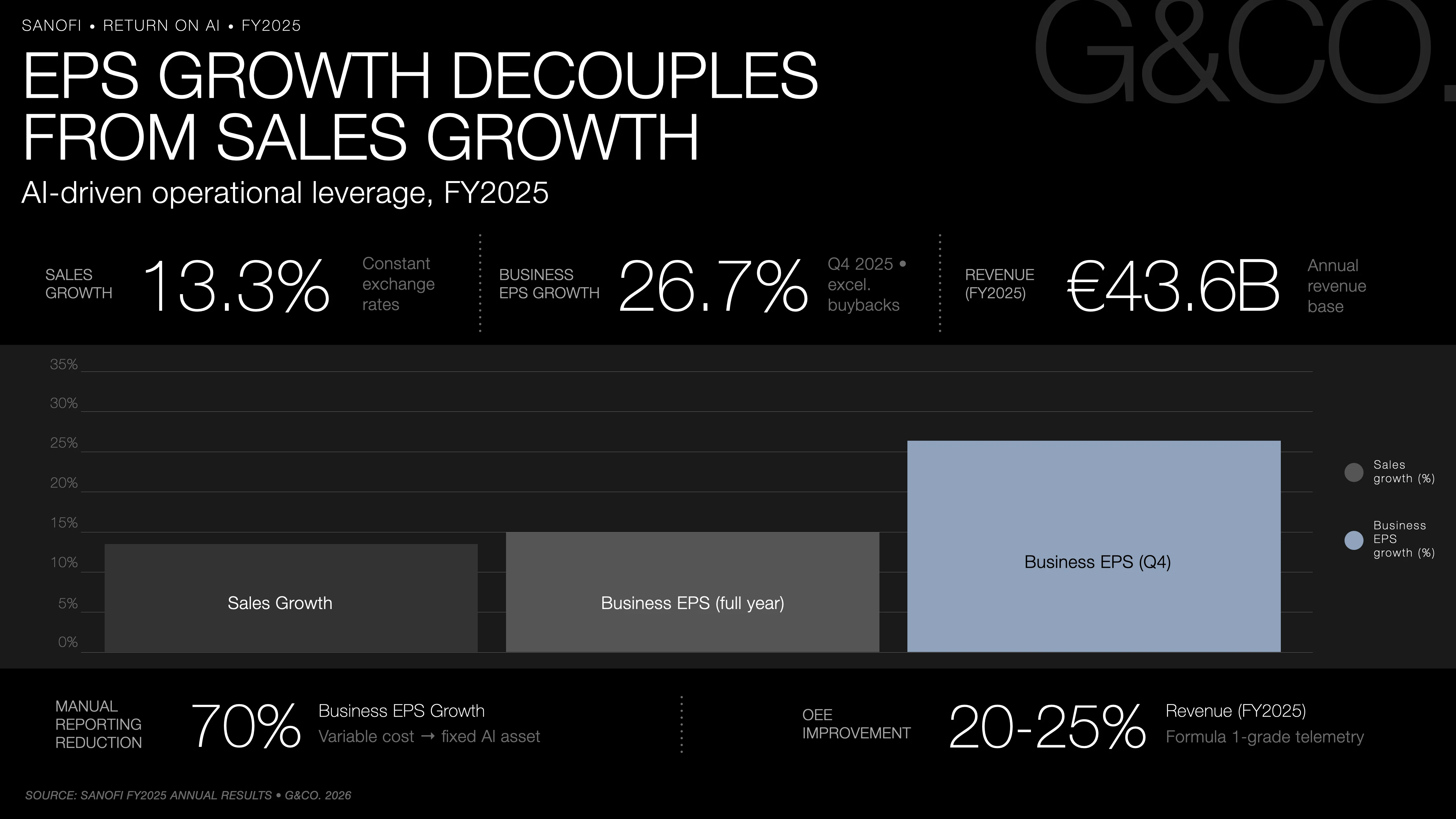
The financial validation is the decoupling of sales growth from operating expense. In FY2025, Sanofi reported 9.9% growth at constant exchange rates, while Business EPS (excluding buybacks) rose 15%, reaching 26.7% in Q4. This “Return on AI,” or ROAI, is driven by a 70% reduction in manual report generation and a 20% to 25% improvement in overall equipment effectiveness through Formula 1-grade telemetry. On the commercial side, predictive personalization lifted conversion by 30%, and on the discovery side, AI-driven R&D identified 10 novel targets in a single year.
Taken together, these signals validate the central thesis: AI for supply-chain optimization and AI for commercial excellence are not separate wins but outputs of one unified data fabric. The efficiency gains are not cosmetic; they represent the conversion of variable manual labor into fixed digital capability, which is what allows earnings to grow materially faster than sales.
Strategic Implications
The Sanofi case crystallizes a repeatable enterprise pattern that reaches across AI, customer experience, digital transformation, data strategy, and supply chain. Digital transformation fails when treated as a series of pilots and succeeds when executed as enterprise transformation, with a central Accelerator that owns the architecture while business units own the outcomes. Generalized, “digital innovation at scale” is really an exercise in reducing organizational entropy: enterprises that integrate CRM and loyalty with predictive AI build an architectural moat competitors cannot bridge through marketing spend alone.
The deeper reframe is the death of the linear value chain. Consensus has long viewed pharma as a sequential progression from R&D to manufacturing to sales. Sanofi proposes a synchronous value loop instead, where commercial insight flows back into R&D in real time, identifying which therapeutic targets have the highest market viability before the first trial begins. On this logic, the most valuable asset in a biopharma company is no longer the patent but the velocity of the feedback loop, and organizations that stay sequential will be structurally disadvantaged against “all-in” AI competitors who can reconfigure commercial and manufacturing strategy on demand.
What Enterprise Leaders Can Learn
- Build a data advantage.
Prioritizing strong enterprise data architecture over individual AI tools creates an advantage rivals cannot easily copy, because it depends on owning and connecting your own data. - Treat delay as a cost.
Data stuck in silos slows every decision; acting on data in real time makes a company far more responsive. - Turn manual work into automated systems.
Success now comes from replacing slow, variable human work with fast, scalable automation. - Aim for precision, not volume.
Real omnichannel marketing means moving from generic emails to targeted engagement informed by a full customer profile at every touchpoint. - Measure how fast you can act.
The truest sign of digital maturity is how quickly you can turn data into action across the business.
Conclusion
Sanofi's shift from a traditional pharmaceutical giant to an AI-powered health platform is a credible roadmap for resilience this decade. By fixing its data foundation and modernizing its architecture, the company removed the hidden delay that was slowing its commercial and research decisions. This is less a story of adopting technology than of speeding up how the whole organization works. The divide between leaders and laggards is no longer about product quality alone, but about the speed of these intelligence loops. Sanofi shows that when AI and omnichannel marketing are treated as core priorities, the resulting efficiency becomes a durable advantage. Companies that fail to line up their data foundations with their commercial goals will stall, with impressive tools but no compounding advantage.
Through the Acumen platform, G&CO.Health gives enterprise pharmaceutical and healthcare brands the intelligence to make digital transformation pay off: where connected data creates real speed and value, how to reach doctors and patients more precisely, and where to invest for the biggest commercial return. G&CO.Health is a certified minority business enterprise through the National Minority Supplier Development Council (NMSDC). For enterprise organizations with diversity inclusion requirements in their procurement process, G&CO.Health meets the criteria for MBE-qualified partner status.
G&CO.Health works with enterprise pharmaceutical and healthcare brands on the data, AI, and omnichannel strategy that turns scattered systems into fast, connected, and compliant engagement. If this Sanofi case study raises questions about your own omnichannel marketing in pharma, pharma digital transformation, or data architecture, submit an inquiry to G&CO.Health on our contact page or click the blue "Click to Contact Us" button in the bottom right corner of your screen. We look forward to hearing from you.
Frequently Asked Questions
What did Sanofi do to improve omnichannel marketing in pharma?
Sanofi centralized its digital work through a Digital Accelerator and used its Turing platform to unify customer data into complete profiles. By connecting its data systems, it cut the time to act on data by roughly 95%, from days to hours, which enabled real-time, personalized HCP engagement and increased commercial conversion by about 30% across its markets. The key was fixing the data foundation first, rather than simply adding more channels or content.
Why did Sanofi choose an "all-in" AI strategy?
Leadership recognized that gradual digitization could not overcome the delay built into its separate systems. By committing to becoming an AI-powered health platform, Sanofi aimed to speed up drug discovery, make its manufacturing more flexible through AI supply chain optimization, and separate its costs from headcount growth, so profit could grow faster than sales.
How did Sanofi use AI in its supply chain?
Sanofi used AI supply chain optimization to make its manufacturing more flexible and reliable. Virtual models of its factories predict about 80% of low-inventory situations before they happen, and it borrowed fast-changeover techniques from Formula 1 racing to reduce downtime. Together these improved how efficiently its equipment runs by 20% to 25%, so commercial demand is consistently met by production.
What were the results of Sanofi's pharma digital transformation?
The strategy produced strong operating leverage, with Business EPS growing well ahead of sales in 2025. AI-driven research identified 10 new drug targets in a single year, and the company cut manual report writing by 70%, sharply improving how fast it can act. On the commercial side, better targeting lifted conversion by about 30%. Some of these figures come from company communications and should be confirmed before publishing.
What can enterprises learn from the Sanofi case study?
The core lesson is to move from pilot projects to one enterprise-wide effort anchored by a strong, unified data foundation. Sanofi shows that AI's real value lies in removing the delay from information and turning slow, manual work into fast, scalable systems that inform the whole business at once. Building strong enterprise data architecture, rather than buying scattered tools, is what creates an advantage competitors cannot easily copy.