
Equinox Case Study: The Luxury Brand Strategy Behind a Premium Gym
This Equinox case study examines how a fitness company built one of the clearest examples of luxury brand strategy in any category. Equinox does not sell gym access; it sells an aspirational identity and a meticulously designed experience, and it uses a high price as part of the positioning rather than an obstacle to it. Through experiential retail, deliberate brand positioning, and premium pricing strategy, Equinox turned a commodity, exercise equipment, into a status symbol people pay a large premium to belong to. The Equinox strategy shows that in luxury, the experience and the price are the product, a lesson for any brand trying to compete on identity rather than on the commodity underneath.
Equinox sells an aspirational identity and a designed experience, not gym access, using a high price and immaculate spaces to position itself as a luxury lifestyle brand rather than a place to work out.
Every gym has more or less the same equipment: treadmills, weights, a few studios. On that basis, one gym is hard to tell from another, and the natural way to compete is on price and convenience, a race to the bottom. Equinox refused to play that game. It looked at the same commodity, a room full of exercise machines, and decided to sell something else entirely: not access to equipment, but membership in an aspirational identity.
This case study looks at how Equinox built a luxury brand strategy around a commoditized product, using premium pricing, experiential design, and careful positioning to make people want to belong to it and pay a large premium to do so. For enterprise leaders, the lesson reaches well beyond fitness. It is about how to escape competing on a commodity by selling identity and experience instead, and why, in luxury, a high price is a feature rather than a barrier.
Key Points
- Equinox sells an identity, not gym access. The equipment is a commodity; Equinox positions itself as an aspirational lifestyle brand, so members pay for who they become and belong to, the heart of its luxury brand strategy.
- Premium pricing, memberships many times the cost of an ordinary gym, signals exclusivity and is central to the brand positioning. Being cheap would break the brand.
- The club is experiential retail, designed end to end. Architecture, lighting, scent, premium amenities, and high-touch service make the space itself the product, customer experience design as strategy.
- Equinox has extended into hotels, provocative marketing, and a roughly $40,000-a-year longevity membership, pushing the aspirational brand into new premium territory.
- It is the opposite of value-based membership. Where mass gyms compete on price and access, Equinox competes on status and experience, proof that in luxury, the experience and the price are the product.
Why This Matters
For CEOs, CMOs, and brand leaders, Equinox is one of the clearest examples of using brand and experience to escape a commodity trap. In a category where the underlying product is nearly identical everywhere and most competitors fight on price, Equinox built a business by refusing to compete on the commodity at all, and instead selling identity, status, and experience at a premium. That is one of the most valuable moves in business: turning a thing anyone can offer into something only you are seen to provide.
The timing matters. As more products and services become commoditized and comparison-shopped, the brands that command premium prices and genuine loyalty are the ones that sell an experience and an identity rather than a spec sheet. Equinox is a working model of how to do that deliberately, and it continues to push the idea further, most recently into luxury longevity and health. For any leader whose product risks becoming a commodity, Equinox shows the alternative: compete on who the customer becomes, not on what the product is.


%20(1).png)

Let’s kickstart the conversation and design stuff people will love.

The Retail & Consumer Index


Strategic Context
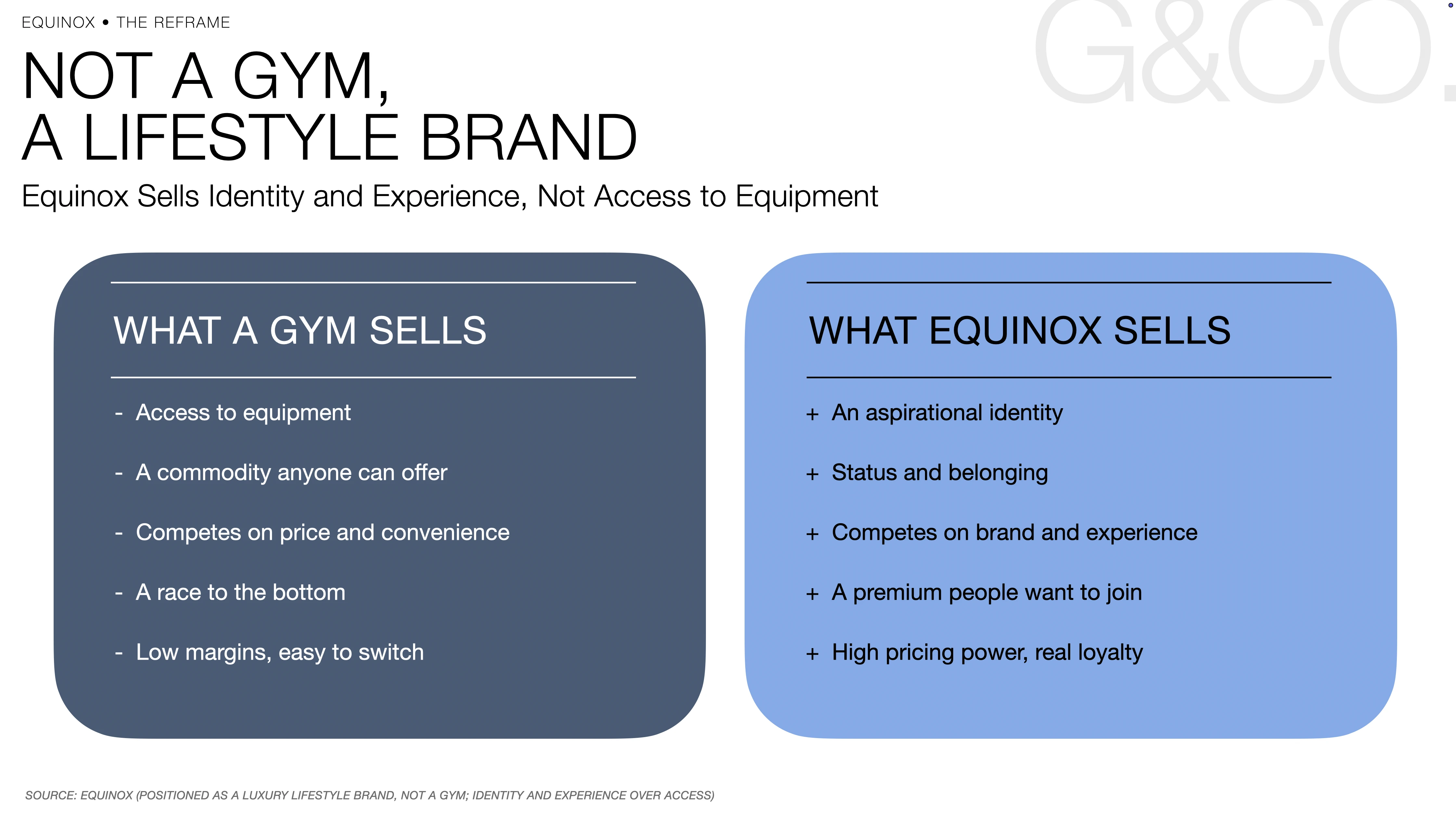
Fitness is a brutal business to compete in on the product itself. The equipment is standardized, the real estate is expensive, and members are price-sensitive and quick to churn, which pushes most operators toward the low end: cut prices, add locations, compete on cost and convenience. It is a race that commoditizes the offering and compresses margins, and it is the game the vast majority of gyms play.
Equinox's founding insight was that people do not only buy fitness; they buy how a place makes them feel and what belonging to it says about them. Exercise is aspirational and identity-laden, tied to self-image, status, and the person one wants to become, and that emotional layer, not the equipment, was where real value and pricing power lived. The strategic choice at the heart of this case is that Equinox chose not to sell a better gym but to build a luxury lifestyle brand, treating the equipment as the least important part of the offering and the identity, design, and experience as the product. That decision, to compete on brand rather than on the commodity, is what everything else follows from.
Company Response
Position it as a luxury lifestyle brand, not a gym.
Everything about Equinox is designed to say it is not a place to exercise but a symbol of a certain kind of life, ambitious, disciplined, high-status. Its marketing is provocative and aspirational rather than promotional, selling an attitude instead of features or price. This deliberate brand positioning reframes the entire offering: a prospective member is not comparing treadmill counts, they are deciding whether they want to be the kind of person who belongs to Equinox. By competing on identity rather than on the gym itself, Equinox stepped out of the commodity fight entirely.
Use premium pricing as part of the brand.
Equinox charges memberships many times the price of an ordinary gym, and that is not despite the brand but because of it. In luxury, price is a signal: a high price communicates exclusivity, quality, and status, and a low one would undermine all three. Equinox's premium pricing strategy is therefore a brand tool, not just a revenue decision, the price is part of what members are buying, because paying it is part of the identity. This is the opposite of the value-membership logic, where low price is the entire pitch; here, the premium is the point.
Design the experience end to end.
The Equinox club is a piece of experiential retail: the architecture, lighting, materials, scent, music, premium amenities, and highly trained staff are all deliberately designed to feel luxurious and distinct the moment a member walks in. This customer experience design is what justifies the price and delivers the identity, the space itself is the product, not the equipment inside it. Equinox extends the same designed experience beyond the club, into hotels, into curated content, and, most recently, into a roughly $40,000-a-year longevity and health membership, stretching the brand deeper into premium life rather than wider into the mass market.
The approach carries real tension. A luxury brand must protect its exclusivity, which limits how fast and how far it can grow without diluting the very premium it depends on. The experience is expensive to deliver and must be flawless everywhere, because a single shabby club damages the whole brand. And Equinox's digital efforts have shown that a luxury built on physical experience does not automatically translate to a lower-priced app. But those constraints are inseparable from the strategy: the exclusivity and the flawless experience are exactly what a discount competitor cannot copy.
Always-On Customer Intelligence
Turn your own customer data into foresight — validate, simulate, and sense every major decision before you commit.


Results and Evidence
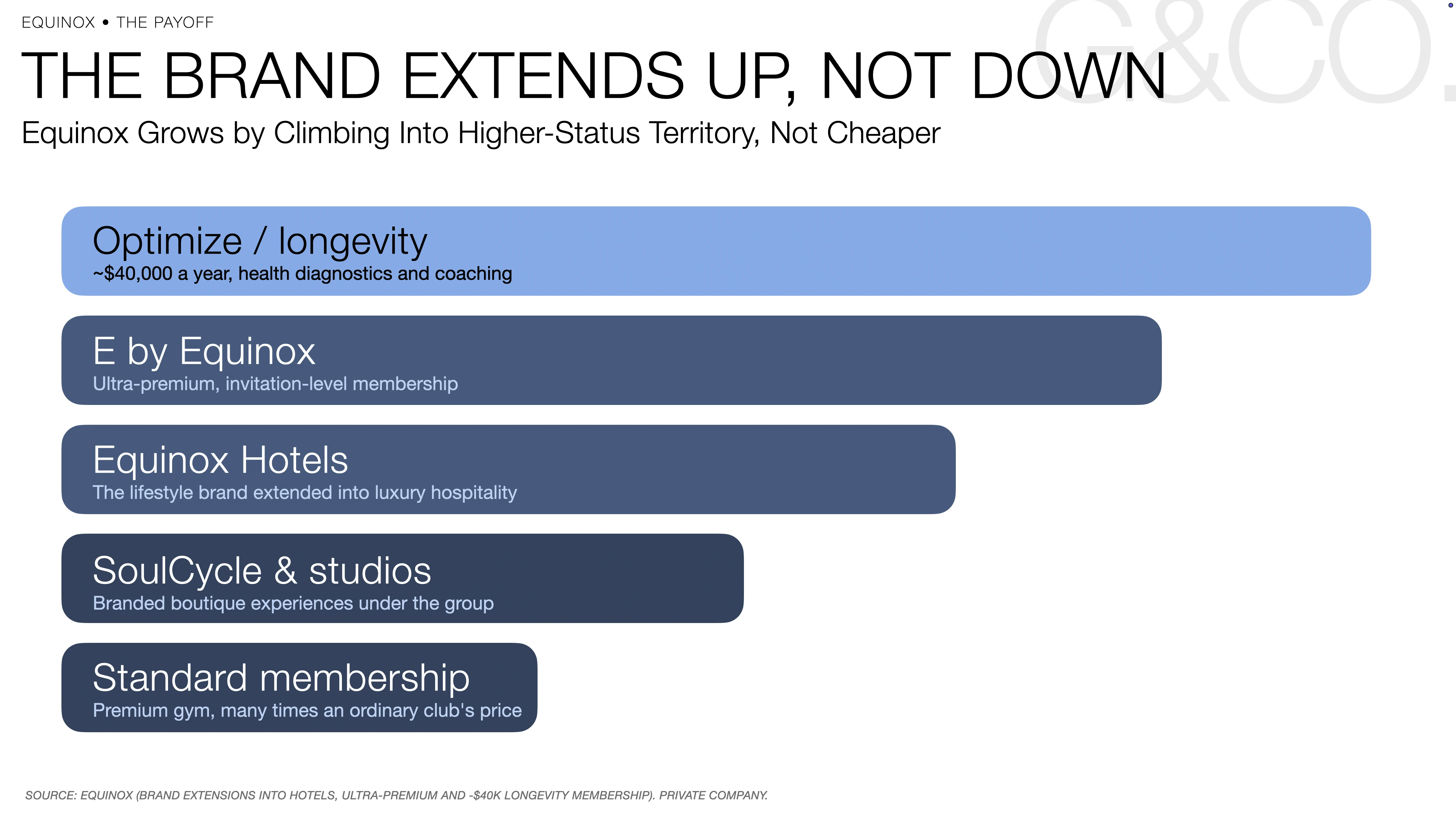
The evidence is in the pricing power, the positioning, and the brand extensions. Equinox sustains membership prices many times those of a standard gym, and its members pay them not despite the cost but because the brand and experience justify it, the clearest proof that it competes on identity, not on the commodity of fitness. It has built a portfolio that reaches well beyond the gym, including SoulCycle, Equinox Hotels, and a new ultra-premium longevity membership priced around $40,000 a year, each an extension of the same aspirational brand into higher-margin, higher-status territory. The most telling evidence is what Equinox does not do: it does not compete on price, discount to fill clubs, or expand indiscriminately, because all three would erode the exclusivity the brand depends on. As a privately held company, Equinox does not disclose detailed financials, so these points describe its strategy and positioning rather than audited results, and should be confirmed against its latest public statements before publishing.
Strategic Implications
Read at scale, Equinox is a case about escaping commoditization through brand and experience, and it connects to the broader questions of luxury strategy, brand positioning, premium pricing, and experiential design. The pattern is repeatable well beyond fitness: when the underlying product is standardized and competitors fight on price, a company can move up and out of that fight by selling identity and experience instead, charging a premium that itself reinforces the brand. Equinox did not build a better gym; in the Equinox strategy it built a brand that happens to contain gyms, and the brand, not the equipment, is what members pay for.
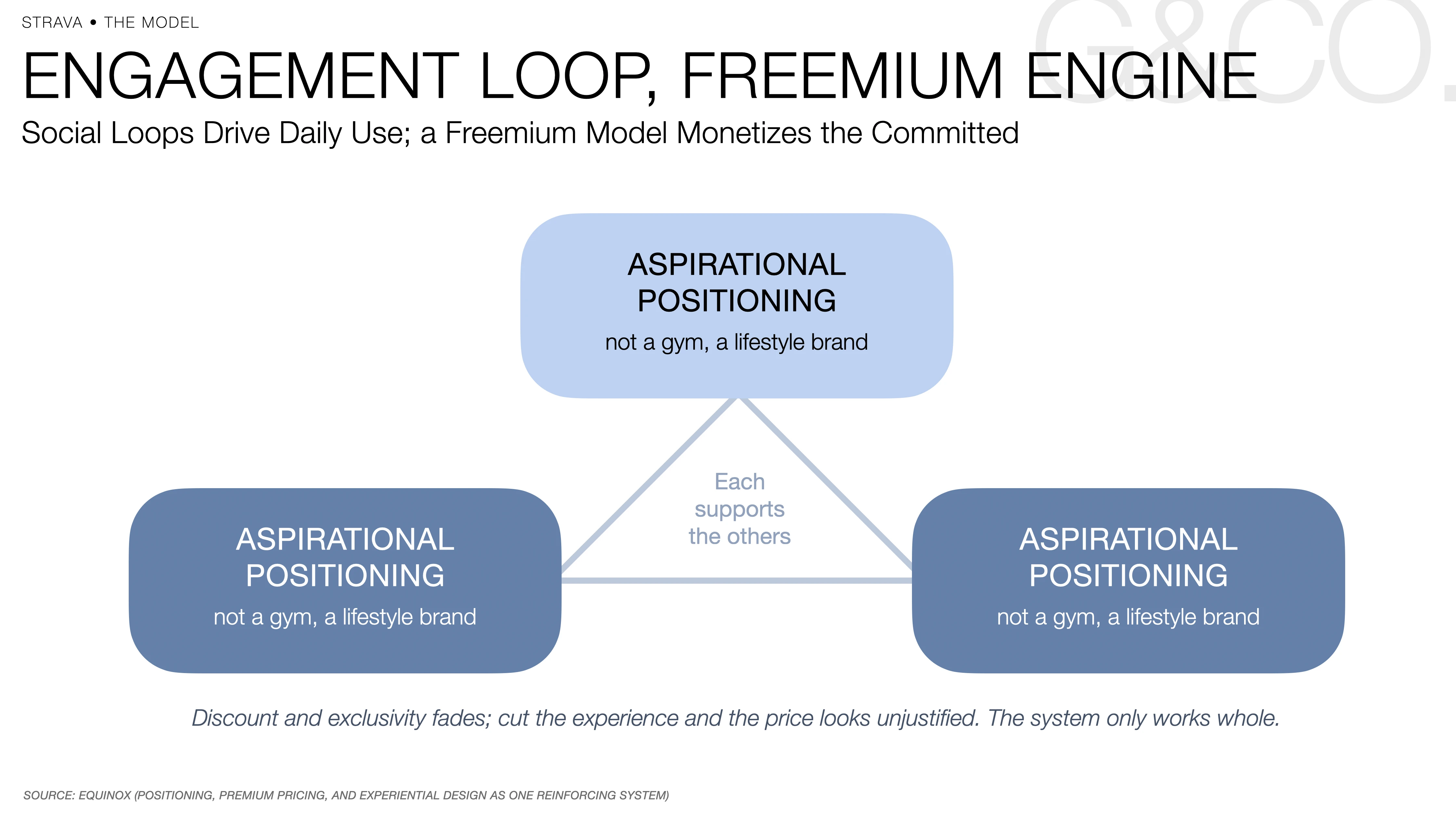
The deeper implication is how premium pricing, positioning, and experience reinforce one another. The aspirational positioning justifies the high price; the high price signals the exclusivity that supports the positioning; and the designed experience delivers on both, giving members something the price and brand promised. Break any one and the system weakens: discount, and the exclusivity fades; cut the experience, and the price looks unjustified. For enterprise leaders, the takeaway is to ask whether their product is stuck competing on a commodity, and what it would take to compete on identity and experience instead, including the discipline to price at a premium and protect exclusivity rather than chase volume. The brands with the most pricing power are rarely the ones with the best product specs; they are the ones customers most want to be associated with.
What Enterprise Leaders Can Learn
- Escape the commodity by selling identity.
When the product is standardized, compete on who the customer becomes by using it, not on the product itself. That is how Equinox left the price war. - Treat price as a brand signal.
In luxury, a premium price communicates exclusivity and quality. A premium pricing strategy can be a positioning tool, not just a revenue lever, and discounting can destroy the brand. - Make the experience the product.
Experiential and customer experience design, the space, service, and details, are what justify the premium and deliver the identity. Design them end to end. - Protect exclusivity over growth.
A luxury brand's value depends on not being available to everyone; disciplined, limited growth preserves the premium that indiscriminate expansion would erode. - Extend the brand, not the discount.
Equinox grows by stretching into higher-status territory (hotels, longevity), not by going cheaper. Extend a strong brand upward, not downward.
Conclusion
Equinox's story is not really about gyms. It is about how to compete when your product is a commodity anyone can offer. Faced with a room full of the same equipment every competitor has, Equinox chose not to sell the equipment at all, but an aspirational identity and a flawlessly designed experience, and it used a high price not as a barrier but as a badge, part of what members are paying for. Positioning, price, and experience reinforce each other into a brand people want to belong to and will pay a large premium to join, which is a far more defensible and profitable position than competing on cost and convenience. For enterprise leaders, the transferable lesson is that the way out of a commodity trap is rarely a better version of the commodity; it is to sell identity and experience instead, to price at a premium with conviction, and to protect the exclusivity that makes the brand worth belonging to. The companies with the greatest pricing power are the ones customers most want to be seen with.
Through the Acumen platform, G&CO. gives enterprise brands the intelligence to escape commoditization through brand and experience: where your product is stuck competing on a commodity, how identity and experience could command a premium, and where disciplined positioning and pricing would build lasting pricing power. G&CO. is a certified minority business enterprise through the National Minority Supplier Development Council (NMSDC). For enterprise organizations with diversity inclusion requirements in their procurement process, G&CO. meets the criteria for MBE-qualified partner status.
G&CO. works with enterprise brands on the positioning, pricing, and experience strategy that turns a commoditized product into a brand people pay a premium to belong to. If this Equinox case study raises questions about your own luxury positioning, experiential retail, or premium pricing strategy, submit an inquiry to G&CO. on our contact page or click the blue "Click to Contact Us" button in the bottom right corner of your screen. We look forward to hearing from you.
Frequently Asked Questions
What is Equinox's luxury positioning?
Equinox's luxury positioning is to sell an aspirational identity and a designed experience rather than gym access. Because exercise equipment is a commodity available everywhere, Equinox competes not on the gym but on what belonging to it signals about a member, ambition, status, discipline. It positions itself as a luxury lifestyle brand, charges a premium that reinforces that positioning, and designs every detail of the club experience to justify it. The result is that members pay a large premium not for machines they could use anywhere, but for the identity and experience only Equinox is seen to provide.
Why does Equinox charge such high prices?
Because in luxury, price is a signal, not just a cost. A high price communicates exclusivity, quality, and status, and a low price would undermine all three. Equinox's premium pricing strategy is therefore part of the brand itself: paying the premium is part of the identity a member is buying, and it keeps the brand exclusive. This is the opposite of a value gym, where low price is the entire pitch. For Equinox, being expensive is a feature that reinforces the positioning, which is why discounting would damage the brand rather than help it.
How does experiential retail apply to Equinox?
Experiential retail means the physical space and the experience of being in it are the product, not just a place to access a product. At Equinox, the architecture, lighting, materials, scent, music, premium amenities, and trained staff are all deliberately designed to feel luxurious and distinct, so the club itself delivers the brand and justifies the price. This customer experience design is central to the strategy: the equipment inside is a commodity, but the designed environment around it is not, and it is what members are really paying for. Equinox extends the same designed experience into hotels and other ventures.
How is Equinox different from a value gym or Costco-style membership?
They sit at opposite ends of the membership spectrum. A value gym or a warehouse club like Costco competes on low price and broad access, its entire pitch is affordability and value for the many. Equinox competes on the opposite: high price, exclusivity, and aspiration for the few. One uses low price to remove barriers and drive volume; the other uses high price to signal status and protect exclusivity. Both are coherent membership strategies, but Equinox's is a luxury brand positioning, where the premium and the experience are the product, not obstacles to it.
What can enterprise leaders learn from the Equinox case study?
The central lesson is how to escape competing on a commodity by selling identity and experience instead. Equinox's repeatable playbook: position the brand around who the customer becomes rather than the product itself, use premium pricing as a signal of exclusivity rather than discounting to compete, design the experience end to end so it justifies the premium, protect exclusivity over rapid growth, and extend the brand into higher-status territory rather than cheaper offerings. Leaders should ask whether their product is trapped in a price war on a commodity, and what it would take to compete on brand, experience, and identity, where pricing power actually lives.