
Cost Containment in Healthcare: FAQs & Key Strategies
Introduction
Cost containment in healthcare is the practice of reducing or controlling expenses without compromising quality of care, through better care coordination, claims integrity, staffing efficiency, and technology. It matters more than ever in 2026, with the medical cost trend projected at 8.5% to 9%, the highest in nearly two decades according to PwC, even as an estimated $268 billion in excess administrative spending remains in the system. This guide answers the key questions leaders ask and the strategies that work.
This article is written for Directors, SVPs, VPs, and department heads at healthcare organizations with over 1,000 employees, those looking to reduce spend without sacrificing performance. You will leave with a clear understanding of what cost containment means, why it matters, and how to implement it effectively across your organization.
Market Context: Disruption & Opportunity
Healthcare costs are rising at their fastest pace in a generation. PwC projects a medical cost trend of 8.5% to 9% for 2026, with 2027 expected to reach 9% for group plans, the highest in about 17 years, and hospital services inflation spiked to 7.59% year over year in early 2026. Multiple forces are converging: surging GLP-1 prescriptions, which nearly doubled between December 2024 and December 2025, behavioral health utilization with inpatient claims up roughly 80%, multimillion-dollar cell and gene therapies, and provider consolidation. The expiration of enhanced ACA subsidies has added affordability pressure, with more than one million fewer Marketplace signups in 2026.
This creates both a challenge and an opportunity. Leaders who embrace strategic healthcare cost reduction can reinvest savings into innovation, improve patient satisfaction, and gain an edge over competitors. Notably, AI cuts both ways: it can reduce administrative burden dramatically, yet 70% of health plans now rank provider AI tools among their top three cost drivers because those tools also optimize revenue capture. Forward-thinking leaders treat cost containment not as a defensive measure but as a pathway to long-term resilience and growth.
FAQs Snapshot

What is cost containment in healthcare?
Cost containment in healthcare refers to the strategies, processes, and actions used to reduce or control expenses without compromising quality. It involves identifying inefficiencies in operations, managing resource allocation, and using data to guide decisions. Effective strategies streamline care delivery, reduce waste, and align spending with value.
Why is cost containment important in healthcare?
Cost containment is essential because it keeps organizations financially sustainable while improving patient outcomes. With the medical cost trend near its highest level in two decades, unchecked spending limits innovation and access and squeezes margins. Disciplined cost management lets providers allocate resources more effectively and invest in long-term improvement.
How much are healthcare costs rising in 2026?
Healthcare costs are rising sharply. PwC projects a medical cost trend of 8.5% to 9% for 2026, restated upward during the year, with 2027 expected at 9% for group plans, the highest in roughly 17 years. Key drivers include pharmacy spending, especially GLP-1 drugs, behavioral health utilization, provider consolidation, and AI-enabled revenue optimization.
How can AI reduce healthcare costs?
AI reduces costs mainly by cutting administrative waste, which adds an estimated $268 billion a year to US healthcare. AI ambient scribes have reduced in-visit documentation time by about 20% and after-hours charting by 30%, and predictive analytics improve care coordination. The caveat is that some AI tools also raise costs by optimizing provider revenue capture, so deployment should target genuine efficiency.
What are common cost reduction strategies for healthcare organizations?
Proven methods include reducing unnecessary procedures, renegotiating supplier contracts, improving care coordination, adopting biosimilars (health plans' top cost deflator for three years running), auditing claims integrity, and investing in automation. These strategies lower operating expenses and improve financial performance without reducing the quality of care.
How does cost reduction in healthcare impact patient outcomes?
Done well, cost reduction improves outcomes by reallocating funds to areas that directly benefit patients, such as care coordination, prevention, and technology upgrades. Poorly planned cuts can harm care, so it is essential to use data-driven, evidence-based methods and to measure clinical impact alongside savings.
Is cost containment only about cutting budgets?
No. Cost containment is about using resources more effectively, not simply cutting budgets. It includes investing in systems that prevent unnecessary readmissions, using predictive analytics to manage population health, and automating administrative tasks. The goal is care delivery that is more efficient and sustainable, not care that is diminished.
What challenges come with cost containment strategies?
Challenges include cultural resistance, lack of data visibility, and difficulty aligning stakeholders. Some strategies require upfront investment and cross-functional collaboration, which can slow implementation. Success depends on executive buy-in, a clear roadmap, and the ability to link spending to measurable outcomes.
Benefits of Cost Containment in Healthcare
Cost containment gives healthcare organizations a way to remain competitive while improving patient care. By implementing clear, focused healthcare cost reduction strategies, leaders can reduce waste, improve efficiency, and make better use of limited resources.
For example, automating manual processes cuts administrative overhead, coordinated care models reduce unnecessary hospital visits, and standardized treatment protocols reduce variation in care. These strategies lower spend and free up capital for innovation. When implemented carefully, cost reduction leads to long-term sustainability, stronger margins, and better service delivery.
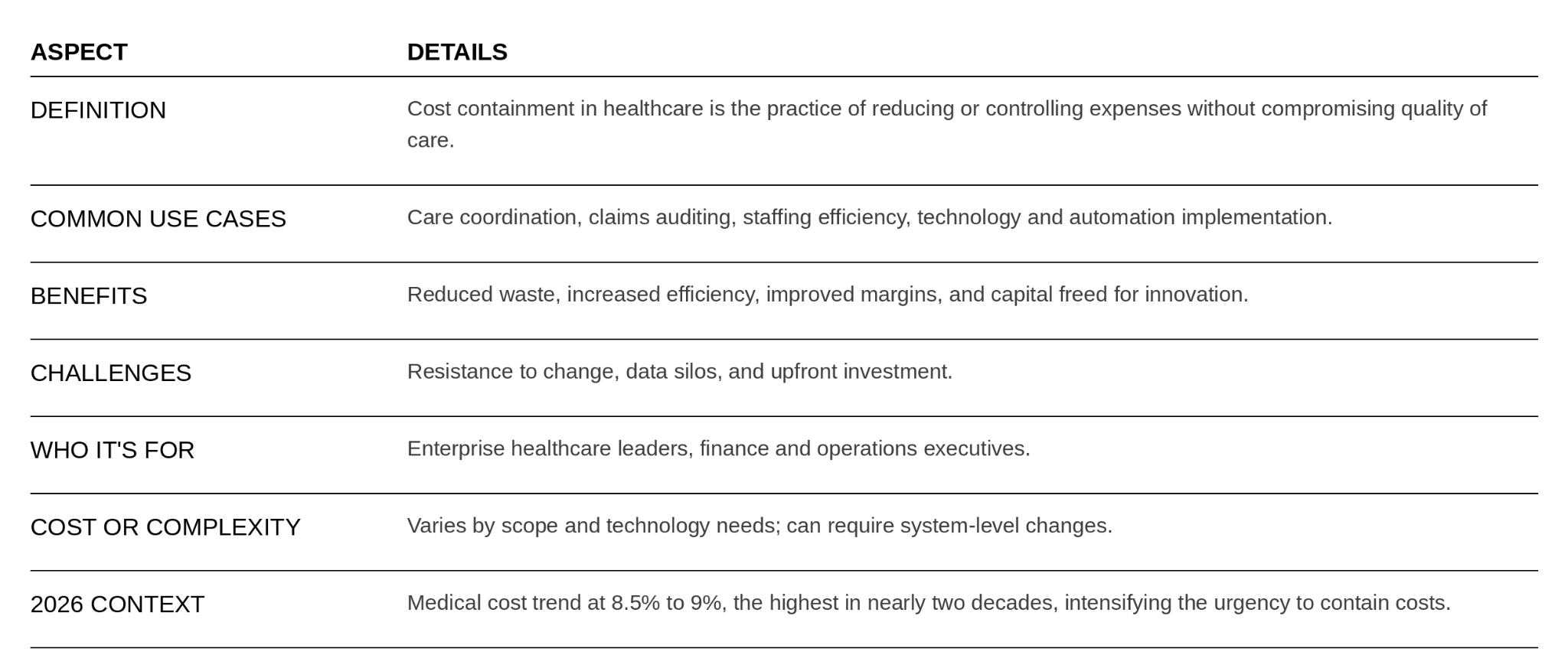
Quick Summary Table


%20(1).png)

Let’s kickstart the conversation and design stuff people will love.

The Retail & Consumer Index


Deep-Dive Sections

What It Is & Why It Matters
Cost containment in healthcare is the process of identifying inefficiencies and reducing unnecessary spending while maintaining care standards. It is crucial because financial pressure directly affects the sustainability of healthcare organizations. With aging populations, expensive new therapies, and a medical cost trend near a two-decade high, the need for long-term healthcare cost reduction is growing. Cost containment enables organizations to survive and scale while maintaining service quality.
How It Works
Effective cost containment works by analyzing spend across departments and identifying areas for improvement. Analytics can reveal which treatments lead to avoidable readmissions, while automation reduces errors in billing and scheduling. These efforts depend on strategic planning, clear goals, and stakeholder alignment. Organizations that use real-time data are better able to monitor progress and adjust in response to results.
When to Use It (and When Not To)
Cost containment is essential during periods of financial stress, market shifts, or organizational restructuring. It should not be used reactively or as a short-term fix, and leaders should avoid cutting high-value services or frontline resources without analysis. Apply these strategies when you can measure performance and link spending to outcomes.
Tools or Platforms Involved
Tools include electronic health record (EHR) platforms, automation software, supply chain management systems, and business intelligence dashboards. AI-powered analytics help identify trends and forecast spending, and AI ambient documentation tools reduce clinician administrative time. The most effective strategies are supported by platforms that improve visibility and decision-making.
Cost Considerations
While some initiatives require upfront investment, they often lead to long-term savings. Common costs include software implementation, change management, and training. These are usually outweighed by reductions in manual errors, supply costs, and operational inefficiencies, particularly given the scale of administrative waste in the system.
Scalability & Flexibility
One benefit of cost containment is its ability to scale across large healthcare organizations. Whether streamlining clinical workflows or optimizing back-office operations, most strategies can be rolled out in phases. Scalable programs often start with pilot programs before expanding system-wide.
Alternatives or Comparisons
Some organizations rely on revenue growth strategies instead of cost containment. While growing revenue matters, it is often more difficult and less predictable than reducing waste. Combining revenue initiatives with healthcare cost reduction leads to better financial outcomes, and comparing platforms and services before implementation helps ensure alignment with organizational goals.
Trends
Key 2026 trends include value-based care, real-time analytics, and AI-driven optimization, alongside growing biosimilar adoption and a national push for price transparency. Many leaders now focus on strategies that improve outcomes and reduce friction, and predictive modeling is increasingly used to guide preventative care and resource allocation.
Pros and Cons
Pros: Lower operating costs, improved resource use, greater sustainability.
Cons: Implementation complexity, internal resistance, upfront investment.
How G&CO.Health Can Help
At G&CO.Health, we help enterprise healthcare brands implement effective cost containment strategies. Our team provides strategic consulting to identify opportunities for healthcare cost reduction, align stakeholders, and implement solutions across departments. We have helped healthcare leaders reduce costs while improving patient outcomes through digital transformation, automation, and strategic planning.
We bring firsthand insight into what works and what to avoid, based on years of experience in healthcare, finance, and operations. Talk to us to clarify your strategy and move forward with confidence.
Conclusion & Next Steps
Cost containment in healthcare is more than an operational fix; it is a strategic priority. With costs rising to their highest level in nearly two decades, shrinking margins, and growing demands, every healthcare leader needs a clear, data-driven approach to spending.
To explore how G&CO.Health can support your cost containment goals, reach out for a consultation. Whether you are looking to reduce waste, modernize operations, or plan a long-term cost strategy, we are here to help.

Always-On Customer Intelligence
Turn your own customer data into foresight — validate, simulate, and sense every major decision before you commit.