Top Pharma Strategy Consulting Firms to Work With - August 2026
Introduction
The questions pharmaceutical strategy engagements are asked to answer have narrowed around one problem. A concentrated wave of biologic patent expiries lands before the end of the decade, and Medicare price negotiation now applies downward pressure to the products meant to replace that revenue. Portfolio decisions that could once be deferred are being forced early, which has moved demand from broad strategic reviews toward asset-level judgement made under real commercial constraint.
This article compares ten pharma strategy consulting firms: what each is suited for, what distinguishes its model, and where each is the wrong choice. It is written for VPs of Strategy, Commercial, and Business Development at pharmaceutical and biotechnology organizations selecting a partner for a portfolio, launch, or access mandate.
How We Selected These Firms
This ranking is published by G&CO. We evaluated firms on life sciences specialization, therapeutic and scientific depth, enterprise client experience, geographic reach, evidence of published thinking, and suitability for high-stakes portfolio and commercialization decisions.
We include ourselves at the top because pharmaceutical strategy sits directly inside our remit: we work at the intersection of commercial strategy, customer experience, and digital transformation for enterprise pharmaceutical and life sciences organizations. No firm on this list has paid for placement, and no entry on this page is sponsored.
Firms Compared
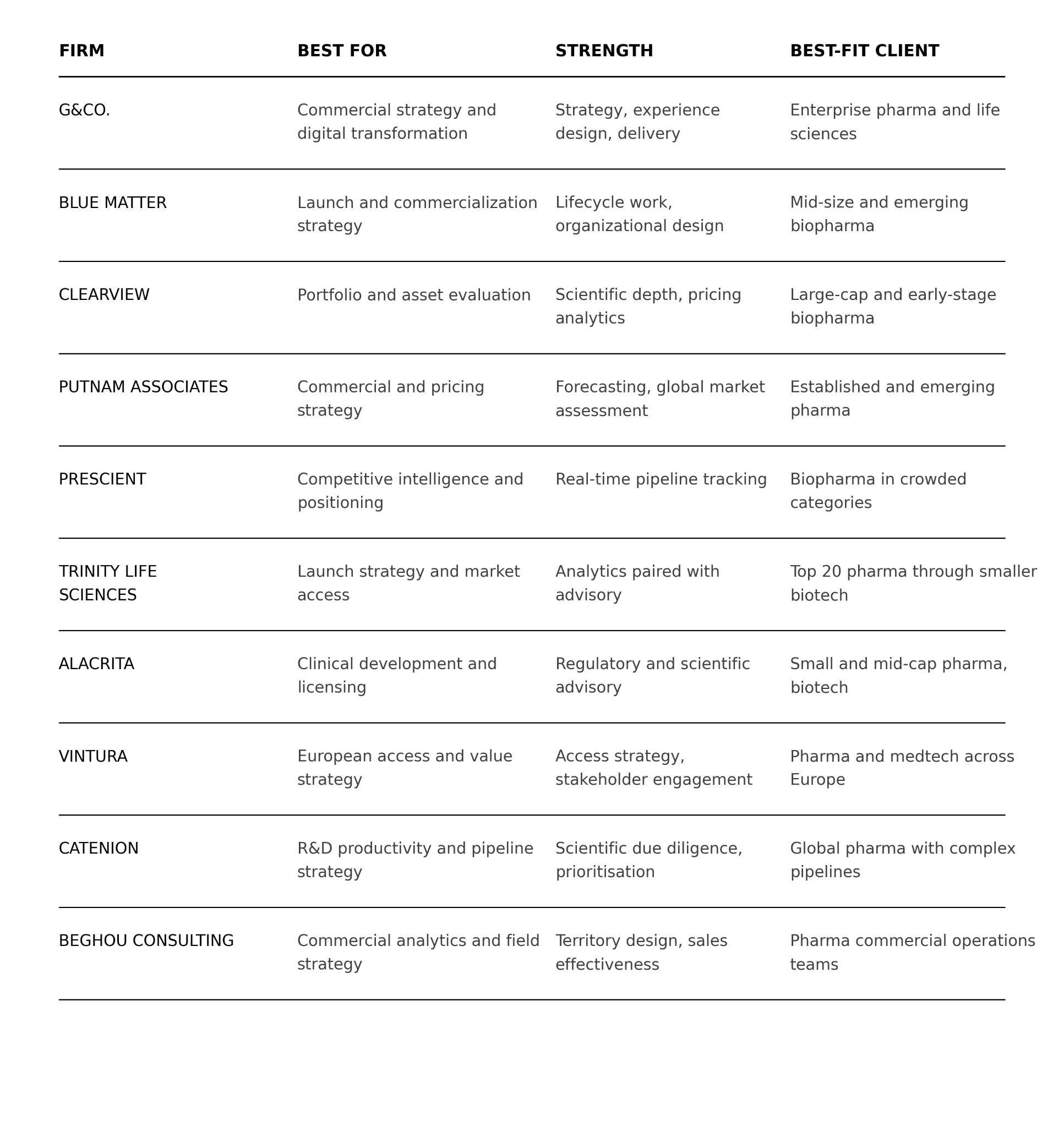
The Firms
1. G&CO.Health
Best for: Pharmaceutical organizations where commercial strategy has to connect to how the brand is experienced by patients, prescribers, and payers rather than stop at the recommendation.
Why it stands out: G&CO.Health works with pharmaceutical organizations on go-to-market strategy, commercial model design, and the digital transformation that carries both. Capability spans omnichannel strategy and business intelligence, which means launch planning happens with knowledge of the channels and data infrastructure that will execute it. G&CO. is a minority business enterprise (MBE), as certified by the National Minority Supplier Development Council (NMSDC).
May not be best if: You need clinical development strategy, regulatory affairs, health economics modelling, or scientific due diligence as the substance of the engagement.

2. Blue Matter
Best for: Emerging and mid-size biopharma organizations approaching a first or second commercial launch.
Why it stands out: Blue Matter concentrates on the transition from clinical asset to commercial product, covering lifecycle management, portfolio strategy, and the organizational design that a first launch forces. It added biopharma research and development capabilities in early 2026 and communications capability through acquisition, which widens the range of a single engagement. For companies commercialising for the first time, the organizational work is frequently the harder half.
May not be best if: You are a top-tier pharmaceutical organization needing global scale across many markets at once.
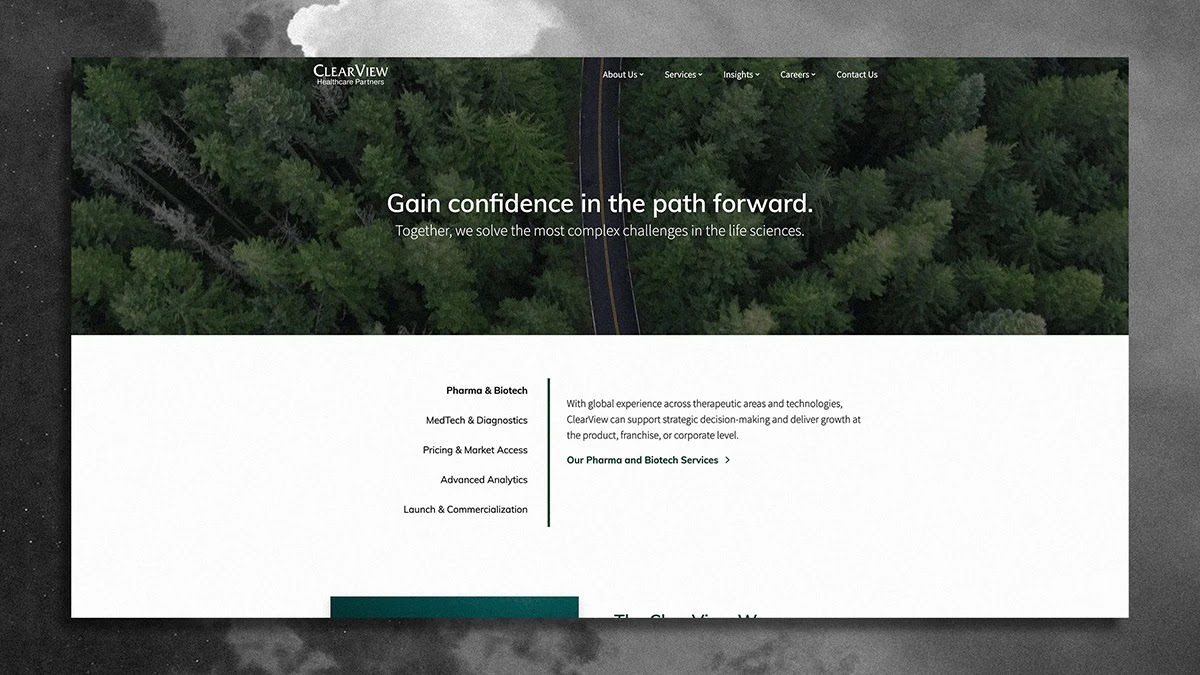
3. ClearView Healthcare Partners
Best for: Asset evaluation and portfolio decisions requiring genuine scientific judgement.
Why it stands out: ClearView pairs therapeutic area depth with commercial analysis, which matters when the question is whether an asset is differentiated rather than how to market it. Its work spans portfolio planning, asset evaluation, pricing, and launch, for both large-cap and early-stage biopharma. Where a decision turns on interpreting clinical data against a competitive set, that scientific grounding is the requirement.
May not be best if: Your mandate is field force design, commercial operations, or digital execution.
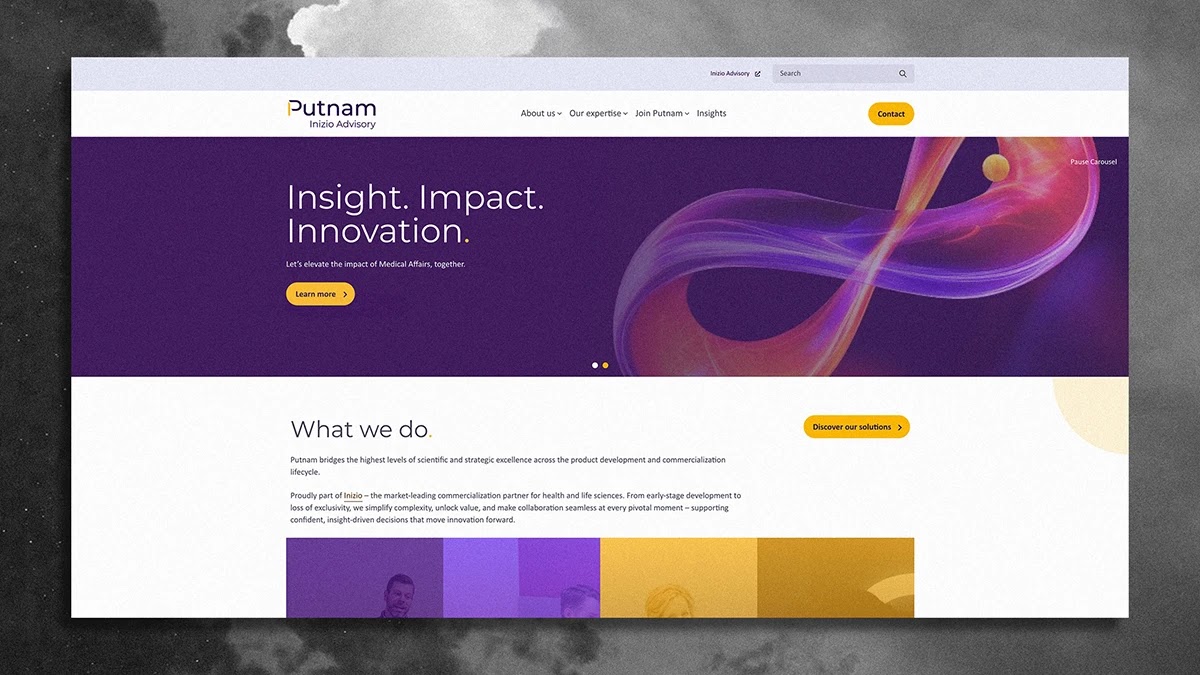
4. Putnam Associates
Best for: Commercial and pricing strategy supported by rigorous forecasting.
Why it stands out: Putnam works exclusively in life sciences, concentrating on global market assessment, forecasting, and strategic planning across the product lifecycle. Its output tends to be quantitative rather than conceptual, which suits organizations that need a defensible number to take into an investment committee rather than a framework to discuss.
May not be best if: You need organizational design, R&D strategy, or implementation support after the recommendation.
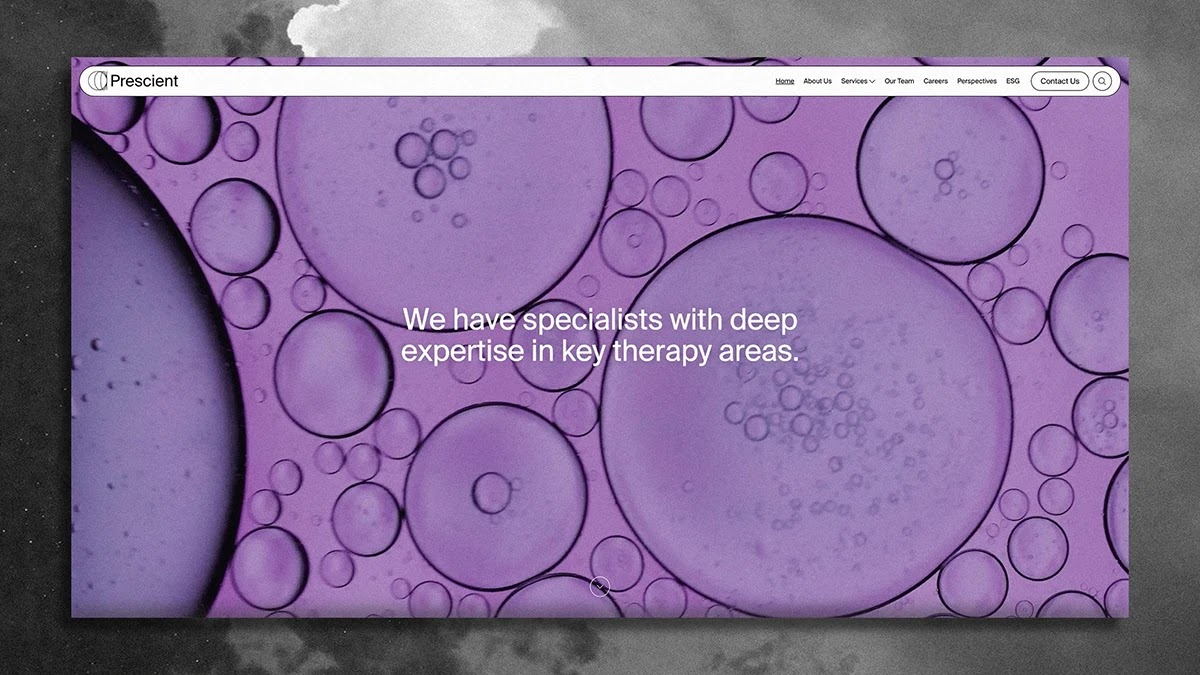
5. Prescient Healthcare Group
Best for: Competitive intelligence and positioning in categories where the landscape moves quickly.
Why it stands out: Prescient specialises in competitive readiness: tracking rival pipelines, interpreting what competitor movements imply, and adjusting positioning accordingly. In crowded therapeutic areas where several assets are approaching similar indications, that continuous view is worth more than a point-in-time strategy that is outdated by the next readout.
May not be best if: Your requirement is a discrete strategic decision rather than an ongoing intelligence relationship.
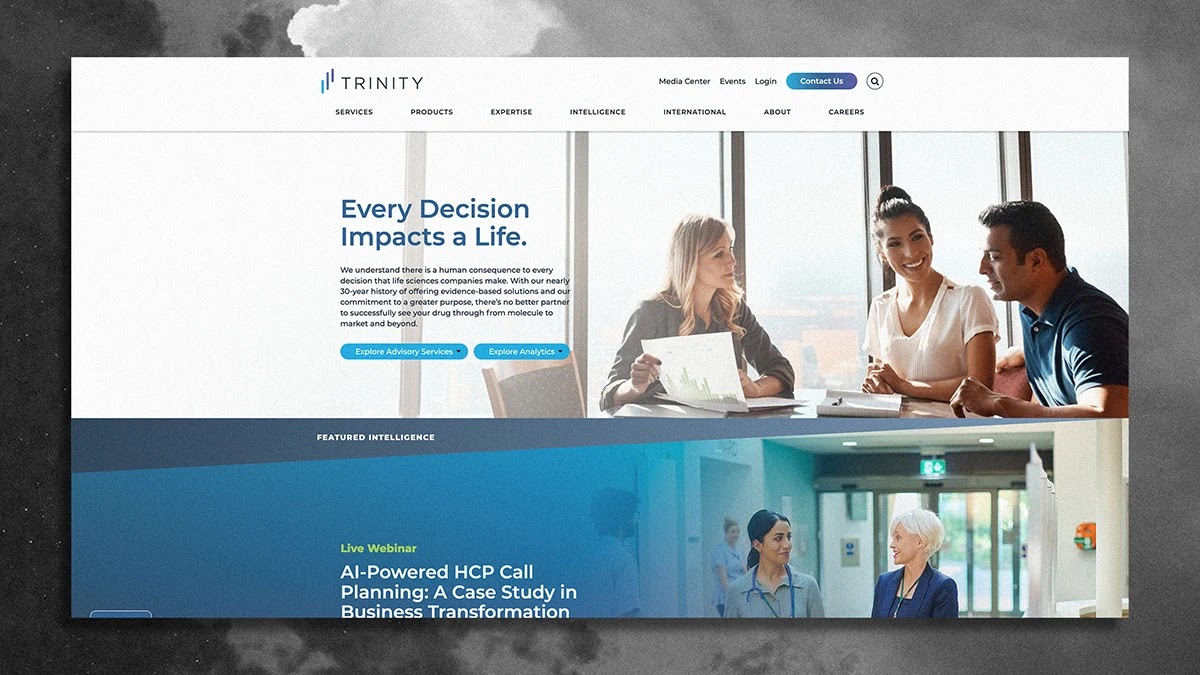
6. Trinity Life Sciences
Best for: Launch strategy and market access supported by substantial analytics capability.
Why it stands out: Trinity combines data science with strategic advisory across indication prioritisation, launch strategy, value proposition development, and payer engagement. Its client range runs from top 20 pharmaceutical organizations to smaller biotechs, which gives it exposure to both resourced and constrained launch conditions. Where access is the binding constraint, the analytical depth is the reason to choose it.
May not be best if: You need creative execution, brand development, or experience design as the primary output.
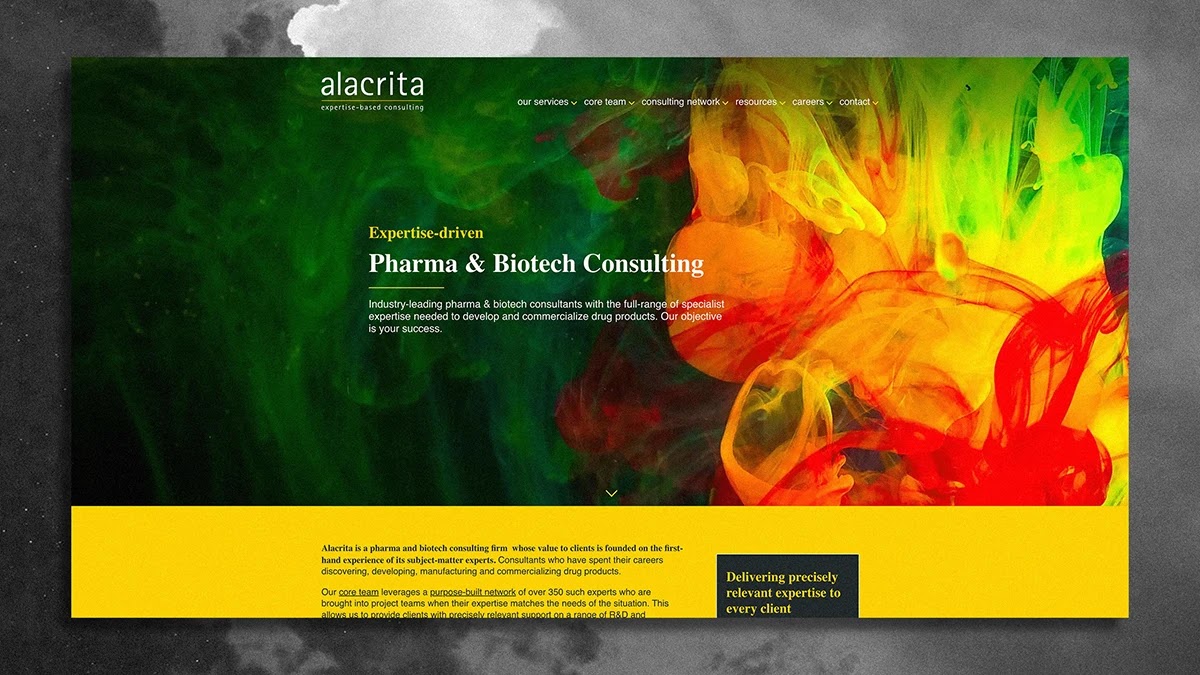
7. Alacrita
Best for: Clinical development strategy, licensing, and scientific due diligence for smaller organizations.
Why it stands out: Alacrita works across biotech, pharmaceutical, and medical technology on clinical development strategy, regulatory affairs, licensing, and commercialization planning. It is structured to give small and mid-cap organizations flexible access to senior scientific and regulatory expertise without the commitment a larger firm would require, which suits companies whose needs are episodic rather than continuous.
May not be best if: You are running a large-scale commercial transformation or need substantial delivery capacity.
8. Vintura
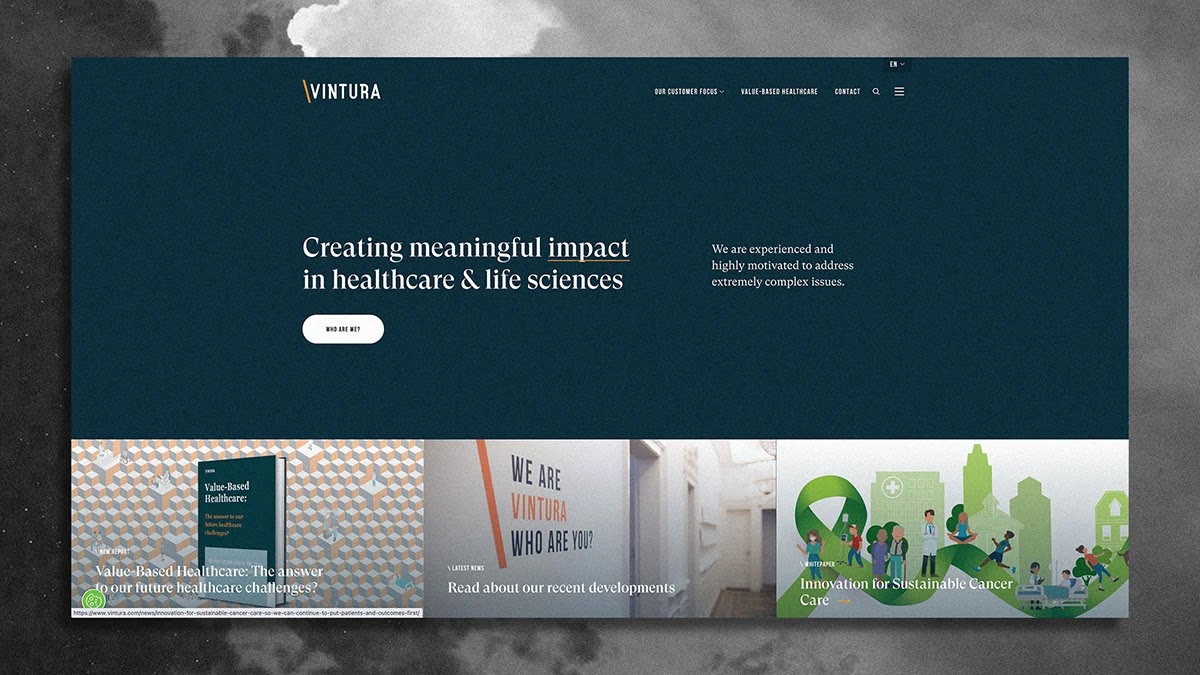
Best for: European market access and value strategy.
Why it stands out: Vintura is European by construction rather than by extension, which matters in access work where each national system has its own evidence requirements and negotiating conventions. It covers portfolio planning, access optimisation, and stakeholder engagement for pharmaceutical and medical technology organizations, with sustainability and impact considerations built into its strategic work.
May not be best if: Your priority market is the United States, or you need global coverage from a single firm.
9. Catenion
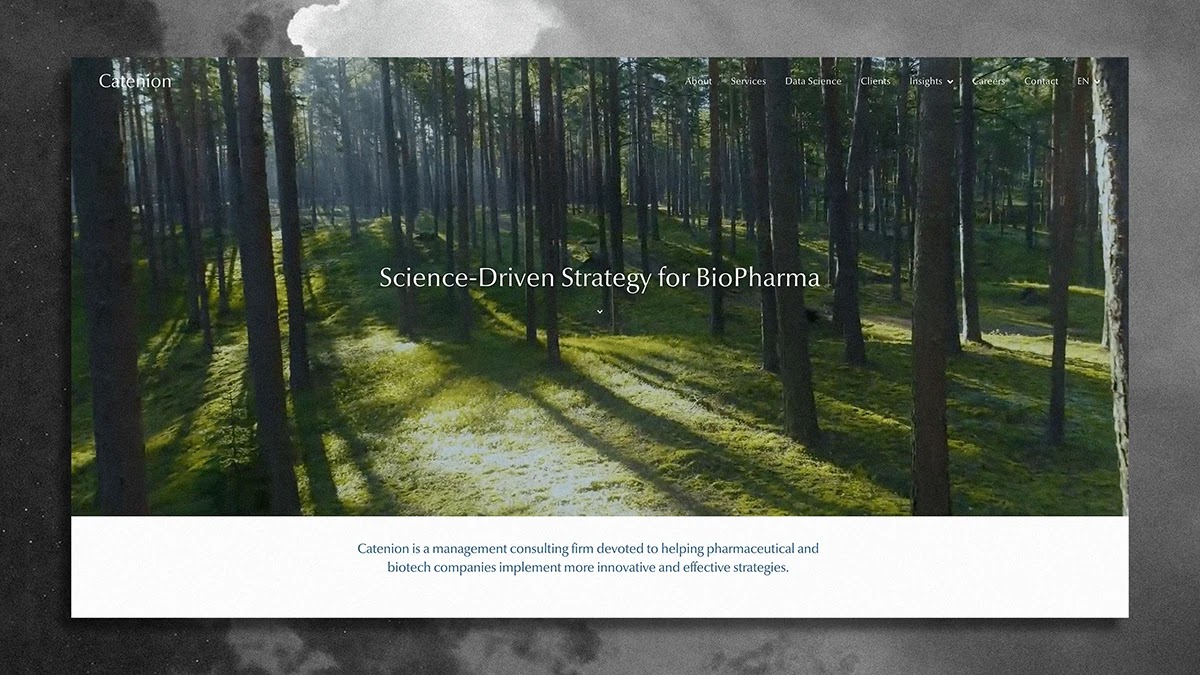
Best for: R&D productivity and pipeline strategy at organizations with complex portfolios.
Why it stands out: Catenion works on the science side of strategy: therapeutic prioritisation, pipeline strategy, and scientific due diligence for global pharmaceutical and biotechnology organizations. Where the question is which programmes deserve continued investment and which should be stopped, the firm operates in the technical detail rather than at the level of portfolio abstraction.
May not be best if: Your question is commercial rather than scientific, or you need launch and access support.
10. Beghou Consulting
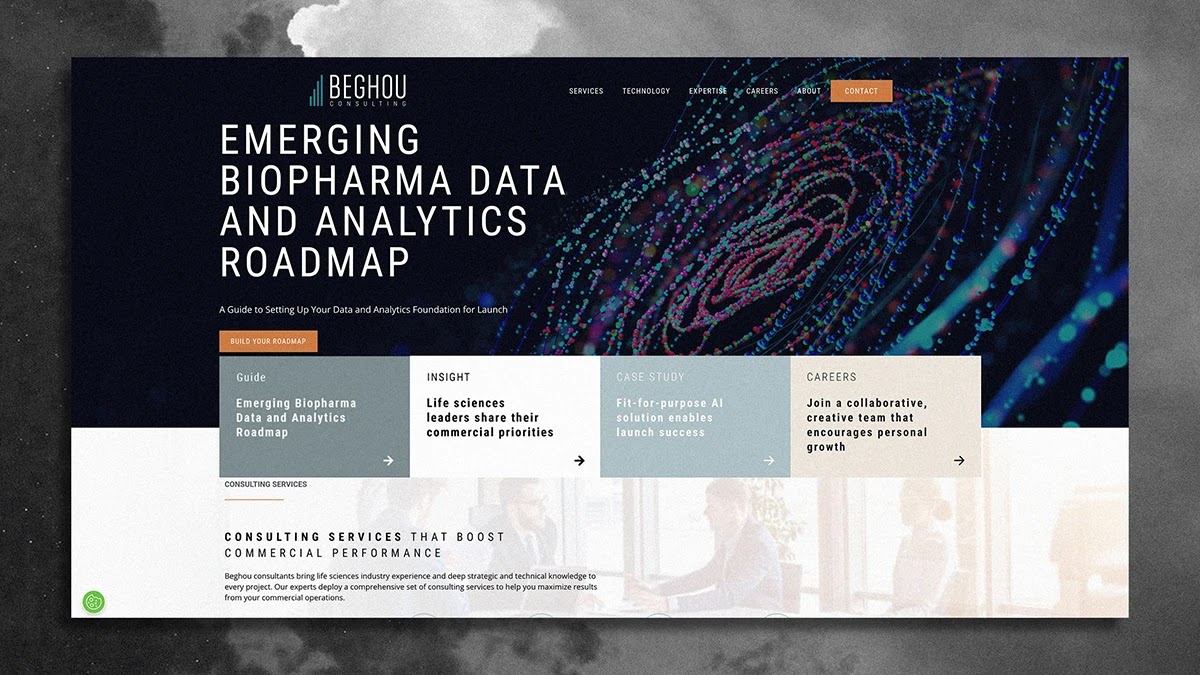
Best for: Commercial analytics, field force strategy, and sales effectiveness.
Why it stands out: Beghou concentrates on commercial execution: territory design, field force strategy, forecasting, and launch execution, supported by its own analytical tooling. For organizations where the strategy is settled and the constraint is how effectively the commercial organization delivers against it, this is the relevant specialisation.
May not be best if: You need portfolio strategy, scientific evaluation, or organizational design above the commercial function.


%20(1).png)

Let’s kickstart the conversation and design stuff people will love.

The Retail & Consumer Index


What Is Pharma Strategy Consulting?
Pharma strategy consulting is advisory work on high-stakes decisions across the pharmaceutical value chain: which assets to develop, how to sequence indications, how to price and secure access, and how to structure the commercial organization that delivers a launch.
The distinguishing feature against general strategy consulting is that the decisions turn on scientific judgement as much as commercial modelling. Whether an asset is meaningfully differentiated is a clinical question before it is a market question, and firms without therapeutic depth tend to produce analysis that is internally sound and clinically naive.
How Does Pharma Strategy Consulting Work?
Engagements typically open with a diagnostic covering internal assets, competitor pipelines, payer conditions, and regulatory position. That establishes the decision space. Analysis then runs through forecasting, clinical benchmarking, and stakeholder research with payers, prescribers, and patients, producing recommendations with an implementation path attached.
What separates this from adjacent categories is the evidence base. Recommendations have to hold against clinical trial data, competitor readouts, and payer behaviour that may change substantially inside the engagement window. Firms working in fast-moving therapeutic areas structure for that, revisiting assumptions as data emerges rather than defending an initial position.
What Is a Pharma Strategy Consulting Firm?
A pharma strategy consulting firm advises pharmaceutical and life sciences organizations on portfolio, development, and commercialization decisions, combining therapeutic knowledge with commercial and regulatory expertise.
The category divides into recognisable models. Scientific evaluation firms assess assets and pipelines. Commercialization firms work on launch, pricing, and access. Intelligence firms track competitors continuously. Analytics firms optimise commercial execution. Regional specialists know one market system deeply. Choosing on reputation rather than model is the most reliable way to buy the wrong engagement.
What Services Do Pharma Strategy Consulting Firms Provide?
Portfolio strategy and asset prioritisation
Evaluating pipeline assets, reallocating investment toward differentiated programmes, and stopping those that will not compete. The decisions with the longest consequences and the least reversibility.
Go-to-market and launch strategy
Market sizing, stakeholder mapping, geographic sequencing, and commercial planning. Launch performance in the first six months is strongly predictive of lifetime product value, which is why this work concentrates so much fee.
Pricing, market access, and reimbursement
Value-based pricing, health economics modelling, payer segmentation, and health technology assessment preparation. Requirements diverge sharply by country, so regional experience matters more than general capability.
Research and development strategy
Asset prioritisation, indication expansion analysis, licensing evaluation, and competitor benchmarking, connecting scientific promise to commercial viability.
Organizational design and operating model
Structuring commercial and medical organizations for a launch, a merger, or a change in portfolio direction. Frequently the harder half of a first commercialization.
Competitive intelligence and scenario planning
Continuous monitoring of rival pipelines and modelling of how the competitive set could develop, so positioning can adjust before a readout rather than after.
Commercial analytics and field effectiveness
Territory design, targeting, and sales force deployment. Relevant once the strategy is settled and execution is the constraint.
Digital transformation and data strategy
Digital engagement models, artificial intelligence use cases, and the data infrastructure supporting commercial and medical teams. Increasingly the largest line in the budget.
How Long Does a Pharma Strategy Engagement Take?
A focused engagement such as a market access assessment for a single therapeutic area typically runs four to eight weeks. A launch strategy or asset evaluation generally runs eight to sixteen weeks. A portfolio review across multiple business units, or a commercial operating model redesign, runs four to nine months.
Three variables move these ranges. The availability of primary research, since payer and prescriber interviews cannot be compressed and recruitment in narrow specialties takes time. The number of geographies in scope, because each additional market adds its own access conditions rather than a fraction of the work. And the pace of internal decision-making across medical, commercial, and regulatory functions, which is usually the binding constraint on anything requiring cross-functional agreement.
How Pharma Strategy Consulting Firms Price Their Work
Fixed fee against a defined scope is the most common arrangement in this category, reflecting engagements with clear deliverables and defined endpoints. Retainers apply to continuous work such as competitive intelligence. Time and materials appear where scope will genuinely evolve, most often in organizational or transformation work.
Primary research is the cost driver that most often surprises buyers. Payer and physician interviews carry real per-participant costs, and recruitment in rare disease or narrow specialties is expensive and slow. Establish whether research is inside the fee or billed separately, and how many interviews are assumed, because that single line accounts for much of the variance between otherwise comparable proposals.
The other figure worth interrogating is the seniority mix. Therapeutic expertise is the reason to hire a specialist firm, so the relevant question is how much of the work is done by people who have it rather than what the headline rate is.
Why Hire a Pharma Strategy Consulting Firm?

The strongest reason is comparative exposure. An internal team launches a product a handful of times in a career. A specialist firm has worked across many launches in adjacent therapeutic areas and knows which assumptions usually prove wrong, which is worth more than the analytical capability being purchased on paper.
The second is independence in decisions with internal consequences. Stopping a programme that a respected team has advanced for years is difficult to drive from inside. An external assessment carries weight precisely because it is not attached to the internal history of the asset.
The third is access to primary research infrastructure. Reaching payers and prescribing specialists at speed requires panels and relationships that most organizations do not maintain, and building that capability for a single decision is rarely economic.
How to Choose the Most Reliable Pharma Strategy Consulting Firm
Start by naming which model the mandate requires: scientific evaluation, commercialization, intelligence, analytics, or regional access. These are different businesses, and firm reputation transfers poorly between them.
Then test three things. Therapeutic area experience specifically, since oncology fluency does not transfer to rare disease or vaccines. Whether the senior scientific staff in the pitch will work on the engagement, which is the most common gap between what is sold and what is delivered. And how primary research is resourced, because that determines both cost and how quickly the work can move.
One further question is worth asking. Ask which of your assumptions the firm would challenge before starting. A partner willing to question the framing is applying judgement. A partner who accepts the brief unchanged is describing capacity.
Always-On Customer Intelligence
Turn your own customer data into foresight — validate, simulate, and sense every major decision before you commit.


15 Questions to Ask Before You Hire
1. Which of our assumptions would you challenge before we start?
A firm willing to question the framing is exercising judgement. One that accepts the brief unchanged is selling capacity.
2. Which senior scientific staff will work on this, and for what share of their time?
Therapeutic expertise is the reason to hire a specialist. Confirm it will be present in delivery, not only in the pitch.
3. What therapeutic area experience does the team hold in our specific space?
Oncology fluency does not transfer to rare disease or vaccines. Ask about your area, not life sciences generally.
4. Is primary research inside the fee, and how many interviews are assumed?
The largest source of variance between otherwise comparable proposals, and the most common overrun in this category.
5. How will you reach payers and prescribers in our therapeutic area?
Recruitment in narrow specialties is slow and expensive. Existing panel access materially changes the timeline.
6. What happens if a competitor readout changes the landscape mid-engagement?
In fast-moving areas this is likely rather than hypothetical. The answer reveals whether assumptions get revisited or defended.
7. Which of your last three comparable engagements ran over, and why?
Every firm has them. A specific answer describes a delivery record; a claim of none describes a sales position.
8. How do you handle a recommendation our internal team will resist?
Much of the value of external advice lies in decisions that are difficult internally. Ask how they are handled.
9. Do you support implementation, or does your work end at the recommendation?
Strategy firms in this category frequently stop at the deck. Establish it in the contract rather than in conversation.
10. How do you build access requirements for markets outside our lead geography?
Access conditions differ by country. A single-market approach extended abroad tends to fail on evidence requirements.
11. What is the seniority mix on the proposed team?
Exposes how much of the work is done by people with the expertise you are paying for.
12. Have you worked on assets facing a similar competitive position?
Comparable competitive dynamics predict relevance better than comparable company size.
13. What will you need from our medical, commercial, and regulatory teams?
Cross-functional input is the usual constraint on pace, and is routinely understated in proposals.
14. How will your analysis be documented so it survives the team that commissioned it?
Strategy work outlives its sponsors. Poor documentation means paying twice for the same thinking.
15. What would make you decline this engagement?
A firm with a clear answer knows where it adds value. No answer means it is describing capacity, not fit.
Why Choose G&CO.

G&CO. Health is the healthcare practice of G&CO., a global strategy and experience partner working with enterprise pharmaceutical and life sciences organizations. On pharmaceutical mandates we work where commercial strategy meets the experience that delivers it: go-to-market and commercial model design, the omnichannel infrastructure that reaches prescribers and patients, and the digital transformation connecting both. Our work spans brand intelligence, business intelligence, and experience design, which allows commercial strategy to be built with knowledge of what the organization can actually execute.
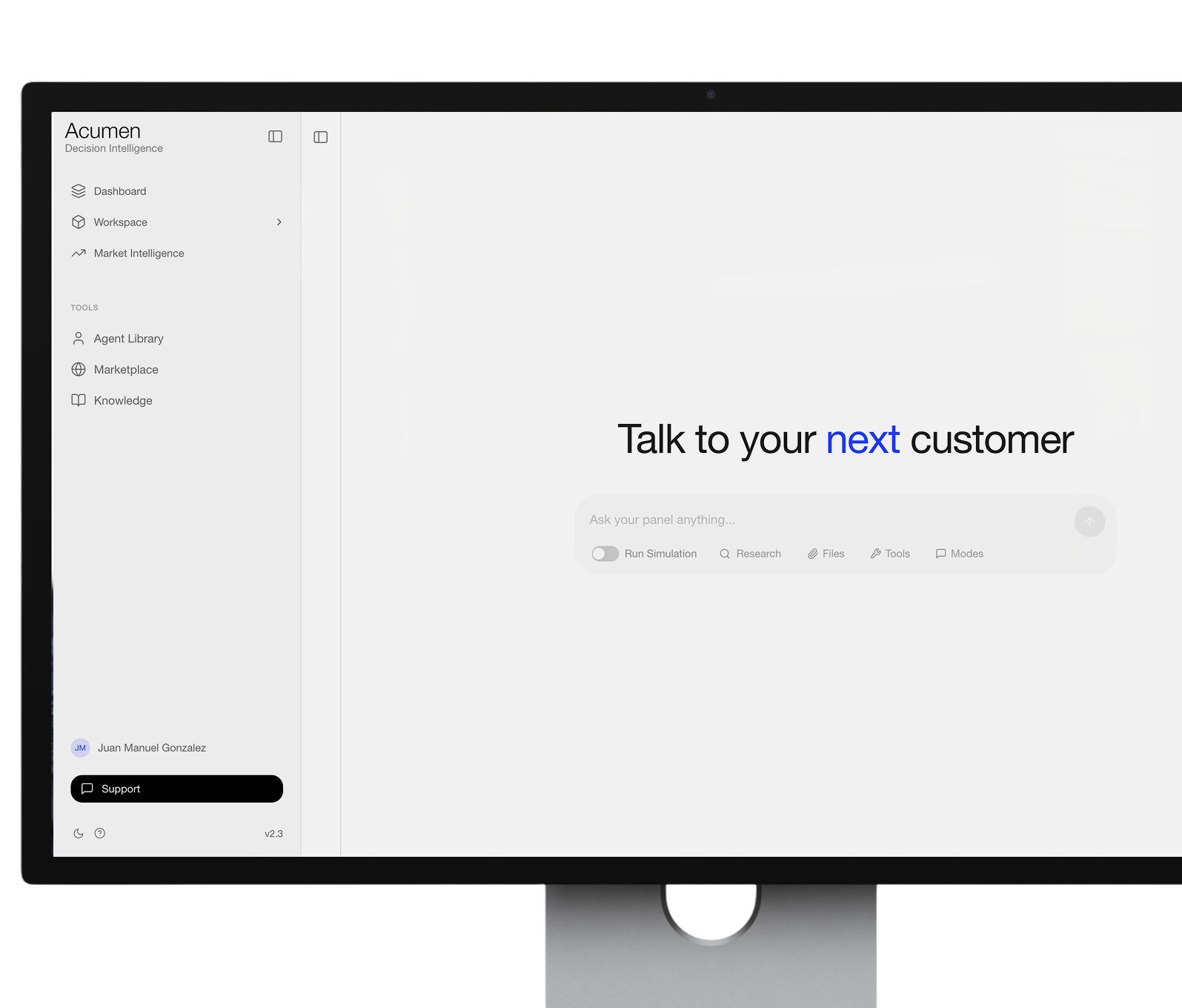
We are typically suited to pharmaceutical and life sciences organizations preparing a commercial launch, redesigning a commercial model, or modernising how medical and commercial teams reach their audiences, where strategy and execution would otherwise be specified separately and arrive incompatible. Where the mandate calls for market and behavioural intelligence alongside the strategic work, our Acumen decision intelligence platform supports the segmentation and analysis that informs how commercial models are designed and measured.
G&CO. is a minority business enterprise (MBE), as certified by the National Minority Supplier Development Council (NMSDC). If diversity inclusion is part of your supplier process, we may be a strong fit for your enterprise.
Submit an inquiry to G&CO.Health on our contact page or click the blue Contact Us button on the bottom right of your screen.